2.35:1 Widescreen

"Where life had no value, death sometimes had its price. That is why the bounty killers appeared."

If you had asked Clint Eastwood about the chances of Fistful Of Dollars being at all successful, he admits he hadn't given it much of a chance. The film took a lot of chances with what was already a tired genre. Add to that the fact that it was a low-budget European effort and there really was no chance that the movie would be remembered a year later. But the film did pretty good money and made a ton of international noise. The men involved ended up with more than a fistful of dollars in their banking accounts. Who could blame them for wanting A Few Dollars More?

“They're right. All those people who say it's our job to just sit and watch people die. They're right.”

A starving, war savaged toddler girl squats, burying her face in the sun baked earth of the Sudan. She remains motionless, near death and locked in catatonic despair. A few feet behind her a vulture, nearly as big as the child, eyes her hungrily and patiently waits for her to grow too weak to fight it off. A photographer quietly circles the scene, snapping away and looking for the best angle. He finds it, gets the shot and leaves. The photo wins a Pulitzer Prize. The little girl presumably gets eaten by the vulture.

"Everybody here has become very rich, or else they are dead."

In 1964 things were very different from the way they are now. The Hollywood western movie was winding down. The genre had pretty much played itself out and was struggling to maintain even on television. Few people knew who Clint Eastwood was. He had a pretty sweet gig on the television series Rawhide but wasn't anywhere near a household name. Sergio Leone was a name almost no one had heard of. And there was no such thing as a Spaghetti Western. With the release of one very low budget film, all of those things changed practically overnight.

“How would you like to use that gun belt for something more than just holding up your pants?”

Although the title of the blu-ray is Return of the Magnificent Seven, the original film’s title sequence just calls it Return of the Seven, and for good reason. There is nothing vaguely magnificent in this movie. This is the type of sequel that gives sequels a bad name.

“We deal in lead, friend.”

In the fall of 1956, Anthony Quinn watched a special screening of Akira Kurosawa’s The Seven Samurai and had an epiphany; this Japanese masterpiece, inspired by the great American westerns of John Ford, would, itself, make a great American western. Quinn acquired the rights and contacted his then close friend Yul Brynner and pitched the idea of him playing the bad guy and Brynner the good guy. Brynner screened Kurosawa’s film and called in producer Walter Mirisch, who in turn contacted director John Sturges (Bad Day at Black Rock, Gunfight at the OK Corral, The Great Escape). Sturges loved the concept and immediately set about acquiring the rights, ultimately forcing Quinn out of the picture. Quinn sued, but lost.

The American Film Company is a new venture that intends to tell historical dramas. There are several stories on the way. They are particularly interested in the lesser known elements of historical events that are, in themselves, rather huge and universally known. One is left with the kind of film that we saw last year in The King's Speech. While we all know about the global events of that time, few knew the story of the struggle over public speaking that the King had during that fateful moment in world history. I think you can say the same for the material in The Conspirator. There's likely not an American alive who doesn't know something of the assassination of Abraham Lincoln. We all know the location was Ford's Theater and many even know the name of the play that was being performed at the time. But there are lesser known facts about the event. That Lincoln didn't want to go is one some of you already know. But how many know that his murder was part of a larger plot to take revenge on the government for the defeat of the South? This film goes even farther than that. It tells the story of one of the more controversial accused in the plot that included the attempted murders of the Secretary of State and Vice-President Johnson. That defendant was Mary Surratt, and she would become the first woman executed by the Federal government. And she may not have even been guilty of a crime.

The film begins at the conclusion of the Civil War where we meet Frederick Aiken (McAvoy) who is a wounded captain. He orders the medics to care for his fallen friend, Baker (Long) who appears to be as good as dead. While the scene plays no real role in the story to unfold, it attempts to set two stages. It's a chance to touch upon the brutal war that has triggered the film's main events. It's also intended to help us get to know how good a guy Aikens happens to be. From there the film quickly moves through the execution of the plot to kill three members of the federal government. Only President Lincoln is mortally wounded, and his killer John Wilkes Booth (Kebbell) is soon captured and killed. All that is left for the struggling government now is to put the entire experience behind them by burying the conspirators themselves.

In my life, I have always made a habit rooting for the underdog. Whether it would be in the business world with a small company or at the NCAA March Madness tournament with a Cinderella team, I always like to see the unexpected. It happens in movies too for the most part, I routed for Rocky, I routed for the Indians in Major League (didn’t root for Rudy though, that was too much even for me.) But what would I think of the little soldier in Little Big Soldier? Well, we will have to see.

It is the year 227 B.C., battles are waged, and wars carry on. Land is gained, people are lost. However, we as the viewer are interested in one large battle between the Liang and the Wei that involves over 3000 people. There are those three thousand people that are soon annihilated by each other in an attempt to win for the other side. It is then when we join the action in progress with bodies lining the earth as far as the eyes can see. The ground is silent until we see one body move in the distance.

“The key to faking out the parents is the clammy hands. It's a good non-specific symptom; I'm a big believer in it. A lot of people will tell you that a good phony fever is a dead lock, but, uh... you get a nervous mother, you could wind up in a doctor's office. That's worse than school. You fake a stomach cramp, and when you're bent over, moaning and wailing, you lick your palms. It's a little childish and stupid, but then, so is high school.”

John Hughes was enjoying a creative peak in the 80s. He owned the teen coming-of-age genre with movies like Sixteen Candles, The Breakfast Club, Weird Science, Planes, Trains and Automobiles, and Uncle Buck. Hughes wrote Ferris Bueller’s Day Off in less than a week to avoid a writers’ strike. The film was shot for a budget of $6 million as a love letter to Chicago. It is arguably his finest movie.

Isn't technology grand? We live in a communication age that is unprecedented in human history. We carry devices, or at least most of us do, that provide the world at our fingertips on machines no larger than our palms. The internet allows us to have a world of information at those same fingertips. We do business over the net. You are reading a movie review over the net. But technology does have its problems. Cell phones mean distracted drivers and more accidents. Teen chat rooms mean that we can no longer guard our homes from the invasion of evil. Trust takes an intense look at just such an invasion and reminds parents just how powerless they are to protect their children. It's a sobering story that isn't presented here to entertain. Consider it fair warning.

Annie (Liberato) has just turned 16 and in all outside appearances she's a very typical 16-year-old girl. She has loving and engaged parents. Will (Owen), her father, is a big-time executive at an advertisement firm. Lynn (Keener), her mother, is a real estate seller. She has a brother Peter (Curnutt) who is about to leave for college. For her 16th birthday her parents bought her a new tricked-out laptop. This is her portal to the outside world and her chat friend Charley (Coffey). Charlie is a high school junior who gives her some great advice on making the volleyball team and on life in general. He seems to be the only one in the world we really understands her. So she's taken a little off-guard when he finally admits to being 20. Of course, the age begins to get older until they finally meet in secret at the mall. Now he's clearly in his mid-thirties but manages to convince her that he's still the same Charlie with whom she's shared so much. While she's a bit nervous, he wins her over and eventually up to a hotel room to model some sexy lingerie he's bought for her. It doesn't take a rocket scientist to figure out what's really going on here. Annie is in over her head, and Charlie takes full advantage of the situation.

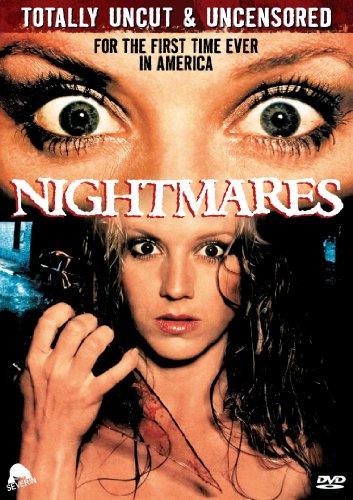
Having accidentally caused the death of her mother, Helen (Jenny Neumann) develops an unhealthy fixation with broken glass. Now an adult and an aspiring actress, she auditions for a role in an absurdist play. She gets the part, and also the attention of her handsome co-star. But then someone starts killing off the cast and crew of the play. Is it Helen?

It isn’t really venturing into spoiler territory to reveal that the answer to that question is “yes.” It is just one of the many odd aspects of this Australian slasher flick that the murders are staged in such a way (often, though not always, in first person) as to conceal the identity of the murderer, while the story makes it clear that there is only one person who could be responsible for the deaths. It then has the nerve to reveal Helen as the killer, right at the end of the film, as if this is some kind of surprise. Imagine if Halloween had concluded with the statement that “The murderer is... Michael Meyers!” and you have the idea. Meanwhile, the editing is frequently disorienting, with the 180-degree rule being violated on a number of occasions, and any sense of geography going right out the window (unless we really are supposed to believe that the critic’s home is an annex of the theatre itself). The storytelling is extremely choppy, with the film being broken up into short, barely developed scenes that have very little connective tissue between them. And as far as the plot itself goes, it’s a typical 1980 slasher in every way, just with Australian accents.
Now having said all that, the theatrical setting does add a measure of interest, and there are moments that call to mind Michele Soavi’s later Stagefright (1986). While the latter is by far the better movie, Nightmares (which was also, by coincidence, known as Stagefright) really comes alive in the rehearsal and performance scenes, with some genuinely witty barbs thrown out at the theatrical world, and some striking camera compositions tossed into the mix. So while this film will remain of interest primarily to fans of the 80s slasher movie, said fans will find just enough different here to make the film worth checking out.