2.35:1 Widescreen

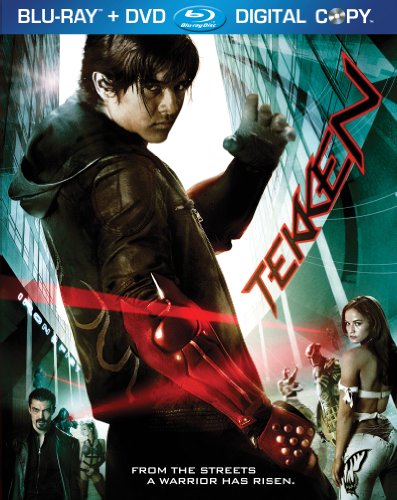
Two of my favorite films of all time are Bloodsport and Mortal Kombat. Before you start groaning, let me explain why. They both act as the total testosterone injection for all of the macho men out there. These movies have tournament style martial arts and MMA mayhem where the only code is to beat your opponent until he/she is defeated. Then they move on to the next fight. Usually, there are theatrics thrown in there too, like to save the world or restore honor. Enter my next review movie: Tekken.

Sometime in the future, the world is plunged into chaos. Eight different corporations take over the world and divide the countries between them. They establish a yearly tournament called Iron Fst which is supposed to determine the greatest fighter of the world. The US territory is controlled by Tekken and headed by one, Heihachi Mishima (played by Cary-Hiroyuki Tagawa) with his son, Kazuya (played by Ian Anthony Dale) in charge of security.

The third BloodRayne film (and second with Nastassia Malthe in the title role) sees the titular dhampir slicing up Nazis, and so the chronology of the third film rejoins that of the first game. During a raid on a death camp train, Rayne accidentally infects a Commandant Michael Paré. Becoming a dhampir himself (a human/vampire hybrid), he and Mengele-figure Clint Howard (because who else are you going to cast as a Nazi scientist other than Clint Howard?) plan to use Rayne’s blood to grant Hitler immortality.

Vampires and Nazis notwithstanding, the important thing here is that this is yet another Uwe Boll film. So what exactly does that mean for you, the discriminating viewer? As regular visitors to this site might know, I have, in the past, actually praised some of Boll’s more recent efforts. I may well have destroyed whatever critical credibility I could lay claim to by being so impressed by Tunnel Rats, but damn it, it was good. Here, though, is yet more evidence that the Indefatigable One is not at his best when dealing with video game material. Also World War II. Opening an action movie about vampires with shots of Auschwitz-bound prisoners is not, methinks, in the best of taste. Furthermore, Boll’s decision to go with a washed-out, gritty feel does a disservice to his heroine. The world of the BloodRayne video games is a fantastic, exaggerated one, Gothic in every sense. It is a world of decadent costume balls, and villains headquartered in castles, and it is the cartoonish, occult-obsessed, iconographically berserk side of the Nazis that lends itself to the kind of stories we fine in the games, not to mention the look of the character. Rayne’s revealing costume, hardly practical, looks even sillier when placed in a context of grime, washed-out colours and snow.

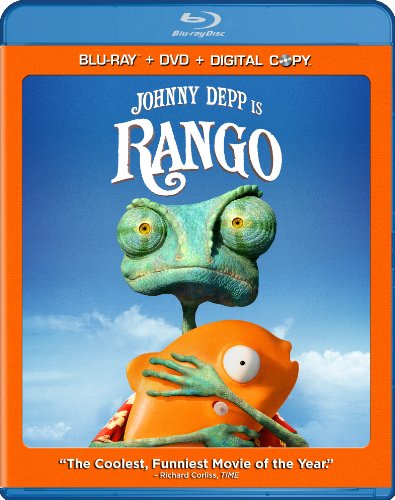
Rango (Johnny Depp) is a chameleon with an enormous imagination. In his terrarium, he has developed a social network with inanimate objects that would be the envy of Castaway’s Tom Hanks. He essentially lives inside his head, but then reality (perhaps – the film maintains a certain ambiguity here) suddenly intervenes and he finds himself cast from his safe, hermetic world. Marooned in the desert, he arrives in the town of Dirt, where his inclination for the dramatic has him claiming to be a sharp-shooting, quick-drawing hero. When he accidentally proves his claim by killing, through sheer stupid luck, a hawk that has been terrorizing the town, he is enlisted by the townspeople to defend them from the tyrants who keep them oppressed and thirsty.

Another day, another self-referential computer-animated film, this one taking on westerns rather than fairy tales. And sure, there are more references than you can shake a stick at, to westerns or otherwise (check out the lightning-fast nod to Depp’s Fear and Loathing in Las Vegas during the highway scene). But this isn’t just a pastiche. The love of classic westerns is palpable, and the film is unapologetic in its adoption of the genre’s convention, but it does take care to fully realize its characters. Visually, the film is extraordinary, displaying a rich palette of colours and moods, an imagination as exuberant as its protagonist’s (a dream sequence becomes exactly what Salvador Dali would have imagined had he been a thirsty chameleon), and the detail work of the animation is bleeding edge. Not everything in the narrative is exactly a surprise, but some pleasures are pleasures precisely because they are familiar, and there are plenty of charming eccentricities to make us forgive the occasional lapses into the been-there-done-that. Certainly one of the better animated films of the year.

When it comes to westerns, I certainly have a love hate relationship. For most westerns, especially anything with Clint Eastwood or spaghetti in the description, I have an extreme loathing and it is honestly hard for me to sit through. But then there is Tombstone which I think is one of the best movies of all time. This summer, I am even excited to go see Cowboys & Aliens. Maybe I just need a western that is out of the ordinary. However, I received Posse to review and by the looks of the cover, this might be a very conventional western or perhaps not.

An old black man (I don't normally get into race, but it is important here) (played by Woody Strode) spins us a story about black cowboys. He tells us to forget about the past and truth. One out of every three cowboys was black. He then goes into a few more facts before telling the tale of Jesse Lee and his posse. It all started long ago during the Spanish-American War, more specifically in Cuba around the year 1898.

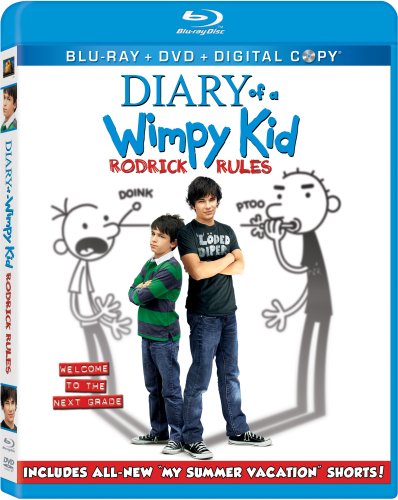
One of my favorite books growing up was Dear Mr. Henshaw by Beverly Clearly. It was a charming book that told the story of a child who would write letters to his favorite author. But somewhere in the middle of the book, it turns from letters to a journal of his life in the second grade. The book series, Diary of a Wimpy Kid focus on the experiences of Greg Heffley and told through the pages of a journal. Today, I get to review the second movie adaptation subtitled: Rodrick Rules.

Like the pages of a drawing book, we join the Rocket Rollers Roller Rink (say that five times fast) where they are welcoming back Westmore 7th graders. A car pulls up and some drawings get out? Oh I get it. By the way, the sign has now changed to, More Lame 7th Graders courtesy of two 8th or 9th graders I assume. As the drawings come out, they dissolve to a family of four.

There has been a trend recently that has seen classic fairy tales being adapted, often with new, modern twists. While this is not a bad idea in itself, it seems that this trend is skipping along, arm in arm, with another trend in not only the movie business, but the entertainment industry as a whole: almost everything is being aimed at 13-year old girls. Beastly is the latest product of that union.

Beastly, as you can probably guess, is a new take on Beauty and the Beast. In this case, we get a modern retelling of the tale, with several plot points that mirror the now classic Disney animated version (though the alternate ending supplied in the Special Features has a moment that, shockingly, pays homage to the even more classic 1946 Jean Cocteau film). However, Beastly not only makes the decision to set its tale in a modern, urban setting, but to attempt to ground it in reality. This is a mistake. Why, you ask? Well, simply because it leads to all kinds of logic-defying moments and paper-thin character motivations which I will address shortly.

"The Dead should never be woken."

Of course, we've learned that lesson countless times before. Stephen King might have been our best teacher with his chilling book Pet Sematary along with its not-as-successful films. Who can ever forget Fred Gwynne, beloved Herman Munster himself, uttering the line: "Sometimes dead is better"? We soon learn that while you might be able to return the dead from their graves, what comes back is usually not quite right somehow. In the end, instead of bringing life to the dead, these journeys usually bring a lot of dead to the living.

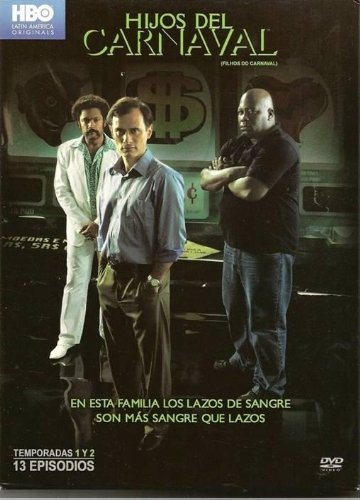
The story begins with the immediate validation of superstition. Anesi Gebara is the head of an illegal lottery and so numbers are crucially linked to his life, both in his work and in the aforementioned superstitions that haunt his life.

The first episode features Gebara's dearest son, Anesinho, killing himself, and the rest of the series follows his remaining 3 sons as they vie to take Anesinho's respected place. As seems to be customary with the majority of HBO programs, dark secrets about each character's past come to light before our eyes. Said secrets often involving lurid sex and death (again, staples in the HBO realm).

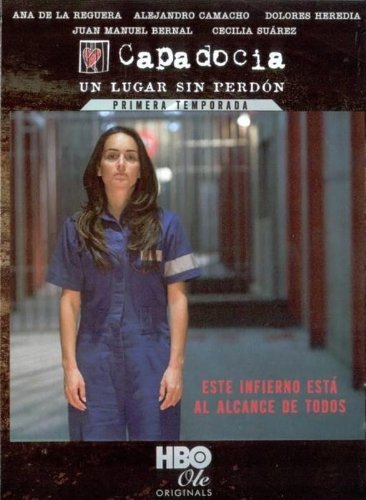
Capadocia: Un Lugar Sin Perdon is an HBO Latin America Original that showcases both the political and social angles of an experimental penitentiary in Mexico City. The penitentiary exploits the inmates as a form of cheap labor for the government. A riot begins that uncovers the violent truths behind the experimental prison and viewers are thrust into the lives of these female inmates. This series depicts the complexities of prison life as well as the political posturing that takes place. There is plenty of emotion in this series and it is executed at a very high
level.

The performances in this series are brilliant.  Much like the HBO original series Oz, there is a proliferation of important characters.  With a series such as this, each character needs to be both written and performed exceptionally well.  Oz achieved transcendence as a series because it had its share of memorable characters.  This series uses a similar template by engaging its audience with a range of interesting personalities. For example, Lorena Guerra (Ana De La Reguera) is a common housewife that commits a crime of passion when she walks in on her husband with her best friend. Once she enters the prison, her performance becomes exceptional as she reacts to the brutality of the violence. A character comparison to Oz would be Tobias Beecher. Guerra and Beecher both are introduced as wide eyed optimists and the system chews them into tougher individuals.

As I have mentioned before on this site, I was married to somebody else before my lovely Sarah. So unfortunately, I know a thing or two about controlling spouses. People who try to force them their loved ones into things they would not normally do and make the least insignificant things into overly important ones. It is a terrible harmful practice and leaves both partners scorned. Thankfully I learned to love again. Let me see what I will think of another controlling drama entitled N-Secure.

A horse carriage rides across the city. We see a young couple, David Alan Washington (played by Cordell Moore) and Robin Joyner (played by Essence Atkins). Later at Chez Philippe, they enjoy some dinner and share some time at their fireplace where David gives Robin a necklace and then we get a romantic night. The next morning, David wakes up and starts his meticulous daily routine before telling Robin to get up and make him breakfast.