Posted in: Disc Reviews by Bob Ross on April 23rd, 2011
By the early part of World War II, the Soviet Union’s ultra-harsh prison system was already an established key to Josef Stalin’s paranoid dictatorship. Hundreds of concentration camps, called gulags, kept criminals and innocents alike trapped behind barbed wire, without edible food or minimal medical care. The most miserable gulags were the notorious Siberian compounds, stuck in such hostile sub-arctic territory that an attempt to escape was considered just another form of suicide.
One such frozen hell is the starting point for The Way Back, a visually breathtaking but icily uninspiring adventure saga from director Peter Weir. Based on a best seller that was sold as non-fiction but later revealed to be largely the author’s invention, it’s long on scenery and short on suspense. That’s because we are told at the start that it’s about escapees who slogged some 4,000 miles through Siberia and Mongolia to freedom in India.
Posted in: Disc Reviews by Archive Authors on April 12th, 2011
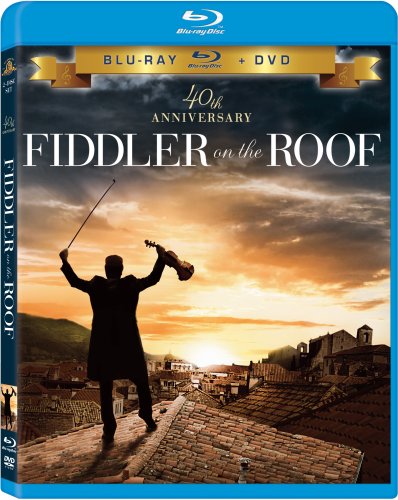
Adapted from the hit stage musical, Norman Jewison’s film version of Fiddler on the Roof has established itself as a classic over and over again since its release in 1971.
“He loves her. Love, it’s a new style… On the other hand, our old ways were once new, weren’t they?” I’ll hardly be the first to write it, but the reason Fiddler on the Roof, a story about Jewish people and their culture, is so popular, is that its themes have universal appeal. In fact, in a way it hardly matters that the characters are Jewish. As we learn from a famous anecdote, when the first Japanese production of the stage musical opened, the show’s creators traveled to Japan to meet the producer. He said to them, “I don’t understand, I don’t know how this piece can work so well in New York. It’s so Japanese!”

Posted in: Disc Reviews by Gino Sassani on April 6th, 2011
If you are old enough to have seen the original Tron back in 1982, you know how much things have changed in the digital world since then. The block graphics of the film and subsequent game might have been state-of-the-art at the time, but it looks like something very primitive to the younger generation. Like all good science fiction, many of the incredible elements of the film have become quite commonplace. The idea that a person can be scanned by a laser and transported into a virtual world might still be out of reach, but it turns out that using lasers to scan objects is exactly how we get three-dimensional images of real-world items into the virtual world. When Flynn is communicating with his program, the program is represented by an image of Flynn himself. Today we'd call Clu an avatar, and it's become quite common for people to socialize in environments like Second Life, where their avatar representatives engage in the same kinds of activities we do in the real world.
Tron wasn't quite the huge box office film you might have expected. It did pull in about $5 million on its opening weekend, which was pretty respectable in 1982. The film ended its box office run with just under $40 million from a $17 million budget. That's not where Tron found its biggest success. The film became more popular as the years went by and some of the content was getting more and more like reality. The game became a classic and is still found in the occasional arcade. That was another trend started by the film. It was one of the first films to spawn a video game, something almost every big-budget genre film does as a matter of course today. The movie was a milestone in computer-generated images combined with animation. It took nearly 30 years, but it really isn't a surprise that Tron has finally gotten a sequel. It's been a commanding presence for years at ComicCon. It's the little big movie that wouldn't die.
Posted in: Disc Reviews by Gino Sassani on April 6th, 2011
Hammer has risen from the grave. A group of investors have resurrected the film brand and intend to honor the tradition of the once-defunct horror giant. President Simon Oakes is a self-proclaimed fan since he was a kid. He has no interest in trying to fit Hammer into the new mold of torture porn or slashers. He acknowledges that there is plenty of room for those kinds of films in the horror genre. He hopes to bring back more than just the Hammer name. He intends to bring back the gothic spirit that was Hammer Films. Let Me In appears to have been a sincere effort in that direction. But the look and feel of that film along with the rich Hammer legacy have set the bar incredibly high. The last thing I expected from all of this was a direct-to-video standard stalker film called The Resident.
Juliet (Swank) has just come from a bad breakup. She caught her ex sleeping with her friend. Now she's trying to set off on her own. She's an ER doctor at Brooklyn Hospital and is looking for an affordable apartment in the area. She gets a call from Max (Morgan) who owns a nice vintage building with a vacant apartment he's fixing up. The place is huge with a spectacular view and is a "reasonable" $3800 a month. She takes the apartment and finds herself somewhat charmed by Max in the process. She finds herself a little creeped out by his grandfather August (Lee). This leads her to send Max mixed signals. She kisses him but pulls back. Later she invites him to her bed but pulls back again. Apparently, she's still in love with Jack (Pace), who is trying to win her back. Max doesn't take rejection very well and has a series of secret passages into her apartment and a large assortment of peepholes throughout. Juliet finds herself feeling uncomfortable in the apartment but just can't quite put her finger on it, which is more than we can say for Max who has no trouble laying his fingers on her. The last 20 minutes of the film is a typical run-and-chase piece with very predictable results. There aren't any twists or surprises to be found here at all.
Posted in: Disc Reviews by Archive Authors on March 30th, 2011
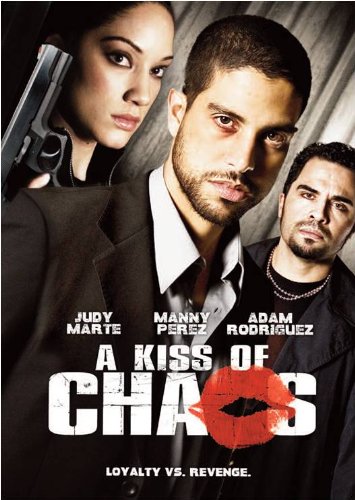
Phoenix is having a rough night. Her scumbag ex boyfriend has just shown up in her apartment with a gunshot wound and a sack of stolen cocaine and her psychotic HIV positive prostitute sister has also shown up, having just shot a john in the face. Plus there are gangsters after the cocaine who will stop at nothing to get it back. Plus there’s her lesbian friend downstairs whose brother is involved on multiple levels and wants to drag her into a plot to steal and sell the cocaine. Plus it’s her birthday.
Phoenix is the central character in A Kiss of Chaos, the unfortunately titled offering from Maya Entertainment. She is played with sullen competence by Judy Marte and surrounded by a cast of “where do I know that dude from?” Latino actors in a basic drug/gangster/crime movie that is clearly aspiring to be more. For one, the character of Phoenix is supposed to be an artist of some kind. We know this because there are a couple of flashes of her on a stage in some kind of coffee shop, apparently reading entries from her diary, which, as her lesbian friend tells her, “sound like poems”. We must, however, take this on faith, since the only tidbit we hear is the enticing entry, “November seventh; I’m in love with the wind”. I’m serious.
Posted in: Disc Reviews by David Annandale on March 23rd, 2011
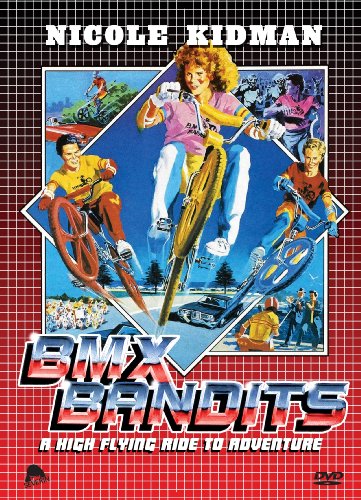
The more famous a star, the more curious their early, pre-icon efforts become. Thus, we watch agog as Humphrey Bogart plays a murderous, blood-thirsty zombie in The Return of Doctor X (1939). And here, a 16-year-old Nicole Kidman makes her debut as a BMX-obsessed teen who runs afoul of a group of not-very-competent gangsters. Once again, one watches agog.
Kidman, Angelo D'Angelo and James Lugton are the trio of teens who need to raise funds to buy new bikes. They happen across a cache of walkie-talkies that are supposed to allow a gang of bank robbers to hear the police while being unheard themselves (though, as matters develop, the opposite is true), and sell them. Understandably irked, the thieves pursue our heroes, and all sorts of car vs BMX chase scenes ensue.
Posted in: Disc Reviews by Bob Ross on March 17th, 2011
Connections between Eastern and Western cinema aren’t new, but they do seem to be proliferating. Back in 1964, Italian maestro Sergio Leone borrowed from Japanese genius Akira Kurosawa, turning Yojimbo into A Fistful of Dollars. Just last year, Korean writer-director Lee Jeong-Beom looked to the West for multiple influences, and the result is The Man From Nowhere, a psychological action-thriller that alternately engages, confuses and kicks major butt.
The film was a late-summer hit in its homeland, but it’s probably OK that the rest of the world had to wait until now for this technically superb Blu-Ray release. Subtitled gangster yarns don’t sell well in the American market – at least not the ones that rely on gritty plotting instead of high-wire special effects. In other words, this is no Crouching Tiger, kids. That’s more of a Chinese development. Like Leone’s Man With No Name, The Man From Nowhere is an enigmatic antihero, and the main reason you root for him is because everyone else in the picture – rival gangs and creepy cops – is more disturbed than he is. The exception is an innocent young girl who becomes a kidnap victim whom our hero vows to rescue.
Posted in: Disc Reviews by David Annandale on March 14th, 2011
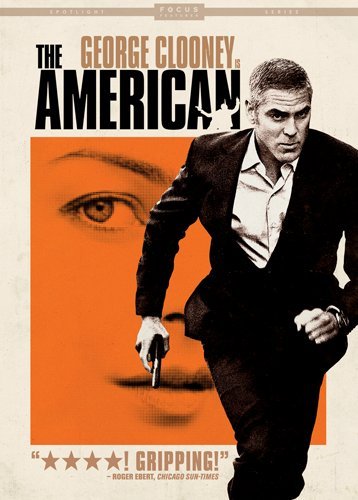
The cover of this DVD is, depending on which signals you pick up on, either misleading or perfectly accurate. If all you see is George Clooney running with a gun, and you therefore come to the conclusion that this is going to be some action-packed thriller, and that is what you're hoping for, then you're going to be disappointed. If, on the other hand, the orange colour and the rather retro look to Cloney's image, not to mention the rather uninformative title, makes you think of the 1970s, then you're on the right track.
Clooney plays the titular American, an intelligence operative whose last job results in rather more bloodshed than it should, and people are clearly after him. Nonetheless, he is given a new assignment, and he takes it. He is to craft a specialized assassination rifle, and he does so while holed up in a hillside Italian village. There he meets a priest and a prostitute, encounters that will alter the course of his life.
Posted in: Disc Reviews by Archive Authors on March 9th, 2011
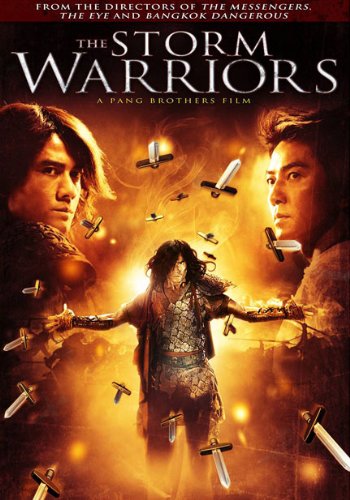
I must admit, I came at The Storm Warriors with very little knowledge of its creators, the Pang brothers, but as someone who appreciates Asian cinema, I felt that I had the sensibilities to enjoy the film. The movie deals with a Japanese invasion of China by a dread warlord named Lord Godless. As the film opens, we learn from an almost impossible to follow title sequence, he has captured China’s mightiest heroes and is preparing to execute them. Being invincible, Lord Godless is almost assured of victory, unless two of the aforementioned Chinese heroes, Wind and Cloud, can combine their power to defeat him and his army.
We learn all this and much more in the first two minutes of the movie.
Posted in: Disc Reviews by Bob Ross on March 5th, 2011
There are two ways to address a familiar film plot. The easy route, of course, is to dismiss it as recycled fluff, reciting the similarities to its predecessors. The more discerning course is to give the newcomer a chance to prove itself as a creative variation on the theme. That’s how you can give Due Date its due. In the first few minutes, you’ll notice the script verges on carbon-copying Trains, Planes and Automobiles, the 1987 John Hughes hit about two utterly mismatched men on a comically catastrophic cross-country road trip.
Check the parallels: One of the guys is an uptight, super-straight, slightly pompous type who has a powerful reason to get home by a certain time. In the original, it’s Steve Martin struggling to make it for Thanksgiving. In the update, we get Robert Downey Jr. , desperate to witness the imminent birth of his first child. Each man’s plans are shattered by a walking disaster – a free-spirited jinx whose apparent sincerity is overshadowed by an uncanny ability to turn any given situation into pain, inconvenience and humiliation.