2.35:1 Widescreen

In 1951 Robert Wise made the Earth stand still. The United States, in fact the entire planet, was in the middle of a frightening cold war. If you believed the media at the time, we were standing just moments from nuclear annihilation. We were given images of a crazy man’s itching trigger-finger poised over a button. School kids were led in air raid drills that promised protection from this powerful menace by the wooden tops of your desks. The government and private sectors were engaged in witch hunts to smoke out “commie” sympathizers. The fear touched every aspect of our lives. Hollywood was no exception. We confronted these atomic fears with giant creatures and post apocalyptic humans, all mutated by radiation fallout. But Robert Wise delivered a morality tale that offered something far different. It offered hope.

I avoided this remake at the box office. This time it wasn’t just because I was too busy. I love the Wise classic and have long considered it off limits for a remake. When I heard about this one, it brought cringes. I had flashbacks to Steven Spielberg’s total rape of War Of The Worlds. Suddenly the new story wasn’t about hope or an interplanetary federation. It was a Captain Al Gore fantasyland come true. I stayed away.

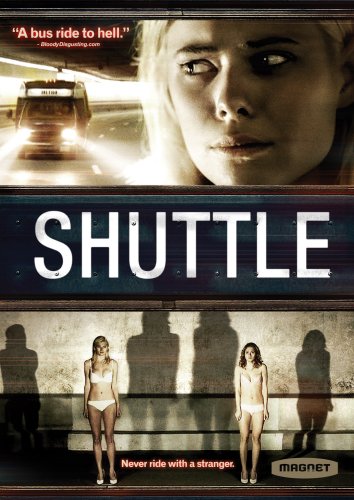
We all knew it had to happen eventually. With the success of the “torture porn” films like the Hostel and Saw series, we had to expect that there would be some lightweight twists and turns on the thriving genre. Shuttle is one of those attempts. It gingerly treads on the now familiar ground of the aforementioned films, but each time it makes the obvious moves in that direction, it pulls back and stalls. Edward Anderson is the writer and director of this mess. It was first attempt at either, and it shows, very badly. He couldn’t decide if he was making a traditional slasher film or one of the more trendy “torture porn” exorcises. So, he ends up doing neither effectively.

The setup was pretty much what we’ve already seen a hundred times. Two young women are on their way home from a Mexican vacation. It hasn’t been going all that well, and the plane ride back to the States was bumpy and plagued by horrible weather. Mel (List) is apparently engaged, and Jules (Goodman) is apparently her best friend. It’s late, and they just want to get home. They opt to accept a ride from a shuttle driver (Curran), who offers to take them for half price, instead of accepting a ride from two guys they just met. They figure the shuttle would be safer. But, of course, if that were true we couldn’t have 106 minutes of movie. By the time this hell ride is over you’re gonna wish they’d just taken the offered ride. The girls would be home safely in their beds, or perhaps the guys’ beds, and your life would now be 100 minutes or so longer to do some of those things you’ve promised yourself needed to be done.

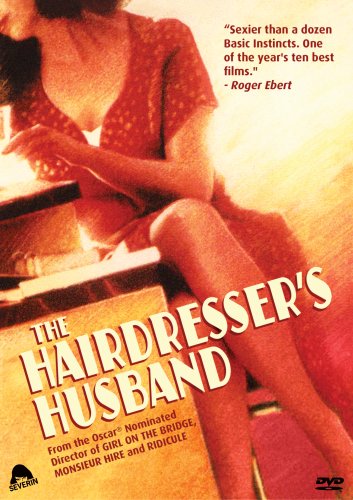
A middle-aged man (Jean Rochefort) recounts his youthful sexual awakening to the charms of the local hairdresser. Developing a fixation on the erotics of a women cutting men's hair, he resolves to marry a hairdresser, and decades later, he gets his wish. His wife is the lovely Anna Galiena, and once wed, they rarely leave her little shop (indeed, they also get married there).

Writer/director Patrice Leconte is dealing with a pretty specialized fetish here, but he in the early goings, he actually comes close to making us understand Rochefort's obsession. Leconte's precise attention to sensual details sells us the young boy's developing passion, but in the long run, the older Rochefort's inclination is rather harder to take seriously, or even be that interested in. The couple's idyllic life in the salon is obviously not mean to be seen in any realist sense, but even as a parable, it's rather thin. Rochefort spends his days doing crossword puzzles while Galiena reads gossip magazines, gazing adoringly at her as she tends to various customers (whose eccentricities feel like the inevitable conventions of this sort of art film, even as they do provide a necessary spark of life to the very still narrative), and launching, at the drop of a hat, into improvised dances to Arab music. This last quality is supposed to be charming, but by the third number (in a short, 82-minute film), it is simply irritating. Having created a situation where, once the courtship is accomplished (a matter of mere minutes of screen time), nothing can happen, Leconte decides to wrap things up with a conclusion that is clearly supposed to be poignant, but is utterly fatuous. The film is delicately wrought, and quite lovely, but also fundamentally empty-headed. In the end, it comes across as little more than a precious presentation of a middle-aged, rather misogynist fantasy.

Jim Carrey’s life and career are in a sort of mid-life crisis. He has avoided doing his usual goofball comedy films and opted for more serious roles. His appearance in Number 23 was a bit of a shock for most of us, but he pulled it off reasonably well. Even his more recent comedies have often been less about one crazy character and more about the story elements. It seems that he has decided it was time to return to the parts that made him a household name with Yes Man. But after watching Yes Man,,I have to wonder if maybe that genre has passed him by. For the first time, you really start to see age catching up on the crazy actor, and while he still has tremendous timing, he doesn’t look altogether quite right when he brings out the twisted faces and expressions anymore. It’s not a dig at Carrey at all. Still, it can’t be very good for a comedy, particularly one with a romantic element to it, when your first reaction is that the lead’s starting to look a little old. It’s not even that he looks bad. He just might need to tone down the goofy and concentrate on being more sincere. When Carrey takes that approach in this film he’s far more believable and, yes, that much more funny.

The story is almost a direct riff from his Liar Liar plot. In this one Carrey plays Carl Allen. Carl is a loan officer at a local bank. He was divorced three years ago, but he still hasn’t gotten over it. He’s become somewhat reclusive and self absorbed. He finds all manner of excuses to avoid doing anything with his friends. Instead he spends each night falling asleep watching rented movies on television. What’s worse is that he doesn’t even know that he’s miserable. One day at lunch a former coworker, Nick (Higgens) approaches him as he’s eating lunch in front of the bank. He tells Carl about how a motivational seminar has changed his life. He invites Carl to come to a workshop, but Carl drops his usual no thanks on him. But later Carl begins to realize how detached he’s become and has a scrooge-like epiphany at just how lonely he is. So, predictably, Carl goes to the seminar. Here motivational Guru Terrance (Stamp) preaches the gospel of Yes. He challenges Carl to merely accept every opportunity that comes his way. He commits him to a covenant to say yes to anything. As soon as Carl leaves the building the expected situations arise, where most sane people would say no. In a series of Yes’s that involve a homeless man, Carl begins to have second thoughts when his affirmative replies appear to put him in a bad situation. That is, until he meets Allison (Deschanel). Suddenly his new life appears to bring him a bounty of experiences and pleasures. As you might expect, it’s all leading to some rather uncomfortable consequences. But, as all “feel good” films must, Carrey eventually learns to live his new life in moderation and lives happily ever after.

“Some of the old time sheriffs never even wore a gun. Most folks find that hard to believe. Jim Scarborough never carried one, that’s the younger Jim. Gaston Boykins wouldn’t wear one up in Comanche County. I always liked to hear about the old timers. Never missed a chance to do so. You can’t help but compare yourself against old timers. Can’t help but wonder how they would have operated in these times.”

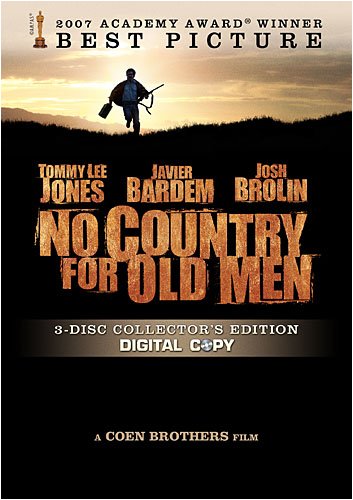
I know I’m getting old myself when a film set in the 1980’s is now considered a period piece. And No Country For Old Men is about as much of a period piece as anything else. More than any part of the story, it’s the mood and the atmosphere of this movie that makes it work on so many levels. Trouble is, no matter how many times you see the dang thing it doesn’t get any easier to categorize what exactly it is. Sure, it is set in the 1980’s, but truth be told it could have just as well been set in the 1880’s. Has West Texas even changed all that much in those 100 years? Watch this movie and you’ll be asking the same question. No Country For Old Men is as much a western as it is anything else. Some call it a “modern western”, but I don’t like that term a whole lot. I mean, when you stop and think about it, what exactly is a “modern western”? I guess you could just as easily answer, No Country For Old Men.

It’s official. I’ve just totally given up on Adam Sandler. Honestly, I haven’t laughed at anything he’s done since the music video for The Lonesome Kicker. How many times can the same absurdity and Romper Room antics work on a film audience? Even in a Walt Disney film that required Sandler to clean up his act a bit, the same sophomoric humor was showing through the threadbare shtick. You just knew there were times he wanted to let loose with some off color remark or obscene gesture. While I was pleased that he gave it the effort, it’s like asking a mute man to talk after you just tied up his hands. There are some moments of genuine warmth with the kids. The guy’s probably a very nice and likable guy, it’s not personal. I’m just tired of the same Happy Gilmore character, just stuck in different situations. Think about it, aren’t they all the same person: Zohan, Gilmore, Little Nicky… The list goes on ad nauseum. A shame, really, because this thing might have had legs with another lead in the role.

Once upon a time in a small hotel, Marty Bronson (Pryce) was trying to run his small family business. Unfortunately, while Marty might have been a great guy, he didn’t have a head for business. He’s forced to sell out to a large hotel chain, owned by Barry Nottingham (Griffiths). The thing that put the deal over the top was Nottingham’s promise to let his son Skeeter (Sandler) run the hotel when he was older. Alas, as I always told my law students in my teaching days: Get it in writing or the promise isn’t worth the paper it’s not printed on. Nottingham does keep Skeeter around, however, as a handyman. Unfortunately he’s treated as a nobody by the entire staff, accept Mickey (Brand). Skeeter’s life is about to change. First, he is given charge of his niece, Bobby (Kesling) and nephew, Patrick (Heit) while his sister, Wendy (Cox) is out of town looking for a job. She’s the local elementary school principal. She’s also a crazy control freak liberal who feeds her kids cakes made out of sawgrass and prohibits such wasteful activities as television watching. Of course, brother Skeeter is going to change all of that. Wendy leaves her friend, Jill (Russell) to help out with the kids and take the “day shift” since she’s also a teacher at their school. But Skeeter’s life might change for the better when he’s given an opportunity to run the new and improved Nottingham Hotel that will replace the current one. If he can come up with a better theme than Nottingham’s future son-in-law and all around kiss up, Kendall (Pearce), he’ll be allowed to finally run the hotel. It doesn’t hurt that he discovers magic in his niece and nephew. It seems that when the three of them engage in some ad lib storytelling (the kids’ books all look like they were written by Captain Al Gore) the stories begin to come true. If he can only manipulate what the kids come up with in his favor, he might just get the big chance he’s been waiting for and even win the girl of his dreams, which he thinks is Nottingham’s Paris Hilton knock-off daughter, Violet (Palmer). Needless to say, it won’t be easy, but Skeeter finds a way to become the hero. Oh, and there’s one of the worst CG creations since Lucas unleashed Jar Jar on an unsuspecting Star Wars fan base. In this case it’s a CG enhanced guinea pig named Bugsy, because of his obnoxiously large eyeballs.

“A dog has no use for fancy cars, or big houses, or designer clothes. A waterlogged stick will do just fine. A dog doesn’t care if you’re rich or poor, clever or dull, smart or dumb. Give ‘em your heart and he’ll give you his. How many people can you say that about? How many people can make you feel rare and pure and special? How many people can make you feel extraordinary?”

In the name of full disclosure, I should probably give you a little background in the circumstances in which I find myself watching and reviewing Marley & Me. If you’re a regular reader of this site and my reviews, you have come to learn that I have a Siberian Husky named Athena. You’ve come to know this because I have, from time to time, allowed her to “review” many of the various dog films that have come my way for this site. You also know that Athena retired recently with her review of Walt Disney’s Bolt. What you don’t know is the reason behind the retirement. About three weeks ago, Athena was diagnosed with bone cancer in her front left shoulder. At 14 years old, there really isn’t much that can be done. She was given anywhere from two weeks to a couple of months, on the outside, to live. We’re able to control any pain she has with medication. In fact, the medication has often given the illusion that she’s getting better. We know she’s not, and that it’s only a matter of time from here on out. It’s a tough situation to be in, as I’m sure any dog owner out there realizes. So far, Athena’s still with us. She’s beaten the lower estimate and continues to avoid too much discomfort. But, the sad reality is that my wife and I are watching our 14 year old companion in her final days. This is not the place you want to be in your life while watching Marley & Me. It might have been the toughest film I’ve had to watch in nearly 10 years of reviewing movies, in one form or another. Enough about my situation.

Slumdog Millionaire has become the latest “must see” Best Picture award winner. While I actually liked the film better than I imagined I would, it’s precisely because the movie is not what it appears, or at times claims to be. If I just took the buzz and advertisement campaign to heart, I would expect a Bollywood picture to the extreme. If you’re not really sure what that term means, I can tell you that this movie will not really clarify anything for you. The traditional Bollywood, Indian made films, feature intense tragedy and love stories. They are usually swimming in song and dance numbers.Looking at the film’s television spot, it would seem that that’s exactly what this movie is. The problem? The song and dance that tends to dominate these spots is not even in the film proper. Rather, the only musical number occurs over the closing credits. Now, while all of this may sound like criticism, it’s actually not. I’ve seen Bollywood productions, and they’re just not up to my tastes. I never fidgeted and yawned so much in my life. That doesn’t mean they’re bad, by any means. I’m sure that there are some that are quite good and entertaining for some people. I’m merely not one of those folks. So, when I discovered that Slumdog Millionaire was going to land on my front door to watch and review, I began to sweat a little bit. How, I asked myself, am I going to handle having to blast the darling of the Hollywood circuit? Am I ready for the barrage of hate emails a negative review is likely to elicit? Fortunately, for us all, this is nothing at all like a true Bollywood film, and try as he might, Danny Boyle just can’t escape his own natural tendencies. In fact, I didn’t fidget or fuss at all. It’s a pretty good film, after all.

A few years ago Who Wants To Be A Millionaire was quite a large phenomenon on American television. The original game show, hosted by Regis Philbin, dominated the primetime airwaves. ABC milked that cash cow for all it was worth, and before long it seemed Millionaire was on just about every night. But, like all fads, the luster wore off, and the show began a steady decline. It survives today, but with lesser known hosts and as a half hour syndication show, usually aired pre-primetime. I’m told the show continues to be a hit abroad, and particularly in India. Whether or not that’s true, I can’t confirm. You do need to accept that premise, however, to buy into the movie. It doesn’t hurt to have at least a passing familiarity with the game’s general format. It looks very much like it did here. A new host and, of course, the currency is in local tender. Still, the spirit of the game we know here exists in India, according to the film.

“The crime you see now, it’s hard to even take its measure. It’s not that I’m afraid of it. I always knew you had to be willing to die to even do this job. But, I don’t want to push my chips forward and go out and meet something that I don’t understand. A man would have to put his soul at hazard. He’d have to say, ‘OK. I’ll be a part of this world’.”

We all know by now that No Country For Old Men became last year’s “must see” Academy Awards Best Picture. Unlike this year’s more ambiguous Slumdog Millionaire, this one really was the best film I’d seen in 2007. It’s already been out on DVD for nearly a year.

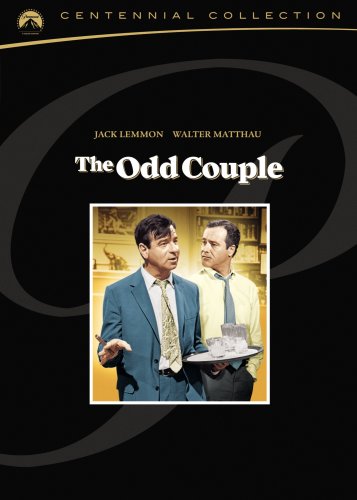
The Odd Couple began as a concept when playwright Neil Simon observed his recently divorced brother share an apartment with another divorced guy. He developed it into a very successful play. In the original play Walter Matthau played Oscar, but it was The Honeymooners star Art Carney who played Felix. Both actors were offered the parts for the film. Carney declined. It was because of the onscreen chemistry between Matthau and Jack Lemon on the film The Fortune Cookie that led to Lemmon being cast as Felix. The decision was a stroke of genius. If you look at it on its surface, there really isn’t much of a story here at all. It is the connection and relationship between these characters, and subsequently these actors, that made this film the classic that it is. Also returning from the play to reprise their roles were Monica Evans and Carole Shelley as the amusing Pigeon Sisters, roles they would actually repeat for the television series two years later.

When I watch this film, I will admit that it’s often a little hard to get the images of Jack Klugman and Tony Randall out of my mind. Most folks have had far more exposure to that 5 year television series than they have with the original film. To me, they will always be those characters. In fact Klugman replaced Matthau on the stage as Oscar before he took the role on television. Still, even with that bias, it is awfully hard not to get drawn into this film. For me characters and performances can be everything. That’s what makes this film have the lasting power it has enjoyed. Most of the film, as the play, takes place inside the apartment. There is a very limited cast, often just Felix and Oscar on the screen. Certainly there are some great moments with the poker buddies and the Pigeon Sisters, but most of the film takes place in a limited environment with just two actors. If you can make that work at all, let alone create a classic experience from it, that’s saying something. There were a few outside locations utilized in the film that were not part of the original play. These were placed there just to give the viewers a change of scenery but were totally unnecessary.