2.40:1 Widescreen (16:9)

WELCOME! TO THE MOULIN ROUGE! *tips her purple satin top hat with an amethyst topped cane* Come in, come in! Take off your cloaks and have a drink of Absinthe! So many lonely women here tonight that need a partner... to dance with of course! Hope you brought lots of cash, your dancing shows, and perhaps a nice big diamond for one of our infamous Diamond Dogs! What's that? Oh! Yes of course! I know, you came to see a show, and of course to see our lovely Satine! Well take a look see, here she comes! *cues "Diamonds Are A Girl's Best Friend" and the curtains pull open!*

The year is 1899, meet Christian (Ewan McGregor)a young, handsome, man who intends to be a writer. He moves from England to the Montmartre district in France to write about love. One problem, he has never been in love before, so how can he write about something he has never experienced? -crash!- A man falls through the ceiling of his room (Jacek Koman) and Henri de Toulouse-Lautrec (John Leguizamo) comes in through the door. A few heads pop around the hole in the floor, and they are discussing what to do about their narcoleptic friend who can't stay awake during the rehearsal for a play they are working on. Oh how they need a replacement, but where oh where are they going to find one? Christian is upstairs rehearsing with the group, and he comes up with some lines that blow their minds. They talk about introducing him to Satine, but decide that will wait till after they have some Absinthe!

For most people in high school, Romeo and Juliet by William Shakespeare is required reading. Sometimes more than once. Somehow, whenever it came time to read aloud in class, I always ended up with the part of Romeo. It certainly wasn’t for my striking good looks but apparently for my charming voice. As a result, I remember most of Romeo’s part to this very day. But would I be able to enjoy a fairly recent adaptation of Romeo and Juliet directed by Baz Luhrmann? We shall see.

Somewhere in Verona Beach there are two families who struggling for power, the Montagues and the Capulets. The blood feud has continued for years between Ted Montague (played by Brian Dennehy) and Fulgencio Capulet (played by Paul Sorvino). But everybody from their wives, Caroline Montague and Gloria Capulet (played by Christina Pickles and Diane Venora respectively) to their families have felt the impact.

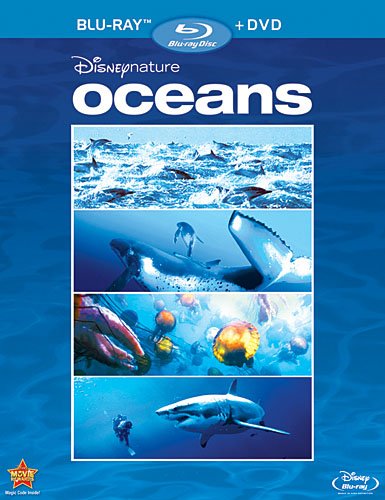
"A boy comes running up, and he asks: 'what exactly is the ocean?' 'What is the sea?' You could hit him with a lot of statistics and Latin names. But the answer isn't something you'll find in a book. To really know what the ocean is, you have to see it for yourself. You have to hear it. And taste it. You have to feel its power. To really know the ocean, you have to live it."

And live it you will with Disney Nature's latest entry into their award-winning series of natural documentaries. Walt Disney Studios is no stranger to the world of nature. While the brand is more quickly identified for its animation and other family fare, the tradition of nature specials goes back to the very roots of the company itself. For decades Disney provided some of the most exotic television documentaries on its many outlets that included The Wonderful World Of Disney. The studio was one of the first to take experienced camera crews and equipment out into some of the most remote places on Earth. And, while Disney had appeared to fall behind in the field for some decades, that all turned around with their groundbreaking Earth series. Suddenly Disney Nature was back in the forefront of frontier footage. The tradition is honored here with one of the latest entries in the family: Oceans.

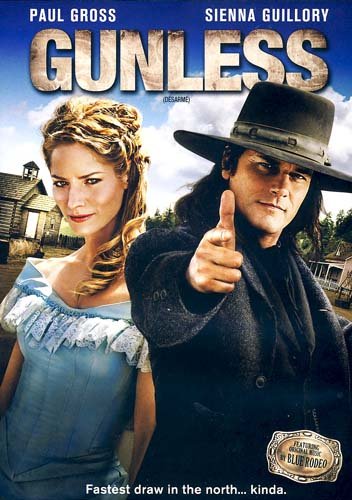
In the opening scenes of Gunless, a horse trots into what appears to be a tiny western town. Atop the horse is an unconscious man, slumped backwards in the saddle with a noose around his neck attached to a large tree branch that drags along behind them. An iconic Western opening if ever there was one. Reminiscent of Clint Eastwood in High Plains Drifter or Hang ‘em High. However, things soon begin to stray from formula when we realize that this tiny town is actually in "The Dominion of Canada" and the man turns out to be the Montana Kid, a notorious American gunfighter.

The ‘Kid’ is soon helped out by a polite bunch of Canadians, and before you can say “American stereotype” he has tried to start a gunfight with the kind local blacksmith. The reason? Why, the blacksmith had the gall to shoe the Kid’s horse. Unfortunately (or fortunately, if you are the blacksmith) he has no gun and therefore, according to the code of the West, can’t be shot. The solution? Why, the Kid will get the blacksmith a gun. But since this is Canada, there are no guns in the area, except for a broken antique owned by the local Brit-accented hottie widow.

We all remember the classic underdog film from 1984. Then it was awkward child star Ralph Macchio and Pat Morita in the lead roles. It was a coming-of-age story that taught some valuable lessons about discipline and patience. It was an immediate classic that pulled in a much more than respectable $90 million at the box office. It spawned three sequels which did not do near as well as the original. Now we find ourselves in an age where just about any movie ever made has to be remade/reimagined/rebooted/ or merely capitalized upon. Should there have been a new Karate Kid?

The box office would indicate that the move was a good one. The take was nearly double that of the original film. You also have to remember that 16 years have come and gone and $176 million doesn't buy you what it used to. Still, it's a huge number for a remade film, so I suspect the folks behind the film feel justified. Don't be surprised to see another group of sequels to follow.

Most people are aware that I don’t care for romantic comedies but nothing gets under my skin more than a horrible prison movie. My attempts to forget the movie are usually successful until the next time a similar movie appears in my review pile. Maybe it is the cliché plot, the contrived and stereo-typed characters, or the male on male forced action. How would a movie fare where it simulates the jail experience in a behavioral experiment? I dare to find out.

Travis (played by Adrien Brody is just another drifter trying to get through life. He works part-time at the retirement home until the state cuts back and lays him off. As he considers his options, he attends a peace protest where he meets a rather attractive girl named Bay (played by Maggie Grace) who is also demonstrating. Bay wants to go to India for spiritual enlightenment and wants Travis to join her. Travis however needs some money to make the journey.

"It is said some lives are linked across time. Connected by an ancient calling that echoes through the ages. Destiny."

The Prince Of Persia is not some new phenomenon sweeping the country. The original video game goes back quite some time to the pre-high-definition consoles of the late 1980's. Over the years the title has had some major staying power and has continued to flourish across several platforms and generations of graphics and game play. Today video games are more and more like movies themselves. Many of these games carry budgets as high as blockbuster effects-laden tent-pole films. It's big business. The technology has nearly merged between film and video game. And while Prince Of Persia is not the first game to be turned into one of these mega-movies, it just might be the closest thing to bridging that gap yet.

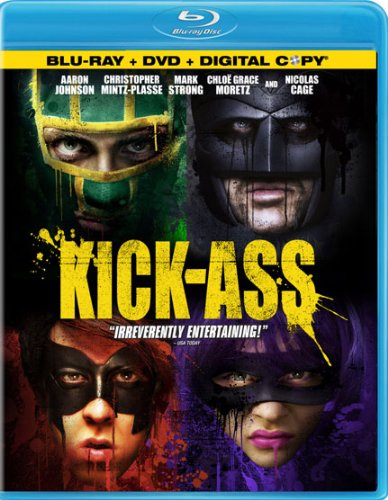
"I always wondered why nobody did it before me. I mean, all those comic books, movies, and TV shows. You'd think that one eccentric loner would have made himself a costume. I mean, is everyday life really so exciting? Are schools and offices so thrilling that I'm the only one who ever fantasized about this? Come on. Be honest with yourself. At some point in our lives, we all wanted to be a superhero. Who am I? I'm Kick Ass."

You have to give the folks at Lionsgate some serious credit for the way they promoted Kick Ass. The film was generating a lot of buzz almost a year before it actually came out. It was a huge topic of conversation at last year's ComicCon, and I must have gotten promo alerts from the studio once a week for several months. But even with all of that hype, the film just refused to interest audiences enough to show up in any great numbers for the quirky superhero spoof. We're talking under $50 million for a film that got so much pre-release attention. And so it was with that history in mind that I rather cautiously approached the film when the Blu-ray arrived here from the studio. Most of what I had heard wasn't so good. I figured, at best, it'll be a nice diversion.

Mention the name of George A. Romero to anyone even remotely familiar with horror movies, and the first thing they're going to think of is zombies. Why shouldn't they? It was Romero who made what might be the first little film that could. Long before Blair Witch Project and Paranormal Activity, Romero set out with his trusty 16 mm camera and a crew of pretty much local Pittsburgh friends, to make Night Of The Living Dead. With this film and the ongoing "Dead" franchise, Romero has pretty much written the rule book on zombies. He is no doubt the zombie king. That's the kind of thing you think of when someone mentions George A. Romero. But, there is this small, at least until recently, group of die-hard Romero fans that might have thought of another film. They might, just might, mind you, be thinking of an obscure 1973 film called The Crazies.

It's a typical small American town. Kids are blissfully riding their bikes. It's the opening day of Little League baseball. Everyone is just enjoying their idyllic Norman Rockwell existence. Don't worry. No one is really trying to pull anything over on you here. We know this pleasantry isn't going to last when the first few seconds of the film depict this very town burning to the ground. Our first hint that something isn't quite as American Pie as all that is when town drunk Rory shows up on the kids' baseball diamond packing a 16-gauge. The gory results cause the town to ask some very easy questions, like why did Rory show up totin' that double-barrel? Sherriff Dave (Olyphant) investigates that very question along with his wife who happens to be the town doctor (Mitchell). The answer, it seems, can be found in the town's water supply and a recently-crashed plane. The U.S. Government has accidentally infected the water supply of a small town with the engineered bio-weapon called Trixie. It eventually infects people and becomes airborne instead. The first stage is a little harmless catatonia. The second stage turns its victims into raging maniacs on steroids before killing them 48 hours later. The feds close down the town and try to round up the residents, corralling them into two groups: The ones who have the virus and the ones who don't. But Dave and his pregnant wife don't intend to stick around while martial law reveals sheer brutality in this once picture-postcard town. It's a tough time to be on the run. Doesn't matter who you run into, crazies or soldiers, both are gonna kill ya dead.

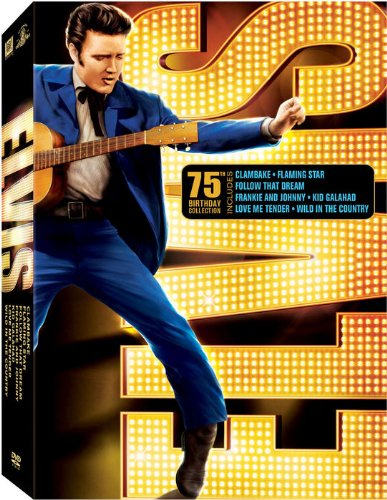
Elvis Presley is often referred to as The King Of Rock And Roll, at least to his fans. There's no denying the impact that he had on the music scene. He was the first rock and roll star, to be sure. Colonel Tom Parker, his long-time manager and partner, created many of the marketing traditions that are commonplace in the industry today. He knew the value of his star, not only as a performer, but as a brand. For the first time, a musician's image and name started to appear on everything from bath towels to women's underwear. Fans are often split on their feelings for the self-styled Colonel, but Elvis would not have become the name brand he still is today, without him.


One of those brand expansions tapped into Elvis's own boyhood fantasy. Elvis had worked as an usher at a local movie theater as a teen. He's often related that he would linger in the auditoriums, watching those movies and fantasizing that he was James Dean or Marlon Brando, two of his idols. With the help if Colonel Parker, Elvis would get to see that dream become a reality. The King was to expand his realm to include the movie business and Hollywood. No experience? No problem. After all, if Elvis could go from failing music in high school to becoming the highest paid musician on the planet, he could certainly tackle the world of acting. And he did just that.