Posted in: Disc Reviews by Michael Durr on March 26th, 2009
The WTO or World Trade Organization came into being on the 1st of January in the year of 1995. It was the successor to GATT (General Agreement on Tariffs and Trade) and was designed to supervise and liberalize international trade. In their ministerial conference of 1999, they decided to have the conference on US soil. The site chosen was Seattle, Washington. The WTO had drawn criticism from protestors around the globe that proclaimed that the WTO was pursuing commercial interests ahead of human principles. In 1999, the WTO convened at the Washington State Convention and Trade Center. Protestors came by the thousands and soon despite their peaceful efforts, riots ensued. There was mass police involvement. It also gave way to some of the more horrific scenes of innocents and guilty arrested alike. Battle in Seattle is a docu-drama directed by Stuart Townsend that mixes a drama-thriller with the real events that surrounded the days that followed November 30th, 1999 in Seattle, Washington.
Jay, Lou and Django (played by Martin Henderson, Michelle Rodriguez, and André Benjamin) are three activists who are planning a mass protest at the 1999 conference of the World Trade Organization in Seattle, Washington. Meanwhile, a SWAT cop named Dale (played by Woody Harrelson) gears up for that same conference in order to keep the peace. His mind is not on the protestors, instead his mind is focused on his wife, Ella (played by Charlize Theron) who is five months pregnant.
Posted in: Disc Reviews by Gino Sassani on March 25th, 2009
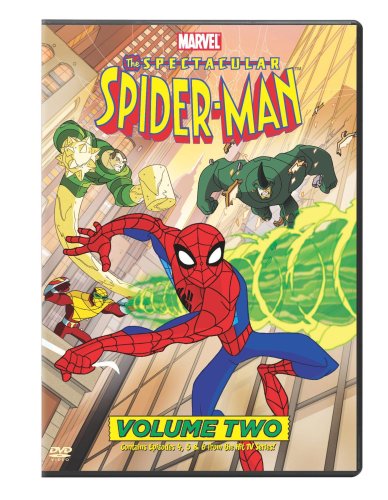
This is not your Friendly Neighborhood Spider-Man. If you’re at all like me, you grew up on the 1960’s cartoon series and, of course, the Marvel comic. A lot has changed since those early days of the web slinger. There’s been a not too successful television live action attempt. The comics themselves have changed significantly. You can’t discount the enormously profitable Sam Raimi films, that have given new legs to an old superhero. It stands to reason that a new cartoon series was in order. Enter The Spectacular Spider-Man, the 10th series based on the Marvel character. This recent cartoon series updates the world of Spidey. The shows take from both the original comics and the film series to create a new fusion of the hero. Like in the comics, Parker is the loner high school kid teased constantly by bullies like Flash Thompson. He has a few girls on his radar like Gwen Stacey and Mary Jane Watson. He still lives with his kind old Aunt May. Unlike the film, Spider-Man was not endowed with his web slinging ability by the radioactive spider. He developed the shooters and the chemical mixture that makes them work. That means he can run out of fluid and lose his ability to shoot webs. The Osborne relationship from the movies exists here. It’s also likely no coincidence that the villains featured in the film have prominence here. Doc Ock, Sand Man, The Goblin, and even Venom are hinted at in the last episode of this collection.
These cartoons are actually pretty good. The animation is pretty solid. Some of the characters look rather strange. Aunt May looks like she’s a 20 year old with white hair. Character jaw lines have a distinctive angular style that makes everyone look like they’re posing for some tough guy magazine cover. MJ looks like a matchstick and says “tiger” way too often. They are not really standalone episodes. Unlike the 1960’s series there is a story arc that connects the episodes into a longer form. The character’s mythology is also played with quite a bit. The cartoons work in a few origin stories and connect them together as a master plan plot devised by OsCorp and spearheaded by Dr. Octavius. The only real complaint I have is that each disc, sold separately, contains a mere 3 episodes. While this is great for bit rate and picture quality, it’s not much of a bargain material wise. The total running time for each disc is just 69 minutes. (That’s about 23 minutes an episode.) Because the stories are continuous, you never really reach the end of the plot. I think Sony would have done much better to wait and release season sets of the cartoon. I wouldn’t be surprised if that comes, making these discs unnecessary in the long run, except to add more money in the Sony cash registers.
Posted in: Disc Reviews by Gino Sassani on March 25th, 2009
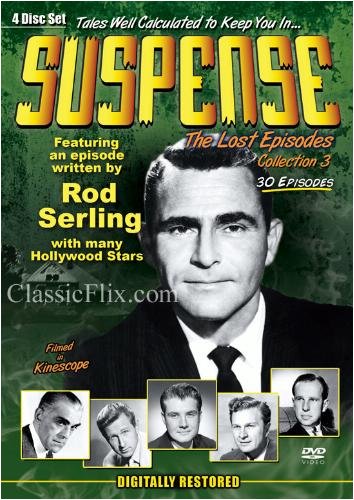
Suspense began life as a very successful radio show on the CBS Radio Network. It premiered in 1942 and lasted just over 20 years on the nation’s airwaves. When television began to make its own waves on the air in the late 1940’s, naturally many of those first shows would be programs that had already shown strong appeal to the radio audiences. Shows like Gunsmoke had been staples on the radio for years and would be a nice way to entice the first television crowds to the new medium. Suspense was one of those shows. It first broadcast in 1949 and was broadcast live from a studio playhouse in New York City. The anthology series presented stories that featured some kind of a horror or thriller theme. Public domain stories were great fodder for the series, and it certainly brought together some of the big names of that genre to the broadcasts. Names like Boris Karloff, Bela Lugosi, Peter Lorre, Nina Foch, and John Carradine would give the show instant credibility. But, the episodes were not limited to the horror field. Crime dramas that involved murders under mysterious circumstances were another favorite staple of the series. Because it was aired live there were no taped copies to be used as reruns, so that each episode was intended as a single broadcast event. For reference purposes a kinescope recording was made, but not very well preserved. These were the days when the networks were just starting, and they didn’t reach a majority of the nation yet. These simple recordings were intended so that the episodes could air in the towns and cities where the networks had not yet penetrated, a whopping 67% of the nation in 1949. It would go on to become one of television’s first hit shows and lasted 15 years. Surprisingly, the radio version would continue for almost another decade after the television series left the airwaves.
These kinescope recordings were uncovered in 2007. Since then they have been released in various sets and collections. 90 episodes in all have been found and somewhat restored. This collection 3 offers the last 30 of those 90 episodes. They feature the likes of Boris Karloff, Eddie Albert, Walter Matthau, Pat Hingle, Lloyd Bridges, Arlene Francis, Jack Warden, Jackie Cooper, James Whitmore, Vic Morrow, George Reeves, and Richard Coogan. The episodes span the entire run from 1949 – 1954, although one episode lists an airdate of 1958. I could find no record of that episode airing at all.
Posted in: Disc Reviews by Gino Sassani on March 25th, 2009
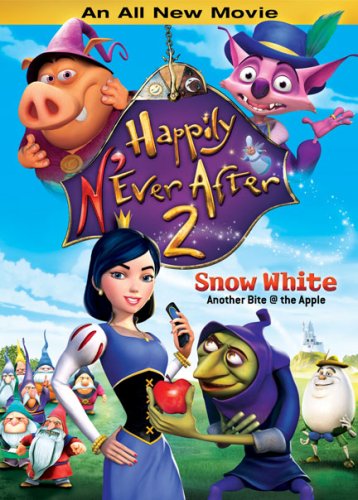
This is one of those direct to video sequels I never saw coming. It’s not like anyone was exactly breaking down the box office doors to see the first Happily N’Ever After film when it debuted in January of 2007. Universally panned by the critics and audiences alike, it disappeared rather quickly from the scene and was, or so we thought, destined to become a distant memory, a legend used from time to time to scare little children into behaving for their parents. “Clean up your room now, or I’ll force you to watch Happily N’Ever After again”. Most of us where never really sure it existed at all. A quick expedition to the local theater revealed the name on a marquee, but did we ever see anyone actually enter the theater to watch the film? There was one scientist in Austria who claimed to have seen a couple enter the theater, but the snapshot he took was fuzzy and it was just not possible to confirm the siting. HBO did one of their expose stories on the existence of an audience for the film, but again no hard evidence was ever presented. It is said that stars like Freddie Prinze, Jr., Sarah Michelle Gellar, Sigourney Weaver, and even George Carlin provided voices for the film, but in interviews none of the alleged voice cast was willing to confirm they even worked on the film. Rumor has it that Carlin was presented with absolute proof of his participation just before he died. Of course, such rumors are rampant in Hollywood and should be discounted as unsubstantiated gossip.
Whether or not there ever was an actual audience for the first film, someone at Lionsgate decided that the film demanded a follow up. This former Lionsgate employee could not be reached for comment at Joe’s Car Wash, where he currently claims to be “cleaning up in the auto industry”. For some inexplicable reason the original voice cast decided not to be involved in the sequel. In fact the IMDB does not even list a voice cast at all on the film’s entry. It’s pretty bad when even industry nobodies want to distance themselves so badly from a project. If I had anything to do with this film, I’d sue to have my name removed from the credits.
Posted in: Disc Reviews by William O'Donnell on March 25th, 2009
This set contains all of the episodes from the first season (or “series” as it is termed in the UK). The show follows a standard teen drama format of a group of high school friends, this time from Bristol. Each token stereotype is covered in the main characters (the quirky girl, the party animal, the dweeb, the cool guy & girl, the ethnic guy & girl, the gay guy) and each receives their own episode to focus on them, with a few ongoing romantic plots stringing all of their stories together. Each of said episodes ends with the focus character coming to some sort of new advancement or revelation in their lives (Example: the character with an eating disorder bites into a burger).
The packaging has reviewers drawing comparisons between this show and Gossip Girl, as if Skins is the raunchier, overseas equivalent of it. The characters of Skins are at least not the privileged horde that infest North American teen dramas such as The OC or Gossip Girl, thereby making them a touch more relatable. At the same time, the situations and stories do get rather disconnected from reality. The beginning episodes wish to be more about real-life troubles, there's even one about homework (sort-of), but by the time the teens are in an episode where they are being deported from Russia and held at gunpoint, the series loses touch with teen issues and starts to play out like a juvenile Melrose Place.
Posted in: Disc Reviews by Archive Authors on March 23rd, 2009
In the vein of The Cincinnati Kid (1965) and a sprinkle of The Sting (1972) John Dahl brings us Rounders. Card prodigy Mike McDermott (Matt Damon) quits the game after losing everything. Once Mike’s best friend Les “Worm” Murphy (Edward Norton), gets out of jail, Worm attempts to get Mike back into the poker world. As Worm’s behavior begins to implicate Mike, Mike decides to come out of poker retirement.
The film itself is good. The on-screen chemistry between Damon and Norton is not forced. The other performances in the film do not distract from the narrative, with Martin Landau’s standing out. The film is shot very plainly without too many fancy editing techniques or wild Dutch angles. Dahl simply conveys a character piece that does what it is set out to do with little failure. David Levien and Brian Koppelman’s script has been appropriately dubbed “cool” by the poker community. Upon initial viewing most poker references will soar above the viewer’s head. However, upon multiple viewings, you tend to pick up on the language. This collector’s edition offers a plethora of bonus features which is miles away from the previous release.
Posted in: Disc Reviews by David Annandale on March 21st, 2009
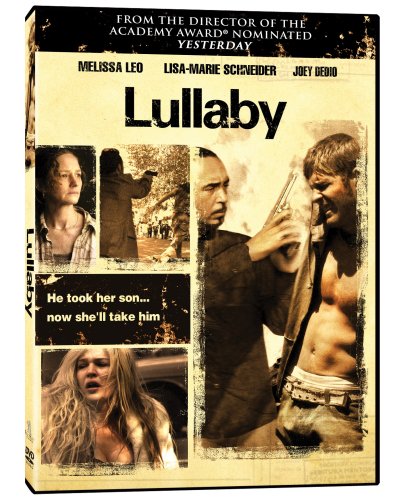
Melissa Leo is a hard-working café waitress in Tennessee who regularly sends what little extra cash she has to her adult son who, for reasons never explained, is a drug-addict in Johannesburg. A drug lord (Joey Dedio) kidnaps said son, and demands a ransom that, for Leo, is next to impossible. Nonetheless, a mother's love knows no obstacles, so she scrapes together the money to fly to South Africa. Once there, she connects with Tina (Lisa-Marie Schneider), her son's prostitute girlfriend, and is made to run the gauntlet by Dedio, who shows very little inclination to let his hostage go, no matter what demand is met.

This is an odd fish of a film, being a rather incongruous mix of gender-flipped Taken and gritty realism. Leo is called upon to do the impossible: be the grief-stricken mother and then terrified mother for the first part of the film, but transform by the end to an avenger whose strategy and vocabulary are worthy of Hannibal Lecter. All of her weepy moments are expertly performed, but so frequent they become tiresome. In other words, we have a first-rate actor being sandbagged by a silly script. And silly the whole thing very much is. Despite all kinds of gestures towards the Harsh Realities of Life, it is, in the end, no more a product of the real world than Transformers. What it is, though, is slick, quick and entertaining.
Posted in: Disc Reviews by Gino Sassani on March 17th, 2009
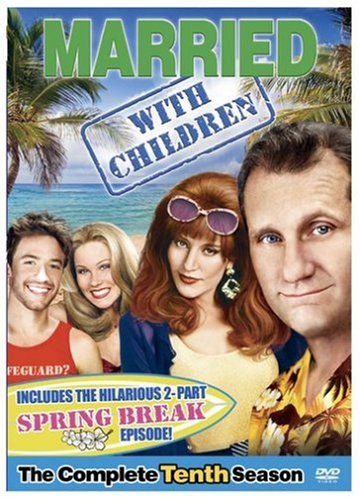
On October 9th 1986 the network television landscape did something that hadn’t been done successfully in its 40 year history. A fourth network broke on the airwaves. It was called FOX and wasn’t even going to broadcast 7 days a week. Most pundits in the television industry never gave it a chance. Most of the channels were in the double digit UHF range. This had long been considered the independent station area, and a lot of televisions didn’t pick up this band as well as the established VHF band. And for a while it looked like the network was going to disappear almost as quickly as it appeared. But by 1987 the network suddenly had two big hits on its hands. The first was a silly cartoon, originally aired as a throwaway segment on a variety show. The cartoon featured the most unlikely of television families, The Simpsons. That show is still with us nearly 25 years later. The second hit was a live action series, also based on a very unlikely and this time seemingly unlovable family, the Bundys. Right from the start there was criticism that the name itself was a death knell. At the time America was still dealing with the pending execution of a far more infamous Bundy. Married With Children, however, would become an almost instant break-out hit.
Al Bundy (O’Neill) was a working stiff. He had seen his high school glory years evaporate into the rearview mirror of his ancient Dodge when he married his childhood sweatheart (no, I did not misspell), Peggy (Segal). The red-headed woman would soon become his curse. She was lazy. Peggy wouldn’t know what a stove looked like if it fell on her. She was content to sit around all day while Al worked for minimum wage at a mall shoe store. Tying Al to his meager existence were two children. Bud (Faustino) was a frustrated teen who couldn’t seem to find his cool. Girls scorned him, and he appeared to be headed to the life of his father. Daughter Kelly (Applegate) was a teen slut. She slept around and used her looks to make her way in life, which was likely good, because she was dumber than rocks. Al was also plagued by neighbor Marcy (Bearse) who was a feminist and usually a thorn in Al’s behind. Her second husband, Jefferson (McGinley) was often Al’s accomplice in trouble. Most of the material involved Al’s suffering and the apathy of his family to his lowly station in life.
Posted in: Disc Reviews by Gino Sassani on March 17th, 2009
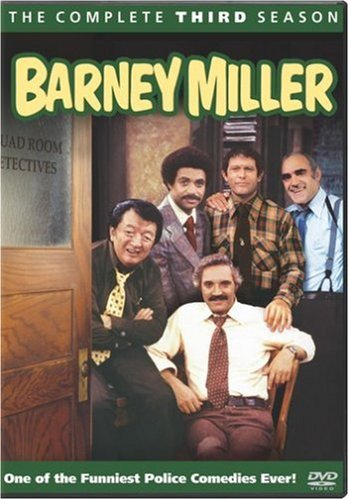
In 1976 a New York media group conducted a survey of the NYPD detectives. The question was: “Of all the TV cop shows, which most accurately portrays life as a detective?” The overwhelming response was the comedy Barney Miller. Seems real cops related to the daily grind and weekly wackos of Barney Miller. Let’s not put aside that this was also one of the most consistently funny shows on television. I remember it took me a while to accept Abe Vigoda in such a light role as Fish. My first exposure to Vigoda was the ruthless mobster in The Godfather. Barney Miller always managed to be funny while still telling a good short story. The characters were always wonderful.
Captain Barney Miller (Linden) was in charge of the detective squad at New York’s 12th Precinct. Among his detectives were a colorful group of odd individuals. Detective Ron Harris (Glass) was writing a book that detailed his life as a New York detective. It was called Blood On The Badge and was far more fiction than fact. He prided himself on his stylish clothes and culture. Arthur Dietrich (Landesberg) was a know-it-all. He had an almost encyclopedic base knowledge on everything and anything. He would bore his colleagues with his endless drone of facts. Stan “Wojo” Wojciehowics (Gail) was the typical New Yorker everyman. He might not have been the brightest tool in the box, but he more than made up for it in heart. At times his desire to show initiative would end up getting the squad in trouble. Fish (Vigoda) was past his prime and spent more time in the men’s room than actually fighting crime. He was always suffering from one old age ailment after another. His bulky frame made him look intimidating, however. Nick Yamana (Soo) was a lovable Japanese guy who wasn’t always the first to understand. He had a literal way of interpreting speech which led to some very classic misinterpretations. He was also a gambling junkie, often on the phone with his bookie. From time to time the squad would be visited by the clueless Inspector Luger (Gregory). He often reminisced about his glory days and often expressed regret that he didn’t go down in a blaze of glory like his old friends had. He was usually intruding upon the squad’s time with long pointless stories. Finally, patrolman Levitt (Carey) was an ambitious uniformed officer who wanted to be a part of the squad, which he eventually did.
Posted in: Disc Reviews by Gino Sassani on March 16th, 2009
There’s a lot to want to love about this film. You have the return of the super powered Malone children, and more importantly, the same actors to portray them. Director John Hough returned to direct the sequel. The film also includes Christopher Lee and Bette Davis as the villains. Like I said, a lot to want to like. Something went terribly wrong along the way. Neither Christopher Lee nor Bette Davis take their roles seriously at all. I don’t think I’ve seen either accomplished thespian show so little effort in a performance. It’s very obvious they considered them to be throwaway roles. Davis remarks she did it only because she wanted to be in a film her grandchildren would like. She’s particularly bad in a role that has her so caked in makeup that she could be a Jack Pierce creation from the Universal horror days. What’s worse, the children spend about 80% of the film apart.
It’s three years later, and the children are returning from their home on Witch Mountain for a holiday, of sorts. They’re placed in a cab and sent off on a destination that they never do reach. Instead they play a prank on the cab driver and disable the engine. Believing he has run out of gas, he sets off to get some. In the meantime Tia has another vision of yet another unfortunate accident. For the second time, the children try to save the day only to be exposed to those who would profit from them. Victor (Lee) is a mad scientist who was experimenting with mind control at the time. When he sees Tony hold his subject in mid air to prevent his death from falling off the roof, he decides he wants to control that power. Along with his rich patron, Letha (Davis) they drug Tony and take him away before Tia knows what happened. Now Tia has to find and rescue her brother. Fortunately, Tony has advanced since the first film. He no longer needs the harmonica and he can now communicate with Tia, but the drugs are interfering. Tia encounters the Earthquake gang, a group of young boys who wanna be tough and bad, but aren’t. With their help she has to rescue Tony, who has fallen under Victor and Letha’s control. They use his powers to their own ends, eventually to hold the world hostage at a plutonium plant.