Posted in: Brain Blasters by David Annandale on September 4th, 2007
It seems to me that it was around this time last year that I was lambasting the desperately misconceived remake of The Wicker Man. Here we are again, then, with another entry in the disastrous remake sweepstakes. Halloween may be a little more mainstream than is, strictly speaking, the concern of this space, but when has that ever bothered me before? While Rob Zombie’s atrocity is in the theatres, I feel it is my solemn duty to warn you off.
Not that a moment’s thought wouldn’t convince most sane individuals that remaking Halloween is a terrible idea in the first place. Sure, and we’ve been down this road before, there have been very good remakes, and what has distinguished these efforts is that they bring enough new to the table that they stand on their own merits as original works in themselves. Just bringing something new isn’t enough, of course. Plenty new was brought to The Wicker Man, and it was all rubbish, demonstrating a total lack of understanding as to what made the original work.
Posted in: Brain Blasters by David Annandale on August 24th, 2007
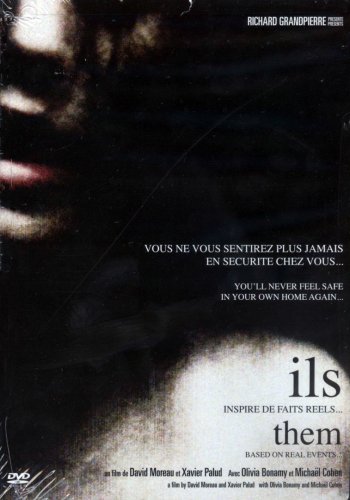
Ils (“Them”) is another recent bit of cinematic nastiness from France, and worth a look from horror fans. Lucas and Clémentine are, respectively, a writer and a teacher who have recently moved to Romania. Their house is big and isolated, and one night, intruders close in, leading to a grueling night of terror. If that sounds like a pretty simple plot, it is, but the film is very tight (a mere 73 minutes long), essentially functioning as one long suspense set piece once the home invasion begins. The DVD boasts solid picture and sound, but has no subtitles, forcing non-French speakers to contend with the English dub. Fortunately, much of the film is devoid of dialogue, so this isn’t a deal breaker.

All right, I’ve been a little coy as to what this column is going to be about, and that’s deliberate. I’m going into some spoilers here, so if you haven’t seen the film, stop reading now, and come back some other time.
Posted in: Brain Blasters by David Annandale on August 17th, 2007
Nacho Cerdá made his name on the underground horror circuit with Aftermath, a short feature that made everyone’s worst surmises about autopsy tables look hopeless optimistic. The question that looms around his feature debut, The Abandoned, just out on DVD, is how on earth he might top Aftermath’s taboo-busting calling card. Wisely, he attempts no such thing. Though there is one notable moment of “yeeeurrrrgggh” in the film, it otherwise marks a very different approach to horror, as well as making clear that Cerdá is the kind of talent that horror desperately needs at this juncture. It’s a criminal shame that the film received to theatrical distribution to speak of, but here’s hoping it will find the audience it deserves on DVD.
The ominous prologue is set in Russia (played by Bulgaria) in 1966. A mortally wounded woman drives a truck to a farm, where the inhabitants discover a pair of newborn twins in the seat beside her. In the present, one of those twins, Marie (Anastasia Hille), determined to learn more about her birth parents, has arrived in Russia from Los Angeles. She is given directions to her ancestral farm. Once she gets there, a malevolent supernatural trap slams shut. She meets her twin, Nicolai (Karel Roden), who is just as caught in the web as she is, a web spun by patient and merciless past.
Posted in: Brain Blasters, Regular Columns by David Annandale on August 10th, 2007
All right, some musings on basics now. I have spilled a fair bit of verbiage over the course of this column about films that are so bad they’re good. But there are questions going unanswered, and, dare I say it, unasked: how exactly does this come to pass. How does a bad movie achieve a certain form of perverse greatness? Why do we enjoy watching these things? I could go on.
A look at the patterns that emerge from consistent viewing of Mystery Science Theater 3000 is helpful here. Wonderful as that series was (and equally wonderful its continued preservation on DVD), not every episode hit comedy gold. The shows where Joel, Mike and the ‘bots had more trouble with the material they were working with confirms, for me, a long-held theorem: that any type of film, if bad enough, turns into a comedy, with one exception: comedy. The sad fact of the matter is that no comedy, no matter how bad it is, becomes another form of comedy. It might almost approach the status of a horror film, but it remains a resolutely dismal experience, as I’m sure anyone foolish enough to line up this week for Daddy Day Camp has learned.
Posted in: Brain Blasters, Regular Columns by David Annandale on August 3rd, 2007
Part and parcel of loving cult movies is a profound sense of nostalgia. This melancholy ache for the past is not necessarily limited to periods one has actually lived through. The shape of the nostalgia also takes on different forms, and can often wind up feeding on itself. This is a phenomenon that the bargain-basement DVD can help perpetuate. Allow me to attempt to explain myself a little more clearly.
Our starting point is the grindhouse cinema of the 1970s. As I’ve mentioned before, I was too young to actually go to any of those dubious houses, or ever see any of their offerings theatrically. But I am just old enough to remember the ads for these films in the paper. As my friends and I started going to movies on our own in the early 80s, the grand days of exploitation were drawing to a close (and we were still too young to be allowed in to many of the titles out there). So that is Stage 1 of the particular form of nostalgia I’m tracking today: the longing for a past that was witnessed from a distance.
Posted in: Brain Blasters, Regular Columns by David Annandale on July 27th, 2007
A little theory, which is mine, regarding film. This theory, at its simplest, holds that the following is a self-evident truth: that the film has not been made that cannot be improved by the addition of dinosaurs. The corollary is that there are strict limits to how bad any film with dinosaurs can be. by extension, the replacement of dinosaurs with a monster of some sort of description is acceptable. I can tell by the skeptical rise of your eyebrow that you don’t believe me.
I invite you to put the theory to the test. Let’s use Steven Spielberg as a case study. A great many people have found flaws of one sort or another with Jurassic Park. Fair enough. But if you are one of those not overly fond of the film, consider how much more you would dislike it if there were no dinosaurs at all in it. See? It would completely suck. On the other hand, let’s think about Schindler’s List. Sure, great movie and all, moving, powerful, yadda yadda yadda, but what if the climax had seen a T-Rex show up to stomp that nasty death camp flat. Now that movie would have rocked.
Posted in: Brain Blasters, News and Opinions by David Annandale on July 20th, 2007
It’s been a fairly commonplace activity over the last few years to compare our current troubled era with that of the late-sixties/early-seventies, with special attention paid to discussion of parallels (and to what degree they are or are not justified) between the Iraq and Vietnam wars. In that context, it is interesting to consider the way popular culture has dealt with those conflicts, with particular reference to genre offerings.
This is by way of making a bit of a case study of Deathdream (AKA , The Night Andy Came Home,Dead of Night and The Veteran), a 1972 horror film directed by the late, lamented Bob Clark. The film was a bit of a first in a couple of respects. From a genre perspective, it marks the beginning of Tom Savini’s make-up career. But it was also, it seems, the first film to directly deal with the domestic cost of the Vietnam war. It tells the story of a young solider killed overseas, but who nevertheless comes home, thanks to his mother’s intense desire for him to do so. She refuses to recognize anything is wrong with her son, and at first, things seem relatively okay. But decay gradually sets in, as do murderous impulses. You see, he must drink blood in order to avoid disintegration. His father realizes what’s up, but is too weak to do anything about it, and his mother is in total denial. Much has been written about the film’s critique of the patriarchal nuclear family, but of more interest here is the movie’s depiction of the costs of untenable beliefs, and of the damage war does to the home front. 1972 was pretty early for such subject matter. The mainstream of Hollywood wouldn’t really deal with these issues until some years after the war, and so here is another prime example (among so many) of a low-budget horror picture blazing the controversial trail.
Posted in: Brain Blasters, News and Opinions by David Annandale on July 13th, 2007
A few years ago, Blue Underground released a spiffy edition of The Final Countdown. At first glance, the move seems counterintuitive. The premiere specialist in grindhouse flicks putting out a special edition of an big-budget effort with major stars? What's going on here? In fact, the release makes sense in more ways than one. In the first place, the associate producer is none other than Mr. Troma himself, Lloyd Kaufman, here involved in a film whose budget probably exceeded that of the entire Troma catalogue....Secondly, there's the wacky nature of the movie itself.
The nuclear aircraft carrier USS Nimitz is on a routine (what else?) exercise mission out of Pearl Harbor. The commanding officer is Kirk Douglas, so we can feel sure that the decision making is in capable hands. Also on board, for no very clear reason, is civilian efficiency expert Martin Sheen, who has been sent on this trip by the reclusive industrialist who in large part designed the ship. The mission has barely been underway when a mysterious storm comes out of nowhere and a vortex (whose effect is somewhere in between Disney's The Black Hole and TV's TimeTunnel) sucks the Nimitz back in time to December 6, 1941.
Posted in: Brain Blasters, News and Opinions by David Annandale on July 6th, 2007
I recently reviewed Warner’s first volume of the Cult Camp Classics box sets, and had a number of kind words to say about Attack of the 50-Foot Woman. I thought I would expand on those remarks, going on at a bit more length as to why this film is so oddly endearing.
First, to re-iterate the review: “I quote Jeff Rovin: ‘If Attack of the 50-Foot Woman was intended to be taken seriously, it’s the worst film ever made. If it was intended as a put-on, it’s one of the great science-fiction satires.... Either way, the movie is hilarious. If Tennessee Williams had written a script for Ed Wood, the result might well have been this tale of rich alcoholic Allison Hayes and her obsessive love for her no-account husband William Hudson, who, along with floozy Yvette Vickers, is plotting to get her out of the way, in one manner or another. An alien giant who needs diamonds to fuel his UFO (called a ‘satellite’ in the film) expands both diamonds and Hayes. Cue giant rubber hands and transparent double-exposure effects. Cheap as the film is, the cast sink their collective teeth deep into the overheated storyline. The result is both hilarious and gripping.”
Posted in: Brain Blasters, News and Opinions by David Annandale on June 29th, 2007
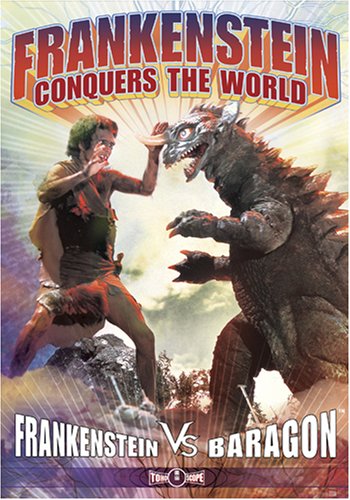
Okay, kaiju fans, there’s another real treat that recently hit DVD. While Classic Media has been releasing one definitive edition after another of the initial Godzilla movies, Tokyo Shock has stepped up with a non-Godzilla Toho effort: 1965's Frankenstein Conquers the World. Present in the 2-disc set are the US release (so if you want to hear Nick Adams speak English, that’s the one to watch), the Japanese version, and the international release. These versions feature a rather different, and utterly bizarre, e...ding, and I’ll be talking about it, so be warned that there are spoilers ahead.
Godzilla’s daddy Ishiro Honda is at the directorial helm again, and it is interesting that, just as the Godzilla films were becoming more and more comical, this effort is, relatively speaking, quite dark. Its opening doesn’t look like a Toho effort at all: as beakers bubble in a gothic lab, we might as well be watching a product of Hammer Studios. The year is 1945. German soldiers burst in on a scientist, grab a box and ship it by sub to Japan. The box contains the beating heart of Frankenstein’s monster (and yes, the name “Frankenstein” is used indiscriminately to refer to both monster and scientist here, *sigh*). The Japanese plan to use the heart to design unkillable soldiers is rudely interrupted, however, as the lab is located in Hiroshima. Wrong place, wrong time. Years later, in a rebuilt Hiroshima, scientist Nick Adams and his team run into a feral child, who turns out to be the regenerating monster. Being radioactive, he also gets really big and escapes. Meanwhile, the monster Baragon (a dinosaur with big, floppy, puppy dog ears) is rampaging about, and Frankenstein (I’ll give in and call him that, since the movie does) initially gets the blame. He eventually confronts Baragon in a dramatic mountaintop finale backdropped by a raging forest fire.