Brain Blasters

Many a month back, I talked about some essential reading material for fans of the cult/exploitation scene. Time (past time, actually) for an update on that subject, because there’s a recent book out there that, while taking nothing away from the excellent Sleazoid Express and Bold! Daring! Shocking! True!, at the same time sets the bar impossibly high for anyone else wanting to contribute to the field.

Stephen Thrower, having already graced us with Beyond Terror: The Films of Lucio Fulci (an exhaustive, and to this day unchallenged, study of the director), now weighs in with the monumental Nightmare USA: The Untold Story of the Exploitation Independents. The book is enormous in every sense. There’s the sheer scale: a coffee table format tome that, at 528 pages, threatens to shatter any coffee table it is place on. And this is only the first of a proposed two volumes! Enormous too is the depth: 23 in-depth studies/interviews with specific filmmakers make up the bulk of the book, but these are followed by 118 reviews that are not mere capsules – many of these pieces are essays unto themselves.

It must stop! Somebody has to take a stand, and I guess that somebody has to be me. But surely I will not be alone. Surely I will have comrades aplenty in my march to justice. Surely the day of victory cannot be too far over the horizon. With courage and determination, we can stamp out the scourge. What scourge? Surely I don’t have to spell it out. Surely you know I am referring to the twist ending.

And one particular brand of twist ending, at that.

I know that some of what I’m going to touch on today is going to overlap with past topics, and so I beg your indulgence. But recent DVD releases have prompted some thoughts on the phenomenon of double-dipping. This is not something that is by any means exclusive to the cult movie scene, but plenty of it goes on here. Consider the umpteen “definitive” editions of Halloween that Anchor Bay has trotted out. But I want to look at a three cases, two of which are admittedly mainstream (though not unrelated to this column’s field), with the third representing an overt stab at cult immortality.

We can deal with the first quite quickly, as it represents one of the most egregious, insulting approaches to double-dipping I have yet to hear of. The current release of David Fincher’s Zodiac has the unmitigated gall to advertise a feature-packed director’s cut to be released in 2008. How’s that for a kick in the face to anyone who bought this? Bring the DVD home, pop it in the player, and be confronted with a product that promotes its own inferiority. That’s some kinda nerve. And the mere fact that it is so brazen points to how unfortunately commonplace the phenomenon has become.

When, in the 1950s, television became widespread and began to take a serious chunk of the audience away from cinemas, the movies fought back in a number of ways. Gimmicks were rife (hello, William Castle). Colour became standard. Widescreen arrived. But other than colour and widescreen, every other innovation turned out to be a brief novelty, never to be seen again. There was once exception, a gimmick that was more popular than most, never became a standard, but refuses to die, resurfacing again and again after periods of dormancy, and that’s 3-D.

Over fifty years after Arch Obler (ironically, the king of radio suspense) unleashed Bwana Devil, there are signs that 3-D might finally be achieving a somewhat more stable position in theatres. It’s a long way from being a mainstream standard, but it has found a niche. Saunter down to your local IMAX and check out the offerings. Most of them will be in 3-D, and that includes blockbuster films (though in their case, the extra dimension turns up only in selected scenes). In IMAX, 3-D has finally lived up to its potential. Gone are the awkward red-and-blue-lensed cardboard glasses. In their place are gigantic plastic units not unlike goggles, that fit very comfortably over the viewer’s own glasses. Gone, too, is the headache-inducing effect of old-school 3-D. The current release Sea Monsters: A Prehistoric Adventure deploys 3-D as we always imagined it might be. The effect absolutely convincing, and absolutely immersive.

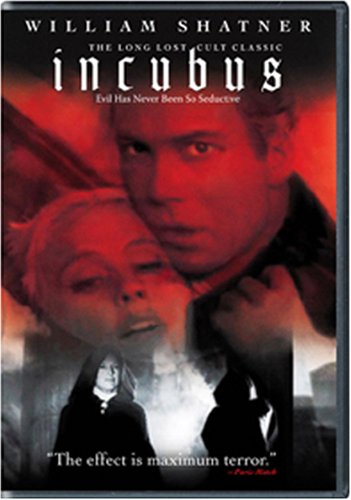
One of the great oddities of film from the 1960s (or, indeed, ever) is a modest little horror film by the name of Incubus. Emerging in 1965, it was shot in Big Sur, and tells the mythic tale of a young soldier returning home to become the target of a female demon. His innate goodness, however, winds up seducing the demon instead, and the titular male demon vows revenge, specifically targeting the soldier’s blind sister. This is already a somewhat odd tale for a mid-sixties American horror film, and the fairy-tale setting is even more unusual. But the real oddities are yet to come. The lead is played by a William Shatner (in his last film before Star Trek). And all of the dialogue is in the artificial language Esperanto.

Why Esperanto? Why indeed. Phil Hardy cites director Leslie Stevens (the creator of The Outer Limits) as describing the language as “at once imaginary and universal, out of time and space.” There is no doubt that film’s effect is precisely that. The world the viewer moves through is completely alien, even if the settings themselves (forests, seasides) are very familiar. When I called the film a fairy tale, I did so advisedly. This is one of the most fairy tale-like horror films ever made (and horror partakes of that form of storytelling more than just about any other genre). This is thus a tale of no place and every place, of no time and every time. It takes very little time for the viewer to get past the strange spectacle of Shatner spouting Esperanto (doing so very naturally, I might add) and be swallowed up by this strange world.

Bert I. Gordon. Now there’s a man who knew no shame. Here was a director who combined the hucksterism of a low-rent William Castle (who wasn’t exactly living on the Boardwalk of Monopoly board of producer-directors, if you catch my drift), the willingness to pile on the spectacle of an even lower-rent Cecil B. De Mille, and the technical competence of a slightly (but only slightly) higher-rent Ed Wood. Here was a director who not only did his own special effects, but for some unfathomable reason thought they were good enough to show for extended periods of time. Perhaps he thought his back-projection techniques in The Amazing Colossal Man, Attack of the Puppet People and Beginning of the End (grasshoppers!) were actually impressive. They weren’t. But they had a certain goofy charm.

And goofy charm is what today’s offering is all about. Gordon’s last film, 1976's The Food of the Gods, has finally found a DVD release as part of MGM’s Midnite Movie series, and it’s about damn time. Here’s a movie that has both the honesty and nerve to claim to being based only on a portion of H. G. Wells’ source novel. I remember, in those heady, summer days of 1976, when Famous Monsters of Filmland trumpeted the film’s upcoming release, complete with plenty of FX shots that I thought were pretty cool. Of course, I was only nine. The film hit Winnipeg at the Pembina Drive-In, long since demolished to make way for highways. I didn’t see the film then, but when I at last tracked the film down decades later on VHS, it was exactly the kind of engaging nonsense I was hoping for, and it’s even better now in widescreen.

Returning to Sinister Cinema’s roster of Drive-In Double Features this year is an offering that distinguishes itself by the rarity of the two films in the pairing, and so it is my bounden duty to bring this to your attention. The two films in question are Caltiki, the Immortal Monster (1959) and The Magnetic Monster (1953).

Caltiki is another blob monster movie in the vein of The Blob and X the Unknown. It isn’t in the same league as either of those films, but is not without both interest and charm. It’s an early genre effort from Italy, coming just before the onslaught of gothics that would begin in 1960, and behind the camera are the two men most responsible for those classic horrors: Riccardo Freda as director, and Mario Bava as cinematographer (who also completed the film after Freda left). The story is bizarre. Our blob in question is discovered in an ancient temple in Mexico, and turns out to be the source of a deity’s legend. The heroic scientists describe it as a unicellular creature, an appellation that certainly doesn’t help the audience’s efforts at sustaining disbelief. But never mind. Though the creature is apparently killed by fire in the tomb, a portion of it retained for study survives and breaks free. The climax takes place in the hero’s residence, with the creature, now in several pieces, oozing all over the grounds and down hallways, closing in on the heretofore neglected wife and child. It’s all rather absurd, but well paced and nicely photographed. As well, in the hero’s troubled marriage, we see an element unusual for monster films of this type and era and, despite the Mexican setting, there’s a faint whiff of Italian social malaise from the Dolce Vita days floating about.

My very first horror film book, acquired in Grade 3, was Denis Gifford’s A Pictorial History of Horror Movies. Among its many stills were a number for films identified by title, but with no other information provided. The result was rather tantalizing. One of those stills was for a 1969 Japanese ditty called Horror of Malformed Men. At long last, thanks to a new release from Synapse (with the title pluralized to Horrors of Malformed Men), my curiosity has been more than satisfied.

All right, seekers of the bizarre, try this plot on for size. The film opens with a man trapped in a cell with dozens of half-naked women. They’re all writhing about as if they’re performing some kind of avant-garde dance number, except for the one who is going after the guy with a knife. Eventually a guard intervenes and he hauls out the man (Teruo Yoshida), blaming him for the ruckus. Turns out the setting is an asylum, and Yoshida is an inmate, with no recollection of how or why he is there. After surviving an equally mysterious assassination attempt, Yoshida escapes. By chance (it seems), he runs into a circus performer who sings the same song that haunts Yoshida’s fragmented memories. She might have information about who he is and where he comes from, but she is killed before she can tell all. Yoshida is blamed for the murder, and he becomes a fugitive. On the run, he reads about the death of the scion of a respected family, a man who could be his twin. Yoshida takes the place of the corpse (!) and fakes a resurrection. He enters the man’s household, hoping to find out who he is, why the dead man is his exact double, and how that man really died.

The current issue of Rue Morgue has a retrospective look at Dan O’Bannon’s Return of the Living Dead, just ahead of yet another DVD release (September 11). Over the course of the interview with O’Bannon, interviewer Dave Alexander asks the director how much he had to do with the new release. This is his response:

“None. It was a surprise, a shock, to me when I was informed they were putting out what they call a ‘director’s edition.’ It runs something like twenety minutes more than the version I shot. The film I shot and edited was 88 minutes. I hear they’re putting out a 117-minute version. Once this thing comes out, I’ll take a look at it [...] and if they have tampered with it in a way that in my opinion hurts the film, then I will publicly abrogate it.”

A little while ago, I looked at a recent (and very strong) example of the Evil Kids movie. I mentioned some of the big names in the field (The Omen, the original Village of the Damned, The Bad Seed), but today, for your consideration, a half-forgotten effort from 1974 (smack in the midst of the golden era of grindhouse and drive-in sleaze): Devil Times Five.


Also known as People Toys and The Horrible House on the Hill, this cheap but satisfyingly unpleasant little movie sees a bus overturn, unleashing five homicidally demented children. They make their way through the snow to an isolated resort, whose only residents are the tycoon Papa Doc (Gene Evans, sporting a character name that is oh-so-tasteful), and his assorted squabbling relatives and associates. The children are taken in, and waste no time in bumping off the adults one by one by means mundane (hatchet to the head), creative (bizarre death swing contraption), and just plain wrong (one woman is drowned in the bathtub while pirana are dumped in with her).