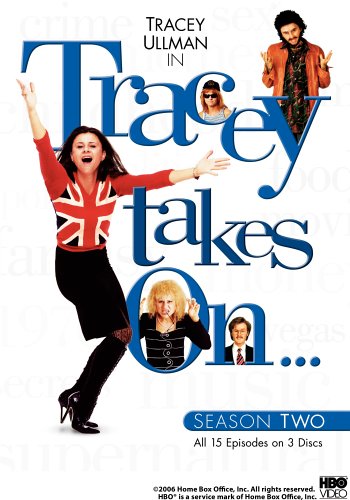
I really enjoy stand-up DVDs, but they're pretty formulaic. The show starts, there is usually a short un-funny skit, and then the stand-up portion starts. The comic does his show, the credits roll, and that's it.

This is really something unique and innovative, however. This film is something of a musical comedy, skit, music video stand-up film. It's a lot to squeeze into a 72-minute film, but is is done surprisingly well. The transitions work out well, and it really shakes up the standard notions of what a co...edy DVD should be.

Valley of the Dolls is a musical that way way ahead of its time. Based on the novel by Jacqueline Susann, the film tells the story of three aspiring actresses and their attempts at becoming stars. Sure, this is an age old tale, but it had not been told as bluntly an honestly until now. The film starts Barbara Parkins, Patty Duke and Sharon Tate as the actresses in question. Audiences must have been shocked upon going to the theater, as they were much more used to rags to riches musicals such as A Star is Bo...n instead of the brutally honest vision that Dolls presented.

The actresses in this film are mean-spirited, nasty, drug-addicted women who will stop at nothing to get where they want to be, and they don't care what they have to do or who they have to step on to get there. As horrible as these women are, this Hollywood musical strips away all the glitz and glamor to bring the true story of what it takes to make it in show business. It is a groundbreaking film that was nominated for an Academy Award for its wonderful musical numbers. Both the beauty and the ugliness of the business are shown here, and the film completely took me by surprise.

Let us consider the term “erotic horror.” This sub-genre doesn’t have a very strong tradition in North America, despite the best efforts of Seduction Cinema and Misty Mondae. I exempt the films of David Cronenberg from this consideration, as they are hardly designed with titillation in mind – they are much colder, analytical works, and the label once applied to them – “venereal horror” – is still more appropriate. No, there just hasn’t been that much on this side of the pond, relatively speaking. Perhaps in its stead... there has been the phenomenon of the “erotic thriller.” And with very few exceptions, the less said about that category of late-night cable-fodder, the better.

Overseas, the story is considerably different. Europe and Asia have been simultaneously targeting fear and desire for decades. Readers looking for a good survey of the European scene owe it to themselves to track down Cathal Tohill and Pete Tombs’ Immoral Tales: European Sex and Horror Movies 1956-1984. There’s an enormous wealth of titles to choose from for a case study (and I don’t preclude returning to this topic), but the one I’d like to consider today is Vampyres, a 1974 effort produced in England, with an English cast, but directed by Spaniard José Larraz.

The thing that makes the death of Bruce Lee an even larger tragedy is that he virtually set back the kung-fu/karate genre from gaining mainstream recognition by a couple of decades. Set back may not even be the proper word for it, as he would have become a larger than life action star whose dreams were bigger than most anyone had anticipated.

In the case of Enter the Dragon, the film was designed to be Lee's crossover attempt into American films, and it's one worthy of his abilities. Bruce (or in this case, Lee) lives at a temple and is invited to a private island for a martial arts tournament where a man named Han (Kien Shih, Once Upon a Time in China) runs the tournament and possibly some illegal operations. His henchman is Oharra (Chuck Norris protégé Robert Wall, Game of Death), who might have been responsible for the death of his sister. Some of the more colorful characters in the tournament are Roper (John Saxon, From Dusk Till Dawn) and Williams (Jim Kelly, Black Belt Jones), friends from America that are also looking to gain the top prize. Lee isn't there to win the tournament, but to try to expose Han's dealings.

Frank (Peter Mullan, Braveheart) has been designing and building ships in a British shipyard for 36 years. Suddenly and very cruelly, Frank is let go without any pension or prospects, and is left wondering what to do. An attempt at job searching finds him virtually at the feet of his sister-in-law, so he is basically left to walk around this nameless London suburb stunned and unsure of what to do with himself. His friends Eddie (Sean McGinley, Gangs of New York), Norman (Ron Cook, Quills) and Danny Boyd (yes, that's Pippin from the Lord of the Rings films, a.k.a. Billy Boyd) all try to help him out however they can. Frank's wife Joan (Brenda Blethyn, Secrets & Lies) is unsure about how Frank is holding up, so she decides to try out for a bus driver's license. Frank's son Rob (Jamies Sives, Mean Machine) is a stay at home Dad, but feels Frank has been resentful of that in some large way because Rob's brother (and Frank's son) died in a tragic drowning accident almost 30 years ago.

Written by first-time screenwriter Alex Rose and directed by Gaby Dellal (Football), the focus of On a Clear Day is undoubtedly Frank, the stoic patriarch who suddenly finds joy in life again with swimming. He notices a boy in the pool who is barely able to swim one length of the pool while Frank can do armloads. At the end of each length the boy rejoices. He perhaps finds these qualities in his lost son, but he is so introverted that he hardly indicates this. And it's that that becomes the inspiration for Frank's quest, which is to swim the English Channel.

Lately, I've been wondering out loud about what will happen to these over-produced teen pop stars who are thrown all this media exposure by their parents (to the point of exploitation). When are we going to start seeing some Playboy or Maxim photo shoots? When are we going to see someone on Cinemax After Dark, or even Night Calls? I mean, it's obvious at this point that Ashley Simpson can't sing, and she's starting to look more and more like her sister in an attempt to become her, without the appeal. And since there's a rumor floating around that she turned down a multimillion dollar Playboy photo shoot (after the proverbial "great deal of thought"), it seems to be the next logical step.

Enter Joanna Levesque (RV), a.k.a. "Jojo". I don't know what song she's famous for, I don't know what she's doing lately, but I know she's been thrown a lot at MTV and Nickelodeon for whatever reason. I know this because I watch copious amounts of both. She plays Hailey in Aquamarine, a bit of a tomboy and a close friend of Claire (Emma Roberts, Blow), who is the granddaughter (I think) of owners of a beach club of some sort, and they both seem to have a crush on Raymond (Jake McDorman, Echoes of Innocence), a local life guard and resident teen hunk.

Tommy Lee Jones makes his directorial debut with The Three Burials of Melquiades Estrada, a new take on the western genre. Set in modern times, this is a unique revenge picture with a more positive message than most. Jones also stars as Pete Perkins, an old cowboy, who embodies all the classic western ideals. Estrada (Julio Cesar Cedillo) is his Spanish-speaking friend and ranch hand, who falls victim to an unfortunate shooting at the barrel of trigger-happy border patrolman Mike Norton (Barry Pepper). After a...failed attempt at cover-up, spearheaded by crooked police officer Belmont - a masterful portrayal by country music star Dwight Yoakam - Estrada's body finds itself in Perkins' possession, and a journey for a proper burial begins. But Perkins isn't going back to Mexico alone. He kidnaps Norton and forces the man into the role of Estrada. Jones does a great job of walking that line between insanity and friendship, nowhere more apparent than the scene, where he proudly boasts of his triumph to slow his old friend's decomposition. (I'll never look at antifreeze the same way again.)

Shot from Guillermo Arriaga's literary script, Jones' interpretation of time and place is stunning. The film begins in a strange place and jumps around with great frequency. Pete and Estrada's relationship contains not a word of English. One minute, the title character is alive. The next, he's dead. Then, he's alive again. It would have been too easy for the film to crumble under its own structural weight, if not for Jones' seamless direction, which keeps the film's nomadic tendencies surprisingly clear. By excluding English (and subtitles) from the scenes with Pete and Estrada, the audience realizes just how special the young immigrant was to Perkins. Their relationship was something exclusive, and it seems as if it was the closest Pete ever came to loving another human being. Unfortunately, there will probably be a few snickers if I don't clarify; but for the record, it's a non-sexual love. It's friendship, plain and simple. And the fact the audience doesn't even get to invade that bond tells all the more what Estrada meant to Perkins.

Discussing the old school DVD’s that still sound and look great in the era of Blu-Ray and HD-DVD technology.

If you’re like me, then you have an old pair of jeans or shoes that need to be thrown out and replaced. But for the love of God, you just can’t bring yourself to do it.

Teddy Roosevelt once delivered a speech with a bullet lodged in his chest from an assassination attempt. It was that kind of bravado that made him one of America’s most colorful Presidents. I’m into Presidential history, having taught it for many years. I also live in Tampa, so have an increasingly avid interest in this particular American figure. Tampa was the staging and training grounds for the Rough Riders before they embarked for Cuba. It was also from a cigar warehouse in Tampa that Roosevelt’s orders were sent hidden in a cigar. History has no shortage of battle cries and slogans. “Remember the Maine,” a bold challenge issued by newspaper baron William Randolph Hearst, was one of the most memorable. An American battleship, the Maine, was sent to Cuban waters to protect Americans in the increasingly hot war zone there. An explosion later revealed to be an armament malfunction on board ship, was nevertheless blamed on Spanish aggression. With no small effort on Hearst’s part, America was soon engaged in the Spanish-American War.

What can we say about Ted Turner? This Atlanta Southerner has explored about every aspect of the Civil War in his productions that there likely is left to exploit. Fast forward a few decades, and now Turner set his sights on the Spanish-American War. It’s somewhat ironic, as Turner himself has often been compared, whether favorably or not, to Hearst himself. Credit Turner for being fair in his depiction of Hearst as an overzealous antagonizer for war. “You supply the pictures, I’ll supply the war,” he was once heard saying to a photographer. Even if George Hamilton appears grossly miscast in the role, the characterization was mostly accurate. In fact it is the acting that hurts this film the most. Tom Berenger is way too manic as Roosevelt. It is unlikely he was always so jovial even as his brothers in arms were dying around him. The portrayal is more often than not a complete caricature instead of a faithful attempt to portray a multifaceted individual. Berenger appears to have but one tone. Even by film’s end when his character can’t help but be overwhelmed by it all, silence is the only way Berenger can reveal Roosevelt’s obvious inner turmoil. Truth be told, too many of the characters are far happier than realism should dictate. Sam Elliott provides the best acting in the film as one of the regiment commanders. Unfortunately for him, his craft appears out of place. Other notable cast members include William Katt, Gary Busey, and Brian Keith as President McKinley.

Homers, Player Hating, and Swinging the ole Battle Axe, welcome to the weener dog that was left on the grill an hour too long known as Dare to Play the Game.