Posts by David Annandale

One of the lesser-known, but more visible, provisions of the Obama administration's stimulus bill is the provision that there must be at least one Sandra Bullock movie in the theatres at all times, regardless of quality. So now, as Bullock collects awards for her turn in the enormously profitable The Blind Side, here is the summer's offering making its home video debut. Our heroine this time around is a deeply eccentric crossword creator whose social skills are somewhere south of Pee-Wee Herman's. Her parents set her up on a blind date with TV news cameraman Bradley Cooper. She is immediately smitten. He is immediately terrified. He heads out on the road, working with reporter Thomas Haden Church. Faster than you can say “restraining order,” Bullock takes off after him. Cue the merry cross-country picaresque chase.

Never let it be said that Sandra Bullock is anything less than gifted when it comes to physical comedy. Her amorous lunge for Cooper, brought up short by a seat belt, is one for the books, echoing the dog-on-a-chain gag from Looney Tunes. She is also very good at inhabiting characters, and she does so very well here. Too well, in fact, as she very convincingly creates a protagonist you wouldn't be able to stand being around for five minutes, let alone the 99 of the movie. Yes, the film is aware of its creepy premise, and yes, it allows a tiny (very tiny) measure of realism to squeeze into the fantasy of its finale, but for the most part, this is a flat, unengaging and unsympathetic would-be romantic comedy.

It is the last month-and-a-bit of Delta Company's tour of duty in Iraq. The IED disposal squad has just lost its leader, and he is replaced by Staff Sergeant James (Jeremy Renner), a brilliant bomb defuser who is also something of a loose cannon, prone to taking foolish risks. What follows is Kathryn Bigelow's best movie to date, as finger-gnawing scenes of bomb disposal and combat alternate with portraits of men's psyches being taken apart by war, both because of what happens to them, and because of what they must do.

The best Iraq war film to date is also, interestingly, fairly apolitical. It takes no real stand on the whys and wherefores of the conflict, and despite the fact that the incidents are very much specific to the situation in Iraq, the theme of the film – the toll war takes on the men who fight it – would be just as true in a WWI setting. James is an intriguing character, one that it is difficult to wholly like or dislike. He is astoundingly good at what he does, yet he puts the lives of his squad mates in jeopardy. He believes in doing the right thing, and yet, in a speech he makes to his infant son (a scene that is the most heartbreaking of the film), he shows how he has been transformed into a specialized machine, unfit for any society other than that of war. This is a powerful film, then, as thoughtful as it is intense. That intensity, however, does come at a certain cost. We are made to feel the paranoia experienced by the soldiers in the visceral way imaginable, but what this does mean is a dehumanization of the Other. The Iraqis, with very few exceptions, come across as unknowable, mysterious, sinister presences, and while this is very likely true to the experience of the point-of-view characters, it does mean that this is another war film that (inevitably, perhaps?) grants us access to the humanity (in its positive AND negative facets) of only one side of the conflict.

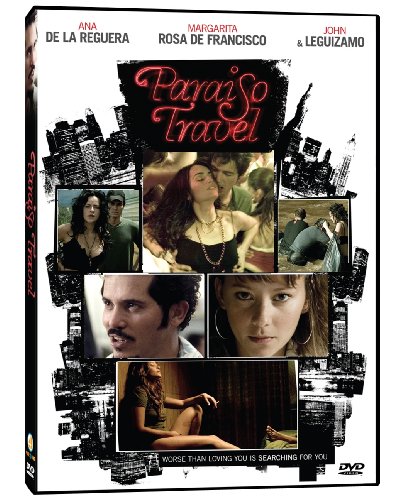
The film begins in the middle of the story, at the end of one journey and the beginning of another. Marlon (Aldemar Correa) and Reina (Angelica Blandon) are illegal Columbian immigrants, and have just arrived in New York City. They are staying in a beyond-seedy hostel in Queens, and Reina has just spent their last coins on a fruitless phone call. Frustrated, Marlon hits the street, and after a panicky encounter with the police, winds up lost in NYC. So begins his second journey one that is both a search for belonging as well as his beloved Reina, that is intercut with flasbacks to the trip that brought Marlon and Reina to the city in the first place, beginning with their leaving the relative comfort of their lives in Medillin and tracking their increasingly nightmarish trek to the States.

The film opens with a bird's eye tracking shot of the various cells (I can hardly call them “rooms”) of the hostel. It's a striking bit of filmmaking, though we have seen this done before (see, for instance, Brian De Palma's Snake Eyes). This is not a bad encapsulation of what is to come – it is both striking (especially the harrowing trip to the States) and familiar, in that it covers ground familiar from other hard-luck immigrant narratives. Marlon is a likable character, but Reina is such a manipulative sexpot that one feels that Marlon would be better off not finding her again. Generally, the male characters are better written and a little less stereotypical than the female ones. There is a lot of power here, then, but the familiar melodrama and iffy characterizations undermine that power.

Tycoon Tom Arnold sends employee and all-signs-point-to-being-future-son-in-law David O'Donnell and daughter Sarah Thompson (a ghastly person who is clearly Ms Wrong) to O'Donnell's home town in order to seal a real estate development deal. There O'Donnell comes up against former flame Nicole Eggert, who is fighting to preserve the town's pristine self. And yes, all of this is happening over the Christmas holiday, though it could just as well be the Fourth of July. At any rate, based on this setup, if there is a single one among you who can't anticipate every single turn of the story, allow me to be among the first to welcome you to the planet Earth.

Let's face it, though everybody and his monkey's uncle seems to have a Christmas movie up a sleeve, the form is actually murderously hard to do well. Think about it: how many really good Christmas movies are there out there? It's a Wonderful Life (1946). The 1951 version of A Christmas Carol. Director Bob Clark has given us two, though I can understand why most people prefer his A Christmas Story (1983) at this time of the year to Black Christmas (1974). Since A Christmas Story, I would argue that we have had precisely one new classic, and that is Elf (2003). All of which is to say that A Christmas Proposal is not a classic. It has all the life, zing and comedic timing of a dead fish. The closest it comes to having a glimmer of life is when Tom Arnold is (briefly) on the screen, and when your high point would be considered the low point in just about any other movie, you are in serious trouble.

Eight-year-old Buddy (T. J. Lowther) likes living in the Alabama countryside with cousing Sook (Julie Harris in a tiny role), but circumstances dictate that he go to New Orleans for Christmas, there to stay with the father he has never seen (Henry Winkler). Old dad is, it turns out, a con artist with an inflated sense of self-importance, currently wooing Swoozie Kurtz, whose mother (Katharine Hepburn) recognizes Winkler for what he is. This being a Christmas movie, hard lessons and redemption will be called for.

At this festive season of the year, studios rummage through their vaults for those films that no one would want to watch at any other time of the year, but will happily do so when even the merest hint of sentiment and the word “Christmas” will apparently be enough to fill us with the warm glow of nostalgia and good cheer. In the movie's defense, it has a more interesting base than most such bargain releases – a Truman Capote story – but it is still a blandly executed made-for-TV pic with some good-looking production and costume design. Lowther, meanwhile, is simply too cold a fish to warm up to as Buddy, and Winkler's performance is both mannered and flat. You're going to have to be pretty undemanding to make it through this one.

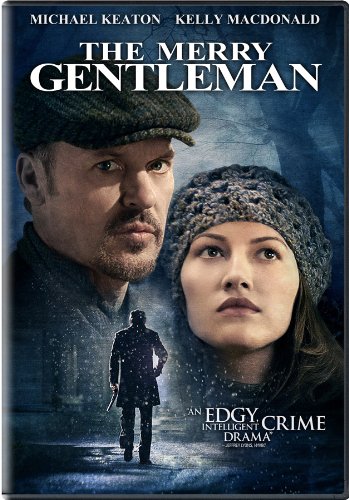
Kate Frazier (Kelly Macdonald) has fled her abusive husband and begun a new, solitary life for herself in Chicago, where she fends off the romantic interest of a number of men, and the curiosity of a great many people who all want to know how she received her black eye. One night, leaving the office, she sees a man about to jump from a building roof, and her scream startles him, breaking his suicidal trance. The man is Frank Logan (Michael Keaton), a contract killer. No longer interested in killing himself, he tracks down Kate, initially intending to kill her, since (though she doesn't realize this), she saw him moments after a hit. He collapses with pneumonia before he can carry out his plan, and she helps him to the hospital, whereupon a most unlikely relationship begins to bloom between two wounded people.


Since a bit chunk of this film takes place around Christmas, why don't we count it among the Christmas films I'm reviewing just now (the other two being A Christmas Proposal and One Christmas, since nothing says Christmas quite like a suicidal hit man. The thing is, this is far and away the best of the three movies in question. Keaton is compelling as a man who finds great difficulty in expressing emotions, and yet the strength of the those emotions are visible in every movement of his eyes, every micro-tremor of his face. In shaping the performance, he is enormously helped by the director, who is none other than Keaton himself, making his directorial debut. He and DP Chris Seager have crafted a film that is strikingly beautiful without being showy, understated yet very powerful. Here's hoping Keaton does more work behind the camera very soon.

Host Tom Cavanaugh takes us for a tour of the some of the lesser known or rarely seen corners and byways of the Smithsonian Institution. The tone is breezy and mildly irreverent, and the exhibits encountered are unfailingly interesting. The episodes this season are “Let's Eat!”, “Top Secret,” “Nature's Vault,” “Crystal Ball,” “Going, Going, Gone,” “Sex 101” and “Villains and Rogues.” The episodes are actually even less specific than the titles might suggest (and they already grant a fair bit of freedom to jump from topic to topic). Thus, “Villains and Rogues” looks at a couple of, well, rogues, and then having Cavanaugh refer to them as snakes is enough of a segue for the episode to suddenly shift its attention to – you guessed it – actual snakes.

Neat as many of the topics are, the sheer range of items covered in a single episode does tend to rob the show of focus. And I'm of two minds about Cavanaugh's hosting. Young viewers will likely enjoy the horsing around, but older ones might well find the steady stream of one-liners a bit grating. Still, if there isn't something here to make you sit up and say, “I never knew that!” then you haven't been paying attention.

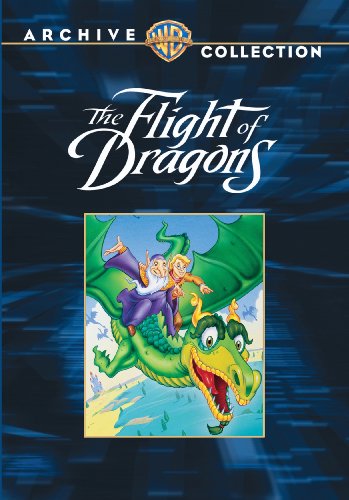
Lo these many Christmases ago, I received a wonderful book by Peter Dickinson called The Flight of Dragons. Gorgeously illustrated by Wayne Anderson, the book's simple yet rigorously pursued conceit is the idea that dragons really existed. Dickinson sets out to show just how this could be, how they flew, how the fire breathing worked, and why there is no fossil record of their existence. In other words, Dickinson takes a hard SF approach to high fantasy, and the result is magical. Now, as part of its Archive Collection, Warner has resurrected a 1982 Rankin-Bass animated adaptation of the book.

Dickinson's book doesn't have a plot, as such. It is, after all, a piece of mock-scholarship. So film's approach is to set a story in a world based on the one imagined by Dickinson. Dragons are still commonplace, but in the struggle between magic and logic, magic is losing. Fearing that it will die out completely (and thus do terrible damage to the world), Green Wizard Carolinus (voiced by Harry Morgan) along with his Yellow and Blue counterparts, plans to create the magical equivalent of a wildlife preserve, sealed off from the rest of the world. Standing in the way is evil Red Wizard Ommadon (James Earl Jones), whose magic remains powerful thanks to humanity's sins. Ommadon must be defeated, but since the wizards are forbidden by Antiquity (the deity who runs the joint, who manifests as a talking tree not at all unlike the burning bush in The Ten Commandments) from taking direct action, humans must be recruited to perform a quest. The leader, Antiquity decrees, will be found in the future, and turns out to be none other than Dickinson himself (John Ritter), who, transported back in time, is tickled pink to discover that everything he has been dreaming and writing about is real.

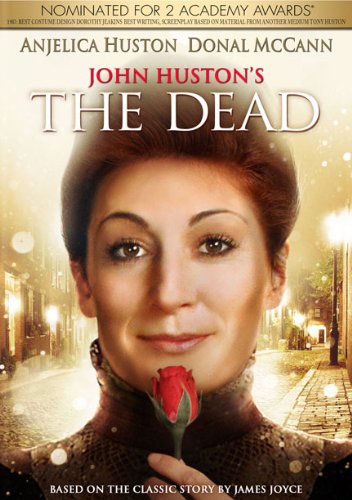
In early-20th-Century Dublin, a winter's musical gathering is being held. The first two-thirds of the film takes us through the course of the evening, from the arrival of the guests, to the musical entertainment, to the dinner and its discussions (and arguments), and finally the departures. During the party, one is aware of a certain tension or distance between one couple: Donal McCann (nephew to the hostesses) and his wife (Anjelica Huston). As they prepare to leave, Huston hears one of the guests sing, and is rooted to the spot. Later, McCann asks her why the song affected her so much, and a painful memory from her past comes out.

John Huston's last film is suitably elegiac. Based on the James Joyce's short story of the same name, the movie is itself in short story form, barely clocking in at 73 minutes, and that's including the credits. The running time is just right, though, as this is a compact, moving tale, whose title does not become clear until the closing minutes. Were the film any longer, audiences would likely become restive at the apparent lack of story during the first two acts, but everything is present for good reason, working in unity towards a powerful conclusion. In all of this, the film is deeply faithful to the Joyce story. But the story also presents an enormous challenge: its conclusion relies on the thoughts of its protagonist, not on dialogue or action, the bread and butter of cinema. What to do? Huston takes what is probably the only path open to him, and goes for a voice-over as the camera gazes at mournful scenes of snow falling in the Irish night. The voice-over, having been absent until this very moment, is a bit jarring, even as its necessity is understandable. So the film might not be flawless, but it is a heartbreakingly moving valedictory gesture from one of cinema's greatest directors.

We are in the late 1920s, and to the family manor comes Ben Barnes, in the company of new wife, Jessica Biel. That this woman is both American and a race car champion does not sit well with the very conservative mother Kristin Scott Thomas. That her nose is out of joint delights husband Colin Firth, a veteran of the Great War who, thoroughly world-weary and disillusioned with just about everything, wants nothing to do with the petty concerns and squabbles of his family. What follows is a clash of cultures and generations, veering between slapstick comedy and something rather darker.

I know you've all been waiting to see Jessica Biel finally star in a film whose script is based on a Noel Coward play, which was first adapted in 1928 by Alfred Hitchcock. All kidding aside, Biel acquits herself well, despite occasionally displaying some rather anachronistically defined pecs. The other cast members aren't having to strain themselves too much -- Scott Thomas has played repressed ice queens before, and Firth pretty much phones in his trademarked display of amused contempt -- but they are never less than efficient in their portrayals. That said, Scott Thomas and the performers playing her daughters have a tendency to project to the back of the hall, and otherwise remind us a bit too forcefully that this material was originally a play. The film is far from the jaunty comedy of mores that the case suggests -- it is rather too dark for that, by the end. It is an enjoyable, though finally slight, bit of entertainment.