Posted in: Disc Reviews by David Annandale on July 6th, 2009
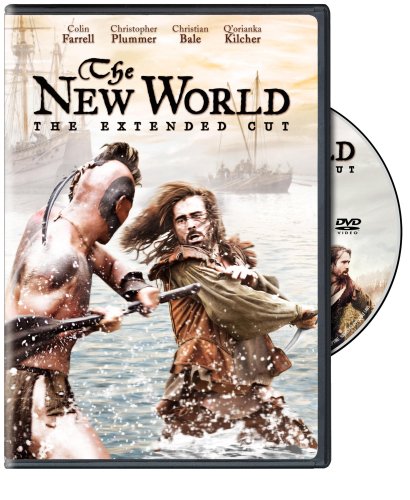
When Terence Malick's latest effort hit the theatres, he had trimmed it down to 135 minutes. Early critics had seen a version running 150 minutes. This version is longer yet, clocking it at 172 minutes. Most of what I said about the previous DVD release holds, and so I'm reproducing it here, with additional comments as necessary.
Virginia, 1607. English ships arrive and a colony is set up, but with considerable difficulty. Famine and disease take their toll. Captain John Smith (Colin Farrell) heads off to seek help from the Powhatan. He is captured, sentenced to death, but waved by Pocahontas (Q'orianka Kilcher, whose character is never actually given that name). So begins a fateful relationship.
Posted in: Brain Blasters by David Annandale on July 3rd, 2009
Ishiro Honda is, of course, best known and (deservedly) beloved for his classic kaiju eiga: he not only directed the first appearances of Godzilla, Rodan, and Mothra, he also delivered many of their subsequent adventures, wrapping things up with 1975's Terror of Mechagodzilla, which would be the last such entry until the mid-80s revival. The high profile of the giant monster movies has a tendency to overshadow some of this other contributions to fantastic cinema. One such effort which shouldn't be overlooked is the inventive and grim Matango (1963).
A rich entrepreneur and his guests head off for a holiday on his yacht. When the weather turns nasty, he overrules his captain, who wants to turn back, and, in a misplaced display of machismo, orders that the course be maintained. The results are inevitable: the yacht is damaged beyond repair, and drifts aimlessly, until the unfortunate characters come across a deserted island. They soon discover that theirs is not the only shipwreck on these shores: they find a much larger ship, whose crew has vanished. Covering many of the ship's surfaces is an unpleasant fungus. Our heroes clean the ship up, make it their home, and set about scavenging food, staying away from the abundant mushrooms, which are apparently toxic. But alternatives are in scant supply. Frictions mount, betrayals multiply, and one by one, the survivors succumb to the temptation of the mushrooms. These are not only addictive, they slowly transform you into one of them.
Posted in: Disc Reviews by David Annandale on July 2nd, 2009
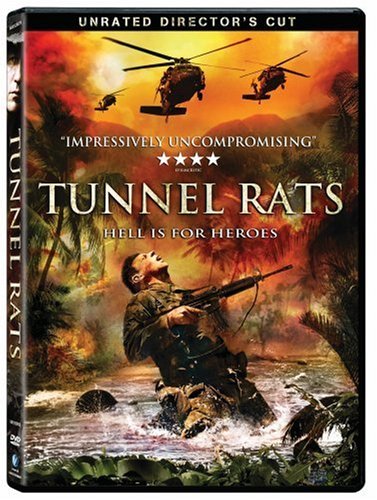
Behind the on-screen title of 1968 Tunnel Rats lurks a vision of Hell. We first get to know a unit of American soldiers tasked with clearing out the networks of underground tunnels constructed by the Viet Cong. Even before the action shifts to the tunnels, the terrible toll of war is on display, with the Lieutenant (Michael Paré) ordering brutal executions and morale very low. Then the operation begins, and everything goes to horribly wrong very quickly.
I haven't noticed the sun turning black or any angels breaking seals today, but the Apocalypse must be upon us, because I have now seen a good Uwe Boll film. The picture succeeds admirably on two fronts. In the first act, as we get to know the troops, Boll turned his cast loose to improvise dialogue and come up with character back stories. While there are no fully rounded characters here, and clichés abound, there is certainly enough here to make these men recognizable human beings. One shot in particular is striking: a prolonged close-up of the sympathetic sergeant breaking down in tears. Then the real lesson about the hellishness of war kicks in, and does so with a vengeance. No character is safe from gruesome demise, and the claustrophobic horror of the setting is milked for all its worth (if you're not reduced to the cold sweats by a scene where a solider finds himself trapped in a tunnel between two corpses, you're already dead). But there are no monsters here – the Viet Cong are not faceless automatons. Instead, we see a group of people, trapped on opposite sides of a ghastly conflict, struggle to stay alive.
Posted in: Disc Reviews by David Annandale on July 1st, 2009
Released just in time for the global financial meltdown, this hymn to designer products features Isla Fisher, who demonstrated her comedic talent by stealing Wedding Crashers from both Vince Vaughn and Owen Wilson – no small achievement. Here she plays Rebecca Bloomwood, a compulsive shopper who, while hoping to land a job working at a fashion magazine, accidentally finds herself hired on a columnist at the sister publication, a rather less glamorous financial mag. Her columns, couching financial advice in shopping metaphors, become a surprising hit, and sparks begin to fly with her editor (Hugh Dancy). Meanwhile, a relentless debt collector is dogging her heels.
Combining Sex and the City voice-overs and clothes with Bridget Jones insecurities, the film sets out to be, I suppose, some sort of female fantasy. And sure, just as we are expected to buy Seth Rogen as a babe magnet in the male POV rom-coms, one can be fairly asked to do some heavy suspension of disbelief exercises when it comes to the match here, too. But why, as seems to be so often the case, are the female characters presented as ADD idiots? It becomes very hard to like Rebecca when, with her career (and quite possibly that of the man who is giving her a shot at the journalistic brass ring) hanging in the balance, she would rather rampage at a sample sale then do her work. Fisher throws herself into the part with enormous energy, but she is working with empty, predictable, numbing material.
Posted in: Disc Reviews by David Annandale on June 4th, 2009
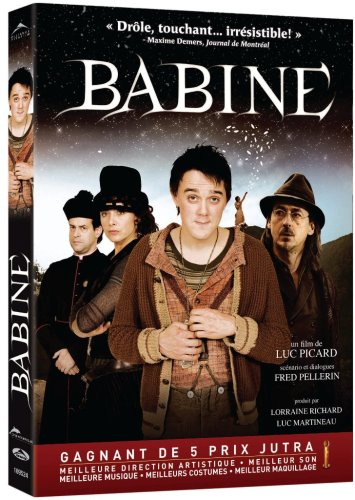
In a village where there is a great deal of time (there are months whose days are numbered in the 40s), the local witch gives birth to the title character. Twenty years later, Babine is the Village Idiot. Though he is a thoroughly gentle soul, he also becomes the scapegoat for every ill, real or imagined, that befalls the villagers. Fortunately, he has some champions, including Toussaint Brodeur (played by director Luc Picard), the local fly-raiser. But then the church burns down, and terrible trouble looms for Babine in the person of the new, fanatical village priest.
Obviously, as the above synopsis suggests, we are in the realm of the utterly fantastic here. Narrated by storyteller Fred Pellerin, whose tales form the basis of the script, Babine is endlessly inventive, at the cost of being a bit too episodic for its own good (something that Picard, during his commentary track, admits he struggled with) and giving short shrift to some of its striking characters. There is no denying, however, that its world-creation is very successful. The film is a visual feast, one very much on par with the likes of Tim Burton, and this achieved with a fraction of the budget of its Hollywood equivalent.
Posted in: Brain Blasters by David Annandale on May 30th, 2009
As I believe I may have mentioned before, I'm of an age that meant I was too young to actually attend any grindhouses in their 70s heyday, though I'm old enough to remember them. When I did come of age in the 80s, the VHS and Beta war was in full swing, video rental stores were sprouting like mushrooms, and the hunger for product on the shelves, any product, was insatiable. Those were the days when people actually rented VCRs, and Mom-and-Pop stores proudly offered the likes of Microwave Massacre, Screamers and The Beast Within for rental. This was the era of distributors like Key Video, Magnum, and many, many more, all with processed cheese computer graphic logos.

And this is where the joys begin on Astron-6: Year One. This is a DVD compilation of short works by a group of young Winnipeg filmmakers. Each piece opens with the Astron-6 logo, which, from its deliberate grain and scratches to its single-chord synth theme, is a dead-on recreation of those delightfully scuzzy formative years of home video. Beyond that logo lies a wealth of demented entertainment.
Posted in: Disc Reviews by David Annandale on May 26th, 2009
Aging senator James Stewart and wife Vera Miles arrive in the prosperous town of Shinbone to attend the funeral of an anonymous farmer. The local newsmen want to know why. Stewart tells the story. Cue the flashback, where he arrives in a much more anarchic Shinbone as a naïve lawyer. Held up and beaten by the brutal outlaw Liberty Valance (a psychotic Lee Marvin), he is determined by bring law and justice to the town, but must come to terms with the fact that he cannot do so without the gun of John Wayne (the aforementioned farmer).
For all intents and purposes, this 1962 film was director John Ford's last western. It is an elegiac, melancholy piece (and one that makes Catlow, reviewed here a few days ago, look even more out of step with time). Like Unforgiven, it is a film whose casting is not only perfect, it is necessary. The collisions between the Wayne and Stewart characters are also the collisions between the symbols of American Myth the two icons represent. Vera Miles, as the woman torn between the two men, comes to represent the country itself, which must, for its own sake, choose the civilization and rule of law embodied by Stewart, even as it grieves over abandoning the larger-than-life figure of Wayne. He is the Old West, a figure from a more anarchic time, perhaps the light to Marvin's darkness, but in many ways not that different. He must vanish to make way for the future, but the future cannot come into being without his help and sacrifice.
Posted in: Disc Reviews by David Annandale on May 23rd, 2009
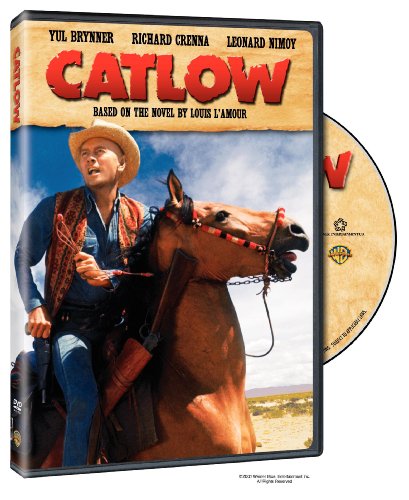
Yul Brynner is the titular Catlow, a jovial outlaw rounding up maverick cattle, much to the consternation of cattle barons who feel the strays belong to them. Richard Crenna is Ben Cowan, Catlow's best friend but also a federal Marshal, who is tasked with arresting Catlow. Leonard Nimoy is the hired gun whose task is rather more lethal. Catlow and Cowan spar good-naturedly as the former plans to steal a great deal of gold in Mexico, which will have many other people annoyed with him.
This 1971 western is a lighthearted romp, or at least it intends to be. In fact, the humour is rather forced, even though everyone is grinning madly and putting a great deal of energy into convincing us that they're having mad fun. The effect, however, is rather flat. The film also trots out unquestioningly almost every old western convention, up to and including a completely unreconstructed vision of its “Indians” as dangerous savages. In the wake of the Spaghetti Westerns and Sam Peckinpah's elegiac orgies of violence, it seems curiously old-fashioned, and in the end functions as little more than passable entertainment.
Posted in: Disc Reviews by David Annandale on May 23rd, 2009
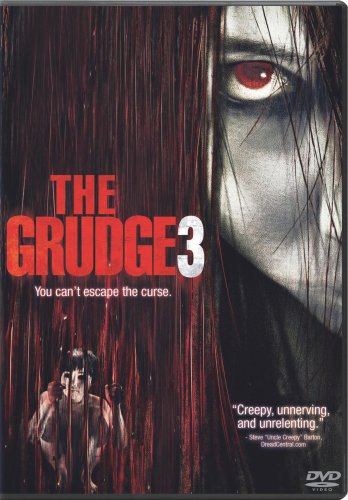
Some weeks back, I wrote about Splinter, and opined that director Toby Wilkins showed real skill. I also expressed worry over the fact that this follow-up was this, the third entry in a franchise that began with a remake in the first place. So here we are. Was I right to worry? Sadly, yes.
The Grudge 3 picks up in the aftermath of its predecessor, with the death of the last survivor of that film's massacre. The setting remains the same Chicago apartment building where evil ghosts Kayako and Toshio in the last thrilling episode (apparently have grown bored with Tokyo). The focus now is on the caretaker and his two sisters, the younger of the two being chronically ill. Meanwhile, Kayako's sister arrives in town, determined to put an end to the curse.
Posted in: Brain Blasters by David Annandale on May 8th, 2009
Suspiria.
Oldboy.