Posts by David Annandale

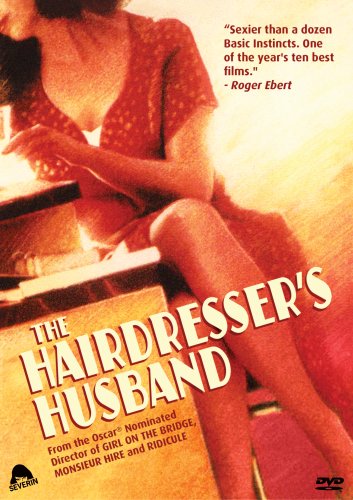
A middle-aged man (Jean Rochefort) recounts his youthful sexual awakening to the charms of the local hairdresser. Developing a fixation on the erotics of a women cutting men's hair, he resolves to marry a hairdresser, and decades later, he gets his wish. His wife is the lovely Anna Galiena, and once wed, they rarely leave her little shop (indeed, they also get married there).

Writer/director Patrice Leconte is dealing with a pretty specialized fetish here, but he in the early goings, he actually comes close to making us understand Rochefort's obsession. Leconte's precise attention to sensual details sells us the young boy's developing passion, but in the long run, the older Rochefort's inclination is rather harder to take seriously, or even be that interested in. The couple's idyllic life in the salon is obviously not mean to be seen in any realist sense, but even as a parable, it's rather thin. Rochefort spends his days doing crossword puzzles while Galiena reads gossip magazines, gazing adoringly at her as she tends to various customers (whose eccentricities feel like the inevitable conventions of this sort of art film, even as they do provide a necessary spark of life to the very still narrative), and launching, at the drop of a hat, into improvised dances to Arab music. This last quality is supposed to be charming, but by the third number (in a short, 82-minute film), it is simply irritating. Having created a situation where, once the courtship is accomplished (a matter of mere minutes of screen time), nothing can happen, Leconte decides to wrap things up with a conclusion that is clearly supposed to be poignant, but is utterly fatuous. The film is delicately wrought, and quite lovely, but also fundamentally empty-headed. In the end, it comes across as little more than a precious presentation of a middle-aged, rather misogynist fantasy.

A heavily armed group descends on a small-town supermarket. They gun down a customer, and announce that they are robbing the place. More killings ensue, but it soon becomes clear that this is no ordinary robbery. A strange form of triage is taking place that determines who is shot and who is allowed to live. Before long, only a handful of employees and customers remain, and it becomes clear that the attackers are not thieves at all, but in fact humanity's last hope against an insidious alien invasion.

The title is utterly generic. It might as well be “Sci-Fi Horror Thriller.” And sure, the flick has its share of scenes of people creeping around nondescript interiors in the dark. But while one would be understandably tempted, at first glance, to dismiss Alien Raiders as yet another bit of filler for the Sci-Fi Channel (oops, sorry, that should be SyFy Channel) and the like, it is, on the contrary, a most engaging and reasonably suspenseful exercise. The monster effects are (wisely) kept in the shadows, making a virtue out of low-budget necessity, and the performances and writing are both sharp, making a very familiar scenario fresh again. The conclusion is telegraphed a little clumsily, but in the end, that's a minor problem. There's a real aura of desperation surround the characters, and one can't help but root form them.

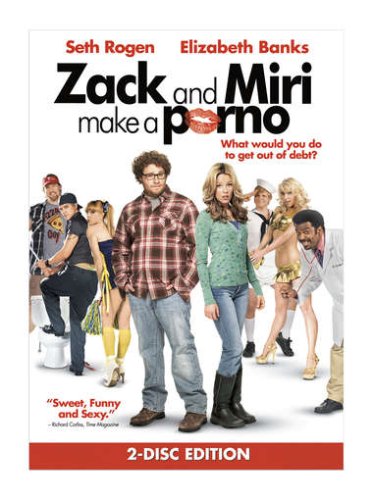
Zack (Seth Rogen) and Miri (Elizabeth Banks) have been friends since school, and are now terminally broke roommates. As their utilities are turned off one by one, and they face the prospect of eviction, Zack hits on the idea of shooting a porn flick to get out of debt. They gather together a motley collection of actors and crew, and, letting no setback stand in their way, start making their movie. But the real question is not whether they will succeed, but whether they will come to terms with their feeling for each other.

In his review of the film Roger Ebert writes, “'I don't know bleep about directing,' Smith once confided to me. 'But I'm a bleeping good writer.'” Smith is half-right. The direction here is very meat-and-potatoes, every shot serving little more than to get the actors decently framed. But I can't agree with his self-estimation as a writer. There are some funny lines here, but many of the laughs are due to Smith's stellar cast. Rogen does his usual shtick, but it's still funny, thanks to his appealing naive/cynic vibe and befuddled stoner delivery. Justin Long shows up for a single scene, and walks off with the movie. None of his lines are particularly stellar, but his cameo is hysterical, all of it due to voice and body language. The man could make the yellow pages side-splitting. This is not to say that Smith's script is that dry, but it veers between clumsy earnestness (I kept waiting for the punchline during the final emotional speeches, the clue that I wasn't really supposed to take this hackneyed dialogue seriously, and it never came) and a potty mouth approach that clearly finds naughty words to be funny in and of themselves. You know, like we all did in grade five. David Mamet this is not. But when all is said and done, there's the cast. Determined to save Smith from himself, they make the film a bizarrely endearing and sweet experience.

So, there have been approximately a godzillion zombie movies made over the years, and a goodly number of those just in the last few years. And there have been quite a number of very creative ones (Shaun of the Dead, Fido, 28 Days Later, but no, NOT the remake of Dawn of the Dead). Likely about to disappear from a theatre near you is one of the most interesting variation of late: Pontypool.

Directed by Bruce McDonald (most recently of The Tracey Fragments), and scripted by Tony Burgess (adapting a section of his novel Pontypool Changes Everything), Pontypool takes place in the eponoymous town, somewhere in the snowy wastes of rural Ontario. Grant Mazzy (erstwhile Nite-Owl I Stephen McHattie) is a former shock jock, turfed from his big city job, and now stuck hosting the morning show out here in the middle of nowhere. After a disturbing encounter with a babbling woman on his pre-dawn drive to work, he settles in behind the microphone to start his shift. Little by little, he and the station's crew of two (Lisa Houle and Georgina Reilly) discover that something really, really bad is happening in and around the town. What that bad thing is, of course, is your basic zombie apocalypse.

Frankly, if you need any information beyond the title of this release, then it probably isn't for you. It's The Sinful Dwarf, man! But if you really must know more, be it on your head. Mind-bogglingly stupid and broke newlyweds Mary and Peter (Anne Sparrow and Tony Eades, actors of an ineptitude that passeth all understanding) check in to the boarding house of retired (and scarred) burlesque performer Lila Lash (Clara Keller) her son Olaf (children's show host Torben Bille), the titular sinful dwarf. Mary hears noises in the attic, but Peter won't listen to her. He should, as Lila and Olaf keep a harem of women up there as prostitutes, ensuring their submission through forced injections of heroin. Now they have their sights set on Mary...

Whatever you fear or hope about a film with this title, the reality will likely exceed your imagination. “Exploitation” is almost too tame a word to describe the spectacles here, whether we're talking about incessant close-ups of Bille's sweaty, greasy, drooling, leering face, or Keller's disturbing Marlene Dietrich impersonation. If you don't need a shower after watching this, you aren't human. In other words, it's sublime.

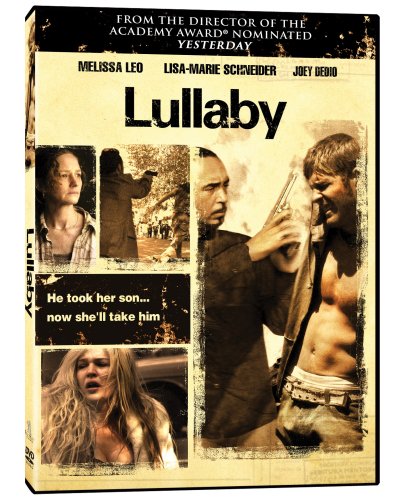
Melissa Leo is a hard-working café waitress in Tennessee who regularly sends what little extra cash she has to her adult son who, for reasons never explained, is a drug-addict in Johannesburg. A drug lord (Joey Dedio) kidnaps said son, and demands a ransom that, for Leo, is next to impossible. Nonetheless, a mother's love knows no obstacles, so she scrapes together the money to fly to South Africa. Once there, she connects with Tina (Lisa-Marie Schneider), her son's prostitute girlfriend, and is made to run the gauntlet by Dedio, who shows very little inclination to let his hostage go, no matter what demand is met.


This is an odd fish of a film, being a rather incongruous mix of gender-flipped Taken and gritty realism. Leo is called upon to do the impossible: be the grief-stricken mother and then terrified mother for the first part of the film, but transform by the end to an avenger whose strategy and vocabulary are worthy of Hannibal Lecter. All of her weepy moments are expertly performed, but so frequent they become tiresome. In other words, we have a first-rate actor being sandbagged by a silly script. And silly the whole thing very much is. Despite all kinds of gestures towards the Harsh Realities of Life, it is, in the end, no more a product of the real world than Transformers. What it is, though, is slick, quick and entertaining.

Well, I might as well follow up last week’s piece with my own thoughts about Watchmen, now that I’ve seen it. Let me begin with the most important point: these musings must be understood as provisional. My feelings are mixed, and I think I will have to see the film a few more times before I can come to a definite conclusion about it.

That caveat out of the way, let me begin by saying that, all in all, Zack Snyder's interpretation is staggeringly faithful to its source material. One isn't really faced with a question of what is changed, because the answer is, other than one significant aspect of the ending, virtually nothing, and even that aforementioned change is true to the spirit of the original, and the case has been made that it is actually an improvement. It is certainly an elegant solution to one of the more problematic, much-debated elements of the comic. In any event, the question is more about what is left out, and even that is precious little, considering the task of packing the entire twelve issues into the space of a single film. Yes, there is compression, yes, there are events passed over, but there is barely a moment from the text that doesn't show up in some form or other.

I'm not even going to try to justify considering Watchmen a cult film. Not on that kind of budget and mainstream-saturation advertising. But the comic book (let's avoid the artificial marketing term “graphic novel,” shall we) is another story, a work whose brilliance is equaled only by the fanatical reverence in which it is held by its fans. Now that's cult. I won't be seeing the film for another couple of days, so whether it does a good job or not I will leave as an open question (what is beyond question, however, is that, whatever flaws it may have, it has to be better than the what the original stab at adaptation, back around 1987 would have been – I read a summary of the screenplay, and “desecration” is too weak a word). What I want to consider today is the rather strange set of conflicting emotions anticipated adaptations such as this provoke.

The basic conflict is quite simple: fans have been regarding a film version of Watchmen with both rabid impatience and all-consuming dread. The latter is easy to understand. Watchmen, with its intricate narrative structure and stately pace, defies easy transfer to film, and audiences not ready to view a deconstruction of the super-hero might well put up a (misguided) resistance. But it's the former emotion that I find puzzling, even as it is one to which I am not immune.

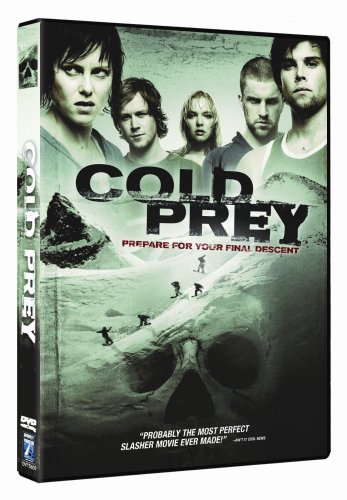
Last week, I offered my paean to King of the Hill. Today, another recent European horror film, which also has a mountain setting: the Norwegian Cold Prey. If King of the Hill was related to the slasher in terms of the idea of the characters being stalked through the countryside by a killer who could strike at any moment, Cold Prey fits far more comfortably within the slasher subgenre. It is, after all, ultimately the story of a group of young people running afoul of a giant masked maniac. Hardly original, I know. But it is how Cold Prey handles its familiar material that produces a delightful gust of fresh air.

Two couples and a fifth wheel head off to the mountains for some off-trail snowboarding. The fifth wheel breaks his leg partway down the slope, rather inconveniently in the middle of nowhere. Fortunately (or so our heroes think, since they don't know what kind of movie they're in), there's a mountain resort nearby. It turns out to be abandoned, but it's shelter, and they can make do. But then, of course, it further turns out that it is not completely abandoned, and one by one they come to gruesome ends.

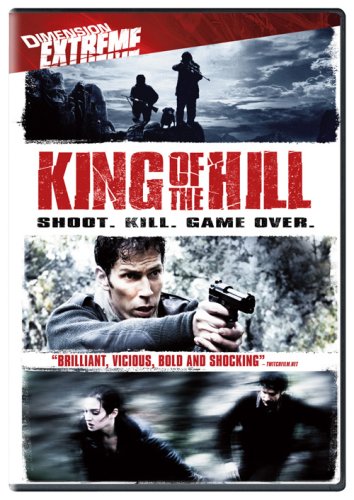
The European horror revival continues apace. Today's entry in the please-don't-remake-it category is the 2007 Spanish entry King of the Hill, directed by Gonzalo López-Gallego. It's another case of a simple premise worked out rigorously, and with great skill. Leonardo Sbaraglia plays Quim, a man on his way though the Spanish countryside. Stopping at a filling station, he has a quickie encounter with shoplifter Bea (María Valverde) in the washroom, after which he discovers that she has lifted his wallet. Catching sight of her vehicle heading up a mountain road, he takes the detour in pursuit. Then, once he is well off the beaten track, nicely far away from civilization as he knows it, he sees a glint on a mountain peak, and then a bullet hits his car.

From that moment on, things very rapidly become much more bizarre and much, much worse. Before long, he and Bea (whose car has also been disabled by the mysterious sniper) are on the run through mountains. They don't know why they are being targeted, and they cannot see their attacker, and therein lies the simple brilliance of the premise. Sure, we've seen many a rural stalking film, be it Deliverance, Rituals, Friday the 13th, or even The Edge (where the stalker is a bear instead of a person). All of these films play on the vulnerability the urbanite in particular will feel in the wilderness. All directions look the same, there are no landmarks, there is no shelter, there are no means of calling for help, the human form is dwarfed in the chaotic immensity, and danger can come from anywhere. King of the Hill takes this idea a step further in that the killer doesn't even have to be anywhere near his victims to strike them down. His reach is infinite.