Posted in: Disc Reviews by David Annandale on May 5th, 2009
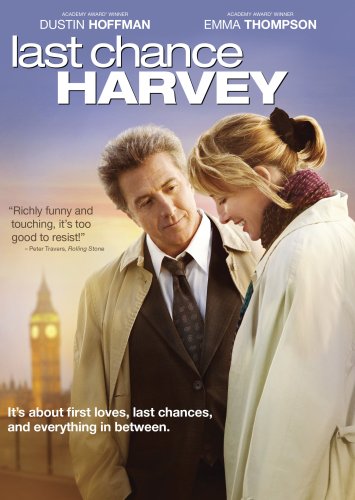
Dustin Hoffman is the titular Harvey, a morose jingle composer who, with his job hanging by a thread, arrives in London for his daughter's wedding. He is a complete outsider at the rehearsal dinner, and feels even more cut off when his daughter informs him that she wants her stepfather to give her away. Meanwhile, the scarcely more cheerful Emma Thompson spends her time being set up for disastrous blind dates and being constantly harangued on the phone by her mother. These two losers at the game of love meet, and something blossoms between them.
And that is really about it as far as plot goes. The script is so insubstantial that it threatens to waft away on the first gentle breeze. The film is quite watchable, however, and that is due to the sheer force of its leads. They make the enterprise seem considerably more substantive than it is, their pained expressions conveying worlds to us. The film is at its strongest when it sits back and lets the two banter, and the relationship that develops feels easy and natural. It is all the more disappointing, therefore, that writer/director Joel Hopkins feels it necessary to shoehorn in the obligatory Romantic Comedy Third Act Falling Out by the most contrived and Deus Ex Machina-like of means. This is a turn of events that is a poke in the eye to any viewer who thought his/her intelligence was going to be respected.
Posted in: Disc Reviews by David Annandale on May 4th, 2009
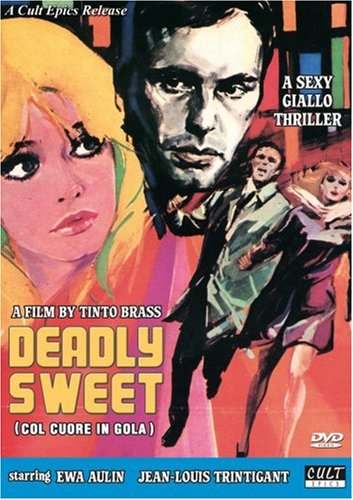
Jean-Louis Trintignant (here dubbed into Italian) is a hard-boiled actor (!). Arriving at a night club to meet the proprietor, he instead finds the man dead, and the luscious Ewa Aulin standing over the corpse, protesting her innocence. Trintingnant believes her, and decides to help her out. The quest for the truth leads them though a series of encounters with various aspects of London nightlife and lowlife, 1967 vintage.
This early Tinto Brass effort is nominally a thriller, though, as he himself points out on the commentary track, the film is only vaguely interested in its thriller aspects. The big influence here is Antonioni's Blow Up, which is name-checked a couple of times. Deadly Sweet has the same kind of meandering plot and love of lingering over various examples of Swinging London counterculture. The other guiding muse is comic book artist Guido Crepax, and Brass mimics comic panels with multiple split screens, shifts between colour and black-and-white, and the like. It is an open question whether all of these games work at a cinematic level, but they are certainly visually interesting. The films is, like so many of its contemporaries, self-indulgent, but in a rather endearing way. For my money, it's a more engaging viewing experience than many of the erotica exercises from the director's mature period.
Posted in: Brain Blasters by David Annandale on May 2nd, 2009
Belgian director Fabrice Du Welz burst onto the horror scene in 2004 with Calvaire, an unforgivingly black tale of a young man running afoul of a town whose exclusively male population would make Leatherface blanch and get the hell out of Dodge. A distinctly European concoction, it nevertheless paid tribute to Deliverance and The Texas Chainsaw Massacre. It was an attack on the audience as assured as it was original. Now, Du Welz has followed up with Vinyan, which is no less original, no less assured, and stakes out its own identity distinct from its predecessor, while still sharing many of Calvaire's thematic preoccupations. People, I think we have an auteur in our midst.

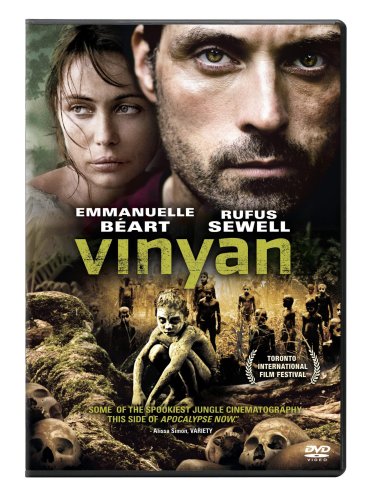
A vinyan is, in Thai mythology, an angry ghost, the spirit of someone who has died a bad death and cannot make its way to the afterworld, and so remains to cause trouble for the living. A bad death is certainly what the son of Emmanuelle Béart and Rufus Sewell suffered: he was swept away by the Boxing Day tsunami. His parents are still grieving, still in Thailand, and Béart in particular cannot let him go. When, at a charity function, a video of the devastation in Burma is shown, Béart sees an indistinct image of a child that she insists is her son, still alive, sold out of a hospital instead of deceased. Sewell sees nothing of the kind, but agrees, in the face of his wife's implacable obsession, to try to find the child in the film. This means contacting the Triads, as they are the only means of sneaking into Burma. So begins a long journey into Hell.
If Calvaire's touchstone was the survival horror films of the 70s, Vinyan too looks to that decade for inspiration, but its model is very different: Apocalypse Now. In fact, I dare say that it is to that film what Apocalypse Now was to Heart of Darkness: a parallel journey with transplanted events and similar tones and themes. Both films and novel share, along with a nightmare boat odyssey into the jungle, a languorous pace that effectively conveys the enervating atmosphere through which the characters move, a careful attention to the oppressiveness of the jungle, which becomes a character in and of itself. There is also an abyssal loss of hope in all three works. Vinyan even re-creates a number the Coppola film's shots of passing trees. There is also a shared sense of penetrating into a strange, surreal world where nothing is explained and everything is possible. Had Marlon Brando appeared in the midst of the feral children that populate Vinyan's last act, I wouldn't have been a bit surprised.
But this journey into another world, signaled by crossing through barriers of fog and rain, is also one of the things that links Vinyan to Calvaire. While the pace and content of the two films is very different, their horrors both occur in dark forests, and both stories concern themselves with the destructive properties of grief. In Calvaire, innkeeper Jackie Berroyer convinces himself that poor Laurent Lucas is his wife come back to him, a psychosis that the entire town shares. Similarly, Béart refuses absolutely to believe that her son is dead. When presented with a boy who is clearly not her son, there is still a moment where it is clear that is willing to believe that it is. In both films, grief and desire are one and the same. They are creative in a the most terrible sense, distorting reality in toxic ways, and therefore, in the final analysis, utterly destructive. The true name for what they really are, then, is the death drive.
Viewers will find Vinyan a challenge. Even fans of Du Welz's first film might find this too slow. But don't go in expecting a visceral roller coaster. Instead, remember Apocalypse Now, especially in its second, increasingly bizarre half, and regard the work as a doom-laden tone poem, and your patience will be richly rewarded.
Oh, and is there an angry ghost? Not in the traditional supernatural sense. But in terms of psychological effects? Definitely. And there is more than enough of the uncanny to go around in the last act.
Posted in: Brain Blasters by David Annandale on April 28th, 2009
I first became aware of J. T. Petty when his Mimic: Sentinel came through for review. I popped it on, expectations very low (it always seems to be a sign of a franchise's last gasp when the digits are dropped from the titles of sequels), and was pleasantly surprised by a clever reworking of Rear Window. Soft for Digging, his feature debut, was just as interesting, and was a quietly effective little ghost story. He hasn't been very prolific as a director (though he did find gainful employ scripting the first three excellent Splinter Cell games), and I missed his S&Man, but now he's back in horror territory with a bleak western with monsters: The Burrowers.
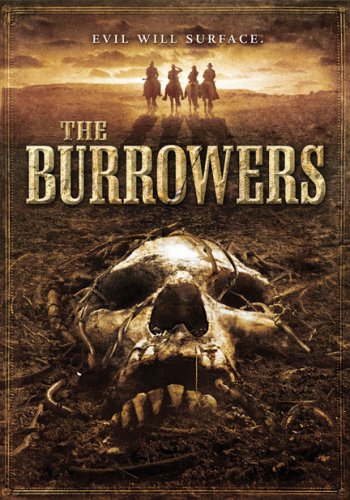
There's a bit of an echo of The Searchers in Petty's set-up: a group of white settlers are abducted, and a posse is formed to hunt down the guilty parties and rescue the captives. While the searchers assume they are after a group of Native Americans, in fact their quarry isn't human at all. What follows has the inevitability of tragedy (and, for that matter, of history): the posse (initially led by a psychotic military commander) perpetuates no end of atrocity against innocent parties, and it is pretty clear from the ferocious racism on display that these men needed very little excuse to start torturing and killing Native Americans. At the same time, the men are very vulnerable to attack from the burrowers of the title.
Posted in: Disc Reviews by David Annandale on April 28th, 2009
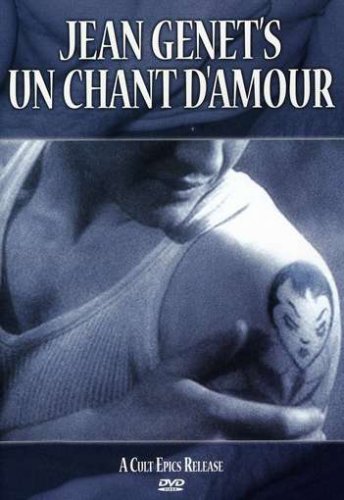
A while back, Cult Epics released a 2-disc limited edition of Un Chant D'Amour. This single-disc reissue features a number of the features (though not all) from the limited release. The actual film and transfer quality are the same, and so much of this review is likewise the same.
Long the bad boy of French novelists, Jean Genet directed this 25-minute short in 1950. Borderline pornographic, it is a silent portrayal of (literally) imprisoned desire. Two prisoners convey their longing for one another through the prison walls, while a voyeuristic guard watches, becoming aroused and frustrated to the point of violence. poetic, fetishistic, and intensely personal, it is a startling and historic piece of underground cinema.
Posted in: Disc Reviews by David Annandale on April 21st, 2009
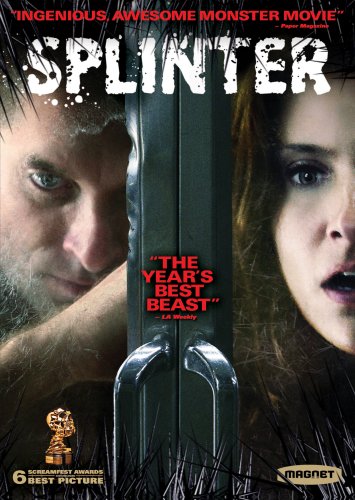
So Toby Wilkins will be helming The Grudge 3. That's a bit of a shame. Not because I think he's the wrong man for the project. Rather, it's the wrong project for the man. Or, less glibly but more precisely, he is showing real promise as a filmmaker, and it would be a shame to see more talent squandered on a franchise that should definitely be put out to pasture. I base this evaluation on the evidence presented in Splinter, a nifty little creature flick .
The film begins with the collision of seriously two very different couples. Seth and Polly (Paulo Costanzo and Jill Wagner) are young urbanites on a camping trip. He's working on a PhD in biology, which becomes important later. Meanwhile, Dennis and Lacey (Shea Whigham and Rachel Kerbs) are on the run (he's an escaped con, and she's his twitchy, detoxing girlfriend). The latter two carjack the former, but the situation becomes much more complicated when they stop at an isolated gas station (is there any other kind in horror movies?) and are attacked by the titular creature.
Posted in: Disc Reviews by David Annandale on April 14th, 2009
Alan Rickman, in a stunningly unexpected bit of casting, plays an arrogant, womanizing SOB of a chemistry professor who has just been awarded the Nobel Prize. While he and wife Mary Steenburgen jet off to Sweden, their son (Bryan Greenberg) is kidnapped. Before long, the parents receive are sent a severed thumb as proof of the kidnapper's serious intent. But nothing is quite what it seems.
What we have here is a blackly humoured cross between farce, caper and revenge story. The name-studded cast also includes Bill Pullman as the detective assigned to investigate the kidnapping, Elize Dushku as Greenberg's love interest, and Danny DeVito as a gardener recovering from an obsessive-compulsive disorder. Ernie Hudson and Ted Danson also show up in small roles. DeVito doesn't have much to do in the film, but then, in the end, neither does just about anybody else. Rickman, though top-billed, isn't asked to do more than his patented bastard shtick, which he can do in his sleep. There's a creative heist scene, and plenty of twists, but these latter have a merely academic interest. There is no emotional attachment to anyone in the film, which means that the OTT flash and dazzle of the editing becomes pure surface distraction. Then there's the soundtrack, partly the work of electronica deity Paul Oakenfold. Too often, it has no relation to the action on screen, and is so loud that, fine as it is in and of itself, it becomes irritating. End result: a slick but empty, only fitfully engaging effort.
Posted in: Disc Reviews by David Annandale on April 13th, 2009
Try this plot on for size: Gordo, an ape owned by carnival sideshow barker the Great Lampini (Paul Richichi), gets loose and rampages about Long Island, raping and killing and stealing cars (!). Meanwhile, the moronic detective in charge of the murder case dismisses the idea that an ape is the culprit, and casts his racist eye on the unfortunate Duane Jones (Christopher Hoskins, whose character is named after Night of the Living Dead's lead).
Though made in 1997, this shot-on-super-8 effort does its level best to come across as the Lost 70s Grindhouse Flick, and it has to be said that it does a pretty credible job in capturing that trash aesthetic. There is also wit on display, most prominently in Lampini's deliberately overwrought and baroque dialogue. The film does, though, take its time getting to the rampage: nearly half its 77-minute running time has elapsed before the attacks begin. That first thirty minutes consists largely of people arguing, which has varying entertainment value. The gore scenes have a charming DIY feel, but there is a nastiness to the attacks on women that, as with Blitzkrieg: Escape from Stalag 69 (director/co-writer Keith Crocker's other recently released effort), is in some ways more off-putting than those of its inspirations, given how much of the rest of the film works as a goofy comedy.
Posted in: Disc Reviews by David Annandale on April 12th, 2009
The sleaze of the grindhouse era inspires a special kind of love. Warped, dubious, indefensible, yet real all the same. Part of that love is a nostalgia from those bad old days. But it takes an even more special brand of that special love to seek to recreate forgotten exploitation genres, and yet that is what we have here: the first Nazisploitation flick in close to thirty years.
With Nazi hunters closing in, former SS commandant Helmut Schultz recounts to a priest his activities as the ruler of Stalag 69. In the closing days of the war, he performs terrible scientific experiments, along with the expected torture, on an international (and co-ed) group of POWs. Said prisoners, meanwhile, plot their escape and their revenge.
Posted in: Brain Blasters by David Annandale on April 11th, 2009
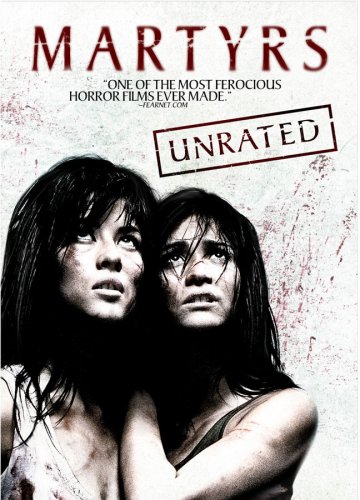
The current wave of extreme French horror marches triumphantly on. The latest wave-making entry is the Franco-Canadian production Martyrs, and it is as nasty as it is a vital piece of filmmaking. Writer/director Pascal Laugier, whose previous film was the honorable but not entirely successful House of Voices, here reveals himself as a force to be reckoned with. Horror fans, the genre is healthy and out to get your.
Pretty much every piece I've read on the film has been very circumspect about the plot, and I will not be the one to break ranks. I will summarize the set-up as have most others: a young girl escapes from a scene of horrific abuse. Years later, the now-grown woman (Mylène Jampanoï) in the company of her best friend (Morjana Alaoui, in an astonishing performance), shows up at the door of the people she believes were responsible for her torture.