Posted in: Disc Reviews by David Annandale on April 15th, 2008
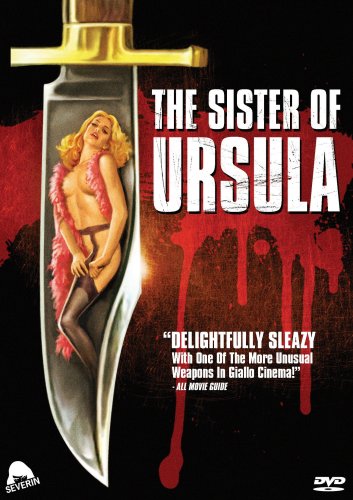
Still grieving over their father’s death, two sisters – the outgoing Dagmar (Stefania D’Amario) and the neurotic, antisocial Ursula (Barbara Magnolfi) – check into an out-of-season hotel. They are almost immediately immersed in a tangled web of relationships and betrayals involving the hotel manager, his estranged wife, a lounge singer and a drug-addicted patron. At the same time, a series of gruesome sex slayings gets underway.
Writer/director Enzo Milioni’s first film is a clumsy giallo. The elements are all there – psychosexual delerium, black-gloved killer, beautiful cast. So too is the aura of misogyny that haunts so much of the genre – the killings here all involve lethal penetration, and while the murders are generally dealt with relative restraint (a hilarious shadow of a looming erection followed by fade to black), there are, late in the film, a number of particularly tasteless shots of naked victims with bloody crotches. Charming. The ineptness of the filmmaking, however, robs these moments of much of their power: the sex scenes are dull and saddled with the same irritating score every time; the editing is rife with nonsensical cutaways (one of which unintentionally suggests that a dog has been masterminding a drug deal); and the story is so choppily told that characterization varies between the risible and the nonexistent. Add to this a resolution that even the most casual viewer of gialli will see coming a mile away, and you have a pretty weak entry. And yet, for all that, there is that delicious ineffable whiff of 70's Italian exploitation that makes even the weakest entries plenty of fun.
Posted in: Brain Blasters by David Annandale on April 11th, 2008
And so the remakes continue apace. While we shudder at the prospect of butchered returns to Suspiria and the like, this weekend we can head on over to Prom Night and pretend it’s 1980, particularly since, by all reports, a not-very-good movie has been redone as an awful one. But it didn’t have to be this way, which is what motivates today’s musings. Let’s say I’m in a if-you-can’t-beat-‘em-join-‘em frame of mind. If the remakes are going to happen, the subjects of the remakes might as well deserve it. Prom Night is a case in point: it’s not like they were messing with a classic here. The Amityville Horror is another example. The original, though dear to my heart, is, if I’m being brutally honest, not exactly what one could call “good.” And yet the remake was even worse.

Go figure.
Posted in: Disc Reviews by David Annandale on April 10th, 2008
Sean Patrick Flanery is Harry Balbo, an introverted nobody at a nothing job where he constantly mocked by the unfunny office clown. One night, on his way home from the convenience store, he sees a female vampire rip off a homeless man's head. No one believes him, and his feelings move from frustration to terror when, a couple of nights later, he sees her at work again, and she scratches his face, marking him. He turns to crippled vampire investigator Michael Biehn for help, and eventually captures the vampire. Unable to bring himself to kill her, he is torn between sacrificing himself or others to her bloodlust.
This is a film that finds its strengths in its incidentals. Harry's depressing work environment, the tossed away dialogue from minor characters, the little humiliations of his life and his eccentric little obsessions all work well, and are very funny. The actual vampire storyline isn't quite as fresh and witty, though nestled in such an enjoyable context, it works well enough.
Posted in: Brain Blasters by David Annandale on April 5th, 2008
Severed hand films. Gotta love 'em. Not because they're necessarily good, as such. The ones that have been (the various versions of The Hands of Orlac, or The Beast with Five Fingers) have been, ultimately, psychological thrillers. There have been honest-to-god crawling hands, of course, in wonders such as Evil Dead 2: Dead By Dawn, but Bruce Campbell's misbehaving limb was a supporting character, rather than the central menace. But I return to my initial statement. Even if the film isn't that good (or good at all), you have to love it for the crawling hand.
Posted in: Brain Blasters by David Annandale on March 28th, 2008
Let’s consider today’s exercise a companion piece to my colleague’s excellent Dare to Play the Game column. That’s by way of saying to that I’m going to risk slightly poaching on his turf by considering a tangentially game-related topic.
I’m probably not going too far out on a limb to assume that just about anyone with access to an Xbox 360 or a sufficiently powerful PC played Bioshock at some point in the last year. Among its many qualities, Bioshock is one of the best-written games to have come down the pike, and one of its not-inconsiderable delights is the dialogue it engages with the ideas of Ayn Rand. Specifically, it is her magnum opus Atlas Shrugged that provides most of the game’s philosophical fodder. Anyone with the time to slog through the book’s utterly lunatic thousand-plus pages will surely find their appreciation of the game increased (and this is one of those rare cases where the writing, characterization and ideas of a game are consistently better than the work of literature it is bouncing off). And the book is so insane that is has an absolutely compulsive, Biggest Train Wreck Ever appeal. But let’s pretend you don’t have that much of your life to give up to an experience that can best be described as the philosophical equivalent of high camp. There is a more time-efficient alternative.
Posted in: Disc Reviews by David Annandale on March 28th, 2008
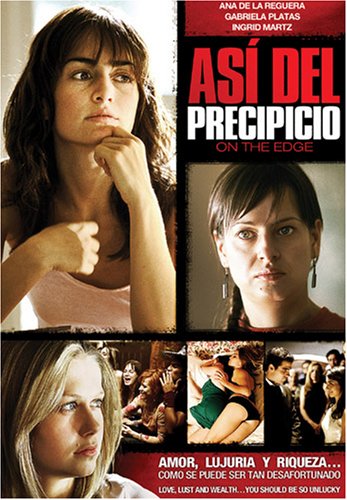
Three female friends are there for each other’s personal storms. One is a coke-addled sensation addict, one aspires to be an artist (and does her share of powder too) and the third is taking refuge from an unhappy marriage and questioning her sexual identity. Many scenes of heightened emotion are the order of the day.
The title (translated as “On the Edge”) recalls Women on the Verge of a Nervous Breakdown, but Teresa Suarez isn’t quite in Pedro Almodovar’s league. The film has some fine comic moments (I’m thinking of one dream sequence in particular), and plenty of energy, but some of that is second-hand: a coke-frenzied drive early in the film more than slightly recalls Ray Liotta’s paranoid excursion in GoodFellas. Further, despite the universally vile male characters in the film, many of the protagonists’ problems are so obviously of their own making that they are hard to care for.
Posted in: Disc Reviews by David Annandale on March 21st, 2008
A tough-as-nails cowboy (James Denton) unwillingly hooks up with a naive greenhorn (Chris Kattan) when they have a run-in with a bent sheriff. They may think they have some problems now, but things are much worse than they think, as the town and the surrounding countryside are in the initial stages of a zombie plague.
Simon Pegg and company might well be starting to rue the day they came up with Shaun of the Dead. Though not the first zombie comedy (that would probably be Return of the Living Dead if we exclude some non-cannibal zombies appearing in some 30s horror-comedies), their magnificent film and its success are the proximate cause of the current flood of would be “zombedies” (as this flick labels itself). A western zombie comedy might seem like a promising mix, until one realizes how few western comedies have actually worked, and this one isn’t breaking the trend. Its opening scene (a clumsy zombie attacking his family) veers uncertainly from the tired slapstick to the truly distasteful, and the rest of the film has all the comedic zing of dragged out SNL skit (Chris Kattan, I am casting my baleful eye at YOU). Turgid stuff.
Posted in: Brain Blasters by David Annandale on March 21st, 2008
Time to praise another journeyman performer, another unsung hero of the heterodox film scene. Today: Robert A. Silverman. He’s been kicking around the scene for ages, popping up in everything from Prom Night to Waterworld to Jason X. But his most memorable work consists of the sterling character turns he has done for David Cronenberg.
Silverman has been appearing in Cronenberg’s world since Rabid (1977), where he is an unconcerned hospital roommate to Marilyn Chambers’ first contaminated victim. His role is short, but is one of the rare genuinely comic moments in a very black film, and Silverman would continue to bring a dash of off-kilter humour to his roles for Cronenberg.
Posted in: Brain Blasters by David Annandale on March 14th, 2008
So last week, I looked at Universal’s latest collection of their vintage SF movies, a set unfortunately limited to a Best Buy exclusive. We have another one of those today: the Universal Horror Classic Movie Archive. It, too, can be tracked down pretty easily through the Amazon marketplace.
Back in the mid-90s was when the films on all of these collections were first showing up in a home video format. It was a great time for collectors (barring that chilling moment when, for a little while, the only version of the original Dracula available was the one with the new Philip Glass score). Now, there are only so many films from that era (30s and 40s for horror, 50s for SF) that legitimately qualify as classics, so more and more B-level pictures followed in the wake of their more famous brethren. There is nothing wrong with this, as the opportunity finally came for many of us to see these things for the first time, and minor gems would inevitably crop up.
Posted in: Disc Reviews by David Annandale on March 14th, 2008
Here are four films from renowned maverick Jean-Luc Godard. Insofar as these films have plots in the conventional sense of the word, Passion is about a filmmaker struggling to rediscover his love for his profession, First Name: Carmen plays with the tale of that same name to tell another story of filmmaking and bank robbery, Detective is an idiosyncratic tribute to films noirs, and Oh, Woe Is Me is about a man who may or may not be possessed by a god wanting to seduce his wife.
Samuel Johnson once remarked that anyone reading Samuel Richardson’s Clarissa for its plot would be moved to suicide, and that is certainly the case for anyone trying to watch Godard for story. That is not what he’s interested in. These films, all from his late period (ranging from 1982 to 1993), are postmodern, allegorico-politico-philosophical musings on the human condition. Narratives fragment; soundtracks are multi-layered, with dialogue that is dense, sometimes obscured, and often opaque; and there is plenty of provocation. These are films that are probably not terribly inviting for newcomers to Godard. If you already have the likes of Weekend under your belt, you’ll be fine. If this is your first time, your might well reject the filmmaker as a pretentious twit.