Posts by David Annandale

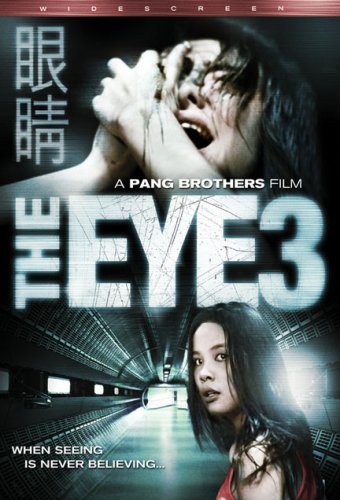
The Pang brothers return with one more instalment to their series of ghost tales. This one also goes under the title of The Eye 10 (and The Eye: Infinity), which is actually the more accurate nomenclature, given the sheer number of hauntings that are present here. A group of friends on vacation in Thailand regale each other with ghost stories. Their host then produces a book that lists the ten ways of seeing ghosts. The group, whose instinct for self-preservation could do with some strengthening, proceed to put the book to the test. They get far more than they bargained for.

In the making-of featurettes that accompany the film, the Pangs talk about how they had too many ideas to fit into the first two instalments of the franchise. So here they have a structure that allows them to pack in a cornucopia of summonings and hauntings. Some of the manifestations are undeniably effective, and there are some pretty decent jolts. On the other hand, the Pangs recycle some of their greatest hits, sometimes to deliberately humorous effect. The tone generally is much lighter than before, but the humour has a tendency to disrupt scenes that are building up a good head of terror. The film is thus a frustrating mixed bag, where flashes of the Pang brilliance are present, but there are also plenty of moments where the brothers seem to be just going through the motions, when they aren't taking the piss entirely.

Last week: the lovably pathetic spectacle that was Airport 1975. This week: Airport ‘77. “Bigger and more exciting than Airport 1975!” boasted the trailer. And for once, the publicity was right. That doesn’t mean the film is good, as such. But it does represent an interesting exception to the law of diminishing returns when it comes to franchises. Three movies in, and we encounter as close to a high point as the franchise is going to get.

The premise is, unsurprisingly, ludicrous, but it is ludicrous in an engaging fashion, and in its naivete is the sort of thing that might have appealed to the Surrealists. Multi-millionaire Jimmy Stewart is Giving Back To Society by putting his priceless art collection on public display... in his private and apparently rather inaccessible home. But hey, it’s the thought that counts. Anyway, he’s flying his collection and an assortment of guests to the opening on his private 747, a plane redesigned to serve as a flying hotel/conference hall. What this means is that the passenger compartment looks like a cocktail lounge, complete with grand piano (which was presumably installed there by the same method ships are placed in bottles). This is a useful (if ridiculous) conceit, because it means that rather than have a bunch of anonymous passengers with a few singled out for attention, now every passenger is an actual character, no matter how thinly sketched in.

So, last time, we examined Airport, which I see as something of a proto-disaster film. While it is in many ways the fountainhead of the 70s cycle, the disaster itself is a third act development. The same is not true of its follow-up: Airport 1975 (1974). This flick emerged at the height of the disaster movie craze (the same year as Earthquake and The Towering Inferno). There's no ambiguity here. It's all about its disaster. It's also quite rightly featured in a little tome entitled The 50 Worst Movies of All Time.

There are two forms of mangled wreckage here. One is relatively minor, and that's the damage the film's 747 suffers when Dana Andrews suffers a heart attack and slams his private plane into the cockpit of the jet. The other is decidedly major, and that's to the careers and dignity of the cast. Showing up for the violation are Charlton Heston, Karen Black, Linda Blair, Myrna Loy, Sid Caesar, Erik Estrada, Gloria Swanson (her last film), Helen Reddy and, it goes without saying, George Kennedy.

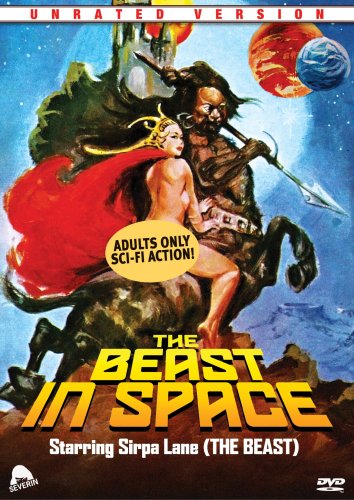
There really was nothing like the Italian film industry in full exploitative steam. The Beast in Space is a perfect example of what I mean. From where else but Italy in 1980 could there emerge a low-rent rip-off of both Walerian Borowczyk’s high-end erotic epic The Beast and Star Wars? Even the poster somehow manages to conjure thoughts of both films. And the title shamelessly implies that it is some sort of sequel to the former. So what kind of alchemy do these elements produce?

Nothing particularly enticing, beyond its considerable value as demented trash novelty. The plot is a surprisingly convoluted bit of nonsense involving and expedition to a planet that has been producing far too much of a supposedly rare mineral. Meanwhile crew member Sirpa Lane (of The Beast) is having bad dreams about being ravished by some sort of satyr-like creature. None of this ever makes any sense, nor is the combination of gruesomely bad FX and costume design with gruesomely boring sex scenes particularly entertaining. But the release is still worthwhile, if only to prove that There Are Such Things.

Recently, I've had occasion to go back and revisit the Airport franchise. The 70s disaster movie arguably came into being with the first film (though the first pure disaster film of that era is more properly The Poseidon Adventure). If the peak of that cycle of cinematic carnage was Irwin Allen's The Towering Inferno, and its spectacularly lovable nadir is Allen's The Swarm, the Airport movies fell somewhere between the two. The best are the first (Airport itself) and third (Airport '77). The other two – Airport 1975 and The Concorde: Airport '79 – approach The Swarm's level of cosmic ineptitude.

Today, let's get back to the roots with Airport. As mentioned above, it is not, strictly speaking, a disaster movie in the same sense that the rest of the franchise entries are. Sure, there's a bomber aboard the plane piloted by Dean Martin, but the threat doesn't surface until relatively late in the film, and is but one of many intertwining storylines. The sequels would move the catastrophe very much to the centre of the action.

I'm very late to the party here, but I've never been shy about jumping on a bandwagon (if I might so mix my metaphors), especially one as spectacularly kitted out as this one, so allow me to add my voice to the legion who are chanting the praises of Inside (French title: A l'intérieur). Directed by Julien Maury and Alexandre Bustillo, this brutally effective piece is yet further evidence that the creative vanguard of the horror film has shifted from Asia to French-speaking Europe.

In the wake of such merciless pieces as High Tension and the Belgian Calvaire comes this even more unforgiving film. Alysson Paradis has just lost her husband in a car accident that miraculously spared her unborn child. It's Christmas Eve, the Paris suburbs are ablaze with riots, and Paradis is going to be induced the following day. She returns home from her doctor's appointment, and is just settling down when the doorbell rings. A strange woman (Betty Blue's Béatrice Dalle) asks to come in to use the phone. When Paradis, justifiably nervous, turns her down, Dalle calls her by name and demands to be let in. And so the siege begins. Before long, Dalle has made her way into the house. Her goal: to slice open Paradis' belly and steal the child.

All right, I know this horse is so dead it’s glue, and I’m one of the killers, but after calling for a remake last week, I have to at least go on record with my extreme dread over some others coming down the pike.

My principle in this series has been to look at films that were botched the first time around, but nevertheless contained a germ of something that might actually blossom into a wonderful piece of work, given the right team. Meanwhile, there are some projects that sound wacky enough that they just might work, but don’t (hello, Neil LaBute’s Wicker Man). And then there are those that are doomed from the start.


A government project goes badly awry, as all government projects do, and, just as inevitably, a plague of zombies is loosed upon the local community. A group of high school students are the only ones able to mount any kind of defense against the flesh-eating ghouls. Sounds reasonable to me.

Writer/editor/director Steven C. Miller and friends put this together for a mere $30 0000, and for that, they should be applauded. The effort is surprisingly slick and sick, and many of the gore effects are effectively done. The zombies themselves, though, are a bit slapdash in appearance. The high school characters are so familiar, furthermore, that they barely qualify as characters. Then there’s the odd decision to shoot the action so that all movements have the herky-jerky, headache-causing aspects that suggests that the entire film was shot on a cell phone. And did I mention that the film ends on a “To Be Continued” cliffhanger?

Two weeks ago, I proposed that, if remakes were inevitable, the subjects of said remakes might as well be worthy of that treatment. In other words, if the original is mediocre or worse to start with, no harm done. And maybe we’ll finally wind up with a good film. Granted, experience hasn’t given us much cause for optimism in this department, but hope springs eternal, even in the face of terrible odds, otherwise the human race would have committed collective suicide long ago.

Today’s proposal, then, concerns, Ghost Story. The 1981 adaptation of Peter Straub’s 1979 novel is, not to put too fine a point on it, an abomination. I heaped a great deal of scorn on The Sentinel’s head, and purely at the level of filmmaking, it is the more egregious offender of the two here. But as an adaptation, and as an exercise in missed potential, Ghost Story is the greater sinner. Both films squander impressive casts. But whereas The Sentinel lumped in seasoned trash performers with people who must have wandered onto the wrong set, Ghost Story gathers together legends of cinema (Fred Astaire, Melvyn Douglas, Douglas Fairbanks Jr., John Houseman, Patricia Neal) to no good purpose. It what would prove to be a career-defining role, Alice Krige plays the menace. In the decades that would follow, she would turn in more than her share of horror femme fatales (Silent Hill being one of the most recent examples). And whatever else one might say about it (which is quite a bit), The Sentinel is at least reasonably faithful to its source material. This is, of course, one of its problems – a classic case of Garbage In, Garbage Out. But Ghost Story is guilty of something far worse.

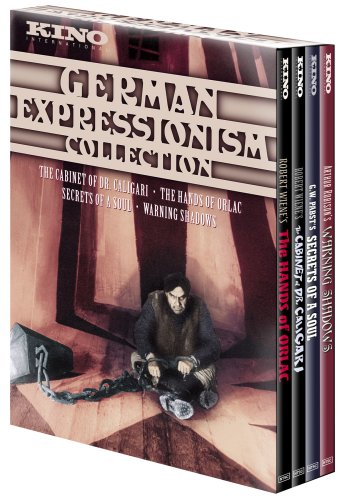
Kino has long been the go-to company for first-rate DVD editions of classic films, with a special emphasis on the silent era. Recently, they have released a box set that is something of a wet dream for fans of vintage, hard-to-find cinema: the German Expressionism Collection.

There are four films here, and the first is the most inevitable: The Cabinet of Dr. Caligari (1919), which is where expressionism first arrives on film. I doubt readers of this column need an introduction to this tale of a mad hypnotist and the homicidal somnambulist under his spell, and anyone interested in this set will no doubt already own a copy of this film. This is a nice print, with two soundtracks (a new one, and a contemporary one). One of the extras on the disc is a 43-minute version of director Robert Wiene’s 1920 Genuine: The Tale of a Vampire. Though this is still a condensation, it is a huge step up from Image’s 1996 edition which offered only a 3-minute excerpt of that film.