Posted in: Brain Blasters by David Annandale on November 2nd, 2007
It must stop! Somebody has to take a stand, and I guess that somebody has to be me. But surely I will not be alone. Surely I will have comrades aplenty in my march to justice. Surely the day of victory cannot be too far over the horizon. With courage and determination, we can stamp out the scourge. What scourge? Surely I don’t have to spell it out. Surely you know I am referring to the twist ending.
And one particular brand of twist ending, at that.
Posted in: Random Fun by David Annandale on October 30th, 2007
Okay, title got your attention? Good. Now the disclaimer. I was thinking of calling this piece “Ten Horrors From the Path Less Travelled,” but that would have been a bit precious. I’m not going to pretend that the serious horror fans out there are unfamiliar with these titles. Nor is this list meant really and truly as a “Top Ten” (see, two lies already in my title). But consider this a reminder that there’s something other than the umpteenth rental of The Exorcist or latest iteration of Saw out there for your Halloween pleasure. So here, chronological order, are ten fine films for the season.
Posted in: Disc Reviews by David Annandale on October 30th, 2007
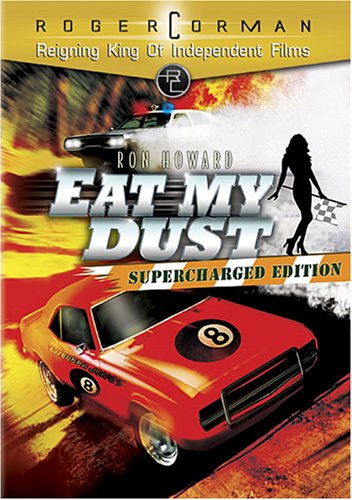
Ron Howard’s move from sitcom star to director began with playing the lead in this Roger Corman-produced car chase flick, after which he would move to behind the camera to direct Grand Theft Auto. Here he plays the son of the local sheriff. In an effort to impress the girl of his dreams (Christopher Norris, and yes, that’s a woman’s name), he steals a stock car, and he and his friends then lead the authorities on a merry chase. As is typical of Corman productions, this works hard at delivering, on a stringent budget, exactly what its audience wants. Writer/director Charles B. Griffith was responsible for some of the better scripts to come out of the Corman stable (It Conquered the World, Little Shop of Horrors, Death Race 2000), and some of his trademark wit is on display here, but without the snap of the better films. It feels much more forced and laboured. The film clips along just fine, but today is little more than a curiosity.
Audio
Posted in: Brain Blasters, Regular Columns by David Annandale on October 26th, 2007
I know that some of what I’m going to touch on today is going to overlap with past topics, and so I beg your indulgence. But recent DVD releases have prompted some thoughts on the phenomenon of double-dipping. This is not something that is by any means exclusive to the cult movie scene, but plenty of it goes on here. Consider the umpteen “definitive” editions of Halloween that Anchor Bay has trotted out. But I want to look at a three cases, two of which are admittedly mainstream (though not unrelated to this column’s field), with the third representing an overt stab at cult immortality.
We can deal with the first quite quickly, as it represents one of the most egregious, insulting approaches to double-dipping I have yet to hear of. The current release of David Fincher’s Zodiac has the unmitigated gall to advertise a feature-packed director’s cut to be released in 2008. How’s that for a kick in the face to anyone who bought this? Bring the DVD home, pop it in the player, and be confronted with a product that promotes its own inferiority. That’s some kinda nerve. And the mere fact that it is so brazen points to how unfortunately commonplace the phenomenon has become.
Posted in: Disc Reviews by David Annandale on October 26th, 2007
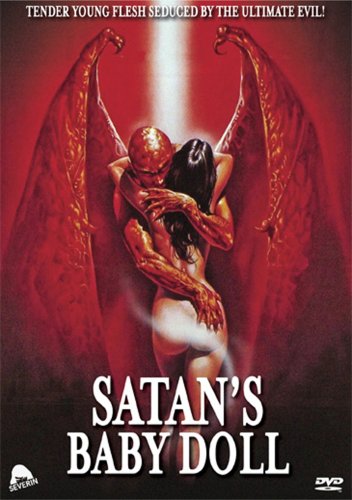
Mario Bianchi’s film is a 1982 remake of the recently reviewed Malabimba. The spirit of a newly deceased woman possesses her daughter, and proceeds to wreak havoc in the gothic castle that is the family’s domicile. Of course, given that the father is a murderous drug-addict, there isn’t that much for the possessed teen to do, as far as the plot itself is concerned. Curiously, this effort is less lurid than its predecessor (barring a couple of insanely OTT performances), with less nudity and taboo-busting, and also a rather less interesting deconstruction of respectable society. Plotting and motivation are haphazard at best. Still, it’s a not-unentertaining late-period Italian gothic, blessed with handsome sets.
Audio
Posted in: Disc Reviews by David Annandale on October 25th, 2007
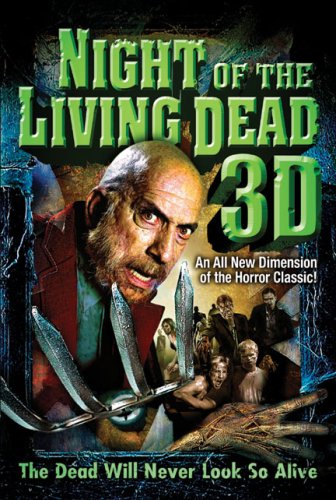
There are plenty of reasons to be grateful for public domain rules, as they make plenty of movies easily available that wouldn’t be otherwise. But there are pitfalls as well, and there is no clearer example of this than what has befallen George A. Romero’s classic film. The great man barely saw a dime from his work, but all and sundry can fiddle with Night of the Living Dead as they see fit, and here is a textbook case. The basic premise is intact: young woman and her brother visit cemetery, are attacked by zombies, and heroine winds up part of a besieged group. Sid Haig lends his presence to liven things up a bit, but he have any real role to play until the movie is almost half-over, by which point many viewers will be sunk in boredom. The zombie attacks are tediously realized, and this is easily the most gore-free version of the story. So what is more pointless than a flesh-eating zombie film with almost no flesh-eating? A zombie movie with a twist, that’s what. Talk about pointless. A twist is to zombie movies what bicycles are to fish, but here we are stuck with one, just to irritate us further. The 3D has novelty value, and will be discussed further below, but that’s about it.
Audio
Posted in: Disc Reviews by David Annandale on October 19th, 2007
Connoisseurs of Eurosleaze will be pleased with this nasty little variation on the gothic. In an isolated castle, a fractious, failing aristocratic family has gathered. There is no more money in the family, except indirectly: one brother, now in a vegetative state, is married to a rather wanton woman, who now holds the purse strings. The matriarch suggests that her other son marry her, even though his brother is still alive. The man is properly horrified by the suggestion, and he is also still in mourning for his wife. But then something – the spirit of his wife? a demon? – invades his teenage daughter, who then starts acting out sexually and recreating scenes from The Exorcist.
Nothing hugely original here, and many scenes are SO blatant in copying The Exorcist that one might as well assume that Friedkin’s film was the last word on possession symptoms. What is interesting, though, is that, unlike Friedkin’s film, the connection between the possession and the hypocrisy of the upper class is made perfectly explicit (in every sense). In fact, much of the misbehaviour on display has nothing whatever to do with the demon – it serves primarily to force the characters into a realization of what they really are.
Posted in: Brain Blasters by David Annandale on October 19th, 2007
When, in the 1950s, television became widespread and began to take a serious chunk of the audience away from cinemas, the movies fought back in a number of ways. Gimmicks were rife (hello, William Castle). Colour became standard. Widescreen arrived. But other than colour and widescreen, every other innovation turned out to be a brief novelty, never to be seen again. There was once exception, a gimmick that was more popular than most, never became a standard, but refuses to die, resurfacing again and again after periods of dormancy, and that’s 3-D.

Over fifty years after Arch Obler (ironically, the king of radio suspense) unleashed Bwana Devil, there are signs that 3-D might finally be achieving a somewhat more stable position in theatres. It’s a long way from being a mainstream standard, but it has found a niche. Saunter down to your local IMAX and check out the offerings. Most of them will be in 3-D, and that includes blockbuster films (though in their case, the extra dimension turns up only in selected scenes). In IMAX, 3-D has finally lived up to its potential. Gone are the awkward red-and-blue-lensed cardboard glasses. In their place are gigantic plastic units not unlike goggles, that fit very comfortably over the viewer’s own glasses. Gone, too, is the headache-inducing effect of old-school 3-D. The current release Sea Monsters: A Prehistoric Adventure deploys 3-D as we always imagined it might be. The effect absolutely convincing, and absolutely immersive.
Posted in: Brain Blasters by David Annandale on October 12th, 2007
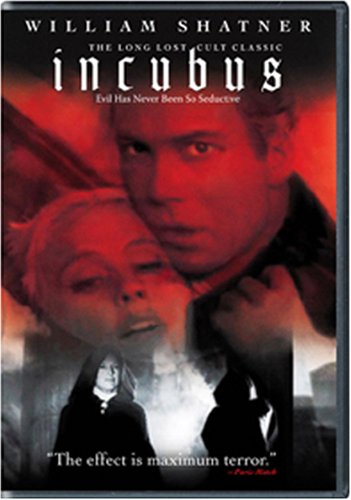
One of the great oddities of film from the 1960s (or, indeed, ever) is a modest little horror film by the name of Incubus. Emerging in 1965, it was shot in Big Sur, and tells the mythic tale of a young soldier returning home to become the target of a female demon. His innate goodness, however, winds up seducing the demon instead, and the titular male demon vows revenge, specifically targeting the soldier’s blind sister. This is already a somewhat odd tale for a mid-sixties American horror film, and the fairy-tale setting is even more unusual. But the real oddities are yet to come. The lead is played by a William Shatner (in his last film before Star Trek). And all of the dialogue is in the artificial language Esperanto.
Why Esperanto? Why indeed. Phil Hardy cites director Leslie Stevens (the creator of The Outer Limits) as describing the language as “at once imaginary and universal, out of time and space.” There is no doubt that film’s effect is precisely that. The world the viewer moves through is completely alien, even if the settings themselves (forests, seasides) are very familiar. When I called the film a fairy tale, I did so advisedly. This is one of the most fairy tale-like horror films ever made (and horror partakes of that form of storytelling more than just about any other genre). This is thus a tale of no place and every place, of no time and every time. It takes very little time for the viewer to get past the strange spectacle of Shatner spouting Esperanto (doing so very naturally, I might add) and be swallowed up by this strange world.
Posted in: Disc Reviews by David Annandale on October 12th, 2007
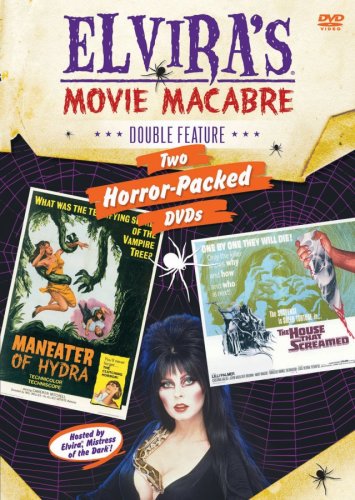
So here we have another double feature of episodes from Movie Macabre, with Elvira this time taking on Maneater of Hydra (1966) and The House That Screamed (1969). The former has the disconcerting spectacle of Cameron Mitchell appearing not only as a baron (ookaaayyy) but being dubbed. He’s experimenting with plants on his remote Greek island, and a group of tourists run afoul of one of his results. Given how long it takes for the titular plant to show up and relieve the dullness, one starts to wonder if the title doesn’t refer instead to one of the hot-to-trot tourists.
The House That Screamed, meanwhile, is a Spanish effort that is something of a period giallo. The setting is a private girls’ school where a series of brutal murders take place. The production is handsome enough, though its concept is no less sleazy for all that.