Posted in: Disc Reviews by David Annandale on November 22nd, 2007
Severin unleashes three more entries from Italy’s long-running sexploitation saga, and the result is another fascinating collection. The quality of the movies themselves up and down, but the good stuff is very good, and the collective result is something that is completely fascinating. Exploitation fans should be over the moon.
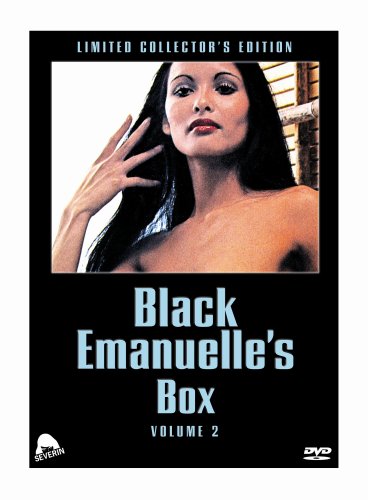
I’ve already gone on at length about Black Emmanuelle/White Emmanuelle (1976) elsewhere, so I won’t rehash everything again. Briefly, though, the set-up has Laura Gemser as Emanuelle (let’s stick to the single “m” version to avoid confusion with Sylvia Kristel), here a model instead of a journalist, arriving with SOB photographer boyfriend at the palatial home of some friends in Egypt. Much aristocratic ennui ensues, until Laure (Annie Belle) arrives to tear down everyone’s comfortable illusions. The most nicely shot and intelligently scripted of the films, there is something absolutely mesmerizing about the display of decadent self-loathing proposed here. Writer/director Brunello Rondi’s effort is emphatically a high point of the series, and invites repeated viewings.
Posted in: Disc Reviews by David Annandale on November 21st, 2007
This collection of SpongeBob cartoons has a distinct musical theme, underlined by the main offering, “Atlantis SquarePantis,” a 2-part episode that just aired. SpongeBob and friends travel to Atlantis on a song-powered bus (but of course!) and witness the many marvels of the lost city. Their tour guide is Lord Royal Highness (voiced by David Bowie). The action is cheerfully episodic, and many of the song sequences are very funny (one highlight being Sandy’s ditty which occurs with the cast transported into a 1991 video game). The other shorts are pretty fun, too, with the highlight being “Sing a Song of Patrick,” wherein the starfish writes his own pop tune, with hilariously catastrophic results.
Audio
Posted in: Brain Blasters by David Annandale on November 17th, 2007
So I’m in the middle of working my way through Severin’s latest Black Emanuelle box set, and a screening of Black Emmanuelle/White Emmanuelle (actual title Black Velvet) has prompted these musings, which I inflict on you here rather than in the review itself. Now, European sexploitation movies from the 70s aren’t exactly the deepest experience going, but there’s plenty of food for thought in this film, even despite (or because of) its flaws.
First, let’s consider the characters. Laura Gemser reprises her role yet again as Emanuelle (ignore the second “m” of the title). But whereas in the other entries of the series (particularly the Joe D’Amato ones) she is a photojournalist. Here, she’s a supermodel. This is a pretty significant switch. Now, I’m not about to make any kind of crazy argument about the gender sensitivity of D’Amato’s films. However, as a photographer, Emanuelle controls the gaze. She is using the camera, hers is the active look, and her investigations are usually what power such plots as the films possess. That said, she is very much subject to the male gaze of the actual camera. In Brunello Rondi’s film, she is a very passive figure, figuratively and literally abused and raped by the male photographer, Carlo. So, the question arises, is this an undermining of the character (though Gemser is called on to deliver a much more varied performance than is usually the case), or is it a more honest appraisal of the actual nature of Gemser’s position in a sexploitation film?
Posted in: Disc Reviews by David Annandale on November 14th, 2007
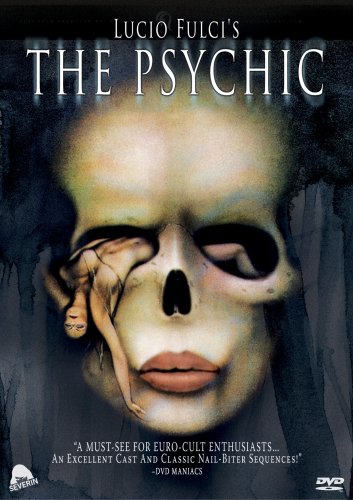
As a woman commits suicide by leaping to her death on the English seacoast, her daughter in Italy has a vision of her fall. Years later, the now-grown Virginia (Jennifer O’Neill) is married to a wealthy businessman, and is suddenly plagued by visions again. Following the evidence, she discovers the skeleton of a young woman who has been walled up in her husband’s ancestral home for years. He is immediately arrested. Virginia works to prove his innocence by investigating the other mysteries of her visions, but she is letting herself in for more than she bargained for.
Having made quite a name for itself as a purveyor of lovely editions of classic European sexploitation, Severin branches out in spectacular fashion with this 1977 effort by Lucio Fulci. Fans of the director who know him exclusively for films such as Zombie and The Beyond will no doubt be disappointed by the lack of extreme gore. (Exception: the opening suicide, which delivers a nasty jolt as we see the woman’s face smash against the rocks as she falls. Unfortunately, Fulci has to show us the effect more than once, and it loses its effectiveness as its artificiality becomes clear.) But, as clearly derivative as it is of both Nicholas Roeg’s Don’t Look Now and Dario Argento’s Deep Red, this is still evidence that Fulci was more than capable of assembling a film that is gripping at the level of narrative and suspense. Unlike Don’t Look Now, where we are kept as much in the dark as its protagonist as to what the visions mean, here Fulci makes sure we are a few steps ahead of Virginia. We realize quite early that what she saw was a vision of the future, not the past, and watch helplessly as the strands of fate wind inexorably around her. There may not be much to her character, but her plight is so clearly articulated and so unstoppable that we cannot help but feel a soul-deep dread. A excellent slice of Eurohorror.
Posted in: Disc Reviews by David Annandale on November 12th, 2007
After going all the way back to the 20s with the last entry in this series, now Cult Epics gives us a collection from 1960s, a period that marks the beginning of the end for this kind of pornographic short. Theatrical hardcore is just around the corner, and things will never be the same. In the meantime, though, things are remarkably the same. Other than some clothing styles (in those brief moments when clothes are actually on), it’s interesting to note that there is very little to distinguish these twelve entries from those of any other decade, a point driven home by the bonus short from the 1940s, which doesn’t feel very different from the rest of the offerings. Artistically, there is not much going on here (surprise, surprise), but the star rating indicates the fact that, despite this, there is some clear archival value here.

Audio
In the manner of the 1920s release, the audio track that had been standard for the rest of this series (the sound of film running through a projector) has been replaced with a music score. In this instance, it’s a series of swinging grooves, very much in keeping with the 60s, and acting as one of the only reminders of when these movies were actually made. The music is treated well by the 2.0 mix. The movies themselves are, of course, silent.
Video
Posted in: Brain Blasters, Regular Columns by David Annandale on November 9th, 2007
Many a month back, I talked about some essential reading material for fans of the cult/exploitation scene. Time (past time, actually) for an update on that subject, because there’s a recent book out there that, while taking nothing away from the excellent Sleazoid Express and Bold! Daring! Shocking! True!, at the same time sets the bar impossibly high for anyone else wanting to contribute to the field.
Stephen Thrower, having already graced us with Beyond Terror: The Films of Lucio Fulci (an exhaustive, and to this day unchallenged, study of the director), now weighs in with the monumental Nightmare USA: The Untold Story of the Exploitation Independents. The book is enormous in every sense. There’s the sheer scale: a coffee table format tome that, at 528 pages, threatens to shatter any coffee table it is place on. And this is only the first of a proposed two volumes! Enormous too is the depth: 23 in-depth studies/interviews with specific filmmakers make up the bulk of the book, but these are followed by 118 reviews that are not mere capsules – many of these pieces are essays unto themselves.
Posted in: Disc Reviews by David Annandale on November 8th, 2007
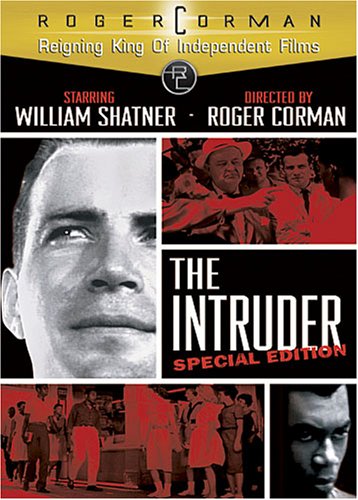
Roger Corman is fond of saying that only one of his movies ever lost money. It was this 1962 release (shot in 1961), and it is his bravest film, and still arguably his most powerful. William Shatner plays Adam Cramer, a white supremacist associated with the “Patrick Henry Society” (read: John Birch Society), who arrives in the southern town of Caxton on the eve of racial integration of the school. The demagogue whips up the hatred of the white townspeople, leading to cross-burning, church-bombing, and worse.
Corman’s film has lost none of its power to shock and appal. Nor has it lost its power to amaze. An absolutely blistering condemnation of bigotry, it makes the likes of Mississippi Burning look mealy-mouthed by comparison, and its unblinking political directness is all the more astounding for when and where it was made. As we learn from the accompanying featurette, the cast and crew operated under the constant threat of violence, and the sort of events they were depicting were actually taking place nearby. One of the first cinematic statements on the struggle for civil rights, it is still hard to find another film as raw and as uncompromised as this. And those whose only impression of William Shatner is of a shameless ham are in for a revelation. His performance is a satanic mixture of charm, smarm, self-love and seething, explosive hatred. He incarnates a textbook definition of “evil charisma.”
Posted in: Disc Reviews by David Annandale on November 7th, 2007
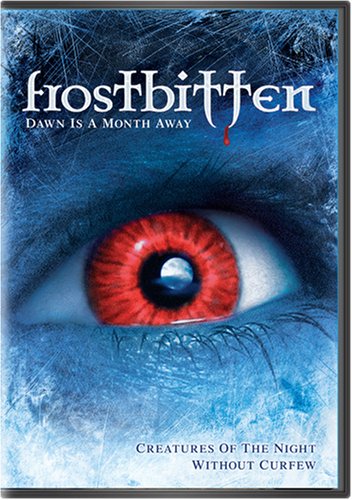
Stop me if this sounds familiar: in a far-northern community, night lasts thirty days, which makes the area highly hospitable to vampires. Yes, Frostbitten shares a very similar premise to the excellent 30 Days of Night. And while the Swedish film predates its American counterpart, it is more recent than the graphic novel. At any rate, the similarities pretty much end there, as Frostbitten is more interested in comedy than its cousin, and is also nowhere near as good.
The prologue is promising, with Scandinavian volunteers in the German army during WWII becoming lost and encountering vampires in a remote cabin. Flash forward, and the surviving member of the unit is now a respected geneticist performing experiments that only he knows the truth about on rather unusual patients. A teenager and her divorced mother arrive in the community just in time for all hell to break loose. Said hell does feature some inventive and humorous moments, but the film is hamstrung by dead clichés when it shifts its focus to the local high school and the group of characters we have seen far too many times before and never want to see again.
Posted in: Disc Reviews by David Annandale on November 6th, 2007
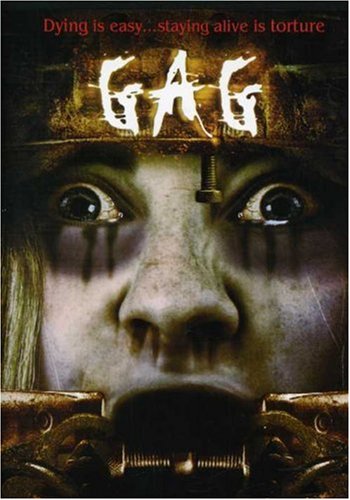
Hmm. A vision of elaborate torture in washed-out tones on the cover. A three-letter title. Gee, could Gag be inspired by Saw? Perhaps, but fortunately not in any slavish way, limiting its connections to the idea of extended torture, and that’s hardly something Saw invented. As opposed to the Saw franchise’s increasingly risible plot convolutions, Gag keeps its setup simple: a pair a burglars break into a house where they first discover a man chained to a bed, and then are captured themselves by the resident nutjob. The ensuing drama is a claustrophobic one, with the main characters trapped in the torture room at the mercy of a lunatic who has a definite, if mysterious, goal.
The film handles the grime and oppression quite nicely, and the torture scenes are genuinely disturbing. The limited budget is apparent in some of the sound design limitations, and the quality of the performances is variable, but still, this indie effort is far from dishonorable. I can’t help but feel, though, that the opening scene’s drooling voyeurism of a naked woman’s body just before she’s gruesomely killed isn’t gratuitous in the one sense that even this sort of film would do well to avoid.
Posted in: Disc Reviews by David Annandale on November 5th, 2007
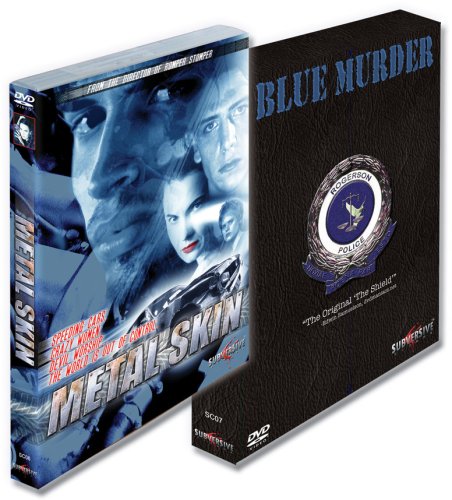
The name of this double-pack is slightly misleading, but that is not to suggest the film and television mini-series on offer are in any way bad. Quite the contrary, in fact. It’s just that they aren’t exactly “action” films per se. So don’t pick this up hoping for something in the vein of The Road Warrior. Instead, these are brutally intense dramas with strong action elements. Both titles are excellent.
Metal Skin is a 1994 effort from director Geoffrey (Romper Stomper) Wright. He returns here to the world of youth subculture. Here, instead of Skinheads, this is a world of underground races, but the denizens are just as doomed as in the earlier film. The main character is a disturbed young man whose dreams of driving a fast car and forming a romantic attachment are utterly deluded. He has a fraught relationship with a trio, each of whom has his/her own reasons to see the world as a black hellhole. When the car-duel climax arrives, it is earned at the emotional level, and makes the likes of The Fast and the Furious look even more anaemic than it already is.