Posts by David Annandale

A good friend of mine and I have had long-standing difference of opinion about Black Sabbath. He has no interest in anything post-Ozzy. I continued to buy Sabbath albums though all the band’s different incarnations, and while some releases did, I confess, require a greater degree of loyalty than others, the Ronnie James Dio studio albums (Heaven & Hell, Mob Rules, Dehumanizer) have always been favorites of mine. So the events of the last few years were something of a roller coaster ride for fans of my ilk, the joy of a new album (The Devil You Know, with this configuration of the band rechristened Heaven & Hell), followed by the shock and sadness following Dio’s untimely death. This release, a record of a 2007 concert, is a fitting valediction to a great band.

The fifteen songs are a fine selection. Doubtless, each of us will miss one favorite or another. I’m sorry that “Turn Up the Night” and “Buried Alive” were left off the playlist. But I can’t complain about any of the songs that are included. All three albums are well represented, and the absolutely necessary pieces – “Mob Rules,” “Children of the Sea,” “Die Young,” “Heaven and Hell,” “Neon Knights” – are all present and correct. Also performed are two songs – “The Devil Cried,” “Shadow of the Wind” – that were (along with “Ear in the Wall”) included on the Dio Years collection and heralded the band’s return to active songwriting.

World War II has just ended, and the recently discharged Robert De Niro hits New York on the prowl for sex. He runs up against WAC Liza Minnelli, and the more she resists his advances, the more determined he becomes. There is more: he is a saxophonist, and she (of course) is a singer). So begins a tempestuous relationship between two artists whose enormous talents and equally enormous personalities mean they can neither live with nor without each other.

The idea of Martin Scorsese taking on the form of the classic musical is so bizarre that it had to happen, and here it is. Scorsese’s conceit is ingenious: all the conventions are there (the meet cute, the songs, the artificial sets and colors), but they collide with the naturalism of the performances and the emotions. A perfect case in point: wandering the streets at night, De Niro sees a sailor and his girl perform a dance together. It is a classic musical moment, but the only sound is that of a train passing. It is a scene of extraordinary beauty, grit, and cinematic truth. And it belongs in an extraordinary film.

The second version of Cornell Woolrich’s novel “Waltz Into Darkness” (previously filmed as François Truffaut’s Mississippi Mermaid), this is a decidedly steamier version, especially here, in its unrated form.

Cuban plantation owner Antonio Banderas advertises for a wife, and the woman who answers his ad is, he believes, plain but pure. Who shows up, however, is the beautiful but duplicitous Angelina Jolie, who has larceny rather than matrimony on her mind. Her scam runs smoothly at first … but she hasn’t counted on the depth of Banderas’ obsession with her.


When the ambassador husband of Lady Elena Hamilton (Anita Rinaldi) is kidnapped by pirates, and she receives no help from the authorities, she decides to rescue him herself. To this end, she recruits the roguish Captain Thomas Butler (Carlo De Palma), and together they put together an eccentric band of misfits for the mission.

If ever a film had an unfortunate retitling, this is it. Originally released in 1999 as “I predatori delle Antille” (“The Predators of the Antilles”), this film will, under its new monicker, lose a good chunk of its intended audience (who will no doubt assume it to be porn) and alienate whoever would be drawn by the new title (there are only a couple of brief nude scenes). What we have here is a fairly straightforward low-budget adventure film, one that makes the most of its handsome sets, and makes for a not-unpleasant but far-from-memorable 90 minutes. The only real point of interest as far as the plot is concerned lies in the fact that, while Lady Hamilton must promise herself to Butler in return for his help, she doesn't, in the end, have to uphold her end of the bargain, having managed to cement the relationship between Butler and the woman who adores him (Venere Torti).

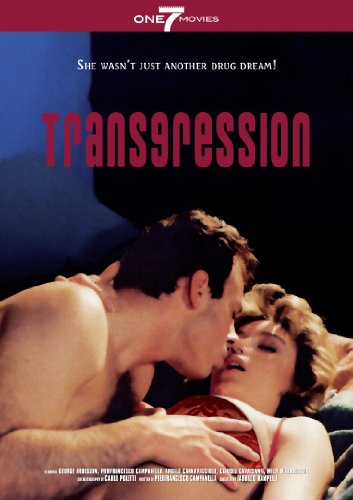
Pierfancesco Campanella (who also wrote the film) stars as a university psych grad student working on his doctorate. He embarks on some radical research by shooting up, and the next thing we know, he's killing his mother by depriving her of drugs, poking a baby with a needle, and generally behaving rather badly. He winds up at a rich man's residence, hooks up with his spoiled daughter, and the two embark on a picaresque journey of debauchery and murder.

Warning: spoilers ahead (but trust me, the film isn't really interesting enough for you to care). At any rate, two thirds of the way through the film, it transpires that everything we've been seeing is a drug-induced hallucination, and we return to Campanella's ordinary life, one filled with disappointments and petty humiliations. Where will this lead? Exactly where you think it will. So the first two thirds of the film are too episodic and nonsensical to be engaging, and the last is too predictable. And though the most trivia-oriented of Italo-trash fans will find some interest in the past and future credits of some of the cast, that's hardly a recommendation. At best fitfully amusing, this is, for the most part, a film that gives transgression a bad name, and is a reminder that the European exploitation scene but out its share of dull efforts in the 80s.

Sigh. Another day, another misleading title. Let's get one thing straight right off the bat. This is NOT a sequel to Ruggero Deodato's Cannibal Holocaust. It isn't even an imitator. It isn't even fiction (at least, it isn't meant to be). It's original title is “Nuova Guinea, l'isola dei cannibali” (“New Guinea: Island of Cannibals”), and it's a 1974 mondo movie, purporting to feature footage shot for the benefit of Queen Elizabeth on the occasion of her visit to the island, so she would have a better idea of the culture she was encountering. Whatever. In any event, this is a film made five years prior to the movie its title suggests it is following, and doesn't actually have any cannibals, as such, in it.

Which isn't to say it isn't exploitative. This is pure shockumentary, so fans of the mondo film will no doubt be pleased by the maggot-eating or the scene where mourners rub the oils from a thoroughly bloated corpse on their bodies. And surely any exploitation flick that opens with footage of the Queen and Prince Phillip is a fine example of... er... something.

Jean-Hugues Anglade plays Zorg (yup, that's his name), a handyman living in a beach-front house, scribbling away quietly in his spare time. Not so quiet is his tempestuous affair with Betty (Béatrice Dalle in her debut), whose passions overwhelm both of them. First, she moves in on him with no warning. Then, when she discovers his writing, she decides they must move to Paris so he can have a career as a writer. To make sure Zorg complies, she burns his house to the ground. Once in Paris, her plans for him fall apart, and so, bit by bit, does she.

Writer/director Jean-Jacques Beineix has both audience and characters sweltering from the get-go, setting the tone for another French tale of amour fou. Angalde and Dalle inhabit their characters perfectly (though one might be forgive for wondering what exactly Zorg sees in Betty, beyond the physically obvious). The film is stylish and dramatic, and if, at 185 minutes, it outstays its welcomd, it doesn't do so by much.

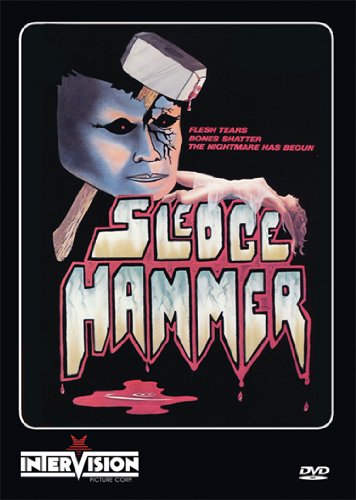
A mother locks her child in a closet so she can have an uninterrupted tryst with her lover. But the couple is rudely interrupted after all, as they are bludgeoned to death. Ten years later, a group of friends arrive at the deserted house to party down. After doing so for a fair bit of running time, they then fall prey to a hulking masked maniac, who not only has the titular hammer, but also has all sorts of supernatural powers.

This is, according to the box, “the first shot-on-tape slasher movie for the home video market.” This is a warning as much as anything else: don't be expecting John Carpenter or Dario Argento behind the camera. That the film is amateurish goes without saying, but I'll say it anyway. Viewers should be prepared, then, for lots of padding (a slow-motion scene of a couple walking that goes on for minutes), bland camera set-ups, ropey script (let's have a complete food fight sequence!) and whipped-up-in-the-kitchen gore. On the upside, once the supernatural kicks in, logic goes out the window, and all sorts of strange things start happening with no explanation whatsoever, resulting in a rather charming sort of dime store surrealism. This isn't a good film, but it is a likable one.

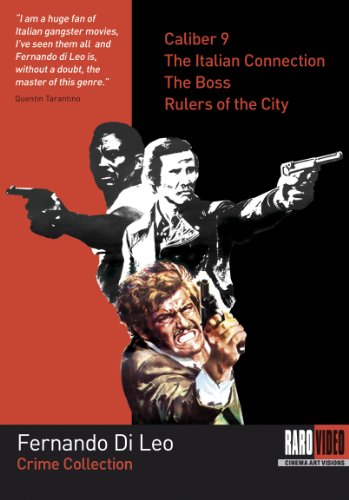
Looking for a something a bit different for you gangster flick fix? Then look no further than this box set of gritty, thematically linked Italian crime pictures from director Fernando Di Leo. Things don't get much more delightfully 70s than this.

Caliber 9 headlines Gastone Moschin as Ugo Piazza, a mob tough guy just out of prison. Everyone believes he stole 300 grand from the the mafia, which leads to no end of beatings and threats of worse. The old gang forces Ugo to work for them again, in order to keep an eye on him, and he tells girlfriend Barbara Bouchet that his plan is to find out who really took the money.

During the Korean War, a platoon led by Laurence Harvey and Frank Sinatra is captured and sent off to Manchuria. Here the men are brainwashed into believing that Harvey saved them all in an incredible feat of heroism (which he did not) and that he’s a loveable guy (which he isn’t).The unfortunate Harvey is programmed to become a remote-control assassin. Back in the States, Sinatra is plagued by nightmare memories of the experience, and gradually comes to believe that something … really did happen. The question is whether he and Harvey can solve the mystery and discover the target before Harvey is triggered.

The Manchurian Candidate accomplishes a spectacular balancing act. It is simultaneously one of the most intense suspense thrillers ever to emerge from Hollywood, and an absolutely corrosive satire. Said satire is all the more brilliant for savaging both the extreme right and the extreme left of the political spectrum. Also of note is Angela Lansbury’s ferocious performance as Harvey’s gorgon mother. Only 37, and but three years older than the man playing her son, she is utterly convincing, and a villain for the ages. Unquestionably, this is director John Frankenheimer’s masterpiece.