Posts by David Annandale

Paula (Carmen Montes), a dancer at a strip club, is arrested for the murder of Paula (Paula Davis), a fellow dancer. The arresting officer (Lina Romay) questions the near-catatonic Paula, and the rest of the film is a slow-motion, flashback of the dead Paula dancing, the two women making love, and the murder. Once the slow-mo begins, there is no further dialogue, except for a cryptic fable that Paula tells to the camera.

Jess Franco's latest effort is his most minimalist, and in some ways most personal, film to date. There is no set to speak of: the film was obviously shot in Franco and Romay's apartment, which doubles for both the home of the Paulas and, perhaps, the police station. I say “perhaps” because the notion of any definable space is a very tenuous one in this film. The only set dressing consists of a few aluminum screens, which play a role in the zero-budgeted surrealist effects. As has been pointed out elsewhere, there is nothing groundbreaking about the effects the Franco conjures here. The kaleidoscopic images, frequently involving Davis fusing and splitting from her double, would not have been out of place in the 1960s, and aren't going to break the back of even the most basic computer editing suite today.

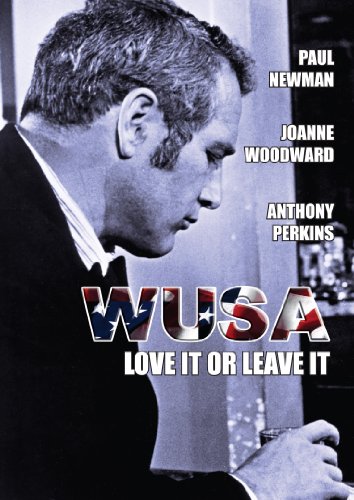
Cynical, alcoholic ex-musician Paul Newman arrives in New Orleans with barely a cent to his name. Following a tip from scam-artist preacher Laurence Harvey, Newman lands a job as a DJ for WUSA, an extreme right wing/white power propaganda radio station. Newman has no patience for his employers' message, but he's happy to take the money and drink himself into an apathetic stupor. Acting as the unwelcome voice of his conscience are the scarred hard-luck woman he has taken up with (Joanne Woodward) and the twitchy, anxious liberal (Anthony Perkins) who is about to discover that the survey work he has been doing in the city's ghetto is, in fact, in the service of Newman's dark masters.

Very much a reflection of, and commentary on, its turbulent times (1970), this is a film that is messy in its construction but ferocious in its convictions. The plot meanders more than is good for it, the script takes some rather pretentious flights into poetry, and Newman's character changes too little to be very interesting, with the result that the final scene lacks the kick that it clearly wants to have. Perkins, however, is magnificent in his painful, tortured sincerity, and the climax – a WUSA rally that becomes a hellish riot – is a knockout.

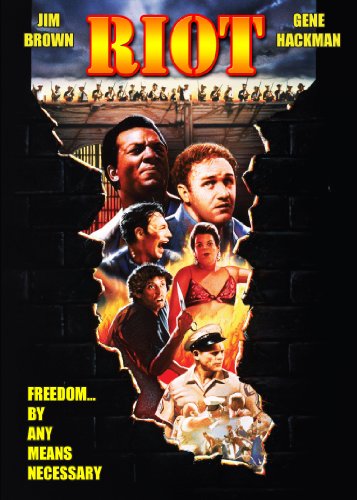
While the warden is away, the inmates of the isolation block break out out of their cells and seize a group of guards and administrators as hostages. Caught, by pure chance, in the wrong place at the wrong time, is Jim Brown, whose sentence is short enough that he wouldn't choose to become involved. However, before he knows it, he is, along with Gene Hackman, leading the riot. The ruckus is, in fact, a cover for an escape attempt: the inmates are digging a tunnel while, as a stalling tactic, Hackman presents a list of grievances to the authorities. But even as Brown becomes more and more enmeshed in the running of the operation, Hackman becomes more and more engaged with the protest, forgetting that it is supposed to be a charade.

Nice, gritty jailhouse piece, shot entirely at the Arizona State Penitentiary, and featuring not only plenty of real inmates, but the actual warden playing the warden of fictional prison. As one would expect of a film starring both Brown and Hackman, the characters are a tough lot, and the action is brutal. Characterizations are strong, with even the minor figures clearly defined. The only false note is sounded by the clumsy pseudo-Johnny Cash prison song that thuds against the ears several times over the course of the film. Otherwise, this is a bone-crunching good time, and is another example (along with Rosemary's Baby) of how different films merely produced by William Castle were from the films he actually directed himself.

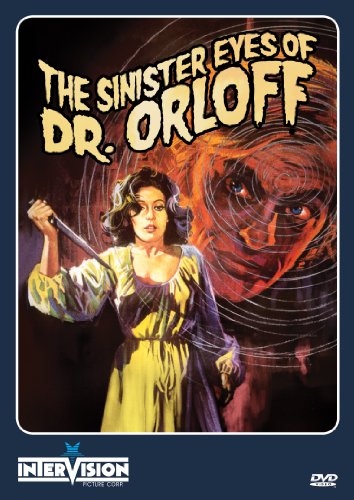
Haunted my recurring nightmares, crippled Melissa (Mona Proust), the heiress to a huge fortune, falls under the care of Dr. Orloff (William Berger). Unforunately, Orloff doesn't have Melissa's best interests at heart. Still enraged over having failed to win the lover of Melissa's mother, Orloff enacts his revenge by using his hypnotic powers to transform Melissa into a killing machine. One by one, the distinctly unsavory members of Melissa's family fall under the knife.

A 1973 effort by Jess Franco, the god-emperor of Eurosleaze, this is a pretty handsome film. Franco doesn't abuse the zoom lens quite as much as elsewhere, and he makes excellent use of his Gothic settings, especially in a remarkably strong stalk-and-kill sequence late in the film. There are quite a number of truly beautiful scenes, showing what Franco is capable of when he's interested. Meanwhile, the violence and nudity are very restrained by Franco standards, but the characters are just as depraved and twisted as ever (that's a good thing). The score (by Franco), meanwhile, varies from the disturbingly effective (abstract soundscapes punching home the nightmare Melissa is trapped in) to the WTF laughable (a folk song so dire it will live forever). This isn't Franco's best work, but it has a lot going for it, and fans are strongly advised to check it out, with two strong caveats in mind. One is that the subtitles are horrendous. The grammar is all over the map, vocabulary is mind-boggling (one character is “condoned as a pedophile”), and the subs go missing altogether for the entire sequence that explains Orloff's motivation! That's helpful! The other problem is the picture quality, about which more below.

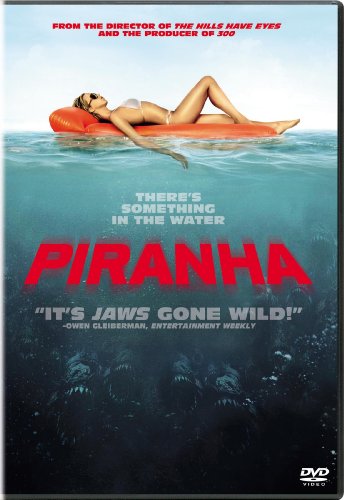
Underwater tremors open up a cave that has been sealed off from the rest of Lake Victoria for millions of years, unleashing a ravenous school of giant piranha. Making short work of a cameoing Richard Dreyfuss (in his Matt Hooper clothes), the fish descend on a resort town in the middle of Spring Break celebrations and so, naturally, the financially-minded authorities Won't Close The Beaches. As Sheriff Elizabeth Shue tries to find out what's going on with all the bodies showing up, her son (Adam Scott) unwisely volunteers to act as location guide for Jerry O'Connell (sleazing it up as the director of a Girls Gone Wild clone production), and winds up far from help when the fish launch their attack in earnest.

Alexandre (High Tension) Aja's remake is nowhere near as clever as the original, but it is highly entertaining, at least once the rampage is properly underway. This is easily the goriest summer movie in recent memory, and everyone involved seems determined to deliver on the trash value as thoroughly as possible. And while I have plenty of fondness for the retro-grindhouse trend, there is something going a little awry when the supposedly arch, self-conscious, post-modern films are more exploitive than the movies they're echoing. So while Piranha does boast one of the best severed penis gags I've seen in ages (one that loses some of its awesomeness by being reduced back to 2D), the endless parade of naked breasts, the obsessive need to mutilate them, and the clear expectation that the audience laugh at the result, is more than a little off-putting coming from filmmakers who surely know better but decide to indulge themselves all the same. In the end, what Piranha does well, it does very well indeed, but its lapses in judgment are pretty noticeable, too.

It's funny how the zeitgeist works, in that it is hardly unusual for two films with very similar high concepts to hit the screens at close to the same time. Dante's Peak and Volcano. Deep Impact and Armageddon. Hell, The Towering Inferno came about as a result of Fox and Warner cooperating in order to avoid making identical films. And this year, two animated features with super-villains as their protagonists: Despicable Me and our current subject: Megamind.

His childhood consistently ruined by the budding Metro Man (Brad Pitt), Megamind (Will Ferrell) becomes the super-villain he feels he was destined to be. But when his latest scheme actually succeeds in destroying Metro Man, he finds life curiously empty, and so sets about creating a new super-hero: Tighten (Jonah Hill). But Tighten, it turns out, is more villain than hero, while Megamind, thanks in no small part to a budding relationship with reporter Roxanne Ritchie (Tina Fey), moves ever closer to hero territory.

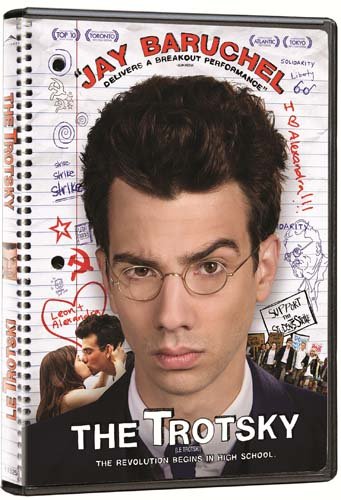
Leon Bronstein (Jay Baruchel, in a knockout performance) is convinced that he is the reincarnation of Leon Trotsky, and is determined to live out his life in the same way, right down to getting himself assassinated (“hopefully somewhere warm” his note appends). He also has only three years left to find Lenin, but in the meantime, his attempts to kick-start the revolution are meeting with little success. His struggle to unionize his father's factory manages only to embarrass and anger his father, who retaliates by removing him from private school and packing him off to a public one run by the tyrannical Colm Feore. Delighted to have worth enemy, Leon sets about mobilizing the student body, while trying to romance Alexandra (Emily Hampshire). Not only does she bear the name of Trotsky's first wife, the age gap between the two (she is almost ten years older) is the same. It must be destiny

This is enormous fun. Baruchel's Leon could easily be a figure of ridicule, and though he is funny, he is also possessed of such indomitable will and the desire to change the world for the better, not to mention a complete imperviousness to social humiliation, that it is impossible not to get behind him. Writer/director Jacob Tierney makes good use of his Montreal setting, adding the city's quirks to his characters', and the cast is engaging mix of new faces and veteran Canadian actors (Feore, Geneviève Bujold, Saul Rubinek). Sharp, witty, and unapologetically optimistic, this is about as feel-good as feel-good gets. And, as an added bonus, the film features the most hilarious riff on the Odessa Steps sequence from Battleship Potemkin I have ever seen.

Roger Greenberg (Ben Stiller) once was a musician, but now he is a carpenter and an inveterate writer of letters of complaint (to pet taxis, for instance, for not having a soft carpet for the paws of their passengers). After a stay at a mental institution, he arrives in LA to look after his brother's house and dog while the family is away in Vietnam. He reconnects with an old friend from his band days (Rhys Ifans, a long way from his manic energy in Notting Hill), and circles around a stop-start romance with personal aid and professional doormat Florence (Greta Gerwig).

Stiller's performance here reminds me of Adam Sandler's in Punch-Drunk Love. In both cases, we have actors known for embodying a particular comic type: Sandler is the raging man-child, while Stiller is the sensitive soul prone to social catastrophe. And in both films, we see the actors working with a distinctive auteur (P.T. Anderson, Noah Baumbach) on a low-key comedy that is very much a film of personal expression (to borrow a term from William Bayer). Finally, the borderline art-house trappings and new gravitas notwithstanding, they are still playing recognizable versions of what they've always done. It's just that what is a type of clown perfect for one form of comedy becomes a psychotic in the more realist version. At any rate, I find Stiller's same-yet-different performance very interesting, and very good, and that goes for the other performers too, especially Gerwig, who nails Florence's insecurities, naivete and strength. However, though I found the performances interesting, I didn't find the characters that interesting. Greenberg is thoroughly repellent, and that's fine, but he isn't compelling. I found myself unable to care about what he would do or say next (partly because I had a pretty good idea of what that would be), and wished that Florence were the protagonist instead. Though her self-destructive crush on Greenberg is as inexplicable as it is nonsensical, and so she too tries our patience, she has enough off-beat quirks and surprising resilience to make her worth following around. This is, then, a film that is finely wrought, written and acted, but that is also rather static and distancing.

George Papdapolis (Alex Karras) and Katherine Calder-Young (Susan Clark) meet on a Greek cruise, and, after a whirlwind romance, return to Chicago. They're a bit of an odd couple – she's a blue-blood, complete with male secretary, and he's an ex-football player. The cross-class romance is barely underway, however, when they suddenly find themselves the guardians of the unspeakably adorable seven-year-old Webster (played by twelve-year-old Emmanuel Lewis) after his parents die (George had agreed to be his godfather back in the day). All sorts of cute misunderstandings, cute heart-warming lessons and cute sentimentality then ensues.

There is no denying diabetic-shock-inducing cuteness of Lewis, though there is also something a little bit creepy about the way the camera presents him, shamelessly exploiting that cuteness for all its worth, offering up Lewis for the audience to cluck over as if he were some kind of ambulatory teddy bear. The humour, meanwhile, is typical of an 80s sitcom – banal jokes in tandem with a Serious Message. And some of the gags are, to put mildly, antediluvian. Oh, look! Katherine is a woman who can't cook! Hilarious! For those with fond memories of the show, however, none of this will matter. But those who have no such memories are probably better off not forming them.

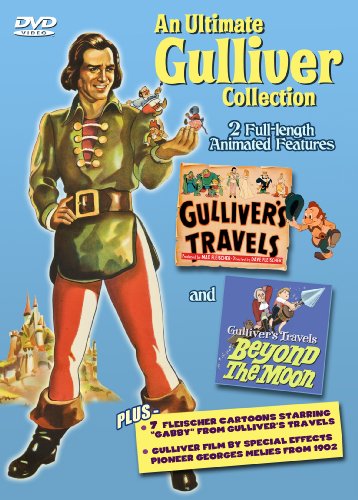
Johnathan Swift's Gulliver's Travels was never meant to be a children's tale. It is one of the most corrosive satires in the English language, one that has lost none of its brilliant venom over the passage of centuries. But endless bowdlerizations have given its first two sections (the voyages to Lilliput and Brobdingag) the reputation for being children's classics. Obviously, references to people being “the most pernicious race of little odious vermin that nature ever suffered to crawl upon the surface of the earth” are usually left out. At any rate, said bowdlerizations inevitably resulted in various anodyne film adaptations. And so, as Jack Black galumphs across the screen to box office disaster, here is a collection of animated takes on Swift's work.

Gulliver's Travels: (76 mins.) This 1939 effort is the main attraction here, the second feature-length animated film ever made. It limits itself to Gulliver's journey to Lilliput, where, in this version, he must bring about the end of a war between Lilliput and Blefuscu so that bland princess and prince of the respective nations can marry. The Fleischer brothers are best remembered for Betty Boop and their excellent Superman cartoons. Gulliver's Travels, on the other hand, is far from their best work. The animation is fluid, though the backgrounds are lifeless and still, a far cry from what Disney had just done with Snow White. The pace is slack, meandering along through rather tired slapstick. The cartoonish Lilliputians are charming enough, but the more realistic characters are expressionless waxworks, or, in the case of the rotoscoped Gulliver, dip alarmingly toward the uncanny valley. The piece is a historical curiosity, but is no classic. Still, it's much, much better than...