Posts by David Annandale

John Cena is The Marine. Though, as matters develop, The Maroon might be a better handle. At any rate, after being discharged for having Disobeyed a Direct Order in Iraq (where, in a scene distinctly reminiscent of the opening of The Naked Gun, our boy shoots up one of those elusive Al-Qaeda training camps that nobody else seems to be able to find). Readjustment to civilian life is difficult, but then, while heading out for a little holiday with his wife (Kelly Carlson), an unfortunate stop at a gas station results in Carlson being abducted by a violent gang of jewel thieves headed up by Robert Patrick (who comes across, as was pointed out to me, like the love child of Martin Sheen and Chandler Bing). Cue the pursuit through the swamps.

So as we’re watching this, my girlfriend turns to me and says that there’s a problem with a movie when the hero could be removed from the picture to little discernible effect. And she’s right. In fact, Cena disappears completely once the action gets going (!!?!), leaving the field for Patrick to camp it up. What role he does play could have, for the most part, easily been filled by one of the alligators we are shown (but who are never seen again). Perhaps Gustave could have been imported from Primeval to take care of business. And while I love a good explosion as much as the next guy, the ones on display here are so over the top (my favourite is the coop car raised into the air on a pillow of fire) that they are hilarious. And trust me, we’re laughing AT the movie and the steroid freaks in it, not with it (or them).

Bela Lugosi has certainly had his share of collections and box sets hitting the stands, but now, belatedly, Boris Karloff has some sets of his own, and we’re not talking cheap public domain films from late in his career.

Universal, where Karloff became a star with Frankenstein, has released, as part of their Franchise Collection, The Boris Karloff Collection. There are five films here: Night Key (1937), Tower of London (1939), The Climax (1944), The Strange Door (1951) and...The Black Castle (1952). Welcome as these films are to DVD, they are, generally speaking, far from being among Karloff’s most memorable films. But that is largely because his biggest Universal pictures have already appeared either in the Frankenstein or Lugosi collections. These aren’t really horror movies, either. Most are period pieces, with Karloff playing secondary roles. He’s the primary antagonist in The Climax, though, which is a Phantom of the Opera variation sans make-up. The standout is Tower of London, where Karloff is the clubfooted, murderous servant of Basil Rathbone’s even more murderous Richard III.

The next time someone talks about The Sixth Sense having an original twist ending, sit them down and force them to watch Carnival of Souls (1962).

Spoiler warning. If you haven’t seen either of these films, or generally have no idea what I’m talking about, stop reading now. Go away. Come back next week. You don’t want to be hear. God knows, I might spoil the twist in The Crying Game while I’m at it.

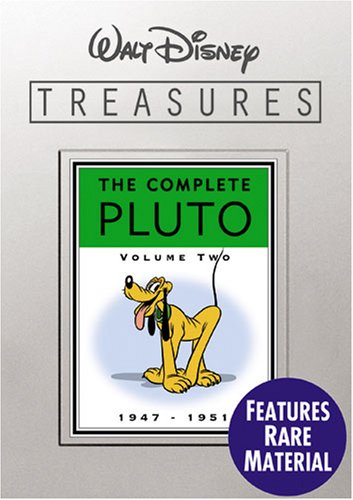
This is the second volume of Pluto cartoons, here going from 1947 to the end of the series in 1951. The neat thing about these themed collections in the Wald Disney Treasures series is that they highlight particular strengths in Disney’s animation. Thus, if the Silly Symphonies sets focus on the marriage of movement with music, the Pluto cartoons are wonders of pantomime, since the central character doesn’t speak. Pluto is not a jot less communicative for not using words, however, and the sight gags involved in some of his facial expressions (such as when wearing the unwanted “Pluto’s Sweater”) are priceless. Pluto’s frequent sidekick Figaro the cat has the spotlight to himself in three bonus cartoons.

Audio

Alexandra Holden is a big-time TV reporter who is traumatized when an intruder breaks into her home and kills her fiancé. (Does this set-up remind anyone of The Howling?) She retreats to her old home-town, moves back with her parents (Sid Haig and Leslie Easterbrook!) and starts work at a local TV station. Her first assignment takes her to a house where murders took place years ago, and she promptly has visions of ghosts and the murders, and she feels she is being called on to provide justice for the ghosts. Their still-living killer has other ideas, however.

The counter-casting of Haig and Easterbrook (most recently together in The Devil’s Rejects) as overly protective parents is enjoyable perverse, but the movie itself has the rather plodding, pedestrian feel of a late-70's made-for-TV flick. The dialogue is frequently awkward and excessively expository, and the characters aren’t always consistent. There are a couple of decently assembled jolts, but there isn’t really much here to lift things out of the run-of-the-mill.

Warner Bros. had the Looney Tunes and Merrie Melodies, Disney had the Silly Symphonies. This is the second volume collecting those shorts, covering the years 1929 to 1938. The shorts are selected on a menu that can be presented in alphabetical or chronological order, and it is the latter approach that is the most enlightening, as we can see the cartoons evolve. There is no dialogue in these shorts – the point was to fuse animation and music. And while that is an end in itself in the earlier cartoons (and quite the technological feat at that), more and more narrative content develops over the years. The culmination of this form of animation would, of course, be Fantasia, and in such early pieces as “Hell’s Bells,” one can see in embryonic form the ideas that would become, for instance, the “Night on Bald Mountain” segment.

Audio

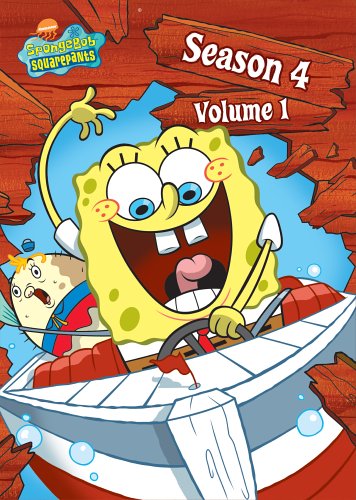
The zaniness continues in Bikini Bottom, and the series shows no sign of losing its appeal or its lunatic creativity. Wonderful little example: “Whale of a Birthday” is about Mr. Krabbs’ daughter’s sixteenth birthday. The highlight: a performance by “Boys Who Cry” singing “It’s All About You.” Perfect. There are twenty episodes here to keep your funny and whimsy bones tickled. (What, you don’t think you have a whimsy bone? Of course you do.)

Audio

Greatness can be aspired to. Its achievement can be the driving goal behind a film. But its realization comes down so often to the kinds of intangibles that frustrate efforts to control or create. And this applies to greatness whether the work is good or not. That’s right, today, we’re musing about greatness in the negative (but therefore curiously positive sense): the films that are so bad they’re great.

I don’t think anything more clearly illustrates the difficulty in reaching this special kind of greatne...s than the case of Uwe Boll. There is no doubt that his films are staggeringly bad. The man’s dogged determination to continue pumping out product and foisting it on a unwilling world is testament to just the kind of boneheaded commitment required of the artiste maudit. He even shows a willingness to experiment (ill-advisedly) with the form, and he inspires the worst in otherwise talented casts and writers. And let us pause for a moment at the recent spectacle of his literal boxing matches with his critics. You have to admire that. There’s even a consistency to his body of work, in that it consists of the demolition of one video game after another: House of the Dead, Alone in the Dark, BloodRayne, the forthcoming Dungeon Siege and Postal.

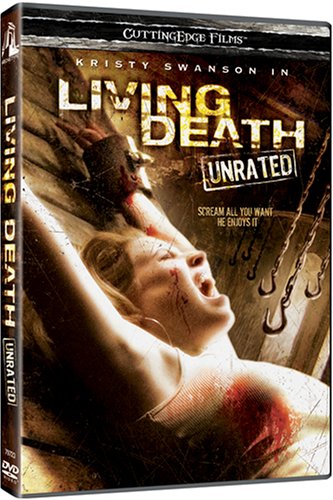
Victor (Greg Bryk) is one piece of work: a millionaire playboy with a taste for torture and absolutely no regard for anyone but himself. Who wouldn’t want this guy dead? His wife Elizabeth (Kristy Swanson, emerging from the where-are-they-now file) and his lawyer Roman (Josh Peace) are having an affair and plan to knock him off. They poison him, but it turns out the drug only creates a death-like stasis. He is still fully conscious, even as he’s about to be dissected. Understandably, when he regains mobility, his disposition has in no way been improved.

The film is at its strongest during Victor’s pseudo-death, as it gives free reign to black humour, and the initially ho-hum lovers-kill-evil-husband plot ventures into fresher territory. The dialogue becomes quite witty at this stage as well. The first and third acts are rather more conventional DTV fare, though the gore level is surprisingly, and pleasingly, high. When all is said and done, this flick isn’t going to rock anybody’s world, but it is brisk, efficient and bloody enough that one won’t complain about the lost 85 minutes either. Call it rental fodder that actually delivers what it promises.

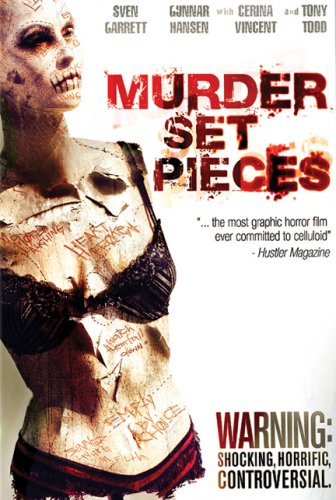
Sven Garrett plays the Photographer, who, when not exercising his profession of photographing beautiful women, is busy torturing and killing them. His girlfriend’s little sister (Jade Risser) thinks there’s something creepy about him, but isn’t listened to. Meanwhile, the bodies pile up.

There’s not a heck of a lot more to the plot than that. The title is an apt description of the film: it is basically a collection of set pieces. References to Nazi Germany and footage of 9/11 are tossed in to no very compelling purpose. The acting is painful, as is the dialogue (what one can make out of it – more on this below). This is a film that has stirred up quite a fuss among the critics, horror or otherwise, but viewers wanting to see what all the fuss is about won’t be enlightened by this release. The film originally ran 105 minutes, according to IMDB. This version runs 83. So when I said this is a collection of set pieces, I should have said “truncated” set pieces, and all the really nasty stuff is completely absent. The result is akin to a hardcore porn film with the sex removed. The actual technical aspects of the film are quite slick, but that doesn’t make it watchable.