Posts by David Annandale

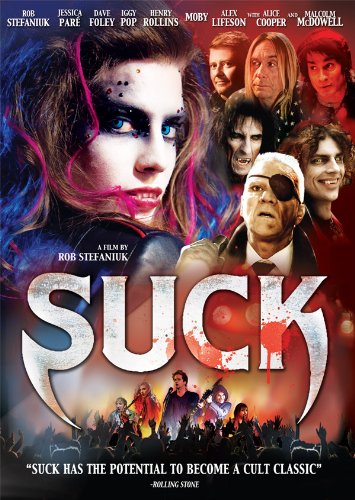
The Winners are anything but, being an undistinguished rock band playing to tiny, apathetic audiences in nowhere bars. Their time has not only passed, it never arrived. But just as they seem headed for the scrapheap, their bass player (Jessica Paré) is bitten by a vampire. Though her newly acquired taste for blood is a bit of an inconvenience, leading to some extremely messy murders to clean up, she now mesmerizes audiences, and the band catches fire. Leader Rob Stefaniuk is so desperate to catch a break that he is willing to turn a blind eye to just about anything. But complications loom, not least of which is Malcolm McDowell in full Van Helsing mode, heavily armed and sporting an eye patch.

Suck has the potential to become a cult classic,” reads the blurb from Rolling Stone, and that might well turn out to be the case. But Suck also rather desperately wants to be a cult classic, and that desire can stand in the way of its becoming the genuine article. It pulls all the right moves – black humour, full musical numbers, rock star cameos, outrageous gore, Malcolm McDowell – but those moves feel just a bit too self-conscious. The songs are rather bland, and the humour is hit and miss – though to its credit, when the film is funny, it is very funny (Iggy Pop's deadpan turn is one highlight). The flashback scenes of McDowell's traumatic first vampire encounter are very well done, cleverly incorporating repurposed footage of a young McDowell. In the end, while not everything works here, what does work, works well enough to make this worth a rental.

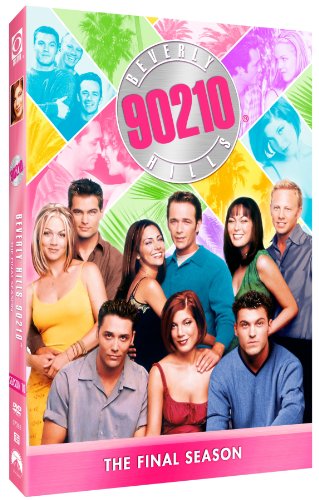
The teenage soap opera sensation of the 90s came to an end with this, its 10th season. As one would expect, in a season all about wrapping up storylines, along with various assorted crises, romantic and otherwise, weddings are in the offing. One is supposed to be between Kelly (Jennie Garth) and Matt (Daniel Cosgrove), but is complicated by the brooding presence of Dylan (Luke Perry). Will Kelly and Dylan sort out how they feel about each other (and I note with amusement that the jacket copy describes the relationship between these two twenty-somethings as “age-old”)? Perhaps more promising is the wedding between David (Brian Austin Green) and Donna (Tori Spelling), which provides a reason for most of the cast, past and present (minus the problematic Shannon Doherty) to reassemble for the grand finale.

This was always a pretty slick package, and for all that it was about terminally pretty people, the series did delve into some heady topics (gay bashing is one that is handled this season). But the overpowering odor of cheese was never far away (I remember a particularly hilarious studio-set version of Paris that the gang visited), and how did anyone ever take Perry's Poor Man's James Dean impression seriously? This will be an enjoyable nostalgic trip for fans, though, and a startling reminder of how many cast members became household names, only to plunge into the Where Are They Now File within seconds of the series' cancellation.

Having made it through WWII, fellow soldiers Bing Crosby and Danny Kaye are now a song-and-dance team. Kaye is worried about the lack of romance in Crosby's life, but that problem seems likely to be resolved when sister act Rosemary Clooney and Ver-Ellen show up. These two pairs of entertainers must pool their talents in order to save the inn run by former general Dean Jagger from financial ruin.

The plot is, of course, very thin, a mere excuse on which to hang the sentiment and the songs. This is, of course, not the film which originated the title track – that was the earlier Holiday Inn (1942), which Crosby was teamed up with Fred Astaire. The holiday this time is strictly the Christmas one, and White Christmas goes its predecessor one or two better in terms of spectacle, thanks to Technicolor and VistaVision. The end result is not really the classic it self-evidently wants to be, but it and its cast are extremely likable.

In 2024, the Earth’s ozone layer has been depleted (or so most assume), and life is protected by an electromagnetic shield designed by Connor MacLeod (Christopher Lambert). Eco-crusader Virginia Madsen, however, believes that the ozone layer has restored itself, and the corporation that runs the shield is maintaining it for its own purposes. Meanwhile, back in the past, villain Michael Ironside sends assassins to the future to kill Lambert, who is an aging man as the film begins… The assassins fail, Lambert becomes young once more, and he summons Sean Connery back from the dead. Ironside arrives to take care of his nemesis personally.

I could go on, but I feel a brain embolism coming on. The Highlander concept was never the most intelligent SF/Fantasy idea (and I’m not just talking about casting Frenchman Lambert as a Scot and Sean Connery as a Spaniard), but here the vacuity becomes painfully evident, and the time travel aspect is beyond stupid. The dialog is equally mind-numbing, and for a storyline of comparable inanity, the closest thing would be Battlefield Earth. From Lambert’s embarrassing old-man voice to the ridiculous assassins, new idiocies assault the viewer with every passing second. Granted, the production was shut down before the movie was completed, but it is hard to imagine the film was really salvageable. This edition represents the closest version yet to what the filmmakers had in mind. The special effects have been heavily overhauled, but this isn’t a case of George Lucas-style endless tinkering. The previous version of Highlander 2 had effects that were slapped on by technicians who were not part of the original team, and the look of the film has been notably improved (the shield, for instance, is now blue instead of a garish red). So the film looks much better, but no amount of effort can make a silk purse out of this sow’s ear.

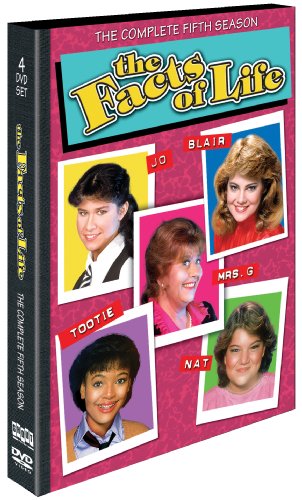
Season 5 of this most well-meaning of sitcoms finds a major change. With the cast now having aged to the point that not all the girls could reasonably be in high school together, Mrs. Garrett (Charlotte Rae) opens Edna's Edibles, a bakery-slash-coffee-shop, and the opening two-parter establishes the new status quo (essentially doing whatever is necessary to keep the main characters together). Otherwise, things proceed as they always have, with each story combining standard sitcom hijinks with Important Life Lessons and forays into weighty subjects. So, for example, the friendship between Natalie (Mindy Cohn) and Tootie (Kim Fields) hits a rough patch when Natalie's reaction to being asked out by Tootie's cousin is perceived, by Tootie, to be racist.

The series' flaws and strengths are much as they always were. On the one hand, the commitment to deal with serious issues is commendable, and the actual integration of these themes into the structure of the stories is fairly smooth. On the other, the performances are thuddingly broad, and the dialogue (and its attendant jokes) is both chronically and acutely awful. In the final analysis, only viewers who have retained a devotion to the show will really be able to get much out of this.

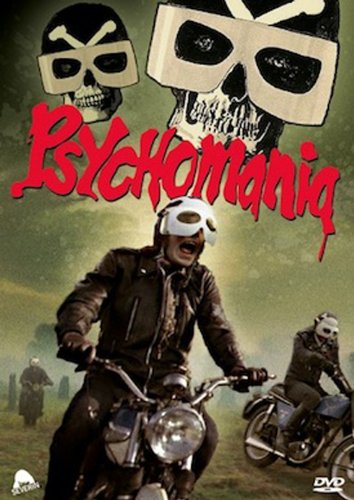
Nicky Henson plays Tom, the leader of a hellraising biker gang known as the Living Dead. His goal is to make that moniker absolutely literal, and it helps that his mother (Beryl Reid) is a medium who has made some sort of Satanic pact, and the butler (George Sanders, in his final role just before his suicide) might well be an infernal power himself (his precise nature is never made clear). At any rate, all it takes to come back from the dead, apparently, is to kill oneself while firmly believing that one will return. Tom proves this formula to be correct, and soon almost all the other gang members follow suit. The one member who might hold out is his girlfriend Abby (Mary Larkin). Meanwhile, as the Living Dead embark on a reign of terror, will anyone be able to stop them?


This is a pretty odd duck of a film, and quite delightful for precisely that reason. In the first place, the Living Dead are hardly the most threatening biker gang ever to grace the silver screen, and though they do rack up quite the body count of policemen and civilians, many of their other bits of misbehaviour are not so much atrocities, but more in the line of shenanigans (as a fellow viewer aptly put it, the gang don't become flesh-eating zombies, only unkillable twits). The precise nature of Reid's motivation is never made clear, Abby is so whiny and callow that one is hard-pressed to feel any sympathy for her, and there's this strange preoccupation with the idea of the frog as an embodiment of evil. But these very oddities contribute to, rather than detract from, the film's off-kilter entertainment value. There's a wealth of incident, so the viewer is never bored, there are  some very fun chase scenes, and (which is a good thing) there is a rather knowing sense of humour about the whole affair. Definitely one of the odder horror films to emerge from England in the 1970s, and an engaging rediscovery.

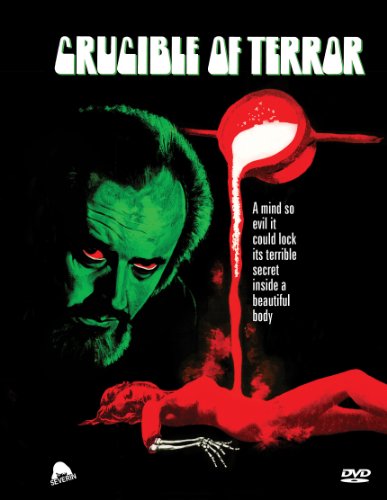
Former pirate radio DJ Mike Raven plays Victor Clare (a case where the actor has a scarier name than the character he plays), reclusive artist who, one strongly suspects, has the unpleasant House-of-Wax-y propensity to pour molten metal on his models in order to bronze them. A group of characters with varying agendas gather at his Cornwall abode: his senile wife; his sexually ambivalent model; his weak, alcoholic son (Ronald Lacey, a long way from the menacing Nazi he would later play in Raiders of the Lost Ark) and impatient daughter-in-law; a neophyte art dealer and his girlfriend, Millie (Mary Maude). Victor becomes obsessed with Millie, determined make her his artistic muse. Meanwhile, the cast is being gruesomely bumped off one after the other.

Raven comes across very much as a poor man's Christopher Lee. He has the height (more or less), he has a deep voice, and he even looks not unlike Lee. But he has none of the master's screen presence, and isn't as frightening as he clearly should be. Most of the film is a rather dull plod, with characters wandering about, flirting or sniping at each other, and repeating conversations ad nauseum. The murders come along every so often to spice things up, but given Victor's obvious villainy, one might well wonder why the film is being so coy about the killings, and refusing to show us the killer.

So Troll 2 hits Blu-ray. That fact is as sure a sign of the coming Apocalypse as any I can think of, and, at the very least, must threaten the entire Blu-ray format with destruction, as judgment rains down from the hands of an angry God. If, Gentle Reader, you come to this review without any foreknowledge of the film, and are actually wondering if a movie called Troll 2 might be good, then please run as fast as you can and hide. Or at the very least, please watch the legendary YouTube clip appended below. What, you're still here? Don't say you weren't warned.

I'm risking my immortal soul by writing any kind of a synopsis of this film, but here goes. Little Josh (Michale Stephenson) is regularly visited by the rather cranky ghost of his grandfather, who warns him about the dangers posed by goblins (yes, this is a movie called Troll 2 that features goblins instead of trolls – already a dire omen). Josh's family heads off into the countryside for a pioneer-style holiday. Less than happy to be on the trip is teenage daughter Holly (Connie McFarland), whose callow boyfriend Elliot (Jason Wright) was supposed to come along, but was late. Elliot and his equally idiotic friends are now trying to catch up under their own steam. Our characters arrive in the town of Nilbog, where the residents turn out to be goblins in disguise. Their dastardly plans involve transforming the people into vegetable hybrids, and then eating them.

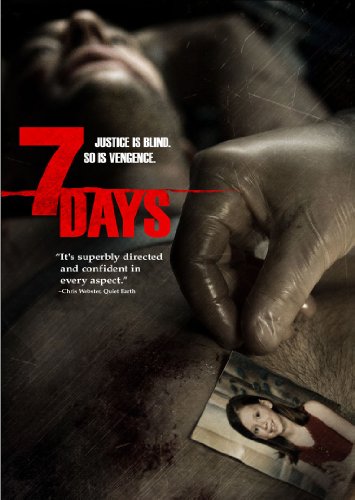
Bruno Hamel (Claude Legault), a surgeon, and his wife Sylvie (Fanny Mallette) enjoy an afternoon tryst while their young daughter Jasmine (Rose-Marie Coallier) heads off to school. Tragedy strikes, though, when Jasmine is assaulted and killed by pedophile Anthony Lemaire (Martin Dubreuil). Bruno and Sylvie are devastated, and each deals with the tragedy an unhealthy way, with Sylvie withdrawing from the world and her husband, and Bruno plotting vengeance. Lemaire is caught, but doesn't remain in police custody long, since Bruno kidnaps him and carries him off to a secluded cottage in the forest. His plan: torture Lemaire for the seven days leading up to what would have been Jasmine's birthday, and then kill him. The police investigation becomes at least as much about saving Bruno's soul as it is about saving Lemaire's life.

Rightly or wrongly, so-called “torture porn” is one of the more reviled subgenres of horror film. While there is no denying that the worst films of this type can be among the most mind-numbing and depressing bits of celluloid stupidity, aesthetically as well as ethically bankrupt, it is just as true that the best can force the viewer into some extremely uncomfortable, but artistically and philosophically vital, territories. One should also bear in mind that though the term “torture porn” is new, that type of story has been around forever. No less a figure of classic horror than Bram Stoker himself wrote a short story called “The Squaw,” wherein a character experiences a sexual thrill by installing himself in an iron maiden (until, of course, things go rather wrong). And if we go all the way back to the birth of literary horror, with the arrival of the Gothic novel at the end of the 18th century, the Marquis de Sade was right there at the start, penning works that articulated what the English Gothics only hinted at, and that depicted horrors that go far beyond anything Eli Roth has dared put on the screen.

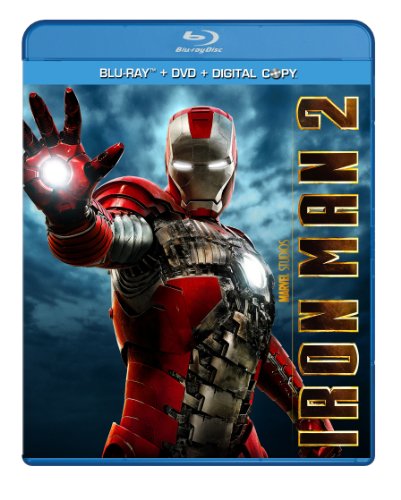
Jon Favreau's Iron Man was one of the happy events of 2008. It was a superb piece of super-hero entertainment, one that handled lightning-quick shifts in tone (grimness in Afghanistan, hilarity in Malibu) with a deftness that made the very hard work look very easy. It also reassured comic fans and mainstream audiences alike that there were still terrific movies to be made based on Marvel characters, reassurance that was sorely needed in the wake of the dire Spider-Man 3. So, the question with Iron Man 2 is, given the returning director and cast, was that same magic recaptured? The answer is a delighted yes.

The story picks up with Tony Stark (Robert Downey Jr) basking in his fame as Iron Man. He puts on a showy entrance at the opening of the Stark Expo, thumbs his nose at a Congressional committee that wants to appropriate his suit's technology, and races fast cars. But beneath the levity is a dying man: he is being poisoned by the very element that is keeping his heart ticking. Other problems arise in the form of Ivan Vanko (Mickey Rourke), the embittered son of a former research partner of Howard Stark (Tony's father), and Justin Hammer (a hysterically funny Sam Rockwell), Tony's self-regarding business competitor, who is a devious and corrupt as he is incompetent. Unlike Hammer, Vanko is dangerous, harnessing the same energy source as Stark to power his own super-suit. They join forces to destroy Iron Man. He, meanwhile, seems bent on destroying himself before they can get around to it. His behaviour becomes erratic, forcing best friend James Rhodes (Don Cheadle) to abscond with the War Machine suit, and he turns over his company to Pepper Potts (Gwyneth Paltrow). Into this mix comes SHIELD, embodied by leader Nick Fury (Samuel L. Jackson) and agent Natasha Romanoff, AKA the Black Widow (Scarlett Johnansson). Fury sees Stark as a potential asset, but only if he can both sort his life out, and save it. The question is whether he will do so before Hammer and Vanko's plans come to fruition.