Posted in: Disc Reviews by William O'Donnell on September 17th, 2010
Zeus' mighty bolt has been stolen, and whomever holds it may have the power to topple the king of the Gods. Zeus suspects Poseidon's estranged, half-human son is the Lighting Thief and threatens his wrath upon the entire realm if it is not returned. Percy Jackson is Poseidon's son, making him a Demi-God, but as far as he knows, he is a just a high school student living with Dyslexia, ADHD and struggling to live with his abusive step-father. As mythic monsters and Gods all start to threaten Percy's life, his best friend and his mother both reveal themselves to be protectors of his life, both with connections to Greek Mythology. Percy;s mother is taken to the underworld and so he sets out on a quest to discover the truth about his Demi-God heritage while fighting to get his mother back from the clutches of Hades, as well as discover who the true Lighting Thief is.
The story moves by at a fast pace, which helps keep the attention of younger, easy to bore audiences, but the conflict set-ups and exposition are a bit too been-there, see-that for my liking. We are meant to assume that Percy is an outsider, thus easier to relate to and sympathize with, because he has issues, but his Earthly problems (step-father, dyslexia) seem hastily tacked on and it doesn't take long before his super-human capabilities are revealed. This is especially aggravating during a wickedly illogical training scene where all of the demi-God children of Camp Half-Blood play capture the flag (fighting with real swords for no good reason!) and Percy earns the respect of the entire camp simply by being able to heal from any wound by touching water and inheriting a wondrous fighting ability from his father's side, without having picked up a sword before. The friends who join him on his quest also have amazing agility and skill, so we have a pack of kids with Superman syndrome, but none of them have enough have that 'Clark Kent' side to give them a mien of humility (do enough people reading this understand where I'm going with that analogy?).
Posted in: Disc Reviews by Gino Sassani on August 18th, 2010
"I remember once going on a school trip to the top of the Empire State Building. When I looked down at the crowds of people on the street, they looked like ants. I pulled out a penny and some of us started talking about what would happen if I dropped it from up there and it landed on somebody's head. Of course, I never crossed that line and actually dropped the penny. I don't think Early Grayce even knew there was a line to cross."
Posted in: Disc Reviews by William O'Donnell on June 8th, 2010
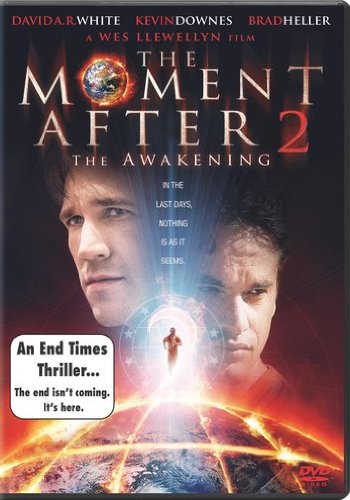
In the previous film, the Rapture (from the Bible) has occurred and two FBI agents were investigating. By the end, each was left in less than desirable situations and we start off with both of them getting into further trouble as the world has become a dystopia run by some sort of “Global Alliance.” One is busted from jail and finds a group of Christians in hiding, and the other is blackmailed into seeking out that same group and revealing their camping location to Alliance bad-guys.
Posted in: Disc Reviews by Gino Sassani on May 24th, 2010
Mel Brooks has often been called the Master of Comedy. The moniker might be a bit too grandiose, but he was certainly the master of the parody. In recent years that has become more evident than ever. Too often I've been forced to sit through something called a comedy. Not only can I do so without ever actually laughing, but there are far too many titles of late that don't even give me the chance to crack a smile. It's not that I've seen so much that it's hard to find anything original. I can still laugh like crazy when I watch a Sanford and Son episode I've seen at least 50 times or an Abbott & Costello routine that was old before they even got their hands on the material. There is a famous quote that states, "Dying is easy. Comedy is hard." Then why does Mel Brooks make it look so dang easy?
While we're on the subject of masters, you really can't avoid the Master of Suspense, Alfred Hitchcock. Perhaps no one understood his audience more than Hitch did. He's influenced a great many of today's filmmaking geniuses. He's been admired by almost anyone who has ever really studied film. Mel Brooks can be counted among his students. On more than one occasion I have seen an interview where Brooks can't say enough flattering things about Alfred Hitchcock. It would have only been a matter of time before Brooks turned his creative mind to one of his own idols. The result is enough to give anyone High Anxiety.
Posted in: Disc Reviews by Gino Sassani on May 19th, 2010
"Even in the most primitive man, the need to create was part of his nature. This need, this talent, clearly separated early man from animals who would never know this gift. And here, in a cave somewhere in the North American Continent, about two million years ago, the first artist was born. And, of course, with the birth of the artist came the inevitable afterbirth ... the critic."
That's me. Afterbirth here. Brooks always did love to poke fun at the critics. And why not? Unfortunately, this was not one of his better films and likely received a lot of poking from the brethren. It was one of his worst films at the box office, pulling in only $31 million. Compared to many of his hits, it must have been a disappointing take for Mel at the time. Now out, along with some other of his films, on Blu-ray, this rather forgettable film looks even more dated and overindulgent than ever. Certainly, there are some classic moments. Mel, is, after all, Mel. But he never could string enough of them together to meet expectations. Too bad, really. It was a grand idea.

Posted in: Disc Reviews by Gino Sassani on May 18th, 2010
"You, sir, are guilty of disseminating disbelief. Killing dreams. Committing first-degree murder of fantasy, which by Fairy Law, in order to pay your debt to humanity, you are hereby ordered to serve time as a Tooth Fairy. The normal sentence is one week, but because you have the nerve, the unmitigated gall, to actually call yourself a Tooth Fairy, thus making a mockery of everything we stand for, I'm sentencing you to two weeks Tooth Fairy duty."
Dwayne (once The Rock) Johnson has made a bit of a new career move over the last few years. When he left the wrestling ring to "go Hollywood" the expectation was always that he would become an action hero. It's what his fans expected. It's what Johnson wanted, at the time. Movies like The Scorpion King were created completely as vehicles for Johnson to show off his physique and join the ranks of the big strong action heroes. It didn't exactly work out as well as everyone involved expected. He wasn't a flop, but he wasn't setting the movie industry on fire either. But with movies like The Game Plan and Race To Witch Mountain, Johnson appears to have a knack for working with kids in films targeted primarily at kids. He's become a big teddy bear, and it's paying off quite handsomely. While he still hasn't given up the wrestling gigs and an action role here and there, his biggest success so far in Hollywood has been with the kids.
Posted in: Disc Reviews by Gino Sassani on May 17th, 2010
For most of this last decade Mel Gibson might as well have vanished from the face of the planet. The once extremely popular actor had charmed the world. Women found his childish grin to be irresistibly sexy, and men bought into the “kick ass and crack a joke” style that made the Lethal Weapon films such a romp of fun. But lately, you expect him to be the subject of a “Where Are They Now” segment from a late show on television. It's no secret why Gibson climbed so quickly out of the public eye. I'm sure everyone still remembers the drunk-driving arrest where Gibson compounded his already serious case of bad judgment with even worse judgment. He tussles with the police officers who stop him and lets loose one of the worst anti-Jewish rants since Pharaoh unloaded on Moses. He apologized, of course, but some things just can never be put back into the box. There's an old Latin phrase that roughly translates to "In wine there is truth". The idea is that Gibson's true feelings were revealed by the reduced inhibitions of alcohol. Whatever his real feelings might be, none of us will ever know, and I don't really have an opinion, or care for that matter, except for the fact that it has removed Mel Gibson from the front of the camera pretty much ever since. His only projects have been as director, producer, and even writer. Even those efforts have been controversial. It's hard to watch The Passion Of The Christ without a visceral reaction to what you've seen. It's been a rough decade for Mel Gibson.
For those who have seen the British mini-series, and I reviewed it in these pages some time ago, you'll find that while the story doesn't really change, the dynamics of the story certainly change, and for the better. This wasn't a good story to drag out over six hours. The British version went into some fantasy elements that this version absolutely avoids. While Craven still appears to be seeing the "ghost" of his dead daughter, it appears to be more in his mind and a product of the grief. In the British series it got rather silly with her teaching him how to do laundry. It was quite absurd, after a time. The basic story elements do remain:
Posted in: Disc Reviews by Gino Sassani on April 26th, 2010
"You're not in Kansas any more. You're on Pandora, ladies and gentlemen. Respect that fact every second of every day. If there is a Hell, you might want to go there for some R&R after a tour on Pandora. Out there beyond that fence, every living thing that crawls, flies, or squats in the mud wants to kill you and eat your eyes for Jujubes..."
I don't really have to tell you what Avatar is. If you haven't heard of it by now, I have only one question to ask of you: How was that coma? Ever since he cleaned up at the box office with Titanic, James Cameron has been planning this movie. The only trouble was that the technology to make it did not exist. Most filmmakers would have either tried anyway, or simply waited until the hardware caught up with their imaginations. Not James Cameron. He decided to invent the equipment himself. The result is a new 3D filming process that allows for the most realistic images you likely have ever seen on a movie screen. He combined the new process and equipment with new state-of-the-art computer-generated technology. The result is a movie that is truly the first of its kind. It was a huge risk for Cameron. A lot of money went into not only making the film but the technology development. In many ways Avatar was really an audition film. Cameron wants to make his equipment the stuff other filmmakers use to create their own silver screen dreams. It was a gamble. Judging by the box office take, it paid off big time. With a box office return of nearly $3 billion worldwide, James Cameron now has the number one and number two top-grossing movies in the history of the industry. If you're keeping count, it's a total box office take of just under $5 billion for two movies.
Posted in: Disc Reviews by Gino Sassani on April 16th, 2010
Remakes are a fact of life. It might seem now more than ever that we are plagued with this reality, but it's been true for a very long time. It's not so new, as you might expect. Even the lauded Cecil B. Demille The Ten Commandments was a remake of his own silent 1923 film. They've existed almost as long as the movies themselves and will continue to exist for the foreseeable future. So, the question should be: Why should a particular film be remade? Often technology catches up with the content in a film. The ability to create on the screen something that was simply impossible originally is a legitimate reason to tackle an older film. Sometimes the movie is so powerful that it bears retelling for a new generation.
But then there are the reasons why a film should not be remade. There are some classics that simply should be off limits forever. Would anyone even dare attempt to remake The Godfather? There are those films that are just not worth being remade. How many versions of Piranha do we really need? Then there are the films that are remade in title only, like the 1999 version of The Thomas Crown Affair.
Posted in: Disc Reviews by Gino Sassani on March 31st, 2010
"More of this is true than you would believe."
What was intended as a somewhat thought-provoking quirky comedy looks a lot like something you would expect to see on a late night rerun of The X-Files. All of the subject matter has been covered there, just not quite in this way. It all started with a non-fiction book written by Jon Ronson. He claimed to have researched various government studies in human behavior that entered into the world of the paranormal. It was part of an ideology of waging non-lethal war. It was a strange combination of 1980's new age mysticism and actual studies that showed that soldiers in World War II were, in fact, quite reluctant to kill or even harm the enemy. The study claimed that almost 80% of the soldiers deliberately looked for excuses not to fire or merely aimed inaccurately to avoid killing. The study went further and claimed that of the minority that did shoot with deadly results, most of them suffered terrible guilt over the experience, often making them unable to remain effective soldiers. The study regards the remainder of the study group, the ones who did fire accurately and did not suffer guilt as psychopaths. In short, the book gathered a lot of speculative ideas and put them into a rather oddball collection of "facts".