Posted in: Disc Reviews by Gino Sassani on May 6th, 2010
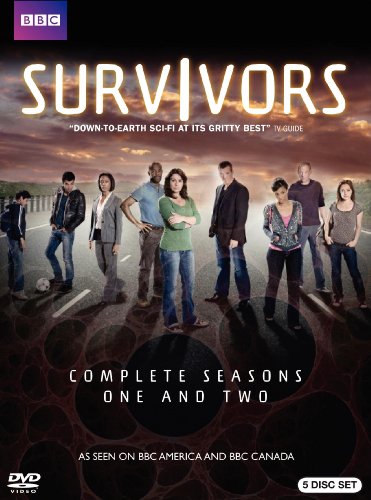
"Most of the world's population has been wiped out by a virus. Civilization, as we know it, has come to an end. For the few survivors, every day is a fight for life. But sinister forces threaten their future."
Right from the opening credits, you can see that a lot has changed since 1975 and the original series. I'm guessing that my watching them back to back allows for even more dramatic notice of the changes. Everything is cleaner here. The production values are light-years away from what they were. Even the disc menus reflect the higher-tech edge of the 21st century production values. The credits claim that this series is not really based on the original show, but more on Terry Nation's novel. I never read the novel, but it appears there is some truth to that statement. The episode titles no longer have individual titles. They are merely listed as Episode One, Two... and so on. Once you begin to watch the show, you will find that you recognize many of the characters by name and, at times, circumstance, but these are not the same people at all. More on that later.
Posted in: Disc Reviews by Gino Sassani on May 4th, 2010
These last couple of years have seen a resurgence of a particular kind of character study. For me I think it started with The Wrestler. For Mickey Rourke, it was a powerful comeback and led to an example of grand theft at that year's Oscar celebration. Now, I wouldn't exactly say that Jeff Bridges was in any particular need of a comeback. He's had some pretty steady work over the years. Still, you just can't watch Crazy Heart and not be reminded of The Wrestler. These characters could not be more different in a lot of ways. But they are also cut from the same cloth. Both have already seen their glory days behind them. They've each indulged in some pretty self-destructive behavior. In The Wrestler, it could be argued that the abuse he put on his body was a necessary part of the life he chose. With Crazy Heart, we're talking alcoholism, pure and simple. Still, any of those old cowboys might make the argument that booze is as much a part of the life they choose as the drugs and physical punishment are for a wrestler. It's a pretty good point. Both characters are looking for some kind of redemption with a past child. In this case it's a son. Both are attempting to find healthy relationships, perhaps for the first time in their lives, with single moms who have had some bad luck in the romance department. Finally, both characters are looking for a comeback. Here is where the stories truly diverge. For Mickey Rourke's Ram, he returns because it's the only thing he knows. His job defined him. His comeback will likely mean the end of his life. For Bad Blake, the new career in music could well be his salvation and a chance at a longer life. Whatever the comparisons, both are strong character-driven pieces.
Bad Blake (Bridges) was once on the top of the country charts. But that was a long time ago. Today, he's driving around in his Suburban from gig to gig with about 10 bucks to his name. He's gone from great arenas to bowling allies and small-town dives. He still has a small core group of fans that make even this life possible. The trouble is that Bad chain smokes and drinks his health away. He can barely stand for one gig. His old guitar player Tommy Sweet (Farrell) has offered him the chance to open for his act. More important, Sweet wants him to write some new songs for him, and is willing to pay well for them.
Posted in: Disc Reviews by Michael Durr on April 26th, 2010
The first District 13 movie was considered a modern day cult classic. It featured a number of meticulous and daring stunt scenes that were worked without the use of wires or computer generated effects. It was written and produced by Luc Besson famous for Fifth Element & Leon. But would the sequel set in the future 3 years later be able to hold the same interest?
It is France in the year 2013. Gang overlord, Taha Bemamud has been dead for three years leaving chaos in the streets and at the political level. Five territorial gangs are fighting for control and none are willing to back down to usurp control. The government is working on establishing peace and harmony to the troubled sector stationed firmly in the heart of Paris but is having considerable difficulty with the 2 million plus people stationed there.
Posted in: Disc Reviews by Gino Sassani on April 26th, 2010
"You're not in Kansas any more. You're on Pandora, ladies and gentlemen. Respect that fact every second of every day. If there is a Hell, you might want to go there for some R&R after a tour on Pandora. Out there beyond that fence, every living thing that crawls, flies, or squats in the mud wants to kill you and eat your eyes for Jujubes..."
I don't really have to tell you what Avatar is. If you haven't heard of it by now, I have only one question to ask of you: How was that coma? Ever since he cleaned up at the box office with Titanic, James Cameron has been planning this movie. The only trouble was that the technology to make it did not exist. Most filmmakers would have either tried anyway, or simply waited until the hardware caught up with their imaginations. Not James Cameron. He decided to invent the equipment himself. The result is a new 3D filming process that allows for the most realistic images you likely have ever seen on a movie screen. He combined the new process and equipment with new state-of-the-art computer-generated technology. The result is a movie that is truly the first of its kind. It was a huge risk for Cameron. A lot of money went into not only making the film but the technology development. In many ways Avatar was really an audition film. Cameron wants to make his equipment the stuff other filmmakers use to create their own silver screen dreams. It was a gamble. Judging by the box office take, it paid off big time. With a box office return of nearly $3 billion worldwide, James Cameron now has the number one and number two top-grossing movies in the history of the industry. If you're keeping count, it's a total box office take of just under $5 billion for two movies.
Posted in: Disc Reviews by David Annandale on April 25th, 2010
We are in the mid-60s, when, during the glory days of the Stones, the Who, and other colossi of British rock, the BBC allows almost no airplay of said music. To the rescue comes a group of commercial pirate radio stations, broadcasting from ships off the coast. Priggish minister Kenneth Branagh is determined to shut them down, and our focus is on one particular ship, run by Bill Nighy, and boasting such luminaries as Philip Seymour Hoffman and Nick Frost as DJs. Onto this ship of counter-culture rebels comes a young Tom Sturridge, and this wet-behind-the-ears youth becomes the eyes through which we watch the various eccentric goings-on.

Director Richard Curtis is a dab hand at ensemble romantic comedies, as the sterling likes of Four Weddings and a Funeral and Love Actually more than demonstrate. But though he has a terrific cast here, including such regulars as the always watchable Nighy, this is a misfire. It is surprising, given some of the indelible characters in Curtis' previous films (notably Emma Thompson's role in Love Actually) that the female parts here are so woefully underwritten (the women in this film are little more than disposable sex objects). As well, would-be funny scenes of the farcical, slamming-door variety (such as the scene where Frost tries to get the virginal Sturridge to replace him in bed) are older than the hills and eroded completely flat. So the comedy, the odd line here and there notwithstanding, barely raises more than a mild grin. And the tone is so light and unconcerned that it robs the context of any real rebellion or vitality. This radio station might as well be a standard classic-rock denizen of the FM band for all the edge we feel. Then there's some laziness to the writing. If we are to believe this is circa 1966, why have someone anachronistically talk about “thinking outside the box”?
Posted in: Disc Reviews by Gino Sassani on April 20th, 2010
Flight Of The Intruder is one of those films that appears and disappears off of the film world radar about as quickly as a stealth bomber. It has had its share of accolades but often passes swiftly into that entertainment night of obscurity. While it is at its core a Vietnam War film, the movie never really appears to be about the war at all. It attempts to capture some of the sartorial wit of Catch 22 while still trying to pass itself off as a serious enough movie. Make no mistake. This film leaves no war cliché unused, particularly in the stilted, sometimes gung-ho dialog of its characters.
Jake "Cool Hand" (Johnson) is a bomber pilot during the Vietnam War. He's stationed on an aircraft carrier. He's growing a bit bored with the missions he's being ordered to fly. Instead of taking out the important military installations he's assigned to, the locations end up being just empty jungle, or worse. Some of them are simply civilian farms and villages. His morale is already pretty rock-bottom when one of these useless missions catches his plane some serious fire and kills his navigator. Now Jake wants to do something worthwhile, not to mention get a little payback on the enemy. Commander Camparelli (Glover) is growing concerned with the emotional state of his pilot. He tries to keep him reined in as best he can. Enter Jake's new navigator Lieutenant Commander Cole (Dafoe). This guy loves combat. He's just volunteered for his third tour of duty. Like Jake, he wants to make some kind of a real difference. Jake convinces him that they should fly an unauthorized mission straight to downtown Hanoi where it is believed there is a stockpile of SAMs (Surface to Air Missiles) that are responsible for bringing down a lot of American planes. They know it's likely a suicide mission and that even if they should survive, a court martial is about the best they can hope for from the service.
Posted in: Disc Reviews by Gino Sassani on April 16th, 2010
Remakes are a fact of life. It might seem now more than ever that we are plagued with this reality, but it's been true for a very long time. It's not so new, as you might expect. Even the lauded Cecil B. Demille The Ten Commandments was a remake of his own silent 1923 film. They've existed almost as long as the movies themselves and will continue to exist for the foreseeable future. So, the question should be: Why should a particular film be remade? Often technology catches up with the content in a film. The ability to create on the screen something that was simply impossible originally is a legitimate reason to tackle an older film. Sometimes the movie is so powerful that it bears retelling for a new generation.
But then there are the reasons why a film should not be remade. There are some classics that simply should be off limits forever. Would anyone even dare attempt to remake The Godfather? There are those films that are just not worth being remade. How many versions of Piranha do we really need? Then there are the films that are remade in title only, like the 1999 version of The Thomas Crown Affair.
Posted in: Disc Reviews by Archive Authors on April 15th, 2010
Holy crap, this movie made a boat load of money for Fox when it came out around Christmas 2006, making $250 million and running second only to the Pirates of the Caribbean sequel for box office money. And to see Ben Stiller finally appear in a film that could be considered a blockbuster success was nice too. And in Night at the Museum, he gets to play Larry, night security guard in the New York Museum of Natural History.
Based on a book by Milan Trenc, the story contains man… of the same qualities of a Jumanji or even a Zathura. Larry takes over for a trio of retiring night guards (played by longtime veterans Dick Van Dyke, Mickey Rooney and Bill Cobbs) at the Museum. What he doesn’t know is that the inhabitants of the museum come to life at night, and he has to make sure that the inhabitants stay in said museum from sunset to sunrise, or else they turn into dust.
Posted in: Disc Reviews by Archive Authors on April 15th, 2010
Ice Age – The Meltdown is a funny, well-animated sequel that offers up a new adventure for the memorable characters from the original Ice Age film. As a great bonus, it’s nicely balanced for audiences young and old.
20th Century Fox Animation is still a poor second cousin to Disney’s Pixar Animation Studios, but for sheer entertainment value, Ice Age – The Meltdown doesn’t get knocked completely out of the water by top-shelf blockbusters like The Incredibles. Sure, the animation is weaker, and story is less inspired, but the voice work is excellent, with the talent of Ray Romano, John Leguizamo, Queen Latifah, Denis Leary, Jay Leno, and the list goes on.
Posted in: Disc Reviews by Gino Sassani on April 14th, 2010
I’ve often spent a lot of time talking about how Pixar has dominated computer animation, at least as far as full-length features go. With few exceptions, there isn’t anything out there that even comes close. Most films rely on toilet humor and crude innuendo to get a few laughs. A lot of the kids and adults might suck that stuff up, but they can’t hold a candle to Pixar. There are, as I’ve mentioned, some quite notable exceptions. The Fox Blue Sky Studios has had enormous success with their Ice Age films, and when you take a look at the third and latest entry in that franchise, you’ll understand why.
Ice Age came out in 2002 and took the box office like a blizzard piling up a drift of cash that amounted to almost $180 million before it was over. Not bad for a $50 million dollar film. Add in another $200 million in foreign receipts, and a sequel was an absolute forgone conclusion. The film introduced us to some memorable characters. Manny (Romano) was a lovable woolly mammoth. Diego (Leary) was a kind and wise saber-toothed tiger. Sid (Leguizamo) was their tagalong friend with not much going on in the noggin. A side story involved a prehistoric squirrel named Scrat who loved his acorns. He had a Wile E. Coyote/Roadrunner relationship with acorns and took a lot of punishment to get one. Together they tried to return a lost human infant to his tribe. In retrospect of two sequels, it's neat to look back to before these original core characters met for the first time.