DTS HD 5.1 MA (English)

"If the glass is half empty, at least you can't drown."

When I looked at the title and description of this film I couldn't help but think of that Jimmy Stewart classic It's A Wonderful Life. I'm not sure if it is the close title or the idea of a cynical man finding some kind of epiphany about his life and how he interacts with others. So, maybe it was that connection and inevitable comparison and expectation that caused me to dislike this film as much as I did. It's not fair, you might say, but it is the filmmakers themselves who invite this comparison and apparently welcome it. I'm sure the idea was that it would bring in that particularly large audience of viewers. Unfortunately, it was more of an anchor providing a standard that Wonderful World simply can't meet. But let's forget the comparisons for a moment. This is still a pretty bad film. It made its run of the film festival circuit for a time and even managed a very limited American box office run which barely grossed nine grand in total.

It seems like yesterday, but about a year ago; my cat of 14 years had died. Her name was Burns. She had survived through my college years and the worst period in my life during my 20’s. Sarah had come into my life at that point and I guess my cat finally realized she could let go. Burns was always a loyal companion and there to bring me up when I needed it. I never had a better pet than her, and I probably never will. Hachi, A Dog’s Tale is another story about a faithful animal, adapted from a Japanese true story.

It’s hero day at a local school. One student named Ronnie (played by Kevin DeCoste) starts to spin the tale about his hero: Hachi. Hachi is a dog that was actually owned by his grandfather, Parker (played by Richard Gere). We then start to flash back to a Japanese man shipping an Akita dog that travels cross county and ends up in Rhode Island.

It's back to the 1950's with its telltale alien invasion science fiction matinees. There's Doo Wop coming out of the radio. The cars have tail fins and plenty of color and chrome. That's right. This is 1950's Americana. Well ... almost. You see, the alien invaders are humaniacs. They turn the helpless population into mind-controlled zombies, and they eat brains for breakfast. Those sure are the classic cars, all right. But they're rounded, and instead of wheels they ride on a cushion of air. And then there's the "people". They're green. They have tentacles for hair. And they have only 4 fingers and toes on each hand or foot. Can anyone say, "Give me a high four"?

Meet Lem (Long). He's your typical 1950's teen. His biggest worry is how will he impress Neera (Biel), the girl of his dreams? He holds down a job proudly at the local museum and planetarium, where he teaches that the universe is nearly 500 miles across, containing 1000 stars. Wow! He doesn't have time for the fantastic movies and comics that depict humaniac invasions. His friend Skiff (Scott), on the other hand, reads and watches them all. He's quite well versed in the topic of alien invasion. He's convinced that "they" are coming, if they're not already here, that is. For these innocent and peaceful folks, the nightmare scenario that they've feared their entire lives is about to come true. An alien has invaded!

"There's two kinds of people in this world when you boil it all down. You've got your talkers and you've got your doers. Most people are just talkers. All they got is talk. But, when all is said and done, it's the doers who change the world. And, when they do that, they change us. And, that's why we never forget them."

And while The Boondock Saints never did bring in box office gold (heck, it didn't even bring in Box Office aluminum) like the characters in the film, they were not forgotten. There were conventions and local film festival showings that brought out untold thousands to share the movie experience. It became what we commonly call today a cult hit. But that's a term of endearment used by critics and fans to describe this kind of grass roots fan base. Unfortunately, it's a dirty word in Hollywood. No one in the studio highchairs wants to produce a cult film. Well, no one except maybe Troy Duffy.

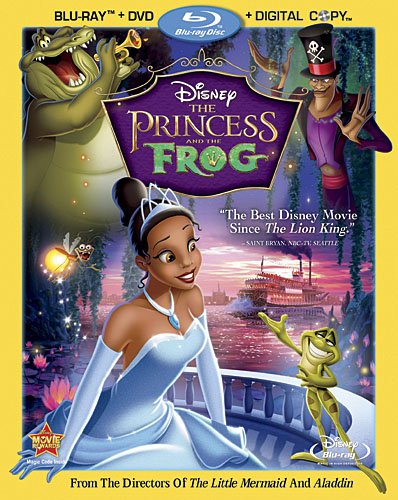
If any studio out there knows princesses, it has to be Disney. Uncle Walt has brought us so many memorably magical moments in the realms of fairy godmothers and the rags to riches tradition. A list of such Disney characters would serve as a rather complete roll call of such familiar animated ladies: Snow White, Cinderella, Ariel, Sleeping Beauty, Jasmine, and now you can add yet another name to the growing list. The studio that invented the animated fairy tale returns to its hand-drawn animation roots with The Princess And The Frog.

When Pixar finally landed permanently at Disney, no one was more excited than I was. It seemed somehow quite fitting that the studio that invented the animation feature should now take the lead with the company that invented the computer animated feature. It was a match made in heaven, or at least Neverland. But, I was as shocked and dismayed as many fans of the medium when Disney made a rather abrupt decision to close down its hand-drawn animation studios. There was plenty of rancor from the move and more than a few talented artists suddenly without jobs. It appeared that the Mouse House had traded one legacy in to acquire another. And so it looked as if we would never again see the wonderful marvels of a hand-drawn Walt Disney creation. Ah, but we all forgot. Disney is in the fairy tale business, after all. And like every good story, just as it looks like the villain has triumphed and all hope is gone, a white horse bearing a hero can never be far behind.

I'm sure that somewhere inside of Jared Hess's mind all of this makes perfect sense. I get the feeling that after he completed Gentlemen Broncos the writer/director/producer sat down to a screening with a group of his friends and the congregation rolled in the aisles with laughter. I'm equally sure that when his friends went home they were left scratching their heads. Somewhere in Hollywood a corner drugstore made a killing in aspirin or something stronger. In his own private world, where they all get the joke, Gentlemen Broncos might not be so bad. As for this reviewer, it was perhaps one of the worst films I've ever had the displeasure of watching. I'm putting in for hazard pay on this one, guys. This film will subject you to images that you'll pay good money not to have in your heads. Once again, a payday for the drugstores who likely made about as much off this movie as the film produced at its limited box office run. For anyone out there ready to accuse me of "not getting it" or some such defense of "your" movie. Look at the film's gross take of $113,000 against a $10 million budget and talk to me then.

Benjamin (Angarano) is a young awkward boy who likes to write fantasy stories. He's socially inept, helped in no small part in his problems by a neurotic mother who babies him and designs incredibly bad nightgowns. She ends up sending him to a writers’ camp where he gets to meet his idol, writer and illustrator Chevalier (Clement) who is really quite too full of himself to be believed. Chevalier is out of ideas, and he's about to get dropped by his agent if he doesn't come up with something good, and soon. When Benjamin submits his story Yeast Wars: The Bronco Years to a writing contest at the camp, Chevalier decides this is just the story he's looking for. He changes a few names and submits the story as his own. Meanwhile Benjamin has sold the film rights to his story to amateur filmmaking couple Tabitha (Feiffer) and Lonnie (Jimenez) who turn it into a gay space opera with incredibly poor filmmaking. The stuff is about to hit the fan as the two versions of the story are about to collide with Benjamin in the middle of it all.

I have to admit that I approached Old Dogs as cautiously as I'd approach a rabid junkyard dog. With a story that sounds like another retelling of Three Men And A Baby and the setup, and director, of Disney's Wild Hogs, it seemed pretty apparent that this film was not going to offer anything terribly new or exciting. When I started watching the film I discovered that I was pretty much right. This is very much Three Men And A Baby meets Wild Hogs. More importantly, I was also correct in believing the film wouldn't offer up anything all that original or new. What I didn't expect, and what will make this a film worth watching for you anyway, is that the delivery here is actually pretty special.

The story itself couldn't be any more contrived. Charlie (Travolta) and Dan (Williams) have been best friends and business partners for over 30 years. They run a sports marketing firm and have done pretty well, even if they're not the millionaires they always hoped they would be. They are the kind of Bromance couple that are always there for each other. In a story that Dan likes to tell clients to "break the ice", we learn that 7 years earlier Dan got divorced and it nearly tore him apart. Charlie pestered him into taking a carefree Florida vacation where a one night stand led to a quickie marriage and annulment as well as an embarrassing tattoo, which was supposed to shout “Free Man” across his hairy chest, but due to a mixup in translation with the tattoo artist says “Freemont” instead. Now the boys are on the verge of a $47 million deal with a huge Japanese company that will finally get them the riches they've been seeking. Feeling on a bit of a high, Dan decides to set up a meet with Vicki (Preston) to see if he can fan the old romance flames once more. He gets more than he expected, however. Vicki has twins, Zach (Rayburn) and Emily (Travolta) and, predictably, they are Dan's. Coincidentally, Vicki is about to serve 2 weeks in jail for a political activism stunt, and Dan ends up crushing the hands of her hand model friend, who just so happens to have been her babysitter for her time in stir. Dan, feeling suddenly fatherly, agrees to take the kids in an attempt to bond with his newly discovered family. The rest is pretty much what you would expect. Dan and "Uncle" Charlie try to seal the big deal and learn to care for the kids with the usual hijinks and comedic results. Because this is, after all, a Disney film, we know that the movie is going to end with one of those warm life lessons and everything is going to work out fine. Who does storybook endings better, right?

"Perseus and Andromeda will be happy together. Have fine sons... rule wisely... And to perpetuate the story of his courage, I command that from henceforth, he will be set among the stars and constellations. He, Perseus, the lovely Andromeda, the noble Pegasus, and even the vain Cassiopeia. Let the stars be named after then forever. As long as man shall walk the Earth and search the night sky in wonder, they will remember the courage of Perseus forever. Even if we, the gods, are abandoned or forgotten, the stars will never fade. Never. They will burn till the end of the time."

Talk about your perfect storm. You take the master of stop motion technology, Ray Harryhausen, and you combine those creature animation talents with one of the oldest stories surviving today in Perseus and Andromeda. How can the combination not be magical? The story has always been a favorite of mine, likely because I was born on the Summer Solstice, the critical moment of this story. I was preordained to love this film. The truth is that this film never got quite the recognition it so richly deserved. Now, on the cusp of a computer generated remake, it was my unmitigated privilege and joy to watch the original 1981 film in the glory of high definition.

Remember the blaxploitation films of the 1970's? These films generally played on the ghetto stereotypes that would likely not be as well tolerated today. The films were populated with fur-adorned pimps driving in purple Caddys. The street language was almost indiscernible. The black population sat around drinking from large malt liquor bottles in brown paper bags. In a day where almost every potential racist remark is pounced upon, it's hard to imagine that this kind of thing could have existed at all. But the point was that these films weren't feeding into the stereotypes for the most part. They were making fun of them. They were showing us how ridiculous they looked when taken to such extreme. What's more, the films offered the first real star vehicles for so many talented black actors. Certainly, the genre has always had its detractors, but they never seemed to cause a stir among the members of black leadership. The truth is that these films no more depicted black culture than mafia movies depict Italian culture. It's just a lot of fun to poke fun. You gotta let your hair down, or frizz out, sometimes.

The genre was important during the time and its influence began to be felt in mainstream pictures of the era. Characters like these began to show up everywhere. Starsky And Hutch was a white cop , but their streets were often populated with these characters, most notably the Huggy Bear snitch. Even James Bond suspended his international fight with global domination crooks to tackle a gang of blaxploitation drug dealers in Live And Let Die. In the 1970's you couldn't get away from it. Some of these films became huge. Shaft and Super Fly became huge hits. The recently departed Rudy Ray Moore created Dolemite, a bad Kung Fu/kick butt and take names, F Bomb droppin' bad dude. There's no question that Moore's character was a huge influence on Black Dynamite.

When the original 1987 film The Stepfather came our way, the world was a very different place. Of course, that's true with any titles that are separated by nearly 25 years of time. When reboots or remakes are attempted, as they all too frequently are today, it is often true that some allowances must be made for those inevitable changes in our world. Filmmakers attempt to make whatever adjustments they deem fit and bring the old favorite, or not so favorite, into our current collective consciousness. Like all things, sometimes it works. More often it does not work. And then there are those occasions where it simply could never work. The Stepfather was released just at the dawn of this new instant information age. In 1987 most public records weren't available at the click of a mouse. There weren't social networks and Google options that allowed any normal person to become a private investigator. Put simply, it was a time when a person could still step into a new persona and leave his past acts behind him. Certainly, the ambitious could still research someone, but that required dusty basements in newspaper offices or library microfiche. The idea so essential to the suspense and thrill of The Stepfather simply no longer exists. The only way a remake could have really been effective was to make it a period piece and set it in the 70's or 80's, if not earlier. A ten year old kid can get the goods on you now. Here David doesn't appear to be concerned at all about fingerprints and DNA.

The original film had more than a slower information age going for it. Terry O'Quinn delivered one of the creepiest performances of his career. Yeah, that's the same Lost John Locke Terry O'Quinn, so it shouldn't be that hard for you to imagine an enigmatic performance. Even in 1987 the idea wasn't terribly original. There were enough stalker films by then that the concepts were already tired and worn. What made that film work more than anything was that performance. I remember particularly a moment, badly reproduced here, when O'Quinn's character stops and looks blankly at the camera and says, "Who am I here?" O'Quinn gives us a look that totally defines the hideous pathos of his character, and in that instant we realize how dangerously deluded he really is. It wasn't the back story. It wasn't the body count leading up to that moment. It was all in that look. It sent a shiver through the stoutest spine. And it is that element that is completely absent here. Dylan Walsh is a fine enough actor, and his performance is solid, but he never truly frightened me. Without that glue, the pieces of this remake simply cannot hold together.