Posted in: Disc Reviews by Archive Authors on November 27th, 2009
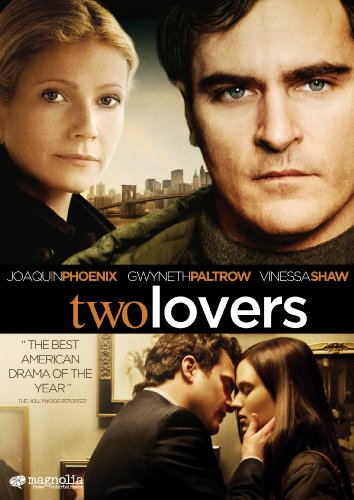
James Gray’s Two Lovers revolves around the troubled Leonard Kraditor (Joaquin Phoenix). Leonard has moved back into his childhood home to recover from his recent break up. In quick succession, two women enter Leonard’s life: Michelle (Gwyneth Paltrow), an entertaining and peculiar neighbor who transcends Leonard’s world and Sandra (Vinessa Shaw) a classy, traditional woman who is the daughter of a businessman attempting to purchase Leonard’s family business. Leonard becomes confused between desire and love and the story unfolds from there.
The performances in this film are what resonate with the audience the most. Joaquin Phoenix crafts his character from a dark place and displays great emotion in this role. His complicated past slowly unravels throughout the film and audiences become more and more aware of his emotional instability. Phoenix is truly a great performer; it is unfortunate that he has taken a recent ‘break’ from acting. Both of the female leads are strong as well. Vinessa Shaw’s performance is passionate and powerful. Her scenes with Phoenix are both romantic and realistic as well. Viewers can definitely identify with the dialogue between the two of them. Gwyneth Paltrow is not breaking new ground with her performance. However, her scenes are all remarkably interesting. Her character is deeply conflicted by her current relationship and the growing relationship with Leonard.
Posted in: Disc Reviews by David Annandale on November 25th, 2009
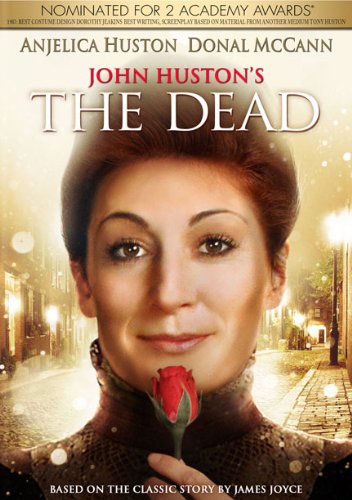
In early-20th-Century Dublin, a winter's musical gathering is being held. The first two-thirds of the film takes us through the course of the evening, from the arrival of the guests, to the musical entertainment, to the dinner and its discussions (and arguments), and finally the departures. During the party, one is aware of a certain tension or distance between one couple: Donal McCann (nephew to the hostesses) and his wife (Anjelica Huston). As they prepare to leave, Huston hears one of the guests sing, and is rooted to the spot. Later, McCann asks her why the song affected her so much, and a painful memory from her past comes out.
John Huston's last film is suitably elegiac. Based on the James Joyce's short story of the same name, the movie is itself in short story form, barely clocking in at 73 minutes, and that's including the credits. The running time is just right, though, as this is a compact, moving tale, whose title does not become clear until the closing minutes. Were the film any longer, audiences would likely become restive at the apparent lack of story during the first two acts, but everything is present for good reason, working in unity towards a powerful conclusion. In all of this, the film is deeply faithful to the Joyce story. But the story also presents an enormous challenge: its conclusion relies on the thoughts of its protagonist, not on dialogue or action, the bread and butter of cinema. What to do? Huston takes what is probably the only path open to him, and goes for a voice-over as the camera gazes at mournful scenes of snow falling in the Irish night. The voice-over, having been absent until this very moment, is a bit jarring, even as its necessity is understandable. So the film might not be flawless, but it is a heartbreakingly moving valedictory gesture from one of cinema's greatest directors.
Posted in: Disc Reviews by Gino Sassani on November 24th, 2009
“You got everything money can buy, except what it can’t. It’s pride. Pride is what got you here. Losing is what brung you back. But, people like you, they need to be tested. They need a challenge.”
There have been a ton of boxing films. They’ve been popular going back to the Silent Era. Most of them have many of the same themes. But there was always something about Rocky that stood out above all of the rest. That “something” can’t really be described or defined. As the Supreme Court once said about the definition of obscenity: “I can’t define it, but I know it when I see it.” That’s all you can say about Rocky. Some might call it heart. That’s about as good a word for it as anything else. Rocky himself would call it “stuff in the basement”. It almost demeans it to put a word on it at all. Whatever you call it, you don’t necessarily see it in Rocky … you feel it.
Posted in: Disc Reviews by David Annandale on November 23rd, 2009
We are in the late 1920s, and to the family manor comes Ben Barnes, in the company of new wife, Jessica Biel. That this woman is both American and a race car champion does not sit well with the very conservative mother Kristin Scott Thomas. That her nose is out of joint delights husband Colin Firth, a veteran of the Great War who, thoroughly world-weary and disillusioned with just about everything, wants nothing to do with the petty concerns and squabbles of his family. What follows is a clash of cultures and generations, veering between slapstick comedy and something rather darker.
I know you've all been waiting to see Jessica Biel finally star in a film whose script is based on a Noel Coward play, which was first adapted in 1928 by Alfred Hitchcock. All kidding aside, Biel acquits herself well, despite occasionally displaying some rather anachronistically defined pecs. The other cast members aren't having to strain themselves too much -- Scott Thomas has played repressed ice queens before, and Firth pretty much phones in his trademarked display of amused contempt -- but they are never less than efficient in their portrayals. That said, Scott Thomas and the performers playing her daughters have a tendency to project to the back of the hall, and otherwise remind us a bit too forcefully that this material was originally a play. The film is far from the jaunty comedy of mores that the case suggests -- it is rather too dark for that, by the end. It is an enjoyable, though finally slight, bit of entertainment.
Posted in: Disc Reviews by William O'Donnell on November 23rd, 2009
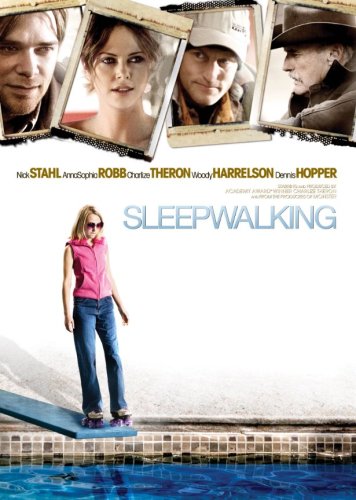
This is the story of an unfortunate underachiever who is left with his niece after his even less fortunate sister abandons them. Unhappy with social services and the places they are forced to live, they take what little money they have to fund an aimless trip across the country until arriving at the home of his abusive father.
This film relies on the performances since the story is so utterly bleak at times that all the audience has to cling to sometimes is the recognition of the stars within it. Filling up the smaller roles are the likes of Woody Harrelson, playing the goofy friend, Dennis Hopper, who is devouring the scenery as the aforementioned abusive father, and Charlize Theron, who is greatly missed during most of the film for she delivers probably the most solid and engrossing performance as the troubled mother. Theron controls the first fifteen minutes then becomes nothing more than a reference for the better part of the proceeding film.
Posted in: Disc Reviews by Gino Sassani on November 13th, 2009
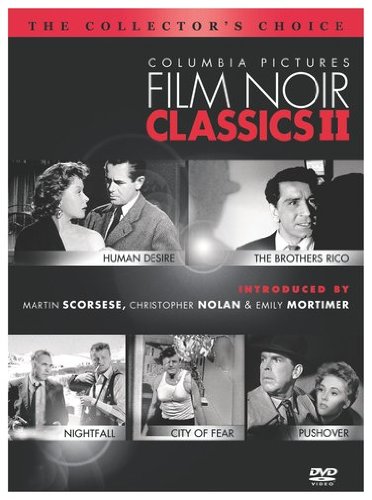
“In the 1940’s, a new genre – film noir – emerged from the world of hard boiled pulp magazines, paperback thrillers and sensational crime movies. These films, tough and unsentimental, depicted a black and white universe at once brutal, erotic, and morally ambiguous.”
And so Sony collects 5 of these films as part of what looks like is going to be an ongoing series. But what exactly is film noir? You hear the word used from time to time, but what does it mean?

Posted in: Disc Reviews by David Annandale on November 13th, 2009
Jeff Daniels plays Arlen Faber, author of the mega-bestselling Me and God, a book of self-help spirituality that comes across as an aphoristic mix of Zen and the Art of Motorcycle Maintenance and The Purpose-Driven Life. The book is coming up for its twentieth anniversary, and Arlen hasn't written anything since. He is now a cynical recluse, but begins crawling out of his shell when he encounters a struggling single-mother chiropractor (Lauren Graham) and an alcoholic used bookstore owner (Lou Taylor Pucci). They are looking to him for wisdom, though he doesn't really believe he has any to give. In turn, they are teaching him how to live again.
Posted in: Disc Reviews by Gino Sassani on November 13th, 2009
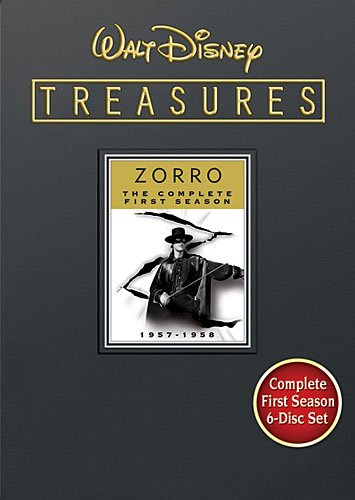
“Out of the night when the full moon is bright comes a horseman known as Zorro. This bold renegade carves a “Z” with his blade, a “Z” that stands for Zorro. The fox so cunning and free, Zorro who makes the sign of the “Z”. “
Zorro first appeared in pulp magazines in 1919 written by Johnston McCulley. He told the story of a talented swordsman who masqueraded as a dull, inept, and spoiled young rich man. But, when he put on his trademark black cloak and mask he took to the countryside of Spanish California in 1820, fighting for the peasants and anyone treated unjustly. He was a regular Robin Hood. While he did not steal, he was considered an outlaw and had to spend much of his time fighting off the law. He was known for using his sword to cut a “Z” on anything from trees to the clothes of his enemies. He lived by a strong code of honor and morals. He never killed, unless it was absolutely necessary, which it seldom was. It didn’t take long for this inspiring character to reach the silver screen. In just a year from his publishing debut, Zorro was a movie staring Douglas Fairbanks as the heroic vigilante. But it didn’t end there. McCulley kept writing books, and the character became one of the most famous characters of the age. Republic created serials and the films kept coming. From 1920 through 1990 there wasn’t a decade that did not feature a live action version of the hero. Comics would follow.
Posted in: Disc Reviews by Gino Sassani on November 11th, 2009
“The perpetrator is an expert marksman. He’s an expert in explosives and tactics. Gentlemen, play this one by the numbers. Maintain your fields of fire… We’re blind and he’s seeing in 20/20… We have not contained him. He’s contained himself.”
“He” is Samuel L Jackson in the 1998 action thriller The Negotiator. Jackson stars as Danny Roman. He’s a Chicago Metro hostage negotiator. As the film opens we get to see him in action saving a little girl from a tight hostage situation. He’s obviously good at his job and he has the respect and admiration of his fellow officers and commanders. Roman’s partner Nathan Roenick (Guilfoyle) has gotten a hot tip from an informant. Someone inside the department has been skimming money from the union’s retirement fund. He’s about to blow the case wide open when he’s killed. Roman discovers his friend and partner just as other cops arrive to see him leaning over the dead body. He becomes the prime suspect not only in his partner’s death but the missing money as well. Someone has gone to great lengths to frame him for the crimes. When evidence of his guilt is found at his house, not even Roman’s friends believe he’s innocent. With everyone turning their backs on him, Roman goes to Inspector Niebaum (Walsh), an internal affairs cop that Roenick mentioned as a part of the embezzlement scam. The confrontation quickly gets out of control, and before anyone knows what’s happened, Roman has taken the internal affairs department hostage. He demands that Lt. Chris Sabian (Spacey), another hostage negotiator that Roman trusts, be put in charge of the operation. Sabian takes over, but he’s dealing with a perp who knows all of the rules of engagement. To make matters worse, the book doesn’t cover this kind of negotiation. Roman isn’t asking for money and a plane full of fuel at the airport. He wants someone to get to the bottom of the frame job, or else.
Posted in: Disc Reviews by Archive Authors on November 10th, 2009
The names of the characters are hardly consequential, as they are used to further storylines more than develop character. But Pacino plays a cop who is tracking a group of robbers, among them Val Kilmer (Wonderland) and Tom Sizemore (Saving Private Ryan), a group headed by DeNiro. The group receives offers for work from Jon Voight (Runaway Train), and they rob anything from gold, to coins, to bearer bonds. They are all ex-cons, and know all the ropes. They are a highly professional crew, which you see in the opening moments of the movie, despite the addition of a new man to the crew. What also helps to differentiate this from a usual cops and robbers movie are the secondary plotlines of the families involved. Pacino’s is clearly distant and breaking (played by Diane Venora and Natalie Portman), while DeNiro doesn’t have one to speak of, despite an emerging romance with Edy (Amy Brenneman, Judging Amy). At 3 hours, there are some unnecessary scenes involving a banker (played by William Fichtner), but the underlying message is that almost all of the actions in the movie do not involve just the primary characters, but also friends and loved ones of those characters. Kilmer’s wife in the film, played by Ashley Judd, desperately wants to get him out of his line of work, as she wants to start a new life for her family. An ex-con (Dennis Haysbert, 24) is stumbled upon working in a greasy spoon, and offered a chance to work by DeNiro. Haysbert’s character wants to be right, but runs into so many obstacles from it that he takes the job, only to wind up perishing in what results in a massive gunfight in the heart of Los Angeles while a bank robbery is being pulled.
With other solid supporting performances by Ted Levine (Monk), Mykelti Williamson (Forrest Gump), and appearances by Bud Cort (Harold and Maude), Jeremy Piven (PCU), Hank Azaria (The Simpsons) and Henry Rollins (The Chase), the movie is certainly not without its star power. The director behind this work is Michael Mann, who also wrote a much better than expected story. The man responsible for such striking visuals in films such as Manhunter, Ali and The Insider contributes more outstanding work here, and while it’s been out for awhile now, Warner Brothers finally gives it a high definition Blu-ray release