Drama

49th Parallel is a film that I had heard mentioned in passing on occasion, but never really had any practical knowledge of until now. Having now seen the film for myself, I find it to be one of those rare productions that only Criterion seems to be able to find. This is something that I would have never dreamed existed. While the idea of war films told from the Axis point of view are almost commonplace today, such a thing was practically unheard of in 1941, with the United States on the brink of entering World...War II themselves.

This is just part of what is notable about this film however. The truth is, the film stands on its own merit in any time frame. This is an epic feat of filmmaking that would qualify as a big budget project even today. The film follows the crew of a German U-boat as they make their way into Canadian waters. When they sink a Canadian tanker ship, the crew becomes the target of a massive manhunt. In an effort to evade capture, the crew take to land and move from hideout to hideout, eventually making their way to the United States.

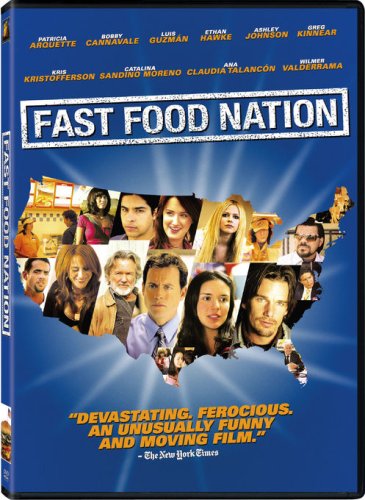
The lines between news and entertainment, documentary and fiction continue to fade every day. It's a dangerous trend, as people have begun to believe the fiction, and ignore the facts. This film seems to make that line disappear altogether. The movie is based on a bestselling book of the same name, written by Eric Schlosser. The book is a fascinating investigation of the fast food and meat packing industries in the United States that has really shed some light on this often-overlooked dark secret of the dining indust...y.

While the book was a fantastic expose of the problems that exist, the movie is something else entirely. When I heard they were making a fiction film about a non-fiction book, I wondered how they were going to do it. Turns out, the writers have constructed a thinly-veiled interpretation of the author's own book research. Greg Kinnear leads an all-star cast (including Wilmer Valderrama, Luis Guzman, Bruce Willis, Patricia Arquette and others), playing an executive from a fast food chain who is sent to investigate the company's chief meat supplier and find out how feces has gotten into the meat. Meanwhile, we also get to see the story of a group of migrant workers as they work in the plant (Babel style).

On its surface, Coastlines is a modestly produced film that was written and directed by Victor Nunez (Ulee's Gold), telling the story about a guy who was just released from prison for dealing drugs, but bites the prison bullet for the favor of a friend. He comes out and is looking for the financial windfall promised him, but also tries to get back in touch with his roots. On a deeper level, Coastlines, well, doesn't go that much deeper I guess.

The ex-con in question is Sonny (Timothy Olyphant, Deadwood), who quickly reunites with the criminal element of his past in Eddie and Fred Vance (played by Josh Lucas, Hulk, and William Forsythe, The Rock, respectively), who also give him the opportunity to get back into business for himself. He finds a bit of a conflict in this, because he is close friends with Dave (Josh Brolin, Into the Blue), who happens to be a Sheriff in town. Sonny also has feelings for Dave's wife Ann (Sarah Wynter, Species II).

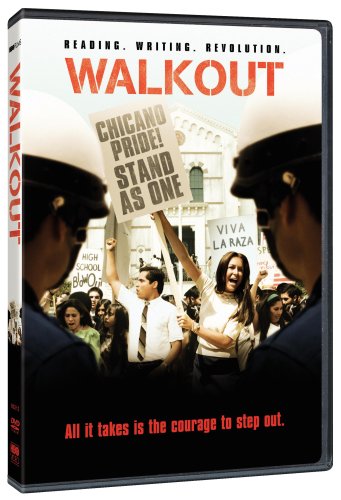
I don't mean for this to be a joke, but when Paul Mooney recently said that he was glad that Hispanics got their (and I'm paraphrasing here) "African-American wake up call" in the midst of the illegal immigration debate of 2006, the problem wasn't whether or not the Hispanics were being treated fairly or not. The problem was that this discussion has been going on in some manner or fashion for almost four decades now without a large-scale epiphany that required action. However back in 1968, there was some action (which led to the coordinated efforts of students to walk out of their classes in Los Angeles High schools as a protest of the conditions there), and Walkout helps to tell the tale.

In this film that was directed by Edward James Olmos (Miami Vice) and produced by Moctesuma Esparza (who was one of the organizers of the protest), the film details the activities of Paula Crisostomo (Alexa Vega, Spy Kids) who is a pretty good achiever in school who hangs out with friends like Bobby (Efren Ramirez, Napoleon Dynamite). She has an influential teacher in Sal Castro (Michael Pena, World Trade Center) who helps inspire her to take action. When latino kids are punished for speaking Spanish in class, they are disciplined for it and the manner it's done is offensive. When latino kids are forbidden to use bathrooms during lunch because the inside of school is locked, they're forced to urinate outside in the courtyard. And even as she sees these things, she's dissuaded by her father Panfilo (Yancey Arias, Live Free or Die Hard). However in an era where Bobby Kennedy and Martin Luther King are touchstones for action, Paula thinks the same thing should be done, lawfully, to protest the conditions.

The return of the historical epic hit Hollywood hard in 2005/2006. Troy, Kingdom of Heaven, King Arthur and the two Colin Farrell vehicles, The New World and Alexander, all hit theaters pretty close to each other... and all flopped. The basic complaint was the same about all these films; they were too long, the pace was too slow and they were hard to follow. As much as these huge pictures cost, the studios quickly looked to the DVD cash cow to try to recoup some of the production co...ts. The first to hit was King Arthur, which was released in the theatrical PG-13 format (full screen only), and the director's preferred extended unrated cut (presented in widescreen). Antione Fuqua's fighting with the studio over the final cut of the film was widely known, so it was nice to get to see the director's original, more violent, vision. Audiences were pleased too, as this new cut was widely regarded as superior to the original.

A very similar thing happened with Ridley Scott's Kingdom of Heaven. The theatrical release was regarded as average, as it was on DVD. When Scott re-cut the film and released it as a four-disc special edition, however, consumers and critics went wild, declaring this new extended cut far superior to the original theatrical version. In fact, this new vision was named the DVD of the year last year by many critics. Scott has since said that this new cut represented more of his original vision for the story, but that the studio feared that it was far too long for theater audiences. (Remember, these are the same audiences who had complained that the film was too long to begin with, proving that filmmakers' would be best served creating their films on their own terms, without the input of the general public.)

If you've seen any of Terry Gilliam's other films, you can probably guess that this one is pretty bizarre. Based on the novel of the same name by Mitch Cullen, Tideland is an eccentric, grotesque and imaginative tale of a child's resilience.

I'm going to say right off the top, I wanted to like Tideland, and for two reasons. One, Gilliam has made some incredible films in his career, from Monty Python and the Holy Grail to Twelve Monkeys and Fear and Loathing in Las Vegas. Other than the flawed Brothers Grimm, it's been seven years since a Gilliam-helmed film was released. So I wanted to like this one. I really did. Unfortunately, while I admired the creativity in Tideland, and was at times intrigued and repulsed, I ultimately found the film extremely unsatisfying.

As I right this review, the date is February 24th, 2007 one day before the Annual Academy Award Ceremony, which is a show that this film is nominated in the Best Picture category for. Numerous other reviewers, whether they're critical or simply just internet journalists like myself, have labeled this one as this year's Crash. A statement like that made me worry going into this one because simply put Crash isn't Best Picture material nor is it even close to Best Picture material. While I haven't seen every other Best Picture nominee, I wouldn't completely mind if the Academy did award Babel with the Oscar.

Babel tells the story of Richard (Brad Pitt) and Susan (Cate Blanchett), two rather wealthy Americans from San Diego who're vacationing in Morocco. Their two kids are back in San Diego with their Mexican housekeeper named Amelia. During their vacation in the country, a local herdsmans' young children find a rifle and, unknowingly, take aim and fire at passing spectators on a bus. Unfortunately Susan is hurt during the incident. At the same time we learn that a trip involving Richard, Amelia and Richard's two children has put these characters in a complex situation that may result in them not being able to return to America. And at the same time as that's occurring, another event is occurring in Tokyo involving a widower who just happens to be tied to the earlier mentioned rifle via an ownership right. But this widower also has to worry about the straining relationship he's having with his deaf daughter Chieko.

An epic is defined as an artistic work that celebrates the feats of a legendary figure. The film Cleopatra actually deals with many such figures, the title character being merely one of them. The truth is the film was never really about the Egyptian queen as much as it was about Rome and its relationship with Egypt.. Of course, Elizabeth Taylor's portrayal has achieved something of a classic status that is not completely deserved. Much has been made of the Richard Burton and Elizabeth Taylor pairing in this film. Certainly both delivered entertaining and even at times compelling performances. However, these efforts pale in comparison to the brilliance of Rex Harrison as Julius Caesar and Roddy McDowall as Octavian. Others like Martin Landau add considerable weight to often underused characters. It is doubtful much would have been made of this film at all, let alone Burton and Taylor's overrated contributions, without such help. Taylor in particular makes more use of her looks than any thespian grandeur here. Elaborate and frequent costume changes are designed to take full advantage of her more obvious attributes. She does appear a stark contrast to the unusual woman most notable in recent years for her staunch loyalty to Michael Jackson. The enormously grand cinematography also plays no small role in the film's ultimate success. This release is intended to pay homage to the Academy Awards taken by this film, which included statues for cinematography and visual effects.

Cleopatra runs over four hours and can be broken down into four distinct parts. Hour one is clearly a setup for things to come. Julius Caesar (Harrison) is close to a glorious victory over his rival Pompey Magnus in a Roman civil war. His quarry has fled to Egypt, where Caesar is in pursuit. Upon his arrival Pompey's head is presented by the boy king Ptolemy. Caesar inserts himself into Egypt's civil war in favor of the King's exiled sister, Cleopatra (Taylor). Upon his fathering a son with the Nile Queen, the hour ends with her safely back upon her throne.

We are in Haiti during the late 1970's, under the brutal dictatorship of Pap Doc Duvalier. At a beach resort, we meet three middle-aged women engaged in what amounts to sex tourism. Charlotte Rampling is Ellen, an imperious ex-pat British professor; Karen Young is Brenda, a psychologically fragile American divorcee; and Louise Portal is Sue, an earthy warehouse manager from Montreal. Disillusioned by their romantic prospects back home, they revel in the (paid) sexual attentions of handsome young Haitians, most notably Legba (Ménothy César), with whom both Rampling and Young are in love.

Director/co-writer Laurent Cantet observes his leading ladies with an eye that, while caustic, avoids easy judgments. He does not in any way let them off the hook for what amounts to a new form of predatory colonialism, and we see them engage in activities they would never consider in their home countries. So, for instance, we learn that Brenda had her first sexual encounter with Legba three years ago, when he was 15, and we see her being tempted to take advantage of a boy who can’t be a day over 12 (something Legba witness, and nips in the bud). But neither does Cantet engage in easy condemnation. He makes all of his characters fully developed human beings, and encourages us to understand these women, even if we do not sympathise. The film is not an unqualified success, however. Once the characters and the setting have been established, the film tends to meander, taking too long to tell us not much more than we knew at the start.

Some films can be intensely personal. Written and directed by one individual, the stories are fairly long in runtime and epic in terms of hopes and dreams, with characters that intertwine either coincidentally or a little bit more directly. They always seem to have a big name marquee star or two in them and always end on a message of hope or optimism.

Take the case of Babel. Written by Guillermo Arriaga and directed by Alejandro Gonzalez Inarritu, who were the creative team behind the Amores Perros and 21 Grams films comes perhaps their grandest idea yet. The film follows four storylines. The most notable for a lot of people was the one involving Richard (Brad Pitt, 12 Monkeys) and Susan (Cate Blanchett, The Aviator), who are spending some time in Morocco when tragedy strikes. Back at home, their children are being tended to by a kind immigrant named Amelia (played by Adriana Barraza, La Primera Noche), who decides to bring the kids across the border to Tijuana to attend her son's wedding, but when her cousin Santiago (Gael Garcia Bernal, The Science of Sleep) reacts poorly to a border officer's interrogation on their return to America, Amelia is forced to do something she doesn't want to do. Going back to Morocco, two young brothers who help with farming and goat herding, decide to play with a gun that their father gave them (which turned out to be a gift from a friend). And when the playing has some ramifications, the boys head down a road where there's no going back. The last one goes to Tokyo, where Chieko (Rinko Kikuchi, Tori) is a teenage deaf-mute girl who witnessed her mother's suicide as a child, and she looks to try and discover the joy of pleasure despite having to deal with her handicaps.