Horror

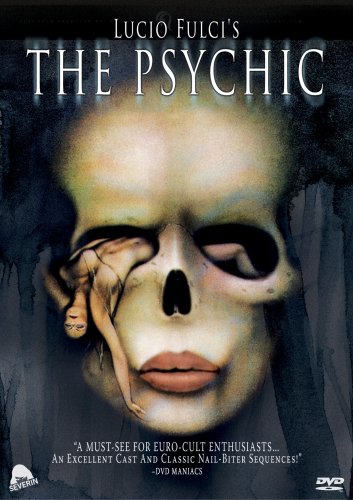
As a woman commits suicide by leaping to her death on the English seacoast, her daughter in Italy has a vision of her fall. Years later, the now-grown Virginia (Jennifer O’Neill) is married to a wealthy businessman, and is suddenly plagued by visions again. Following the evidence, she discovers the skeleton of a young woman who has been walled up in her husband’s ancestral home for years. He is immediately arrested. Virginia works to prove his innocence by investigating the other mysteries of her visions, but she is letting herself in for more than she bargained for.

Having made quite a name for itself as a purveyor of lovely editions of classic European sexploitation, Severin branches out in spectacular fashion with this 1977 effort by Lucio Fulci. Fans of the director who know him exclusively for films such as Zombie and The Beyond will no doubt be disappointed by the lack of extreme gore. (Exception: the opening suicide, which delivers a nasty jolt as we see the woman’s face smash against the rocks as she falls. Unfortunately, Fulci has to show us the effect more than once, and it loses its effectiveness as its artificiality becomes clear.) But, as clearly derivative as it is of both Nicholas Roeg’s Don’t Look Now and Dario Argento’s Deep Red, this is still evidence that Fulci was more than capable of assembling a film that is gripping at the level of narrative and suspense. Unlike Don’t Look Now, where we are kept as much in the dark as its protagonist as to what the visions mean, here Fulci makes sure we are a few steps ahead of Virginia. We realize quite early that what she saw was a vision of the future, not the past, and watch helplessly as the strands of fate wind inexorably around her. There may not be much to her character, but her plight is so clearly articulated and so unstoppable that we cannot help but feel a soul-deep dread. A excellent slice of Eurohorror.

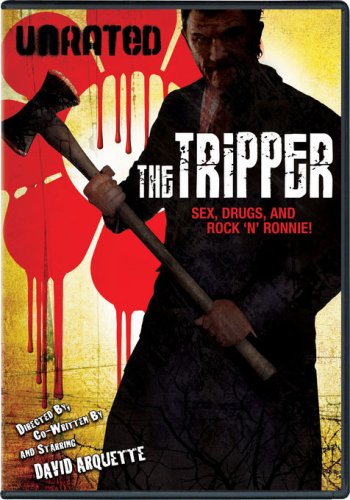
Bad horror movies are like watching a trainwreck. There are bodies all over the place and everybody is screaming in agony like a little school girl. And you can't turn your head away. So imagine my complete enjoyment when I received the Tripper to review. I screamed like a little school girl, my rabbit fainted and my girlfriend actually was able to turn her head away several times. I understand why they are the stronger sex cause I watched intently and was considering therapy when my 90 minutes was up.

The Tripper is the story of Ronald Reagan gone wrong. The back story indicates trauma to a young kid named Gus (played by Noah Maschan ) who chainsawed a tree hugger who was preventing his father, a lumberjack from performing his job. One would assume he spent the rest of his adolescence in a mental institution and then re-appeared as an axe wielding, Ronald-Reagan mask wearing psycho killer (played by Christopher Allen Nelson).

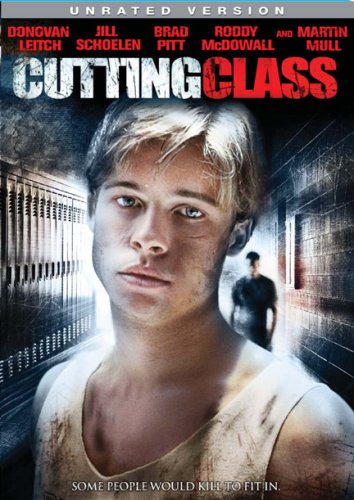
It’s probably a pretty bad sign when a film’s star makes a public apology to his fans for doing the film just when it is getting released on DVD. Brad Pitt did just that, and you know what? He should be sorry. This film is an absolute mess all the way around. I think it’s supposed to be a slasher film, but there are never any good 1980’s slasher moments to be found. It’s true that at this point in his career Pitt wasn’t exactly being offered the cream of the crop. He wasn’t paling around with George Clooney and friends just yet. So perhaps it’s not Pitt but the folks who made this film who should be apologizing. Cutting Class has no idea what it wants to be when it grows up. Is it a comedy or is it a drama? Ultimately it fails on both counts.


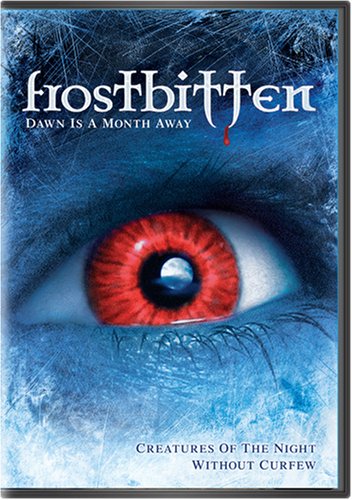
Stop me if this sounds familiar: in a far-northern community, night lasts thirty days, which makes the area highly hospitable to vampires. Yes, Frostbitten shares a very similar premise to the excellent 30 Days of Night. And while the Swedish film predates its American counterpart, it is more recent than the graphic novel. At any rate, the similarities pretty much end there, as Frostbitten is more interested in comedy than its cousin, and is also nowhere near as good.

The prologue is promising, with Scandinavian volunteers in the German army during WWII becoming lost and encountering vampires in a remote cabin. Flash forward, and the surviving member of the unit is now a respected geneticist performing experiments that only he knows the truth about on rather unusual patients. A teenager and her divorced mother arrive in the community just in time for all hell to break loose. Said hell does feature some inventive and humorous moments, but the film is hamstrung by dead clichés when it shifts its focus to the local high school and the group of characters we have seen far too many times before and never want to see again.

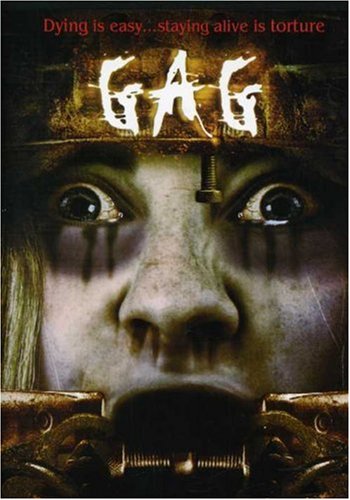
Hmm. A vision of elaborate torture in washed-out tones on the cover. A three-letter title. Gee, could Gag be inspired by Saw? Perhaps, but fortunately not in any slavish way, limiting its connections to the idea of extended torture, and that’s hardly something Saw invented. As opposed to the Saw franchise’s increasingly risible plot convolutions, Gag keeps its setup simple: a pair a burglars break into a house where they first discover a man chained to a bed, and then are captured themselves by the resident nutjob. The ensuing drama is a claustrophobic one, with the main characters trapped in the torture room at the mercy of a lunatic who has a definite, if mysterious, goal.


The film handles the grime and oppression quite nicely, and the torture scenes are genuinely disturbing. The limited budget is apparent in some of the sound design limitations, and the quality of the performances is variable, but still, this indie effort is far from dishonorable. I can’t help but feel, though, that the opening scene’s drooling voyeurism of a naked woman’s body just before she’s gruesomely killed isn’t gratuitous in the one sense that even this sort of film would do well to avoid.

Stephen King must be solely responsible for an acre of deforestation a year in legal pads and typewriter pages alone. I have heard it said that he writes at least ten pages a day, including holidays. A quick check of IMDB shows that he is credited for writing 106 television or movie stories, at least in part, since "Carrie" in 1976. While no writer - as I well know - can hit a home run every time they put pen to paper, King's "good to crap" ratio is far superior to that of the majority of the novelists working today.

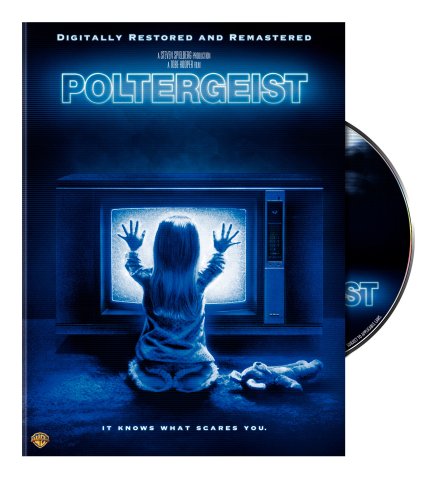
Everybody remembers the first scary movie that gave them nightmares for days and months after they saw it. For some, it was the Exorcist and for more recent folks perhaps it was Scream or Saw. For me, it was Poltergeist. I was but seven years old and thought it would be something like E.T. Phone Home, but with swirly demons and ghosts? It was PG, how bad could it be? In the next two hours, I was treated to something that resonates with me to this very day. From the moment I heard "They're Here", I knew I would never see static on televisions the same way.

It's 3:00 in the morning, the national anthem is playing and then the television goes to static (remember those days, now we just get infomercials about losing weight). A small child named Carol Anne (played by Heather O' Rourke) gets out of bed and walks towards the television. She starts talking to the set and works up a pretty good conversation. The people inside the television were trying to communicate with the 5 year old child. However, there was something else in the television set, something far more sinister. There was more at work here than a girl perhaps making an imaginary friend.

OK, brace yourself when I tell you that Hallowed Ground was a straight to video release. I know, you're stunned, right? You can't even get up. I was as shocked as you. But I've got to hand it to the filmmakers, they've got a decent idea by putting a somewhat scary image on their cover and keeping a brother intrigued, so to speak.

Written and directed by David Benullo, he of Shadow Man fame, this film focuses on the town of Hope, where Liz (Jaimie Alexander, Kyle XY) finds herself standed. The people are nice to her, but for some reason, they just come off as being "too nice". She manages to find out the town is pretty much composed of religious fanatics, who find out that Liz is part of a prophecy as outlined by the town's preacher. The funny part is that the preacher died a century ago and was crucified and hung like a scarecrow, resulting in the semi-cool picture. So the town tries to hold her hostage while the scarecrow gets his pseudo freaky deaky on.

I admit I don't have the strongest faith. Sure I believe in God, but it pretty much ends at that like any other agnostic. So when I get a movie that is based on the idea of the Ten Plagues; let's say I'm not that familiar with the subject matter. I know there are locusts attacking and toads dropping involved along with the whole river of blood thing but outside of that I'm a little thin. However, not to say I wasn't interested. In fact I'm always intrigued by stories in the bible when they are used as methods of literature and peaks into the historical past.

The Reaping is the story of Katherine Winter (played by Hilary Swank), a LSU professor who has made a living off debunking miracles by explaining them away with science. We find out from her backstory that she was in fact an ordained minister who lost her faith when her husband and daughter were killed in Sudan on a mission. Her partner and fellow teacher, Ben (played by Idris Elba) helps her out. They are approached by Doug Blackwell (played by David Morrissey), a schoolteacher from Haven, LA about a new case. Haven, LA has seen a young 12-year old girl Loren (played by AnnaSophia Robb) murders her brother and turned the river to blood. The town also believes this is the start of the Ten Plagues of the Old Testament. Katherine & Ben go to investigate.

What happens when the reviewer who did Dante's Cove decides to tackle its vampiresque cousin, The Lair? (Besides scheduling more sessions with his psychiatrist) You get somebody who starts understanding what makes up the Here! network. We're homies, we break bread together. Just don't expect me to wear my pants that low nor participate in your late night parties. I got an image to uphold. Season one of the Lair provides something that no other show on the Here! network has proved to this point. A show where there is actual dialog and something more than a cheap excuse to show lots and lots of male on male action. Welcome to the Fang Bang.

The Lair is the story of a journalist, Thom (played by David Moretti ) who is investigating the John Doe murders when he comes across a janitor, Frankie (played by Brian Nolan) who gives him information about a club called the Lair. The Lair as it turns out is a sex club with all gay male clientèle (expect gratuitous scenes of six or seven men at a time doing things that would make Ron Jeremy walk out of the room) who have much darker secrets than their lifestyle. They are vampires. The vampires are lead by Damian (played by Peter Stickles) and Colin (played by Dylan Vox). Colin looks like he should be the double for Billy Idol's next televised concert. Seriously, I expected him to bust out with White Wedding at any moment. The story starts to get interesting when Thom's jealous boyfriend Jonathan (played by Jessie Cutlip) goes to the Lair and finds himself in a deadly situation. This leads to Thom who must keep himself alive and in the process unravel the mystery of how the John Doe murders and the Lair are connected.