Horror

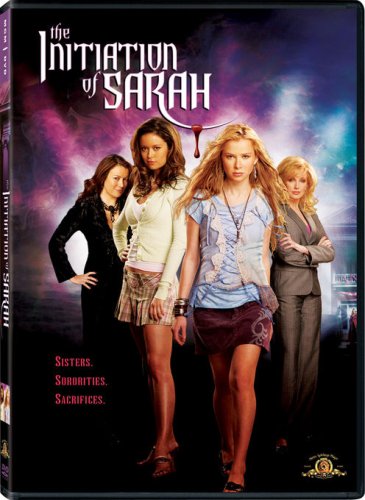
Remakes of movies seem to be common these days. Originality is found almost nowhere and more often than not you get retreads of old ideas. Now it even seems that tv movies are getting remakes like The Initiation of Sarah. The original was made in 1978 and starred Shelly Winters and Morgan Fairchild. The remake produced in late 2006 would also feature Morgan Fairchild in a role. But would it be as good as the 1978 classic or would it simply be a silly excuse for teenage college mayhem with sororities and witchcraft?

Sarah and Lindsey Goodwin (played by Mika Boorem and Summer Glau) are two new freshmen at Temple Hill University. Their mother Trina (played by Morgan Fairchild) shows them the sorority that they will be rushing at, Alpha Nu Gamma. She also makes mention of the fact that they need to stay away from PED, which is a rival sorority. We find shortly after that Sarah has interesting witch like powers and is being labeled as the one. From that point forward she is pursued by both Alpha Nu and PED. For you see, both sororities are groups of witches. Alpha Nu, headed by Corinne (played by JoAnna Garcia) and PED, headed by Dr. Eugenia Hunter (played by Jennifer Tilly)want Sarah to join their side. But the questions about who is good and who is evil in this fight for campus superiority continue to mount as Sarah recognizes her true power.

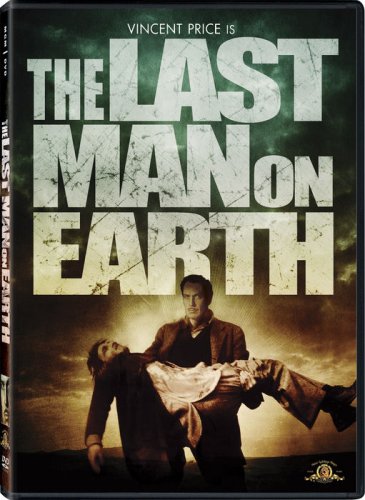
Robert Morgan (Vincent Price) is the lone human survivor in an LA devastated by a worldwide plague that killed most of the global population and turned the rest into vampires. For three years he has survived on his own, mourning his lost family and systematically staking every vampire he can find, working his way block by block through the city. Then, one day, he sees what appears to be another survivor...

Richard Matheson wrote a screenplay adapting his novel I Am Legend, but by the time the film was actually made, his script had been sufficiently changed that he replaced his name in the credits with a pseudonym. There is no denying that the film has its share of flaws. The dubbing of the Italian cast members is hit-and-miss, the action scenes are indifferently staged, and one feels a bit too acutely the monotony of Price’s lonely existence. On the other hand, there is a completely convincing vision of a deserted city achieved on a small budget, and a couple of genuinely creepy moments (most notably when Price’s wife returns from her grave). Furthermore, this remains the adaptation closest to the original novel, and the only version to retain the idea of the hero actually being a villain from the perspective of those he is exterminating.  That alone gives this somewhat clunky effort a bit of an edge of its slicker successors (The Omega Man and I Am Legend).

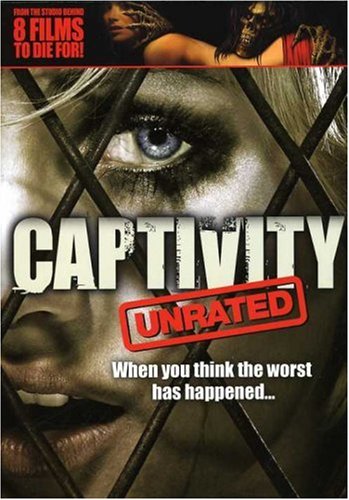
The defendant is charged with impersonating a classic movie, Felony murder of 81 minutes of human life, grand larceny (after review of the film’s sales figures this charge has been reduced to petty larceny), and aggravated assault to my intelligence. The court will show that director Victor Garcia did willfully and with malice and forethought create a sequel to an inferior remake of a classic motion picture. The evidence will clearly show that the film lacks any tangible resemblance to the original film and therefore has fraudulently engaged in a plot to lure the original film’s fans to the video store with false promises of quality and entertainment. The evidence will also show that writer William Massa did in fact commit these horrid lines to script, and in collaboration with others masquerading as actors, did inflict harm on this reviewer and several innocent bystanders. These defendants conspired to take money from unsuspecting DVD renters under the guise of entertainment. I present the following:

In 1959 Rod Serling changed the face of television. This unimposing thin man stepped in front of a camera and told us we were entering a world of shadow… the Twilight Zone. The anthology series ran for 5 years and included some of the best genre tales ever told. We all have our favorites, and my list is too long to go into here. Even years after when Serling himself had passed it never truly died. Syndication found a huge new following for the series, and it inspired not only revivals of itself but a long list of other anthology shows over the years like Tales From The Crypt and Tales From The Darkside, but none of these imitators ever came close. Serling was a genius in not only picking out great material, but he was a master presenter as well. So in 1983 when 4 of the world’s leading genre filmmakers banded to do a Twilight Zone Movie, the expectations went through the proverbial ceiling.


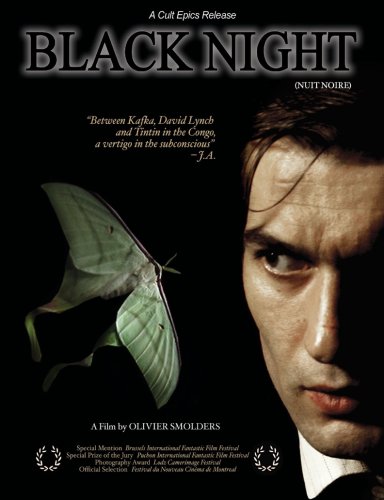
Belgian filmmaker Olivier Smolders, after a successful run of gorgeous and disturbing shorts, here makes a feature debut that is just as gorgeous and disturbing. Strongly reminiscent of the works of David Lynch, but far darker overall, the film is set at a time when the world is shrouded in the night of a perpetual eclipse. Day only comes for 15 seconds at 12:23 pm each day. Oscar (Fabrice Rodriguez) is a museum entomologist haunted by traumatic dreams involving the death of a sister who might or might not have every existed. He returns home one night to find a dying and pregnant African woman in his bed, a woman who is somehow linked to his father’s colonial past.

Trying to summarize the film’s plot is like trying to describe a dream: either case involves imposing linearity where none exists. Don’t try to figure out exactly what is going on here. Think of it as fevered nightmare inflected by guilt of Belgium’s gruesome colonial history, served up as a stunningly beautiful meditation on death, sex and insects.

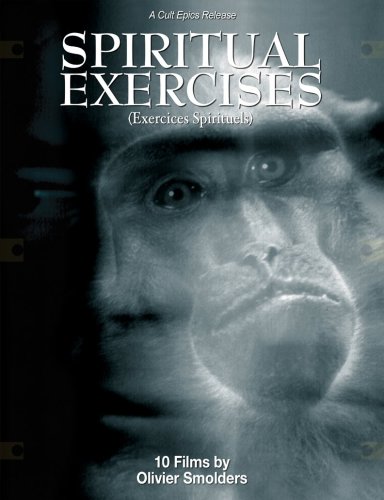
Olivier Smolders is a Belgian filmmaker with a sensibility as distinctive and challenging as his artistry is developed. Cult Epics has done North American audiences a huge service by bringing his films to Region 1 DVD release. This disc has ten short films. Each piece has its own distinct identity, yet they are all very clearly the work of a singular creative talent. The frequently disturbing shorts range from a tale of murder and cannibalism in “Adoration” (previously available on the Cinema of Death collection), to the heartbreaking “Mort à Vignole” (where Smolders narrates a family tragedy filtered through home movies made by his and his wife’s parents, along with his own family footage), to an extended yet elegantly filmed practical joke (“Point de Fuite”) to a most unusual adaptation of Sade with “La Philosophie dans le Boudoir.” The films are invariably gorgeous and clinical in the precision of their observations. The blurbs on the case invoke Lynch, Greenaway and Bergman, and the comparisons are apt, though Smolders is also very much his own man.

Audio

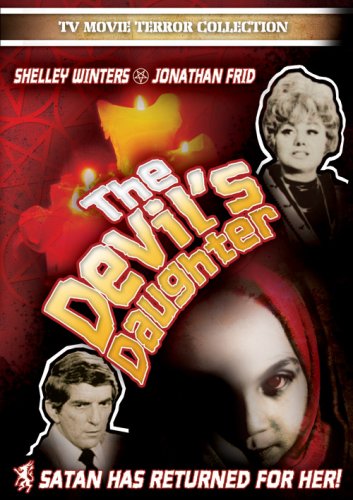
Come with me, gentle viewer, back to the state of horror on TV, Anno Domini 1973. After her long-absent mother dies in mysterious circumstances, Belinda Montgomery attends the funeral where she meets Shelley Winters, an old friend of the family, or so she claims. Winters takes Montgomery into her home, and there our young heroine meets all sorts of strange people, and gradually realizes she is in the clutches of a Satanic cult who believe she is Satan’s daughter.

Televised horror has made great strides since this Movie-of-the-Week era, though even the likes of Masters of Horror still has to work, on its best days, to reach the level of a decent theatrical release. But The Devil’s Daughter is eye-witness to an era where mediocrity was, with very rare exceptions, the best one could hope for. Awful as it is, this pick is awful in entertaining ways. So here we have Shelley Winters teasing us with the promise that she might not take the volume to 11, and then spectacularly breaking that promise; Abe Vigoda channelling the spirit of Boris Karloff; Jonathan Frid stuck with a mute character of unclear motivations; Montgomery’s character portrayed as such an incurious wallflower (she’s only mildly interested in the Rather Big Clue that is the portrait of a cloven-hoofed Satan hanging over Winters’ fireplace) that sympathy is very difficult to muster; Robert Foxworth showing up late in the day as a plot device only the dullest of viewers will fail to see coming; Joseph Cotten doing ditto; and such treasures as a photo album complete with a picture of all the Satanists, in full black regalia, happily posing for a group shot. In other words, the camp comes thick and fast, and that kind of entertainment value is what accounts for this terrible movie’s star rating.

A friend that I work with said that if Hollywood ever ran out of creative and original ideas, and that if a studio managed to make a sequel about pirate zombies that lasted three hours long, it would clean up at the box office. But the fact of the matter is that if we survived a nuclear winter, we would be well prepared about what to do when zombies took over the land, because of the prep we had from guys like George Romero. So even though Danny Boyle’s 28 Days Later might have presumably sealed the deal when it came to this particular interpretation, someone decided to dredge it up for whatever reason.

The sequel, appropriately titled 28 Weeks Later was written by several Spaniards, including Enrique Lavigne (Sex and Lucia), who also produced the film, and Juan Carlos Fresnadillo (Intact), who directed. After the viral epidemic and the subsequent pronouncement that “all was well” in England, the U.S. led NATO troops helped to clean and repopulate the London area. That is slightly down the line of the film’s opening, which has Don (Robert Carlyle, The Full Monty) and his wife Alice (Catherine McCormack, Braveheart) separated when some of the infected invade their countryside cottage, and he manages to get away. Flash forward to the period that shares the film’s title, and Don is a key part of the repopulation effort when his children come back to England. But you know how sequels go, through divine effort or circumstance, London becomes infected again and everything goes straight to hell.

Who says horror can’t be the cinema of personal expression? Director Tim Sullivan follows up his comic horror 2001 Maniacs with this heartfelt ghost story. Raviv Ullman plays David, a teenager whose depression and death-fixation following the demise of his older brother prompts his desperate parents to ship him off to an “Attitude Adjustment Camp.” Basically a brutal cross between boot camp and prison, this is a private institution (inspired by actual places) designed to transform any insipient Columbine-copycats. Once there, David must contend not only with the sadistic Captain Kennedy (Diamond Dallas Page) who runs the place, but also with visions of a ghost who clearly wants a buried truth revealed.

There’s more than a touch of The Devil’s Backbone here, what with the ghost-story-in-an-institution premise and the emphatic socio-political overtones. Sullivan isn’t quite Guillermo Del Toro yet – the spookiness is workmanlike but hardly heart-pounding, and many of the adult performances are pitched far too broadly – but there is a seriousness of purpose here that is admirable, a refreshing (and justified) anger, and the teen members of the cast are believably natural.

In the vein of Underworld, here is another tale of warring supernatural societies. In this case, both sides are werewolves (the “skinwalkers” of the title). The good guys seek to protect a 13-year-old boy who represents a cure for lycanthropy. The bad guys, who like turning into monsters, want to kill him to protect themselves. The weapons of choice in this battle? Fangs, you guess. Nuh-uh. Guns.

Yep, also in the vein of Underworld, gunplay is much more popular than monster mashes, but this effort makes its inspiration look like a masterpiece. The big showpiece gun battle (anatomized at length in one of the features) is a spectacular example of unintentional camp, whose highlight is the Sergio Leone-style drawdown between chief nasty Jason Behr and the boy’s grandmother. You read that right. In a stunning bit of blazing originality, the boy is also asthmatic. Sigh. Add in painfully expository dialogue and an almost total absence of transformed werewolves (who, when they do show up, are in no way worth the wait), and what you have here is a waste of time, which, fortunately, only robs you of just under 90 minutes, and not the 110 threatened on the case.