Horror

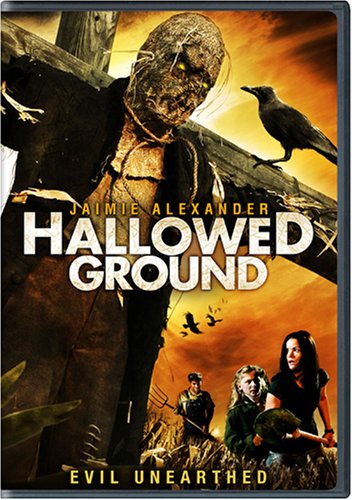
OK, brace yourself when I tell you that Hallowed Ground was a straight to video release. I know, you're stunned, right? You can't even get up. I was as shocked as you. But I've got to hand it to the filmmakers, they've got a decent idea by putting a somewhat scary image on their cover and keeping a brother intrigued, so to speak.

I admit I don't have the strongest faith. Sure I believe in God, but it pretty much ends at that like any other agnostic. So when I get a movie that is based on the idea of the Ten Plagues; let's say I'm not that familiar with the subject matter. I know there are locusts attacking and toads dropping involved along with the whole river of blood thing but outside of that I'm a little thin. However, not to say I wasn't interested. In fact I'm always intrigued by stories in the bible when they are used as methods of literature and peaks into the historical past.

What happens when the reviewer who did Dante's Cove decides to tackle its vampiresque cousin, The Lair? (Besides scheduling more sessions with his psychiatrist) You get somebody who starts understanding what makes up the Here! network. We're homies, we break bread together. Just don't expect me to wear my pants that low nor participate in your late night parties. I got an image to uphold. Season one of the Lair provides something that no other show on the Here! network has proved to this point. A show where there is actual dialog and something more than a cheap excuse to show lots and lots of male on male action. Welcome to the Fang Bang.

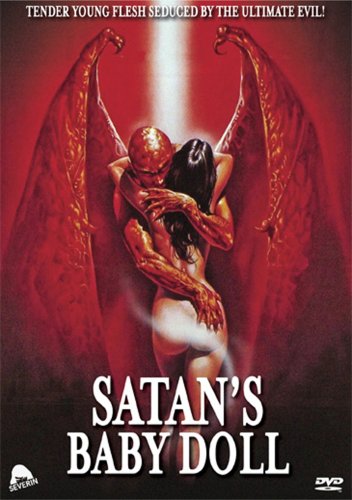
Mario Bianchi’s film is a 1982 remake of the recently reviewed Malabimba. The spirit of a newly deceased woman possesses her daughter, and proceeds to wreak havoc in the gothic castle that is the family’s domicile. Of course, given that the father is a murderous drug-addict, there isn’t that much for the possessed teen to do, as far as the plot itself is concerned. Curiously, this effort is less lurid than its predecessor (barring a couple of insanely OTT performances), with less nudity and taboo-busting, and also a rather less interesting deconstruction of respectable society. Plotting and motivation are haphazard at best. Still, it’s a not-unentertaining late-period Italian gothic, blessed with handsome sets.

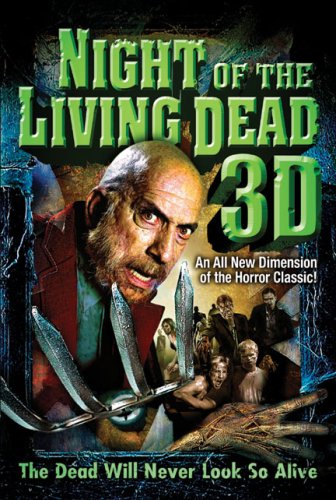
There are plenty of reasons to be grateful for public domain rules, as they make plenty of movies easily available that wouldn’t be otherwise. But there are pitfalls as well, and there is no clearer example of this than what has befallen George A. Romero’s classic film. The great man barely saw a dime from his work, but all and sundry can fiddle with Night of the Living Dead as they see fit, and here is a textbook case. The basic premise is intact: young woman and her brother visit cemetery, are attacked by zombies, and heroine winds up part of a besieged group. Sid Haig lends his presence to liven things up a bit, but he have any real role to play until the movie is almost half-over, by which point many viewers will be sunk in boredom. The zombie attacks are tediously realized, and this is easily the most gore-free version of the story.

Connoisseurs of Eurosleaze will be pleased with this nasty little variation on the gothic. In an isolated castle, a fractious, failing aristocratic family has gathered. There is no more money in the family, except indirectly: one brother, now in a vegetative state, is married to a rather wanton woman, who now holds the purse strings. The matriarch suggests that her other son marry her, even though his brother is still alive. The man is properly horrified by the suggestion, and he is also still in mourning for his wife. But then something – the spirit of his wife? a demon? – invades his teenage daughter, who then starts acting out sexually and recreating scenes from The Exorcist.

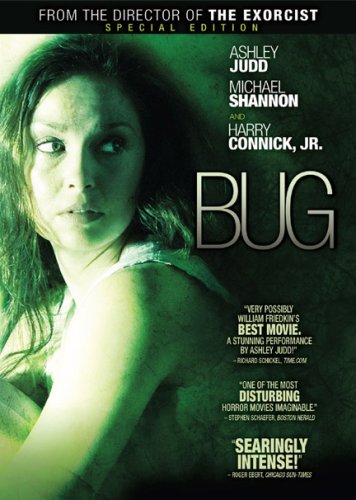
Director Peter Bogdanovich has a theory that you can make almost any movie better by cutting the first 20-minutes off of it. Exposition is intended to set-up the background of the characters for the audience, but it usually just ends up slowing things down until the conflict eventually arises. After watching Bug, I would be willing to accept Bogdanovich's argument, and double it.

Bug is the story of a down-on-her-luck waitress (Ashley Judd, doing her best impression of Charlize Theron from Monster) who lives in a cheap motel and works as a waitress in a honky tonk bar in Oklahoma.

Quentin Tarantino's Deathproof need no longer be sad and alone on your DVD shelf. Robert Rodriguez's Planet Terror - Extended and Unrated (Two-Disc Special Edition) streets October 18, completing the one-two-punch release of the directors' Grindhouse double feature.

Separating these two schlock-fests begs the question, which one's better? Don't ask me. I didn't catch Grindhouse in theatres, and haven't gotten around to Deathproof on DVD. All I can tell you is Planet Terror throws down 105 minutes of mindless, campy and gory fun. So pop your lid, take out your brain and enjoy. But don't leave that brain unattended, 'cause there be zombies about.


What is it with horror films today? They just seemingly lack all original wit and style. And let’s not even mention the remakes that Hollywood forces on us. Having just finally watched John Carpenter’s Halloween (yes I know!!), forcing myself to watch the drab Black Christmas almost made me cringe.

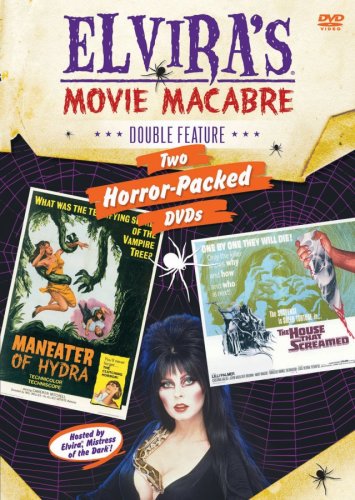
So here we have another double feature of episodes from Movie Macabre, with Elvira this time taking on Maneater of Hydra (1966) and The House That Screamed (1969). The former has the disconcerting spectacle of Cameron Mitchell appearing not only as a baron (ookaaayyy) but being dubbed. He’s experimenting with plants on his remote Greek island, and a group of tourists run afoul of one of his results. Given how long it takes for the titular plant to show up and relieve the dullness, one starts to wonder if the title doesn’t refer instead to one of the hot-to-trot tourists.