Sci-Fi / Fantasy

This series from Comedy Central began as a low budget film hosting show in a small television station in Minnesota. It was the brainchild of Joel Hodgson. It ended up running for 11 years and a feature film version.

Mystery Science Theatre is an acquired taste. For me, I’ve really got to be in that certain mood to watch it. That’s the beauty of these DVD’s. You pop them in when you’re ready. The idea is pretty whacked. Depending on the season you’ve got, Joel or Mike is trapped in space on the “Satellite of Love”. Doomed to spend his life watching very bad films, our hero makes the best of a bad situation. He uses his resources to construct a couple of robot pals. There's Crow T. Robot (Beaulieu), Tom Servo (Murphy), and Gypsy (Mallon). As part of an experiment together, they watch the films from the front row, constantly ranting throughout. If you’re like me, you’ve invited a few friends over to watch a schlock festival. The movies weren’t as important as the banter you created while watching. That’s exactly what you see here. The silhouettes of our host and his robots dominate the lower portion of the screen, where they provide alternative dialog and sometimes witty commentary on the action. The two evil station owners/mad scientists send them a new bad film each week to observe their reactions to the bombs. The films are broken up by off the wall skits and fake commercials to alleviate the tedium. This DVD collection is better than some because it includes films from four different seasons to give you a good sample of the overall series.

The title pretty much speaks for itself. Here are four episodes of the sequel that surpassed its inspiration in television longevity. They are as follows: “Relics” (which sees Scotty revived in this brave new world, and finding himself redundant), “The Inner Light” (an amnesiac Picard lives out an entire lifetime on a strange planet), “Cause and Effect” (the Enterprise and crew wind up stuck in a time loop, and must struggle to escape their repeated collisions with another ship) and “Tapestry” (where Picard winds up in the afterlife, which is certainly more than Kirk could say). It's a bit trickier yanking episodes of ST:TNG out of their season contexts than with the original show, given the former's greater emphasis on continuity, but these stories here are all good standalone adventures.

An odd thing is happening here. Because the original show has been so thoroughly remastered, ST:TNG is now the one that looks dated. The CGI is prone to aliasing and a lack of definition, and the image is rather soft. The colours are decent, but though I know there aren't many opportunities to get a tan in space, the flesh tones are sometimes a bit too far on the pale side of things. All of this said, the transfer is still perfectly watchable. The aspect ratio is the original 1.33:1 -- the show is still old enough that widescreen wasn't the standard yet.

“Sometime in the 23rd Century the survivors of war, overpopulation, and pollution are living in a great domed city, sealed away from the forgotten world outside. Here in an ecologically balanced world, mankind lives only for pleasure, freed by the servo-mechanisms which provide everything. There’s just one catch. Life must end at thirty unless reborn in the fiery ritual of Carousel.”

Logan’s Run started life as a pretty successful novel by William F. Nolan and George Clayton Johnson. The source material was really quite dark and more like Ridley Scott’s Bladerunner than the 1976 film based on the work. For some reason it was decided that this dark reflection of the future wasn’t as marketable. So, the decision was made to make this a very bright film with only hints at the nefarious realities of this future world.

For those Star Trek fans who can't afford the complete season box sets, here's an economical alternative: a single-disc collection of four popular episodes from various seasons. Present here are “Where No Man Has Gone Before” (a propulsion expert's change to the Enterprise's engines propels the crew to the edge of the universe), “Space Seed” (the episode, it need hardly be said, that brought us Khan), “A Piece of the Action” (wherein our gang gets to dress up like 20s gangsters) and “Journey to Babel” (a diplomatic mission turns into a disaster when, among other things, Kirk is stabbed and Spock's father has a heart attack). Strong episodes from a strong series.

The show looks terrific. In fact – purists take note – it looks better than it should. Yes, these are the same remastered prints as the last set of complete season releases, complete with enhanced special effects. So the show not only looks better than it did when first broadcast, it is sharper and has better FX than its Next Generation counterpart. The viewing pleasure is high, then, just not historically accurate.

There have been a couple of releases of Stargate. Mostly it’s been reissues of the same transfer. This time it really is an improvement. The Blu-ray contains a director’s cut which is about 16 minutes longer than the original. If you like the original better, you get that one as well. This was Devlin and Emmerich’s first real blockbuster. I found Independence Day and The Patriot to be better films, but Stargate has its moments. It’s a little hard for me to accept Kurt Russell as Jack O’Neal after 7 years of Richard Dean Anderson. I did gain a new appreciation for how closely James Spader and Michael Shanks portray the pivotal character of Daniel Jackson.

A whole franchise of Stargate has spawned from this 1994 motion picture, and over a dozen years later the franchise still remains successful. This film was originally intended to be a franchise of pictures but instead found its way onto television and writings, with a fair sized fan base. If people still like the concept thirteen years later, then it must be pretty appealing; myself, I have never seen this picture and am pleased that I finally have the opportunity.

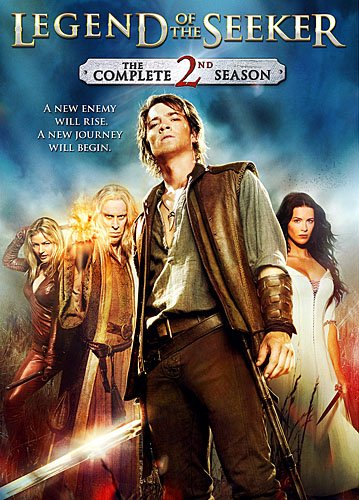
As you might be surprised to find out, my aspirations include more than being a darn good dvd reviewer & video game columnist. I like to write, really write and not just interpret other people's works into a ten to twelve paragraph summary document. By really writing, I mean fantasy or the creation of heroes. My wish beyond being published was always to see my work come to life on either the small or big screen. It was refreshing to find a television series based on a fantasy series of books. The Legend of the Seeker is based on Terry Goodkind's Sword of Truth series. But there was something awfully familiar about the series as I continued to watch it. Let's find out what that is.

A woman named Kahlan Amnell(played by Bridget Regan) is traveling with her sister through the countryside and beach but there is one problem. She's being followed by a pack of angry guardsmen on horses. Her sister is struck by an arrow and falls down a cliff. Kahlan soon realizes that her sister is dead and that she must continue en route to her destination. The woman soon reaches the barrier on a nearby beach and it looks like she might meet her end.

“My name is Dylan Hunt. My story begins the day on which I died. My last look at my world was to be from inside a pressure chamber at NASA’s underground laboratory at Carlsbad Caverns. Our goal was the development of a form of suspended animation which would allow our astronauts to make longer voyages through our solar system. It had been my decision that our method was ready to test on a human so, it seemed that any risks should be mine…”

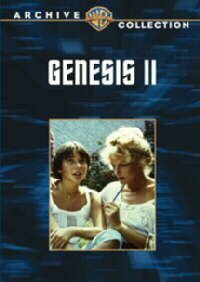
Gene Roddenberry was riding high as Star Trek began to grow more in popularity during syndication than it had as a prime time network series. Suddenly television executives wanted more ideas from The Great Bird Of The Galaxy, as Trek fans began to know him. One of those ideas was Genesis II. It tells the story of a scientist who is conducting a suspended animation experiment. He expects to be under for only a few days, but a cave-in traps him in his chamber, and he is not rediscovered for 154 years. He awakes to find an entirely different world than the one he remembers. Humans live underground as a group called the PAX. They are a peaceful sort and have left behind most of the science that destroyed the world Hunt knew. Their enemies are a group of mutants, identifiable by having two belly buttons, because they have two hearts. They have enslaved humans and live an aristocratic life in the city of Tyranus. Now Hunt (Cord) is being courted by both civilizations. He must choose between them. Attempting to win him over to the Tyranians is Lyra-a (Hartley). She seduces him and tries to taint his opinion of the PAX. But Hunt soon learns from experience which side is the nobler race.

A mysterious figure digs up the shattered remains of an android in the desert wastes of a very grim, polluted future. The man brings the head and hand in for barter, and they are picked by Hard Moe Baxter (Dylan McDermott, in a role that nicely deconstructs Mad Max). Moe takes the hardware back to the flat of his artist girlfriend (Stacey Travis), who incorporates the pieces into a sculpture. Unfortunately, these remains are part of the M.A.R.K. 13 military droid, and when Moe absents himself, the robot reactivates and goes on the rampage.

“Its cold outside, There's no kind of atmosphere, I'm all alone, More or less.
Let me fly, Far away from here, Fun, fun, fun, In the sun, sun, sun.

I want to lie, Shipwrecked and comatose, Drinking fresh, Mango juice, Goldfish shoals, Nibbling at my toes, Fun, fun, fun, In the sun, sun, sun…”

Written by Ashley Orr

Despite its over-animated cover, Battle for Terra, directed by Aristomenis Tsirbas, was a surprisingly interesting flick. With an all-star cast playing the voices, this movie takes animated sci-fi and marries the ideas of philosophy and entertainment in an unusual way.