Posted in: Disc Reviews by Archive Authors on June 2nd, 2011
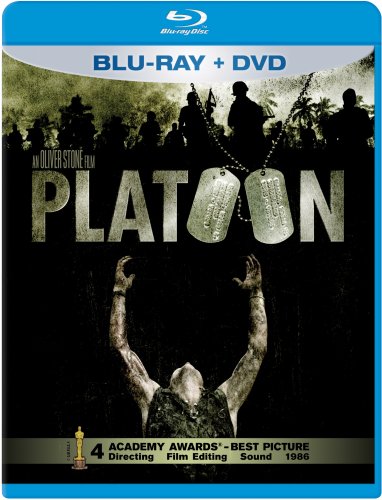
There are a good number of people who have labeled Oliver Stone as a fan of conspiracy theories, out to destroy foundations of conservative ideology, while at the same time re-visiting 60’s nostalgic icons. Despite the jokes and the stereotyping, one has to admit that, as a filmmaker, he has helped bring to screen some of the most talked-about cinematic experiences of our time, including Midnight Express, Scarface, not to mention Conan the Barbarian. As a director, his works, such as The Doors, Nixon, JFK and Natural Born Killers, have generated discussion both within and aside from the technical merits. Platoon was his most personal work, and is widely regarded as one of the defining films of the Vietnam War.
Platoon relates the experiences of Chris Taylor (Charlie Sheen, Major League), who, like Stone, dropped out of college, and volunteered to serve in Vietnam. His battles are everywhere, be it the enemy, with his surroundings, some of his fellow soldiers, or with his identity. He is thrown into a platoon with several characters, each with their own distinguishing characteristics. Sergeant Barnes (Tom Berenger, The Big Chill) is riddled with facial scars, a veteran of many skirmishes in country, perhaps to the point where emotions have dwindled, as he is left a hard-nosed leader. Sergeant Elias (Willem Dafoe, To Live and Die in L.A.) tries to forget the memories and experiences through drugs, but acts as a spiritual center, if one could find that within a war movie. Other actors in this cast include John C. McGinley (Scrubs), Forest Whitaker (Bird), and a very young Johnny Depp (Finding Neverland), among others. They encounter many things during the time there, including ambushes and firefights. They experience the loss of fellow platoon members, either via combat or by other reasons, either wounded or serving their full tour of duty in country. The story and characters are done so well, when watching the movie, their losses are our own. When Taylor leaves his platoon following an injury during combat, the closing shot of the movie is his sobbing on the floor of the chopper taking him out. You could say the sobbing is due to finally being out, or to the friends that he lost, but it is without question that his (and our) experiences leave him a totally different person that when he arrived.
Posted in: Disc Reviews by William O'Donnell on March 30th, 2011
The Nazis have been the subject of countless documentaries and films. On this occasion, The History Channel has decided to place the focus on the people of Germany, with a time line that starts at approximetaly the First World War and leads to the end of the Second World War. With the aid of newly discovered home videos gathered from Germany & Russia, we see a combination of German life during this time, as well as public and private views of Nazi discourse and planning.
There is one film hobbyist in particular who's home movies become the basis for a story within the story. This one family are typical of the German people, and their lives are documented as they, like many others, go from joy, to desperation, to a sense of empowerment, to denial, to horror as their nation is seized by Hitler and his enforcers. There have been many written accounts of what the people felt and experienced, in fact many biographies are quoted and/or use as narration script in this film, but it is all the more rare to have visual records outside of propaganda films or some news reels, especially of Nazi Germany. It is such rare glimpses that makes this film so special to behold and the history of it feel all the more real.
Posted in: Disc Reviews by Gino Sassani on July 21st, 2010
In Florida we have some very large bugs. There's this one particular spider that is quite a problem in my house. It's real name is a huntsman spider, and it grows to about 16 feet, not including the legs. It sports 27-inch fangs and tends to move the furniture around at night while it stalks its prey. Yes, it stalks its prey at night in my house while I'm trying to sleep. Years ago I coined my own name for these clever, ferocious killers. I call them Rambo Spiders. The name fits these long-legged freaks perfectly as they perform their recon missions throughout our home. When I find them, I terminate them with extreme prejudice. I suspect that if these arachnids happen to be movie fans, they have a name for me, as well. You guessed it: Rambo.
John Rambo was the brainchild of novelist David Morrell. In his novel you'll find a John Rambo who is very much like the one played by Sylvester Stallone, yet quite different, as well. While he retains that one-man-fighting-machine persona, in the book he is much more of a cold-blooded killer than the man we meet in the franchise's first film. In that movie, Rambo disables the police and whoever else stalks him, but he never kills one person in that film. The officer who does die does so because of his own actions, not Rambo's. He's actually a very innocent man, when we first meet him. There's a vulnerability that we see in that film's first five minutes that we never will see again over the course of four films. Credit Stallone for allowing us those fleeting moments that you won't find anywhere in Morrell's book. But it is the Rambo as portrayed by Stallone that has become the cultural icon and household word today. The term is in most modern dictionaries, usually to describe a relentless force of strength, which brings me back to those spiders. And before you animal rights people start writing me your displeasure over my spider kills, understand that it's more than a fair fight. They have those 99 inch fangs, and all I have is a rolled-up newspaper.
Posted in: Disc Reviews by David Annandale on May 9th, 2010
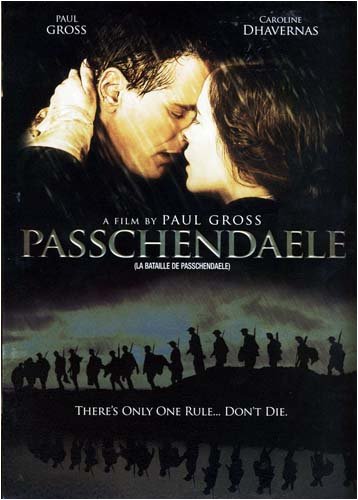
We are in the midst of the Great War. Michael Dunne (Paul Gross) is a Canadian solider recovering from physical and psychological wounds. He falls in love with his nurse (Carline Dhavernas), and when her asthmatic brother enlists, Dunne heads back to the trenches to protect him, and the two men wind up at the gigantic, murderous battle that gives the film its name.
Writer/director/star Gross has an almost messianic commitment to Canadian film and Canadian history, and here he combines his obsessions in a 20-million-dollar effort that is, by the standards of the Canadian film industry, nothing short of gargantuan. And to his credit, the battle scenes are impressive. The editing is frequently startling and brutal, in keeping with the events themselves. On the other hand, the romance is painfully hackneyed, and the naked appeals to national pride can be rather wince-inducing.
Posted in: Disc Reviews by Gino Sassani on March 31st, 2010
"The year is 208 AD. After 30 years of civil war, a deathly calm has fallen over northern China. One by one the rebel warlords have met their end under the sword of Prime Minister Cao Cao. Now even the Emperor bows before his power. Yet, from the south a challenge is heard. Two leaders rise against Cao Cao's tyranny. The aging Liu Bei and the inexperienced Sun Quam. So Cao Cao petitions the Emperor to brand these men as traitors and declare a new war against the peaceful southlands."
And so the stage is set for John Woo's enormous epic Red Cliff. The scale of this film is simply one that must been experienced to quite understand. It has the grandeur of any of the largest films in Hollywood's history. But this film is not a product of Hollywood. Woo filmed his massive triumph in his native China. You won't find a bigger story told with more elaborate sets or with such a legion of actors, required to bring these historic battles to life. Gladiator. Kingdom Of Heaven. The Ten Commandments. Red Cliff deserves to stand with the best of them, and it will.
Posted in: Disc Reviews by Michael Durr on March 29th, 2010
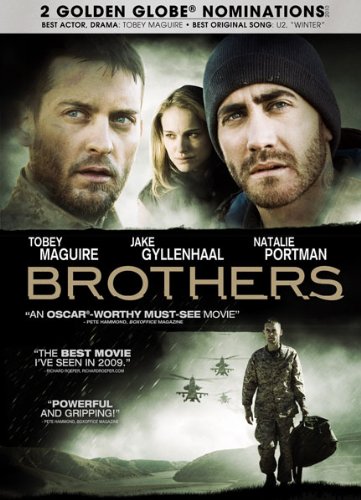
My dad was an ex-Vietnam officer, 1st lieutenant in the United States Army. He gave a lot for his country but never forced me towards any military service. He wanted me to focus more on my studies and make sure I got a proper education. I don’t think I could comprehend what my father or any military personnel in a war situation goes through. However, with the dramatization in Brothers, I can see on some level the horror that some of our fine soldiers have to live with.
Captain Sam Cahill (played by Tobey Maguire) is about to go on his fourth tour of duty to Afghanistan. He is a good family man, has a beautiful wife named Grace (played by Natalie Portman) and two daughters named Isabelle and Maggie (played by Bailee Madison & Taylor Grace Geare respectively). Then there is also Sam’s brother, Tommy (played by Jake Gyllenhaal).
Posted in: Disc Reviews by David Annandale on January 21st, 2010
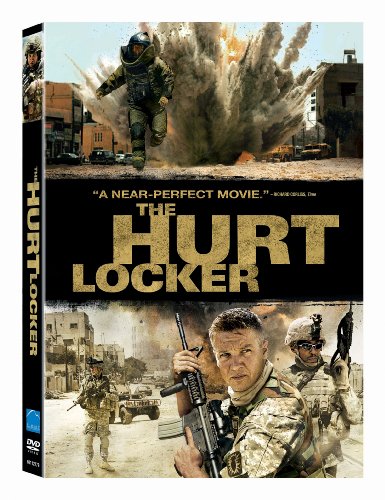
It is the last month-and-a-bit of Delta Company's tour of duty in Iraq. The IED disposal squad has just lost its leader, and he is replaced by Staff Sergeant James (Jeremy Renner), a brilliant bomb defuser who is also something of a loose cannon, prone to taking foolish risks. What follows is Kathryn Bigelow's best movie to date, as finger-gnawing scenes of bomb disposal and combat alternate with portraits of men's psyches being taken apart by war, both because of what happens to them, and because of what they must do.
The best Iraq war film to date is also, interestingly, fairly apolitical. It takes no real stand on the whys and wherefores of the conflict, and despite the fact that the incidents are very much specific to the situation in Iraq, the theme of the film – the toll war takes on the men who fight it – would be just as true in a WWI setting. James is an intriguing character, one that it is difficult to wholly like or dislike. He is astoundingly good at what he does, yet he puts the lives of his squad mates in jeopardy. He believes in doing the right thing, and yet, in a speech he makes to his infant son (a scene that is the most heartbreaking of the film), he shows how he has been transformed into a specialized machine, unfit for any society other than that of war. This is a powerful film, then, as thoughtful as it is intense. That intensity, however, does come at a certain cost. We are made to feel the paranoia experienced by the soldiers in the visceral way imaginable, but what this does mean is a dehumanization of the Other. The Iraqis, with very few exceptions, come across as unknowable, mysterious, sinister presences, and while this is very likely true to the experience of the point-of-view characters, it does mean that this is another war film that (inevitably, perhaps?) grants us access to the humanity (in its positive AND negative facets) of only one side of the conflict.
Posted in: Disc Reviews by Gino Sassani on January 14th, 2010
"Fighting soldiers from the sky. Fearless men who jump and die. Men who mean just what they say, the brave men of the Green Beret. Silver wings upon their chest. These are men, America's best. One hundred men will test today. But only three win the Green Beret."
The Ballad Of The Green Beret has become one of America's most famous marching songs. It has been heavily parodied. The words were written by Staff Sergeant Barry Sadler while he was in the hospital recuperating from a leg wound he received in Vietnam. The music was composed by Robin Moore, who went on to pen the book The Green Berets, on which this film was based.
Posted in: Disc Reviews by David Annandale on October 22nd, 2009
Enzo Castellari, Tarantino fave and director of the original Inglorious Bastards, here gives us a tale of wartime intrigue that sweeps from the retreat of Dunkirk to the Battle of Britain. During the Dunkirk evacuation, a team of Nazi saboteurs don English uniforms and mingle with the embarking troops. Captain Paul Stevens (Frederick Stafford) finds evidence that this has occurred, but no clues to the identities of the saboteurs. Indeed, the second-in-command of the group, Martin (Francisco Rabal) has become his close friend and roommate. The saboteurs target Britain's radar system, a critical part of the island's defense against the Luftwaffe. It's up to Stevens and his specially assigned team to stop the saboteurs before the Battle of Britain is lost.
It's amusing, of course, to watch a film all about England's fate hanging in the balance with not a single English actor in the mix. But the story is a good one, and the action is relentless, ranging from the epic scale (the Dunkirk scenes are quite spectacular) to the more personal (plenty of exciting gunfights around the radar installations). The dogfights are a somewhat less satisfying combination of rather obvious models and stock footage, but Castellari's inventive use of split screen keeps the visual interest high.
Posted in: Disc Reviews by Gino Sassani on September 15th, 2009
“Attention: Tonight’s movie has been M*A*S*H. Follow the zany antics of our combat surgeons as they stitch their way along the front lines operating as bombs and bullets burst around them, snatching laughs and love between amputations and penicillin, as they put our boys back together again.”
M*A*S*H began life as a novel written by an actual Korean War Army surgeon under the pen name Richard Hooker. He based the character of Hawkeye on himself and most of the other characters on actual personnel that were stationed with him at a real M*A*S*H unit. The book was written for the screen by longtime blacklisted screenwriter Ring Lardner, Jr. Lardner was intrigued by the anti-authority message the book had, likely due to his own experiences with the government. He was one of a group of Hollywood talent that refused to testify before the Senate Committee on Un-American Activities. They were thrown in prison and blacklisted in the industry. This particular group became known as The Hollywood Ten. Whatever Lardner’s ideas might have been for the movie, they were enough to get a select group of producers excited about the property and got the ball rolling. We won’t ever really know what those concepts might have been exactly. In the hands of, at that time, new director Robert Altman, the script was practically discarded almost in its entirety. Altman had his own views which were inspired more by the still raging Vietnam War than what he considered an obscure historical event he believed most Americans didn’t even remember. All mention of Korea was deliberately left out of the film. When the studio caught on they forced him into providing a scroll at the film’s beginning that set the location. To Altman and pretty much everyone working on the film they were making a movie about Vietnam, not Korea. He incorporated his own anti-establishment, some might call subversive, ideas and made a film that Lardner would exclaim was nothing like his script. He encouraged rampant improvisation from the cast and little of Lardner’s dialog actually remained.