Western

The setting for Gunsmoke was the by-now-famous Dodge City, circa 1870’s. Phrases like “get out of Dodge” would enter the popular lexicon as a result of this resilient series. Marshall Dillon (Arness) was charged with keeping the peace in Dodge City. The only other character to see the entire 20-year run was kindly Doc Adams (Stone). Star Trek’s own Doc, Leonard McCoy, took many of his traits from Doc Adams. He was the humanitarian of the city, always looking to help someone. Like McCoy, he had a taste for bourbon and a soft heart underneath a rather gruff exterior and was always ready with free advice. Dillon’s love interest throughout most of the series was Miss Kitty Russell (Blake). While there were certainly a few romantic undercurrents, the romance never came to fruition. Miss Kitty was a prostitute on the radio and was likely one here as well, but CBS chose to underplay that aspect of her character as a “saloon girl”. Finally Dillon’s faithful sidekick deputy was Chester (Weaver). Chester often found himself in trouble and was the naïve son figure to Dillon.

Gunsmoke is the longest running scripted live action television show in history. The series ran from 1955 to 1975. At first it was a half-hour black-and-white show that evolved into a color hour by 1967. It actually started before the days of television, premiering on radio in 1952. Then it was William Conrad as the tough-as-nails Marshall Matt Dillon. When television came into its own, Gunsmoke made the jump to the bright living room box and made history. Westerns would ride across our small square screens for the next three decades, making it the most successful genre of that time, and it was Gunsmoke that started it all. The television version of Gunsmoke was originally conceived as a vehicle for John Wayne, who opted to remain in movies. Yet it was Wayne himself who suggested James Arness, and it turned out to be a career for the one-time “carrot” monster from The Thing. Gunsmoke started before all of the big westerns and was around when most of them had departed.

"War and me took to each other real well. It felt like it had meaning. The feeling of doing what you thought was right. But it wasn't. Folks can believe what they like, but eventually a man's gotta decide if he's gonna do what's right. That choice cost me more than I bargained for..."

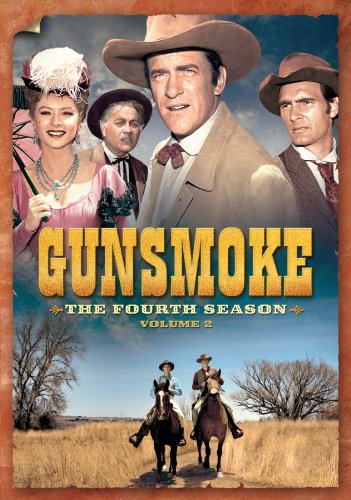
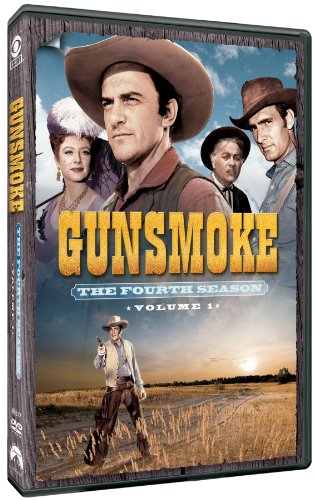
Gunsmoke, in all of its 20 seasons, making it the longest running prime-time drama of all time, has such a strong legacy that it feels odd to review it. Thankfully the challenge is an enjoyable one as the show is at a full head of steam in its fourth season (it was ranked #1 at this time) and each episode is still as engrossing today as it was over 4 decades ago.

James Arness plays Marchall Matt Dillon, and is the law of Dodge City. Both him and the local doctor have rather stony demeanors when it comes to death, and death seems plenty common in 1800s Kansas. More often than not the criminal behind each episodes story is shot dead by the quick draw of Dillon before they could ever see a trial. I suppose that just makes the opening narration all the more suiting as many episodes start with a stock scene of Dillon wandering through a graveyard as Dillon narrates his musings on those that have made one too many mistakes and earned themselves a spot in that yard.

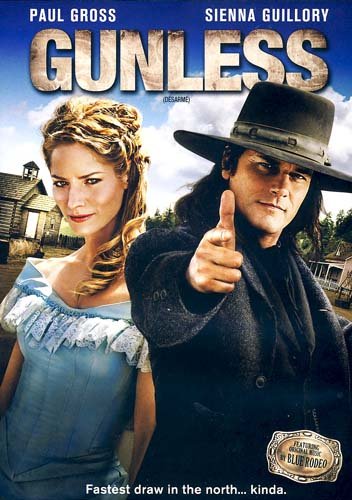
In the opening scenes of Gunless, a horse trots into what appears to be a tiny western town. Atop the horse is an unconscious man, slumped backwards in the saddle with a noose around his neck attached to a large tree branch that drags along behind them. An iconic Western opening if ever there was one. Reminiscent of Clint Eastwood in High Plains Drifter or Hang ‘em High. However, things soon begin to stray from formula when we realize that this tiny town is actually in "The Dominion of Canada" and the man turns out to be the Montana Kid, a notorious American gunfighter.

The ‘Kid’ is soon helped out by a polite bunch of Canadians, and before you can say “American stereotype” he has tried to start a gunfight with the kind local blacksmith. The reason? Why, the blacksmith had the gall to shoe the Kid’s horse. Unfortunately (or fortunately, if you are the blacksmith) he has no gun and therefore, according to the code of the West, can’t be shot. The solution? Why, the Kid will get the blacksmith a gun. But since this is Canada, there are no guns in the area, except for a broken antique owned by the local Brit-accented hottie widow.

Manchuria, the 1930s. The Japanese army has just acquired a treasure map, and are transporting it across the desert wastes by train. But the man who sold the map wants it back, and engages a snappily dressed killer (Byung-hun Lee) to steal it back. He is, of course, the Bad. He stages a spectacular (and spectacularly violent) train robbery. As fate would have it, at precisely the same moment, the Weird (Kang-ho Song) is also robbing the train, and the Good, in the form of a bounty hunter (Woo-sung Jung) is on board, too. The Weird makes off with the map, and what follows is a series of chases as the various factions scramble to get that map.


Director Ji-woon Kim's tribute to Serio Leone's The Good, the Bad and the Ugly follows its model's characterization, with the leads' cold-eyed killer, wacky scoundrel and cold-eyed hero clearly standing in for Lee Van Cleef, Eli Wallach and Clint Eastwood, only much prettier. The financial motivation and the setting of a country in chaos is similar, too. But while the film was a huge hit in Korea (outgrossing, it seems, the likes of The Dark Knight), it lacks the heart and brilliance of Leone's film. There are some wonderful moments during the train robbery and other set pieces, but the film gets draggy in between. The tone is a little uneven, too – the intent seems to be entertaining, cartoonish violence, but the dismissive ways in which women are killed smacks rather uncomfortably of genuine misogyny. There's a lot of visual pleasure to had here, but to ultimately mixed effect.

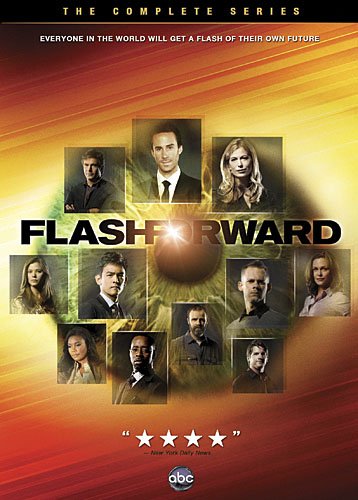
"On October 6, the planet blacked out for two minutes and seventeen seconds. The whole world saw the future..."

For all intents and purposes, it appears just like any routine fall day throughout the world. People are busying themselves about their normal concerns. Suddenly everyone on the planet blacks out for exactly 2 minutes and 17 seconds. Just think about that part for a moment. Every human being collapses at the same moment. Think about all of the things that people are doing at any given moment. Driving cars. Flying planes. Performing delicate surgical procedures, or just walking across the street. Pretty much any activity is going to become dangerous as the blackouts occur. 20 million people worldwide die in the event.

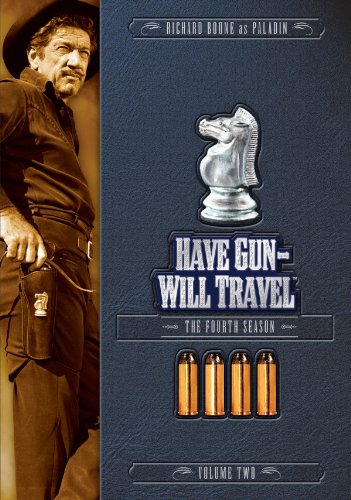
“Have gun, will travel reads the card of a man. A knight without armor in a savage land…”. Those words ended every episode of Have Gun Will Travel, sung by Johnny Western in a time that such words could be sung without irony. Outside of Richard Boone’s black-clad, craggy Rhett Butler gone-to-seed gunfighter, that song was all I could really recall about this venerable Western from television’s golden age. Would it, like so many revisited shows from my youth, ultimately disappoint? Or would it hold up fifty years after it was originally broadcast, viewed as it would be by the far more jaded, cynical man I’ve grown into?

The verdict? It’s pretty darn good.

"This is Fairfax County in the state of Virginia. I was born here. It's peaceful, beautiful, and a long long way from Wyoming; beautiful, too in its special way. Vast, proud and lonely; it's my country now, Wyoming. But not exactly a peaceful one."

"Every town has a story... Tombstone has a legend."

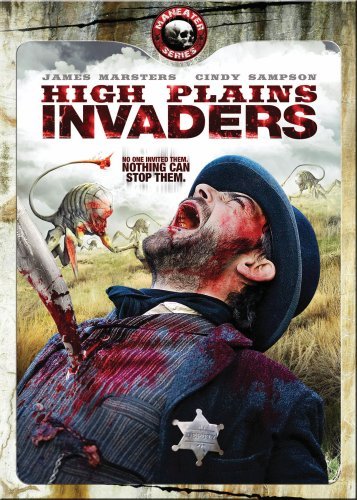
The SyFy Channel has been making original films for quite a few years. Unfortunately, they've mostly been known for their quite bad computer-generated f/x and rather silly plots and stories. It says quite a lot to me that I'm such a huge horror/science fiction fan but have never found one of these original movies to be even remotely good. Instead, I've found myself wincing with each new ridiculous script and every unimaginable lame creature the series has presented. The Maneater Series has been as guilty as any of the themed series in their efforts.

It's the old West, 1898. Sam (Marsters) is about to be hanged for robbing a train where some folks got killed. We later find out their deaths were an accident. So Sam isn't a stone-cold killer, but is going to hang nonetheless. Just as the sheriff is about to spring the trap and drop Sam on into infinity, the town is attacked by a large creature that looks like a giant silver ball with exoskeleton appendages and a tail that shoots radioactive projectiles. Talk about your tail gunner. The creature kills a lot of the folks gathered to watch the hangin', and the mayhem ends up freeing Sam. Instead of running, Sam remains to help fight off the creature and save as many folks as he can, including the sheriff who was about to stretch his neck. Before long a group of survivors is fighting off what turns out to be hundreds of creatures being dropped from a spaceship. The group includes Rose (Van Heteren), a bounty hunter who still wants her two thousand dollar reward for bringing in Sam. There's Abigail (Sampson) who happens to be Sam's old flame. He didn't know this was where she lived these days. Finally, there's Dr. Jules Arning (Knapp) who has been extracting uranium ore, which is what has been attracting the creatures. Together they decide to use the doc's uranium stash to blow up the creatures and their huge ship.