Posted in: Disc Reviews by Gino Sassani on January 6th, 2010
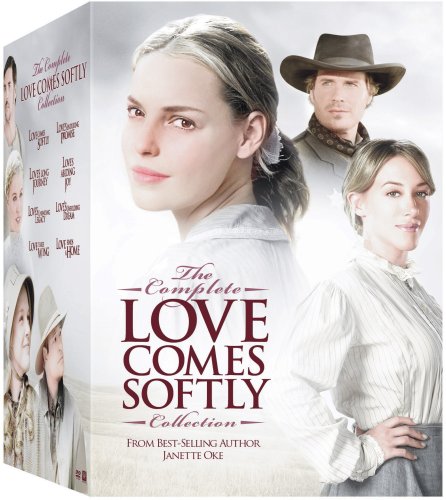
It would appear that Michael Landon, Jr. is attempting to cash in on his late father's Little House On The Prairie appeal. He is one of the driving forces behind this series of made for television films. He has directed several of them and serves as an executive producer on them all. He has also been involved with some of the writing on the series. They are based on a series of books written by Janette Oke. They follow three generations of women in the days of the Western frontier. When I say that Landon is spending on his father's legacy, you need look no further than the common elements of the films themselves to understand how I come to that conclusion. All of the films feature frontier living and the interactions of these small town peoples in surviving the hardships of the West. There's more than one little house on a prairie to be found in this collection.
The films are more than Western affairs. They are intended to be "Faith" films. In ach case someone's faith in God is put to the test and they must find their way back to grace. The films are often interrupted with spontaneous Bible verses and more than a few sermons on faith. There's plenty to go around when it comes to testing that faith. In just about every film some poor girl loses a husband and must rebound with another. Of course, each of these prospective husbands are encountered with a level of hostility at first. I guess I can understand that part, because my own wife and I had less than positive feelings for each other at first. Now we've been married for over 20 years. She hasn't had to find a new one ... yet. The films all do a good job of throwing other adversity at these women. They are often in a situation where they find little support about them and often encounter hostility towards their dreams and ambitions. As the box art tells us, they must use love and faith to overcome these obstacles.
Posted in: No Huddle Reviews by Michael Durr on November 8th, 2009
As explained by many authors in this site, remakes are becoming far too common. In fact, they are so many of these that we aren’t sure of the source material. An obscure movie comes out and apparently in 1953, there was a similar movie made. This movie also probably made the equivalent of $100 American Dollars at the box office. Well, perhaps not that bad. I received one of these movies to review recently and it was titled Angel and the Badman. Let’s see how this one fares.
Quirt Evans (played by Lou Diamond Phillips) is riding along on his horse. He stops when he sees that there is a dead body near a secluded cabin. He inspects the body and all of the sudden three men appear out of the shadows. It’s a trap. Thanks to his quickdraw skills, Quirt is able to put down the three men. He is also able to put down the dead body in its rightful place as he was just acting to set up the ambush.
Posted in: No Huddle Reviews by Michael Durr on October 12th, 2009
The people at Warner Bros recently decided to adopt a new strategy when dealing with some of their back catalog. They would propose a printing on demand option or what they would dub the “Archive Collection”. This would allow collectors to own classics of long forgotten films and keep costs at a minimal to Warner Bros. One such movie was named Lightning Strikes Twice which came out in 1951 with Ruth Roman. Hopefully this one was a gem and not something that should be long forgotten back in the vault.
Richard Trevelyan (played by Richard Todd) has been convicted for murder of his wife. He is about to be executed when the jury becomes dead-locked and no decision can be made. He is then released where he decides to hide out at a Texas ranch where nobody can find him. Everybody is convinced that he did it and nobody seems that willing to stand by his side.
Posted in: Disc Reviews by Gino Sassani on August 18th, 2009
The mutiny on the Bounty is one of those stories that carries with it the adventurous dreams and ambitions of a young child. It’s the smells and sounds of the high seas. The intrigue of a mutiny and the charismatic stature of an imposing captain, the image of sailor’s worst nightmares. Aye, Matey. There’s nothing like it. (We interrupt this review because apparently Gino has been reviewing the wrong film. Please accept our apologies for the misinformation – ed.)
As I was saying…. It’s the Old West, the kind of story that carries with it the adventurous dreams and ambitions of a young child. It’s the smells and the sounds of the open frontier. The intrigue of the famed outlaw and the charismatic stature of an imposing lawman, the image of an outlaw’s worst nightmares. Darn Tootin’, Pardner. There’s nothing like it.
Posted in: Disc Reviews by William O'Donnell on August 6th, 2009
The story originally seems to set itself up to be that of redemption for a young man who is fresh out of jail. While this story is around, there seems to be parallel stories that arise as subplot but soon race alongside the original tale like proverbial track horses (and horses also just so happen to be the nexus for said plots). Just as one seems to buck into the lead, another comes along to grab the focus.
Posted in: Disc Reviews by Gino Sassani on May 27th, 2009
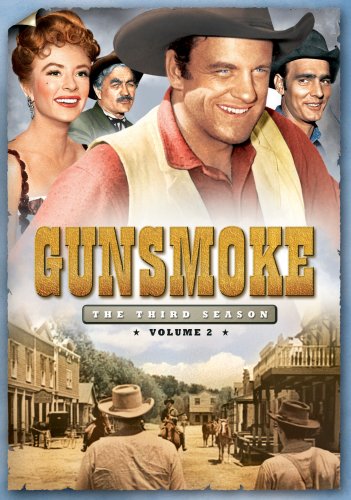
Another release, and it’s another half season of that iconic western, Gunsmoke. Among the 20 episodes found on 3 discs you’ll find Claustraphobia. Dillon has to arrest his old friend Ollie who kills a man because he killed Ollie’s hogs. In Ma Tennis, you’ll meet the ultimate Mama’s boy. When a man ends up in Dillon’s jail, his mother breaks him out. In Sunday Supplement, a couple of newspaper writers come to Dillon looking for a juicy story, even if they have to instigate one themselves. In Texas Cowboys, Dillon closes up all of the shops in town until they are willing to tell him who committed a murder. A woman comes to Dodge wanting Matt to kill her in Amy’s Good Deed. In Hanging Man, there’s a vigilante out there killing folks and making it look like suicide. Dillon’s got a serial killer on his hands now. Chester is nearly killed in a break out attempt in Chester’s Hanging. Finally, in The Gentlemen, Dillon gets caught up trying to keep the peace with a torrid love triangle brewing in Dodge.

The setting for Gunsmoke was the by now famous Dodge City, circa 1870’s. Phrases like “get out of Dodge” would enter the popular lexicon as a result of this resilient series. Marshall Dillon (Arness) was charged with keeping the peace in Dodge City. The only other character to see the entire 20 year run was kindly Doc Adams (Stone). Star Trek’s own Doc, Leonard McCoy, took many of his traits from Doc Adams. He was the humanitarian of the city, always looking to help someone. Like McCoy, he had a taste for bourbon and a soft heart underneath a rather gruff exterior and was always ready with free advice. Dillon’s love interest throughout most of the series was Miss Kitty Russell (Blake). While there were certainly a few romantic undercurrents, the romance never came to fruition. Miss Kitty was a prostitute on the radio and was likely one here as well, but CBS chose to underplay that aspect of her character as a “saloon girl”. Finally Dillon’s faithful sidekick deputy was Chester (Weaver). Chester often found himself in trouble and was the naïve son figure to Dillon.
Posted in: Disc Reviews by David Annandale on May 26th, 2009
Aging senator James Stewart and wife Vera Miles arrive in the prosperous town of Shinbone to attend the funeral of an anonymous farmer. The local newsmen want to know why. Stewart tells the story. Cue the flashback, where he arrives in a much more anarchic Shinbone as a naïve lawyer. Held up and beaten by the brutal outlaw Liberty Valance (a psychotic Lee Marvin), he is determined by bring law and justice to the town, but must come to terms with the fact that he cannot do so without the gun of John Wayne (the aforementioned farmer).
For all intents and purposes, this 1962 film was director John Ford's last western. It is an elegiac, melancholy piece (and one that makes Catlow, reviewed here a few days ago, look even more out of step with time). Like Unforgiven, it is a film whose casting is not only perfect, it is necessary. The collisions between the Wayne and Stewart characters are also the collisions between the symbols of American Myth the two icons represent. Vera Miles, as the woman torn between the two men, comes to represent the country itself, which must, for its own sake, choose the civilization and rule of law embodied by Stewart, even as it grieves over abandoning the larger-than-life figure of Wayne. He is the Old West, a figure from a more anarchic time, perhaps the light to Marvin's darkness, but in many ways not that different. He must vanish to make way for the future, but the future cannot come into being without his help and sacrifice.
Posted in: Disc Reviews by David Annandale on May 23rd, 2009
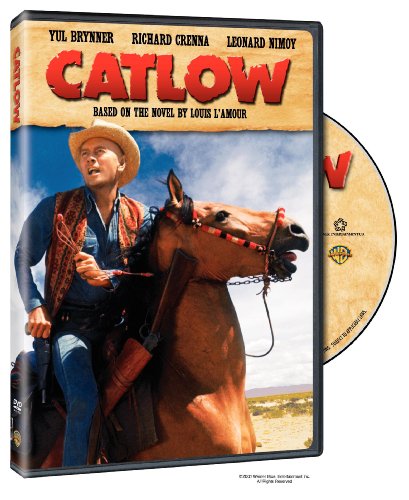
Yul Brynner is the titular Catlow, a jovial outlaw rounding up maverick cattle, much to the consternation of cattle barons who feel the strays belong to them. Richard Crenna is Ben Cowan, Catlow's best friend but also a federal Marshal, who is tasked with arresting Catlow. Leonard Nimoy is the hired gun whose task is rather more lethal. Catlow and Cowan spar good-naturedly as the former plans to steal a great deal of gold in Mexico, which will have many other people annoyed with him.
This 1971 western is a lighthearted romp, or at least it intends to be. In fact, the humour is rather forced, even though everyone is grinning madly and putting a great deal of energy into convincing us that they're having mad fun. The effect, however, is rather flat. The film also trots out unquestioningly almost every old western convention, up to and including a completely unreconstructed vision of its “Indians” as dangerous savages. In the wake of the Spaghetti Westerns and Sam Peckinpah's elegiac orgies of violence, it seems curiously old-fashioned, and in the end functions as little more than passable entertainment.
Posted in: Disc Reviews by Michael Durr on May 19th, 2009
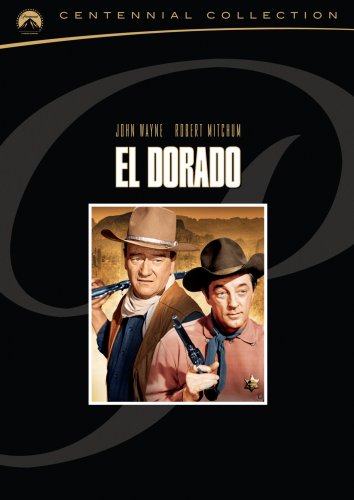
My history with Westerns isn’t exactly a vast one. I watched a bunch of Westerns with my dad growing up and I continued to watch the bigger ones of the modern era like Tombstone and Unforgiven as I progressed through my teenage years and young adulthood. John Wayne is kinda a mystery to me. He’s a huge gritty guy with a lot of patriotism and a funny way of talking. For lack of a better analogy, Sylvester Stallone is my generation’s John Wayne. Or Chuck Norris I guess. El Dorado is an interesting western flic because it was shot later in John Wayne’s career but he had still had the swagger of earlier pictures. A true classic revisited by the minds at Paramount.
Cole Thornton (played by John Wayne) is a gunslinger for hire. He’s been hired by Bart Jason (played by Ed Asner) for some help in a ranch dispute with the McDonald family. Cole rides into El Dorado and is approached by his friend: Sheriff J.P. Harrah (played by Robert Mitchum) who tells him the real tale of the ranch dispute. Cole also finds out that Jason eventually would have put him in a gunfight with the Sheriff. This is something that he didn’t want to do.
Posted in: No Huddle Reviews by Archive Authors on April 14th, 2009
Posted by Ken Spivey
Some movies are simply made better by enjoying them with a six pack of beer and several of your closest, silliest friends. Unfortunately, when I watched “Come Hell or High Water” I was alone drinking a Coke...so the desired experience was diminished. Yet, to better relay the plot of the film, I shall use the lens of myself after about six shots of “Wild Turkey.” This shall lend itself better to the film's narrative style.