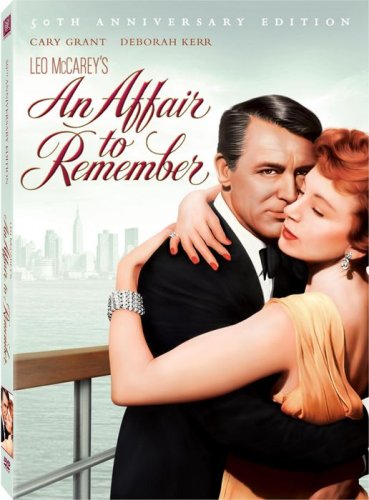
Anniversary Edition

Fox re-releases this beloved weepie in a new edition with a number of new extras. Beyond those additions, this version is identical to the one reviewed here previously. Therefore, my deathless prose once again: “On a luxury ocean liner, playboy Cary Grant meets singer Deborah Kerr. Each is involved with someone else, but they fall deeply in love with each other. Upon arriving in New York, they decide to part and, if all goes well, reunite in six months at the top of the Empire State Building, by which time their lives should be in order. If you’ve seen Sleepless in Seattle, you know what happens next. Though this is one the most celebrated weepies ever, I found it curiously uninvolving. The banter on the ocean liner, though amusing, fails to make us believe in the depth of the relationship, and so the tragedy that comes later lacks punch. The plot meanders interminably, is padded out by Sound of Music-style songs involving sweet widdle kiddies, and the reasons for keeping the characters apart during the third act are so contrived that suspension of disbelief crashes and burns. The ‘scope cinematography is nice, and it’s always fun to watch top stars like Grant and Kerr, but if you want a more convincing heart-tugger, see Now, Voyager.”

Audio

When Close Encounters of the Third Kind came out in 1977, a young Steven Spielberg was coming off of the unexpectedly phenomenal success of Jaws. This was the director's chance to solidify his career as a well-respected filmmaker, and build a lifelong career. While most directors would have either gone the route of making Jaws II or picking up a no-brainer script from a proven scriptwriter, Spielberg wagered his success on the odd tale of a possibly mentally deranged individual's belief in extra-terrestrial life. What he came away with was a film that won an Academy Award for Best Cinematography, was nominated for four Golden Globes (including Best Picture and Best Director), and has become synonymous with the legacy of the famed director.

Normally I would take this opportunity to go over the basic plot of the film, but this is a classic. Most film buffs are already well versed in the plot of this film, and those who are not should be ashamed of themselves. The real story here is not the fact that this film has been released yet again. The story is the manner in which it has been released. In addition to Spielberg's original version of the film, he also re-cut the film into a Special Edition in 1980. In 1998, the film was re-cut yet again, in a version that the Director considers to be his definitive cut. All three versions are included on this three-disc set, so there is plenty here to warrant a purchase for any Close Encounters fan. All versions have been completely remastered, and the set is packaged in a box that reminds one of the excellent packaging of The Soprano's sets.

There are few things as tragic as potential that is unrealized. Whether it’s by choice or by extenuating circumstances, to see a life cut down before it has a chance to develop and make an imprint on the world is sad to see. And it seems to happen disproportionately among musicians. In most casts, drugs frequently has been the main culprit (see Jimi Hendrix, and Janis Joplin), or suicide in some cases (Kurt Cobain being the more notable name in recent memory). But when an entertainer is murdered, the abrupt nature of the crime seems to shake many to the core. It was sad four decades ago when Sam Cooke was murdered, and equally disappointing two decades later when Marvin Gaye was felled by the hands of his father. When Selena Quintanilla was murdered by her business manager in 1995, it sent shockwaves through the Latin music community. Here was a young woman on the fast track to superstardom, gunned down before her full promise could be delivered.

With the cooperation of the Quintanilla family, Selena was made in part to make sure any films that were being made without the family’s approval would be made null and void. So while Selena’s father Abraham had the final say over what was included in the film, the film itself was written and directed by Gregory Nava (Bordertown), and in the main role, a young pre-diva Jennifer Lopez (Gigli) as the Tejano star. Her charisma is noticed early in her life by Abraham (Edward James Olmos, Miami Vice), who was a musician in his early days and he wants Selena to do well and maybe be a star while avoiding the things he had to endure.

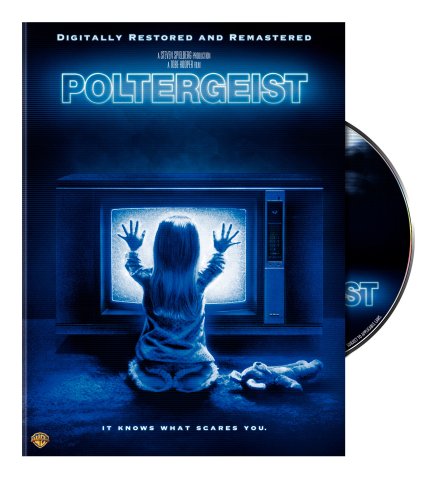
Everybody remembers the first scary movie that gave them nightmares for days and months after they saw it. For some, it was the Exorcist and for more recent folks perhaps it was Scream or Saw. For me, it was Poltergeist. I was but seven years old and thought it would be something like E.T. Phone Home, but with swirly demons and ghosts? It was PG, how bad could it be? In the next two hours, I was treated to something that resonates with me to this very day. From the moment I heard "They're Here", I knew I would never see static on televisions the same way.

It's 3:00 in the morning, the national anthem is playing and then the television goes to static (remember those days, now we just get infomercials about losing weight). A small child named Carol Anne (played by Heather O' Rourke) gets out of bed and walks towards the television. She starts talking to the set and works up a pretty good conversation. The people inside the television were trying to communicate with the 5 year old child. However, there was something else in the television set, something far more sinister. There was more at work here than a girl perhaps making an imaginary friend.

There are two very distinctive schools of thought about Walt Disney’s The Jungle Book. There are the Kipling fanatics who have never forgiven Disney for taking a story considered sacred in literary circles and creating something that honestly bears (pardon the pun) little resemblance to the original work. These folks rightfully point out that the story contains almost nothing recognizable about the story and characters from Kipling’s beloved classic. I have often condemned projects that take names like The Night Stalker and Battlestar Galactica and create a vision incompatible with the traditions I associate with them. Therefore this review might seem a bit hypocritical when I tell you I side with the other camp that considers this film to be a milestone, not only in Disney animation, but in animation history itself. The characters might be distantly removed remote ancestors to Kipling’s creatures, but they are truly classic creations in their own right. What better definition of a classic can there be than the influence that Jungle Book still has 40 years later, not only on our pop culture but on the careers and lives of today’s artists. I venture to say that more people are familiar with Disney’s renderings of these characters than Kipling’s I agree the caparison isn’t exactly fair, but it is accurate.

Although it arose from the talented minds behind The Muppet Show, this 1982 fantasy classic is no kids' film. While The Dark Crystal can be enjoyed by kids, it's a little too dark and a little too abstract for your average seven-year-old.

Set in "another world, in another time...in the age of wonder," The Dark Crystal represents a monumental creative undertaking, and the first live-action feature film to not have any humans appearing on screen. While this 25th Anniversary Edition release appears to be a quadruple-dip, it just might be worth your attention.

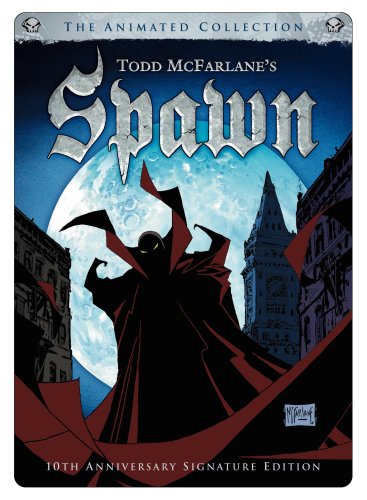
I still remember the first time I watched a Spawn animated episode. I was with my parents in my younger years on what I believe was the last vacation we ever took together. It was a hotel we were staying at which had HBO (I never had that channel growing up). I had read Spawn but didn't even know of the animated series. The fact it was late at night and on a premium movie channel meant it had to be good. I was simply blown away and remember telling my parents that we had to be back at the hotel to watch it again the next night. I remember that later I would procure used copies of the series. All beat up, in snapper cases, it didn't matter. I soon dumped those copies in a couple of years and hoped that it would get reissued in a nice box set. That time has come, Spawn has come home.

Spawn is Todd McFarlane's baby; his issue of defiance when he and a group of artists started Image Comics. Great art, compelling stories and no boundaries. Spawn was the story of Al Simmons who sold his soul to the demon Malebolgia so that he come back to avenge his death and be with his wife Wanda one more time. Problem was once that occurred he was to become an undead "hellspawn". So he fights that control constantly along with enemies from that conflict and those enemies in the human world that would bring him harm. He is not a superhero so much but the boogieman, a character that lives in the shadows and comes out at night to take care of business and then return to those same shadows by morning.

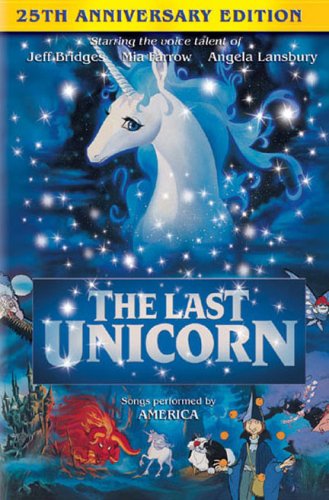
I can't say I'm too familiar with The Last Unicorn, I mean overall, animated children's films were in the midst of a decline in the '80s. However my wife was more than familiar with it and enjoyed it a lot growing up. And Lion's Gate has presumably cleaned up the film and thrown some extras on it just in time for the film's 25th anniversary.

Based on a novel by Peter Beagle and directed by the animation team of Jules Bass and Arthur Rankin (who helped produced such shows as the stop motion of Rudolph the Red Nosed Reindeer and The Hobbit animated version back in the '60s and '70s), the unicorn in question is named, well, Unicorn (voiced by Mia Farrow, The Omen), who walks around rather peacefully in the countryside. She is captured by a witch and is released by her assistant named Schmendrick (Alan Arkin, Little Miss Sunshine). So when Schmendrick and Unicorn are threatened by an ominous red bull, he turns her into a mortal named Amalthea, who finds love by Prince Lir (Jeff Bridges, Tron) and finds out why she was the last unicorn from King Haggard (Christopher Lee, The Lord of the Rings).

Few science fiction films of the 1950’s left as much of an impact as Forbidden Planet. Gene Roddenberry often cited the film as the birth of Star Trek. It is in this film that he took away the interactions of an interstellar craft’s bridge crew. Even the United Planets organization in Forbidden Planet heralds Trek’s United Federation of Planets. Robby the Robot would become a science fiction icon and lead to a great number of copycats, most notably the Lost In Space robot. Robby even made a cameo on that show. MGM ...ulled out all the stops on what must have appeared to be a risky proposition. Certainly science fiction films were popular, particularly as drive-in fare, but most were created on shoestring budgets. Forbidden Planet was an honest to goodness blockbuster budget film long before the steady stream of big budget genre films were popular. MGM launched one of its largest promotional campaigns. For one of the first times in Hollywood history, there were product tie-ins and cross promotion on other MGM properties. Many of the images from Forbidden Planet were already familiar to the movie-going public before the film’s actual release. If anything else, this film would provide a model that huge budget films of today still follow when they hit the market. More than just science fiction cinema changed with this milestone release.

The cast of Forbidden Planet was another trend setter. Walter Pidgeon was already quite an established name outside of science fiction circles. Until this time, most of these films featured no name actors or contract players obligated to participate in whatever was tossed their way. Some prestige was bestowed upon the genre with that kind of a cast decision. Anne Francis, of course, steals the show whenever she is present on screen. Unlike the roles for women often provided on these kinds of things, Francis was given a chance to show true acting skills instead of simply being eye candy for the male audience. That’s not to say she wasn’t quite attractive, but the part required a great deal of emoting that this young actress was able to pull off nearly perfectly. Leslie Nielsen, now more renowned for his deadpan comedy, plays the ship’s commander. It’s not hard to see where Kirk got his flair for the feminine charms while watching Commander Adams working on Altaira. Future Six Million Dollar Man’s Oscar Goldman, Richard Anderson is also a pleasant casting gem.

Warren Beatty attempts directing for the second time in Reds, a film based on the life of John Reed during the Russian Revolution. I didn’t know what to expect from this film, as I had never heard of it prior to its release on HD DVD. I have never seen a movie based on this subject matter, so the movie covered all new grounds for me. Upon investigation I discovered the movie was nominated for twelve Academy Awards and won three, including Best Director for Warren Beatty. Boasting an impressive cast including W...rren Beatty, Diane Keaton, Jack Nicholson, Paul Sorvino, and Gene Hackman, this movie seemed to have a lot of potential.

John Reed was an American journalist and communist activist best known for writing Ten Days that Shook the World. He was married to writer Louise Bryant; they had a hot and cold relationship, which is one of the main themes portrayed in this movie. Of course the others being John Reed’s quest to document the Russian Revolution, and the years beyond it. We learn about things such as communism, the insecurities of the main characters, and observe their somewhat repetitive back and forth bickering. Interestingly, Beatty decided to tie in actual interviews with people who knew John Reed throughout the movie, which gave us real life perspectives about Reed as well as tying together different parts of the story. I enjoyed those parts, as they didn’t interrupt the flow of the movie and it added an insightful sense of realism to it.