Alliance Films

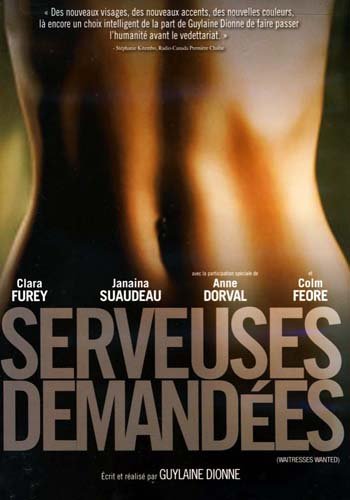
The main plot of the film is that of a young woman from Brazil named Priscilla, whose student Visa expires and is lead into working as an exotic dancer. The title of the film comes from the ad posted by the pimps and promoters of exotic dancers “Waitresses Wanted.” The film is bookended by the profiles of all the dancers featured in the film, all of whom are from a different nation, all beautiful, and all arrived in Canada with different careers in mind than to get involved with Columbian pimps or Russian mob lords.

Priscilla is taken under the wing of Milagro, a fellow stripper who is known for recruiting new girls and the two start up a romance that leads them away from their shady work. I don't exactly buy the immediate seduction of Priscilla by Milagro. It seems to occur simply because the writer wants it to occur. Priscilla is not as strong as she claims to be and cannot get into or out of the stripper life without someone leading her, and she is very easily lead. There is a recurrence of memories and images of Brazil, obviously meant to be Priscilla's. These find a way of attaching themselves to Milagro as she continuously brings up her desire to escape to Brazil, which may explain her attachment and excitement for Priscilla. To Milagro, Priscilla is a part of what she really wants in the end, and as the twists start arriving at the climax of the film, we find out just how significant all of these ties really are.

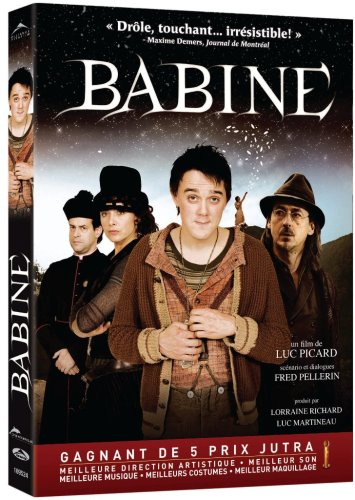
In a village where there is a great deal of time (there are months whose days are numbered in the 40s), the local witch gives birth to the title character. Twenty years later, Babine is the Village Idiot. Though he is a thoroughly gentle soul, he also becomes the scapegoat for every ill, real or imagined, that befalls the villagers. Fortunately, he has some champions, including Toussaint Brodeur (played by director Luc Picard), the local fly-raiser. But then the church burns down, and terrible trouble looms for Babine in the person of the new, fanatical village priest.


Obviously, as the above synopsis suggests, we are in the realm of the utterly fantastic here. Narrated by storyteller Fred Pellerin, whose tales form the basis of the script, Babine is endlessly inventive, at the cost of being a bit too episodic for its own good (something that Picard, during his commentary track, admits he struggled with) and giving short shrift to some of its striking characters. There is no denying, however, that its world-creation is very successful. The film is a visual feast, one very much on par with the likes of Tim Burton, and this achieved with a fraction of the budget of its Hollywood equivalent.

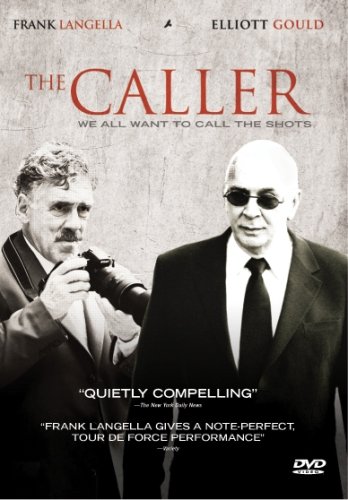
The Caller is a film starring Frank Langella and Elliott Gould. It is a tense thriller about corporate foul play and voyeurism, wait, what year is it?  With the recent critical acclaim of Langella, it seems only fitting to market his name on a low-budget film. Unfortunately for the film, Langella’s performance is one of the only shining moments. Langella plays an aging VP of an energy company that decides to blow the whistle on the corporate wrong doings that are going on. Understanding that he’s written his own death certificate, Langella hires a private investigator (Gould) to follow him to help catch his eventual killer.

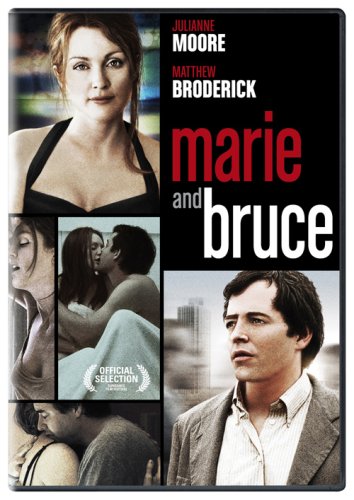
Based on a play by Wallace Shawn (who also co-wrote the screenplay), this film is a day in the life of an unhappily married couple, played by Juliane Moore and Matthew Broderick, who don't know what to do about said unhappiness. The story is simple but the paths each character take is not. After a bitter breakfast scene, they separately go about their day before meeting at a party in the evening where Marie may or may not leave Bruce once and for all.

The dialogue is very reminiscent of a meta-theatrical stage production as the characters are able to freely address the audience in narration or monologues. When speaking to each other, they are terribly open and leave no feeling hidden as they express every thought in a highly unnatural and stylized manner. This leads to some very biting humour as Marie explains her disdain without mercy towards either Bruce or anyone he associates with, while Bruce feels no qualms about detailing the state of is genitals after a one night stand he had 11 years prior. At the same time, this strange and often venomous dialogue is peppered with the persistent use of endearing terms such as “darling” when one of the two addresses the other, which turns into a nice device used by the writers to squeeze out more of a satirical view of decaying, modern couplehood.

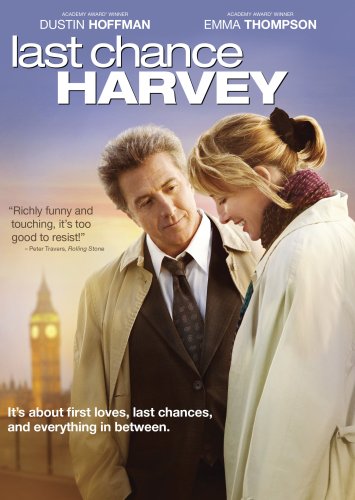
Dustin Hoffman is the titular Harvey, a morose jingle composer who, with his job hanging by a thread, arrives in London for his daughter's wedding. He is a complete outsider at the rehearsal dinner, and feels even more cut off when his daughter informs him that she wants her stepfather to give her away. Meanwhile, the scarcely more cheerful Emma Thompson spends her time being set up for disastrous blind dates and being constantly harangued on the phone by her mother. These two losers at the game of love meet, and something blossoms between them.

And that is really about it as far as plot goes. The script is so insubstantial that it threatens to waft away on the first gentle breeze. The film is quite watchable, however, and that is due to the sheer force of its leads. They make the enterprise seem considerably more substantive than it is, their pained expressions conveying worlds to us. The film is at its strongest when it sits back and lets the two banter, and the relationship that develops feels easy and natural. It is all the more disappointing, therefore, that writer/director Joel Hopkins feels it necessary to shoehorn in the obligatory Romantic Comedy Third Act Falling Out by the most contrived and Deus Ex Machina-like of means. This is a turn of events that is a poke in the eye to any viewer who thought his/her intelligence was going to be respected.

Alan Rickman, in a stunningly unexpected bit of casting, plays an arrogant, womanizing SOB of a chemistry professor who has just been awarded the Nobel Prize. While he and wife Mary Steenburgen jet off to Sweden, their son (Bryan Greenberg) is kidnapped. Before long, the parents receive are sent a severed thumb as proof of the kidnapper's serious intent. But nothing is quite what it seems.

What we have here is a blackly humoured cross between farce, caper and revenge story. The name-studded cast also includes Bill Pullman as the detective assigned to investigate the kidnapping, Elize Dushku as Greenberg's love interest, and Danny DeVito as a gardener recovering from an obsessive-compulsive disorder. Ernie Hudson and Ted Danson also show up in small roles. DeVito doesn't have much to do in the film, but then, in the end, neither does just about anybody else. Rickman, though top-billed, isn't asked to do more than his patented bastard shtick, which he can do in his sleep. There's a creative heist scene, and plenty of twists, but these latter have a merely academic interest. There is no emotional attachment to anyone in the film, which means that the OTT flash and dazzle of the editing becomes pure surface distraction. Then there's the soundtrack, partly the work of electronica deity Paul Oakenfold. Too often, it has no relation to the action on screen, and is so loud that, fine as it is in and of itself, it becomes irritating. End result: a slick but empty, only fitfully engaging effort.

What would you get if you were to cross the films Dangerous Minds and Waiting for Guffman? Well, add a liberal helping of High School Musical and you might end up with Hamlet 2 (though it is difficult to imagine the High School Musical drones belting out songs like “Rock Me Sexy Jesus” and “Raped in the Face” with such gusto).

Zack (Seth Rogen) and Miri (Elizabeth Banks) have been friends since school, and are now terminally broke roommates. As their utilities are turned off one by one, and they face the prospect of eviction, Zack hits on the idea of shooting a porn flick to get out of debt. They gather together a motley collection of actors and crew, and, letting no setback stand in their way, start making their movie. But the real question is not whether they will succeed, but whether they will come to terms with their feeling for each other.

In his review of the film Roger Ebert writes, “'I don't know bleep about directing,' Smith once confided to me. 'But I'm a bleeping good writer.'” Smith is half-right. The direction here is very meat-and-potatoes, every shot serving little more than to get the actors decently framed. But I can't agree with his self-estimation as a writer. There are some funny lines here, but many of the laughs are due to Smith's stellar cast. Rogen does his usual shtick, but it's still funny, thanks to his appealing naive/cynic vibe and befuddled stoner delivery. Justin Long shows up for a single scene, and walks off with the movie. None of his lines are particularly stellar, but his cameo is hysterical, all of it due to voice and body language. The man could make the yellow pages side-splitting. This is not to say that Smith's script is that dry, but it veers between clumsy earnestness (I kept waiting for the punchline during the final emotional speeches, the clue that I wasn't really supposed to take this hackneyed dialogue seriously, and it never came) and a potty mouth approach that clearly finds naughty words to be funny in and of themselves. You know, like we all did in grade five. David Mamet this is not. But when all is said and done, there's the cast. Determined to save Smith from himself, they make the film a bizarrely endearing and sweet experience.

Rob Zombie’s enthusiastic but terminally misguided remake scores yet another DVD release. This one is identical to the previous unrated edition, apart from the fact that there’s an extra disc. More on that later. But in the meantime, as everything else is the same, that will also be true for this review. What follows is what I said about the last version.

“The trailer trash Myers family (inexplicably living in a pretty big house) is a powder keg waiting to go off, what with the rampaging abuse and a young Michael (the admittedly creepy Daeg Faerch) butchering small animals and looking like he’s mad as hell and soon not going to take it anymore. Snap he does, going on a killing spree, before he is captured and locked up for years, while eccetric shrink Dr. Loomis (a shameless Malcolm McDowell) making a career out of trying to learn what makes him tick. Growing to Godzilla proportions, Michael makes his escape, and proceeds to pick up his spree where he left off in his home town of Haddonfield.