Alliance Films

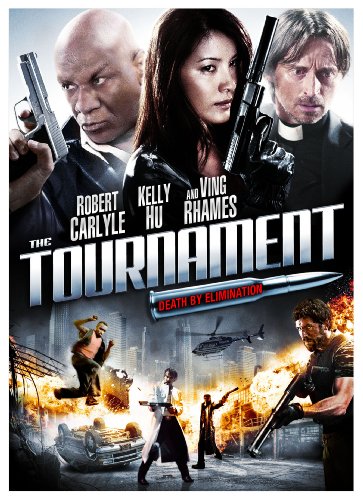
Every seven years, thirty assassins descend on an unsuspecting city and slaughter each other, all the while being observed by hijacked security cameras for the benefit of the high rollers who are betting on the outcome. The previous winner was Ving Rhames, and he thought he had walked away from the life after that tournament. But then his wife was murdered, and he learns that the killer is in the new contest (taking place this time in England). Also taking part is the fatalistic Kelly Hu, who winds up being the reluctant protector of drunken priest Robert Carlyle, who even more reluctantly has become a long-shot competitor in the tournament after accidentally swallowing a tracking device that paints him as a legitimate target.

This sounds a bit more complex than the film really is, as the plot is primarily there just to facilitate the spectacular butchery that follows. The action is fast and furious, and the blood is as copious as you're going to get this side of Hostel. All of which is more than passably entertaining, and there are also some surprisingly witty moments, usually courtesy of Carlyle. In its enthusiasm to go over the top, however, the film does dip its toe into some of the same ugly misogyny that so pollutes the Crank films. Still and all, bloodthirsty action fans could do worse than spend 95 minutes in The Tournament's company.

This film chronicles the career of Maurice “The Rocket” Richard, an NHL player for the Montreal Canadians, from his childhood days in a Junior hockey league, to the season in 1955 where his suspension from playing for the remainder of that season led to violent riots in Montreal. This film is more than just an examination of Richard as a French-Canadian citizen and legendary hockey player (many still argue as the greatest ever to play) but also a look at his impact as an icon and living legend to the people of Quebec.

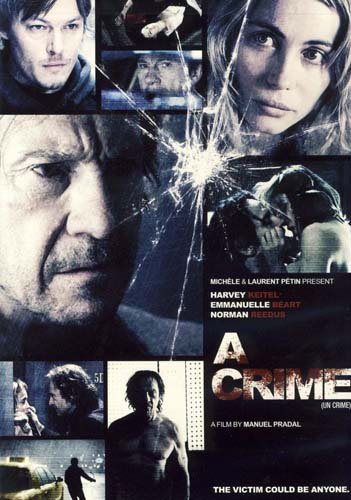
Years after his wife's unsolved murder, Norman Reedus has retreated within himself, carrying on a morose existence in a low-end apartment, gloomily taking part in unofficial greyhound racing. His neighbour, Emmanuelle Béart, is in love with him. Since Reedus is obsessed with solving the murder to the exclusion of any other human interaction, Béart decides to present him a solution. Based on the tiny bits of information Reedus has on the suspect, Béart picks cabbie Harvey Keitel as matching the profile well enough to make for a good target. She begins a relationship with him in order to put him in the frame and give Reedus, though murder, the catharsis he needs.


So goes the setup of this interesting but flawed neo-noir. As one would expect in a noir, the plan does not go exactly as foreseen, and everything becomes increasingly complex and deadly. This is to the good, and there is some nice suspense that builds up, as one is worried first about one character, and then another. Reedus doesn't have too much to do, and is too cold for audience sympathy to really develop, but Béart and Keitel's walking wounded are compelling. But if twists and contrivances are all well and good in the genre, utterly insane coincidences are harder to take, there's finally such a doozy in here that the story's credibility is torpedoed. Along the way, though, the pic makes for gripping viewing.

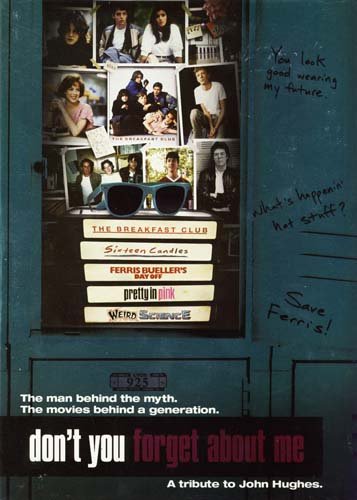
Don’t You Forget about Me is a documentary/tribute to the late John Hughes.  Four amateur filmmakers set out to find answers to the questions, why did you leave? How did you capture adolescence so perfectly in your films? Why do your films remain a fixture in popular culture?  After obtaining interviews with many of the John Hughes alumni such as Ally Sheedy, Judd Nelson, Alan Ruck and Andrew McCarthy, the filmmakers came to the realization that they required an interview with John Hughes to complete the film. The documentary combines the interview footage as well as covers the filmmaker’s road trip from Toronto to Illinois to acquire an interview with the reclusive director. 

The marketing potential of this film rose greatly upon John Hughes’ unfortunate passing.  These filmmakers are deeply interested and moved by the works of Hughes and audiences can see that.  However, there is nothing compelling about the filmmakers.  They are not interesting or provocative. I found myself bored with their stories and opinions. What is problematic about this documentary is the forced fusion of two stories; One being the story of John Hughes and the other being the group of filmmakers. In my opinion, the latter should have been jettisoned altogether. Audiences are engaged in these interviews and suddenly the flow is disrupted with the tiresome antics of these four filmmakers.

We are in the late 1920s, and to the family manor comes Ben Barnes, in the company of new wife, Jessica Biel. That this woman is both American and a race car champion does not sit well with the very conservative mother Kristin Scott Thomas. That her nose is out of joint delights husband Colin Firth, a veteran of the Great War who, thoroughly world-weary and disillusioned with just about everything, wants nothing to do with the petty concerns and squabbles of his family. What follows is a clash of cultures and generations, veering between slapstick comedy and something rather darker.

I know you've all been waiting to see Jessica Biel finally star in a film whose script is based on a Noel Coward play, which was first adapted in 1928 by Alfred Hitchcock. All kidding aside, Biel acquits herself well, despite occasionally displaying some rather anachronistically defined pecs. The other cast members aren't having to strain themselves too much -- Scott Thomas has played repressed ice queens before, and Firth pretty much phones in his trademarked display of amused contempt -- but they are never less than efficient in their portrayals. That said, Scott Thomas and the performers playing her daughters have a tendency to project to the back of the hall, and otherwise remind us a bit too forcefully that this material was originally a play. The film is far from the jaunty comedy of mores that the case suggests -- it is rather too dark for that, by the end. It is an enjoyable, though finally slight, bit of entertainment.

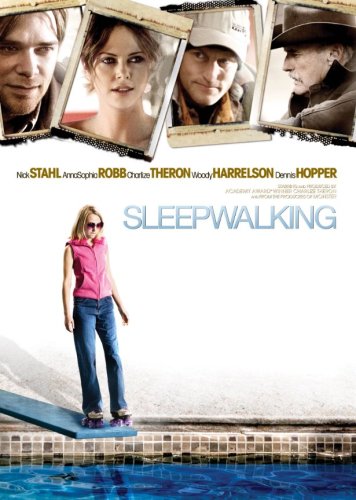
This is the story of an unfortunate underachiever who is left with his niece after his even less fortunate sister abandons them. Unhappy with social services and the places they are forced to live, they take what little money they have to fund an aimless trip across the country until arriving at the home of his abusive father.

This film relies on the performances since the story is so utterly bleak at times that all the audience has to cling to sometimes  is the recognition of the stars within it. Filling up the smaller roles are the likes of Woody Harrelson, playing  the goofy friend, Dennis Hopper, who is devouring the scenery as the aforementioned abusive father, and Charlize Theron, who is greatly missed during most of the film for she delivers probably the most solid and engrossing performance as the troubled mother. Theron controls the first fifteen minutes then becomes nothing more than a reference for the better part of the proceeding film.

Some thirty years after seeing his father killed by a car bomb, Samir Horn (Don Cheadle) is a dealer in explosives. When he is imprisoned in Yemen along with members of a militant group he was about to make a sale to, he is drawn in and becomes an integral part of the group's terrorist activities. But wait – is he in fact an intelligence agent who has infiltrated the group in order to bring down their leader? Meanwhile, FBI agent Guy Pearce is hot on Samir's trail, but if he catches up, will that be a good thing or a bad one?

Given that we are, after all, talking about the lead in a mainstream Hollywood release, it should come as no surprise that the answer to the question of Samir's ultimate loyalty comes as no surprise. Fortunately, the question mark is dispensed with about an hour into the film, and the real suspense shifts to more urgent concerns, such as whether a ghastly bombing plot can be averted. Without venturing into spoiler territory, I must say that the climax leads to as clever a bit of cinematic prestidigitation as I have seen in quite some time, so kudos. Though the film is, first and last, a suspense thriller, and quite the effective one at that, it also makes a few telling points. Though the villains are suitably dastardly, a number of the characters on that side are also humanized – Sarmir's best friend (Saïd Taghmaoui) may be a terrorist, but he is also a man whose motivations are entirely understandable, and he is clearly acting out of genuine conviction. By contrast, intelligence operative Jeff Daniels is willing to go to such lengths to stop the terrorists that he becomes morally indistinguishable from them. And when was the last time that Hollywood had a devout Muslim as the protagonist of an action film? Rank this, then, with The International and The Kingdom as another satisfying exercise in suspense that leaves its audience with plenty to talk about after the closing credits roll.

This is the comedic tale of a grocery store's young assistant manager (Seann William Scott) who believes he is the prime candidate to take over the soon-to-be built addition to the chain. This leads him to buying a house before the job is secured and lo and behold a hotshot Canadian (John C. Reilly) shows up in town from their sister company and begins campaigning for the job himself.

Already languishing in the $6.99 bin at my local Blockbuster, and with dismal reviews on its release, my hopes for The Haunting of Molly Hartley were not high. However, after viewing the DVD I can safely report that the movie falls firmly into the ‘not anywhere as awful as I thought it was going to be’ category.

This is not an endorsement. The movie is by no means good, but nowhere near as wretched as I’d been set up to believe.

When Terence Malick's latest effort hit the theatres, he had trimmed it down to 135 minutes. Early critics had seen a version running 150 minutes. This version is longer yet, clocking it at 172 minutes. Most of what I said about the previous DVD release holds, and so I'm reproducing it here, with additional comments as necessary.

Virginia, 1607. English ships arrive and a colony is set up, but with considerable difficulty. Famine and disease take their toll. Captain John Smith (Colin Farrell) heads off to seek help from the Powhatan. He is captured, sentenced to death, but waved by Pocahontas (Q'orianka Kilcher, whose character is never actually given that name). So begins a fateful relationship.