Fox

"We're all put to the test. But, it never comes in the form, or at the point, we would prefer, does it?"

When The Edge made its debut in September of 1997, you would have thought it had a lot going for it. The idea of putting Alec Baldwin and Anthony Hopkins together in a winter wilderness sounds like a pretty good idea. Audiences didn't seem to think so. The film was gone after just 5 weeks and less than $30 million box office receipts. It lost nearly half of its screens in just 2 weeks. So, what went wrong with this movie? The answer is nothing, and everything.

"Even in the most primitive man, the need to create was part of his nature. This need, this talent, clearly separated early man from animals who would never know this gift. And here, in a cave somewhere in the North American Continent, about two million years ago, the first artist was born. And, of course, with the birth of the artist came the inevitable afterbirth ... the critic."

That's me. Afterbirth here. Brooks always did love to poke fun at the critics. And why not? Unfortunately, this was not one of his better films and likely received a lot of poking from the brethren. It was one of his worst films at the box office, pulling in only $31 million. Compared to many of his hits, it must have been a disappointing take for Mel at the time. Now out, along with some other of his films, on Blu-ray, this rather forgettable film looks even more dated and overindulgent than ever. Certainly, there are some classic moments. Mel, is, after all, Mel. But he never could string enough of them together to meet expectations. Too bad, really. It was a grand idea.

"You, sir, are guilty of disseminating disbelief. Killing dreams. Committing first-degree murder of fantasy, which by Fairy Law, in order to pay your debt to humanity, you are hereby ordered to serve time as a Tooth Fairy. The normal sentence is one week, but because you have the nerve, the unmitigated gall, to actually call yourself a Tooth Fairy, thus making a mockery of everything we stand for, I'm sentencing you to two weeks Tooth Fairy duty."

Dwayne (once The Rock) Johnson has made a bit of a new career move over the last few years. When he left the wrestling ring to "go Hollywood" the expectation was always that he would become an action hero. It's what his fans expected. It's what Johnson wanted, at the time. Movies like The Scorpion King were created completely as vehicles for Johnson to show off his physique and join the ranks of the big strong action heroes. It didn't exactly work out as well as everyone involved expected. He wasn't a flop, but he wasn't setting the movie industry on fire either. But with movies like The Game Plan and Race To Witch Mountain, Johnson appears to have a knack for working with kids in films targeted primarily at kids. He's become a big teddy bear, and it's paying off quite handsomely. While he still hasn't given up the wrestling gigs and an action role here and there, his biggest success so far in Hollywood has been with the kids.

"The Legend Had It Coming."

It seems that pretty much every decade has had its screen version of Robin Hood; sometimes it's on television. Robin Hood is one of the most popular characters in film, and there have been plenty of versions, each with their own particular take on the multiple legends that have made up the character over the centuries. Currently Ridley Scott has just released his own epic version of the tale with perfectly-cast Russell Crowe in the title role. In the early 1990's there were two films on the subject released. The first was the disaster that stared Kevin Costner, so abysmally cast as the titular hero. It was only inevitable that following one of the worst attempts to portray Robin Hood, Mel Brooks would see his chance to lampoon the legend. After Costner's film, the legend truly did have it coming.

I've seen quite a bit from Steven Seagal of late. There was his reality series from his deputy job, and many of his numerous catalog titles are finding their way to Blu-ray. All in all, it's a pretty good time to be a Steven Seagal fan. The latest of these earlier films to reach high definition is the 1990 entry Marked For Death. It pretty much follows the established Seagal formula here, combing martial arts with the vendetta theme, that he has come to personify for so long. It has a little of what the fans are looking for, including the social messages that are a huge part of Seagal's films. I'll give him a lot of credit here. He does appear to have a huge heart, particularly for kids, and tends to press issues of importance to them in many of his films. He also manages to accomplish this without getting too preachy.

John Hatcher (Seagal) works for the DEA. He's in the middle of an undercover operation in Mexico that goes sideways. That means that people are going to get killed, and you can bet your bottom peso that one of those people is going to be someone that Hatcher cares very much about. Playing a family member or partner in a Steven Seagal movie is like putting on a red uniform and beaming down to a hostile planet with Kirk, Spock, and Bones. You'd be safer with a three-pack-a-day smoking habit topped off with a 5th of Scotch and a heroin chaser. No one's going to be selling you any life insurance. So naturally, since we don't see any family members running about, Hatcher's partner is not long for this script. When his partner does die, Hatcher rethinks his job and decides to quit.

"In the West there lives an animal that runs wild and free. Its strength and courage symbolize our pioneering spirit. That magnificent animal is the wild mustang."

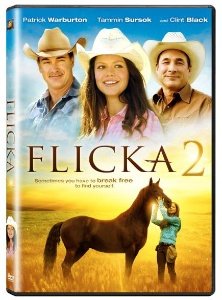
In 1943 a very young Roddy McDowall played a young boy in the perennial classic My Friend Flicka. The film was about a rebellious boy who is given a colt to teach him responsibility. He eventually bonds with the horse and learns the necessary lessons. The film was followed by a 1956 television series that followed the adventures of Gus and Flicka and lasted but one year. In 2006, the story was revived in a remake filmed under the same name but shortened to Flicka before it was released. While the character’s last name was retained, the film went the route of a young girl instead of a boy. It was probably a natural choice. My wife stands as a perfect example of how much every little girl appears to like horses. When I was that age I was more interested in the tough-as-nails cowboys who rode them. The film didn't manage to excite a very large audience and pulled in the small sum of $21 million. You might have expected the story to end there. It hasn't. 20th Century Fox has brought back the friendly spirited mustang in a direct to video release, Flicka 2.

These last couple of years have seen a resurgence of a particular kind of character study. For me I think it started with The Wrestler. For Mickey Rourke, it was a powerful comeback and led to an example of grand theft at that year's Oscar celebration. Now, I wouldn't exactly say that Jeff Bridges was in any particular need of a comeback. He's had some pretty steady work over the years. Still, you just can't watch Crazy Heart and not be reminded of The Wrestler. These characters could not be more different in a lot of ways. But they are also cut from the same cloth. Both have already seen their glory days behind them. They've each indulged in some pretty self-destructive behavior. In The Wrestler, it could be argued that the abuse he put on his body was a necessary part of the life he chose. With Crazy Heart, we're talking alcoholism, pure and simple. Still, any of those old cowboys might make the argument that booze is as much a part of the life they choose as the drugs and physical punishment are for a wrestler. It's a pretty good point. Both characters are looking for some kind of redemption with a past child. In this case it's a son. Both are attempting to find healthy relationships, perhaps for the first time in their lives, with single moms who have had some bad luck in the romance department. Finally, both characters are looking for a comeback. Here is where the stories truly diverge. For Mickey Rourke's Ram, he returns because it's the only thing he knows. His job defined him. His comeback will likely mean the end of his life. For Bad Blake, the new career in music could well be his salvation and a chance at a longer life. Whatever the comparisons, both are strong character-driven pieces.

Bad Blake (Bridges) was once on the top of the country charts. But that was a long time ago. Today, he's driving around in his Suburban from gig to gig with about 10 bucks to his name. He's gone from great arenas to bowling allies and small-town dives. He still has a small core group of fans that make even this life possible. The trouble is that Bad chain smokes and drinks his health away. He can barely stand for one gig. His old guitar player Tommy Sweet (Farrell) has offered him the chance to open for his act. More important, Sweet wants him to write some new songs for him, and is willing to pay well for them.

Cocoon was based on a somewhat obscure novel by David Saperstein. It was also an unlikely film for beginning director Ron Howard. He had made it known since his career began that he had little respect for the science fiction genre. In an interview provided on this very release, he condemns the genre as not being about character or story. I'd say that Ron Howard just hasn't watched the right science fiction. I beg to differ with his assessment. Science fiction has been a remarkable tool to discuss some of the most important issues facing our society. When issues can be couched in aliens and other worlds, the censors and those who avoid socially conscious messages tend to make certain allowances, which has made it a very powerful genre over the decades. Still, that's not the way Howard sees things, and that's why he was likely a bad fit for Cocoon.

The movie has a lot of great actors and some very memorable characters. But Howard left the story somewhere else. Was it the cutting room floor? I don't know, but it never really appears on the screen. What we end up with is a movie with a ton of emotion and charming characters and moments, but it never quite comes together in a memorable film. It did well in 1985, pulling in a respectable $76 million at the box office and earning itself the number 6 spot for the year. There were Oscar nominations, and even a win. These are all impressive accomplishments. Still, Cocoon very swiftly passed out of interest and revealed itself as more a fad than an enduring film. To show just how far and how quickly the film fell, you need look no further than the 1988 sequel. While Ron Howard was not a part of Cocoon: The Return, most of the exceptional cast was back. The film bombed, pulling in just about $18 million, not enough to cover its budget.

"You're not in Kansas any more. You're on Pandora, ladies and gentlemen. Respect that fact every second of every day. If there is a Hell, you might want to go there for some R&R after a tour on Pandora. Out there beyond that fence, every living thing that crawls, flies, or squats in the mud wants to kill you and eat your eyes for Jujubes..."

I don't really have to tell you what Avatar is. If you haven't heard of it by now, I have only one question to ask of you: How was that coma? Ever since he cleaned up at the box office with Titanic, James Cameron has been planning this movie. The only trouble was that the technology to make it did not exist. Most filmmakers would have either tried anyway, or simply waited until the hardware caught up with their imaginations. Not James Cameron. He decided to invent the equipment himself. The result is a new 3D filming process that allows for the most realistic images you likely have ever seen on a movie screen. He combined the new process and equipment with new state-of-the-art computer-generated technology. The result is a movie that is truly the first of its kind. It was a huge risk for Cameron. A lot of money went into not only making the film but the technology development. In many ways Avatar was really an audition film. Cameron wants to make his equipment the stuff other filmmakers use to create their own silver screen dreams. It was a gamble. Judging by the box office take, it paid off big time. With a box office return of nearly $3 billion worldwide, James Cameron now has the number one and number two top-grossing movies in the history of the industry. If you're keeping count, it's a total box office take of just under $5 billion for two movies.

Holy crap, this movie made a boat load of money for Fox when it came out around Christmas 2006, making $250 million and running second only to the Pirates of the Caribbean sequel for box office money. And to see Ben Stiller finally appear in a film that could be considered a blockbuster success was nice too. And in Night at the Museum, he gets to play Larry, night security guard in the New York Museum of Natural History.

Based on a book by Milan Trenc, the story contains man… of the same qualities of a Jumanji or even a Zathura. Larry takes over for a trio of retiring night guards (played by longtime veterans Dick Van Dyke, Mickey Rooney and Bill Cobbs) at the Museum. What he doesn’t know is that the inhabitants of the museum come to life at night, and he has to make sure that the inhabitants stay in said museum from sunset to sunrise, or else they turn into dust.