2.35:1 Widescreen

You simply know you’re in trouble when one of these video titles begins with that age old “inspired by disturbing true events” line. As I watched the film, I couldn’t find anything even remotely based on a true case. I dug deeper and found an obscure remark from writer and director Bryan Bertino that explains he was inspired by the events of the Charlie Manson murders of the 1960’s. You’ve got to be kidding me. There isn’t anything about this film that reminds me of those famous killings. If you say so, Bryan. The film is closer to the recent film Vacancy than anything else I could find. Like that film, we have a troubled couple suddenly pursued by a seemingly random act of violence.


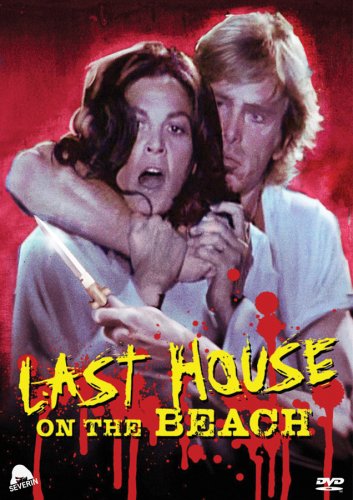
The very first thing you need to know is that this film has absolutely nothing in common with the 1980 cult classic except for the name. Everyone involved has admitted the fact, so, if you’re looking for an update on an old memory, you really are in for a disappointment. The truth is, even if you aren’t expecting the old story you’re in for a huge letdown. Everything about this film screams mundane, from the killer to the story to the acting. The problem is that the film has no niche. It’s definitely not a slasher or splatter film. You won’t find enough blood to give a fruit fly a transfusion. It’s not a horror film per se. The killer isn’t a supernatural being of any kind. He’s just your run of the mill escaped stalker. The film isn’t very suspenseful, and there isn’t any real mystery here. So, what in the heck is this movie? A mess, that’s what it is.


After a violent bank robbery, a trio of criminals descend upon the beach house retreat of a nun and her students. The bad guys take the women hostage, and make themselves at home, tormenting, raping and abusing to their hearts’ content, pushing their victims ever further over the edge.

At the level of plot, not a lot goes on here. The villains are ensconced at the beach house within the first ten minutes, and then story does little more than go through variations of torment until the inevitable retaliation. Nonetheless, there is a fair bit of interest here. The assaults, though very unpleasant and extremely nasty in their content, are, however, filmed with a certain restraint, with the camera concentrating on the faces of attackers and victims rather than on their bodies. Ray Lovelock’s gang leader is a deceptively pleasant pretty boy, and his character arc consistently plays out against expectations. And then there’s the climax, which turns up again almost beat for beat at the end of Quentin Tarantino’s Death Proof.

Very much in the tradition of such other overheated Mexican emotional dramas as Amores Perros and Y Tu Mamá También, Drama/Mex gives us two intertwining plot strands, each dealing with relationships as tormented as they are sexual. In one, upper-class Fernanda’s bad boy ex-lover Chino resurfaces, takes her violently, but she doesn’t exactly hate it, and this has, as one might imagine, some awkward consequences for her relationship with current boyfriend Gonzalo. Meanwhile, a middle-aged man, guilt-ridden over what he has done to his daughter (take a guess), is contemplating suicide when he runs into a precocious teenage hustler. In other words, basically enough material to give Sarah Palin a fatal coronary.


Audio

Most people who know me know that Daredevil is my #1 Superhero of all time. Number #2 is Batman. Third is somewhat of a surprise for a lot of people. It’s the Punisher. It’s surprising because the Punisher is portrayed as a nemesis of Daredevil quite often in the comic books. However, like Batman and Daredevil, Punisher is a classic flawed hero. In the comics, his family was gunned down gangland style and he seeks out to “punish” those responsible. In the proceedings, he finds that the greatest enemy is not those who executed his family but himself. Drinking, suicidal thoughts, and endless pursuit to extract justice at any cost chip away at this very core. Enter 2004, and director Jonathan Hensleigh decides to bring the story of the Punisher to the big screen.

Howard Saint (played by John Travolta) is a powerful and influential mob boss. He has a wife, Livia (played by Laura Harring) and twin boys, Bobby & John (played by James Carpinello). Bobby Saint wants to do something to impress his father. Micky Duka (played by Eddie Jemison), a lackey of Howard Saint, along with Bobby go down to the port at Tampa Bay to negotiate an arms deal. There they meet Otto Krieg (played by Thomas Jane) and the rest of the Russian arms dealers.

To start with I give Spielberg credit for going against the wishes of Lucas to film this thing in digital. Not only did he attempt to reproduce the same film stock look, but he edited the film, not on a computer, but an old movieola. The attempt to make this look like the other films is obvious and appreciated. Some of the sets are simply incredible. The Akator set is massive and dressed with all kinds of detail. It conjures up images of many of Indy’s tomb-raiding past. Again you have to credit Spielberg for wanting his actors in a real place as often as he did. John Williams returns with the traditional Indy fanfare and even some good rousing new music to add to the collection. The vehicle chases remind us of some of the best moments in Raiders. Still, there is a bit too much greenscreen and CG usage here. It is so obvious that many of these locations are studio in front of a greenscreen. I know they tried, but that only made these moments stand out all the more. There are also moments that look like they were trying too hard to be clever. The snake “rope” is absolutely ridiculous. As an Indy fan, you are prepared to suspend your belief, but I feel this movie pushes those limits. There are too often science fiction elements here that, I believe, don’t belong in an Indy film either. But it was good to see the old man in action. I have to admit that in the first scene he really looked old, but I swear he got younger as the film moved along. By the time the real adventure begins, the years have all shed themselves away and Harrison Ford is indeed Indiana Jones again. The film doesn’t stand up to Raiders or the Last Crusade, but is much better than Temple Of Doom. I rank it 3rd out of the 4 films.


I like Mike Myers. I think he’s really talented, and I’ve enjoyed him in films like Wayne’s World, So I Married an Axe Murderer and Austin Powers: International Man of Mystery. That’s why I didn’t want to see The Love Guru. Seeing the trailers for this latest Myers project, I had the distinct feeling it was going to be a black mark on his filmography.

What an understatement — 20 minutes into The Love Guru, I wanted to punch Mike Myers in the face.

“Who? Or What is the newest, most breath-taking, most sensational super-hero of all?”

That was the question asked on the cover of Marvel’s Tales Of Suspense issue number 39. Pictured with that buildup was a character quite different from the Iron Man that we would come to know and love over the next 40 plus years. He was all silver and appeared to be wearing combat boots. He was not very slender, and you could almost hear the clunking as he moved. By the next issue he was gold colored. By Issue number 48 of that same series, the new and improved Iron Man look would appear for the first time. He was sporting the red and gold colors that would be relatively unchanged for decades. Certainly the suit evolved over the years, but Iron Man’s basic design was born. It was December, 1963. In issue 53 the book would begin to incorporate the name of Iron Man into its front page header. Finally in May of 1968 Tales Of Suspense gave way to The Invincible Iron Man. The hero would often be teamed with the likes of Captain America and The Hulk. The Marvel universe was extremely fluid, and characters often crossed over into other books. The ultimate result would be the Marvel Avengers book, which was an answer to DC’s Justice League. It didn’t come as any surprise that Iron Man would be a founding member of the team. His alter-ego Tony Stark would become the all important finance, weapons, and gadgets supplier to the group.

Denys Arcand’s conclusion to the loose trilogy whose first two parts were The Decline of the American Empire and The Barbarian Invasions takes place in a near-future Quebec of soulless bureaucracy and nonexistent human relations. Our hero (Marck Labrèche) is a civil servant with a wife whose job leaves no time for him, two iPod-dependent teenage daughters, and a giant suburban house that is not a home. He retreats from his dead-end life into a series of fantasies which see him as hero, shiek, rock star, celebrated novelist, and so on, always with women rushing to have sex with him.

There is sour diversion here, but this is not deep satire. The jokes are hardly fresh (smokers hiding from guards and dogs). Then there’s the attitude towards women. While one might argue that the fantasy figures are precisely that, and meant to reflect the character’s problems, not the director’s, the fact that the women in the real world of the film are a clutch of castrating harpies makes one suspect that the filmmaker is rather too sympathetic to his protagonist’s worldview. Of course, there is an absolutely terrific film dealing with a weak civil servant escaping into fantasy while labouring in a future society of absurd, Kafkaesque totalitarian bureaucracy. But it’s called Brazil.

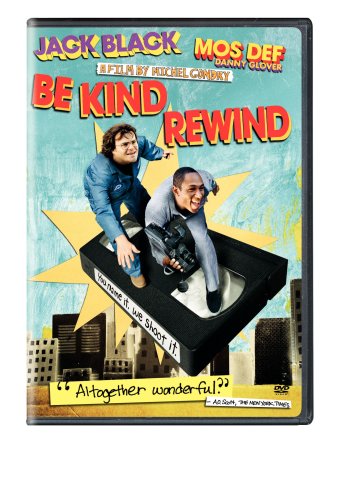
My earliest recollection of VCR’s was when I was just a little boy and my parents went down to the local TV shop and purchased a Zenith for about $600. At the time, it was a wondrous machine and I can still remember fondly my copies of Ghostbusters or Die Hard and how many times I would watch them. I didn’t care whether the tapes had a case or which edition of the tape I had. As long as it was the original movie and the tape wasn’t beat to heck I was a happy camper. Times change. I don’t think I own a single VHS tape that isn’t exercise related and my dvds, more than 400 of them are cataloged and cared for to the utmost degree. In truth, I sometimes miss the VHS days when things were simpler & films sold on the film alone, not on how many extras the dvd has or how fantastic the Dolby Digital 5.1 sound is. Be Kind Rewind goes back to that simpler time and gives a movie that is more about substance than the tiny snap case it comes contained in.

Fletcher (played by Danny Glover) owns a VHS rental store called Be Kind Rewind on a corner lot in Passaic, New Jersey. The place has history claiming that legendary jazz musician, Fats Waller was born in the very store. But business has been in decline and now town officials wish to demolish the building and replace it with a new complex. However, they give Fletcher the chance to bring the place up to code. Fletcher decides to research a more successful DVD store and see what makes it tick. He leaves the store in the hands of his best (and only) employee Mike (played by Mos Def). On the train, Fletcher leaves Mike one last note scribbled backwards on the glass that reads “Keep Jerry Out”. Mike can’t decipher the message as the train speeds away.