2.35:1 Widescreen

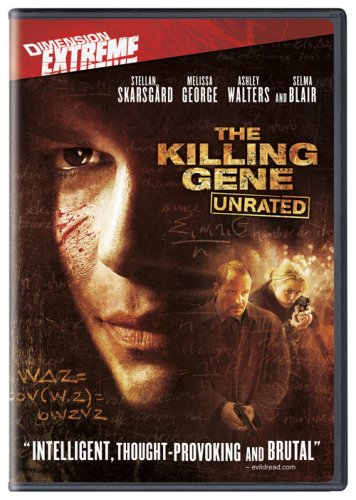
What is love worth? How much pain would you endure before you would murder someone you loved to end it? In The Killing Gene our serial killer seeks these answers, reducing it all down to an algebraic equation. The film is actually the American DVD release titles for the British film WAZ or W Δ Z depending on the source. This title refers to the killers equation which translates to roughly W Δ Z = COV. It’s a rather odd indy looking piece, filmed in Belfast (doubling for the streets of New York) with a mostly British cast and crew.


There's much ado on the case's copy that this was a major inspiration for Crouching Tiger, Hidden Dragon, and the similarities are hard to miss. Like Ang Lee's film, this 1966 effort is a lush period piece with gorgeous, rich colours and elaborate wire work. And, as in the later film, the central character is a female warrior, in this case an officer of the law sent to rescue a kidnapped victim from a clan of ruthless (but not always terribly bright) bandits. There’s a male aid here, too, in the form of an apparent drunken bum who is, of course, in reality a martial arts master.


There is a lot of pleasure to be had here, and the film has considerable charm, though some viewers might be put off by the sometimes jarring juxtaposition of silly, knockabout comedy and harsh violence. Modern viewers might also be a bit disappointed in the fight scenes, which don’t have the grace of the later movie, and they can also be very brief. Nonetheless, a good time at the flicks.

Welcome to Gino’s school of film art. Today I’m going to teach you how to make a modern art film. You know the kind. The type of film that no one really likes, but a lot of folks pretend to like because they think it makes them look cool. Just think how cool you’ll look when you can make one of those pretentious pieces of crap and watch phony critics go on and on about how brilliant it was. Meanwhile you laugh your behind off and cash in on the phony baloney. You might even grab yourself a film festival award, which along with $5 will get you a coffee at Starbucks. Follow these quick and easy steps and pretty soon you’ll be the talk of the town… Tinsel Town, that is. Movie stars. Swimming pools.


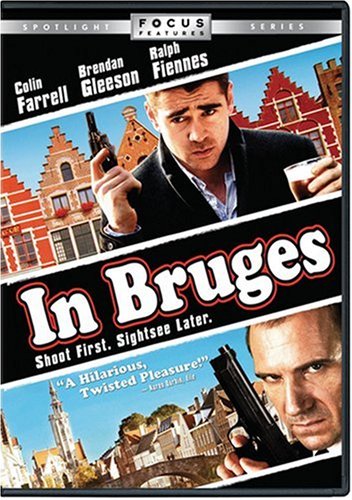
According to Wikipedia, Bruges is the capital of Belgium and home to the college of Europe. Much of the architecture from the 12th and 13th centuries is in good shape and preserved fairly well. The Church of Our Lady is one of the tallest brick buildings in the world. The Basilica of the Holy Blood purports to be a church that houses some blood from Christ. It also serves as the backdrop for a couple of hitmen who have to find comfort in the town for awhile in the film set in Bruges, called In Bruges.

The film was written and directed by Martin McDonagh, whose previous work was in the Oscar-winning short film Shooter. Ray (Colin Farrell, The Recruit) and Ken (Brendan Gleeson, Kingdom of Heaven) are forced to stay in the town for two weeks, after an assassination assignment given to Ray turns particularly brutal. The two look at this presumed exile in two different ways; Ray thinks of it as purgatory; he loves the lifestyle of London and access to anything he wishes. Ken rather enjoys it. He views it as an opportunity to enjoy a place he’s never been before. The nuances of Bruges are also memorable; aside from a little person in a movie and a drug dealing local named Chloe (Clemence Poesy, Harry Potter and the Goblet of Fire), the film is chock full of hilarity and hijinks. When Ken and Ray’s boss Harry (Ralph Fiennes, Schindler’s List) comes to meet with the boys, things take a bit of a dramatic turn.

It’s not that these fantasy-epic films that feature a young child in the starring roles bore me, it goes to the larger notion that Hollywood will remake every child’s fantasy novel into some sort of cinematic product, so a buck or two can be made. For every Harry Potter, there’s a Golden Compass or even Spiderwick Chronicles. The well is rapidly running dry, and you needn’t look much further than The Seeker: The Dark is Rising, a film about a young lonely boy who finds himself in circumstances and an adventure beyond what he might initially suspect. Wait, doesn’t that sound like EVERY children’s movie lately?

The novel was written by Susan Cooper and edited by John Hodge, who did Trainspotting, of all films, and was directed by David Cunningham (To End All Wars). In this, Will (Alexander Ludwig, Race to Witch Mountain) plays the youngest in a family of six Americans who have moved to London for their father’s job. He soon finds out about his real roots, continuing a lineage of warriors, protected by the old ones in Miss Greythorne (Frances Conroy, Six Feet Under) and Merriman Lyon (Ian McShane, Deadwood). No other performers from HBO television series were involved in the making of the production.

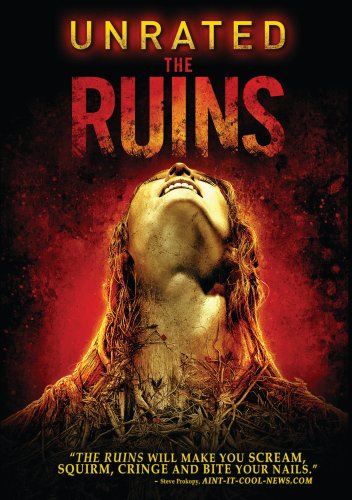
When The Ruins opens, it doesn’t look quite so promising. We’ve got two American couples sharing a vacation in Mexico. They’re reaching the end of their stay and are getting a tad bored with the sun and surf. Enter the foreign stranger who happens to have access to a secret archeological dig and invites the foursome along. Immediately I begin to suspect I’ve seen it all before. I figure the guy’s going to lead them to some isolated torture garden where sadistic maniacs will have their way with the tourists. As the stranger leads them further and further into the isolated jungles, my suspicions are getting that much stronger. When they arrive to find a Mayan pyramid, I’m starting to think that this just might be something different, after all. The group is greeted by some locals who don’t exactly roll out the welcome wagon. They kill the “red shirt” in the group, who we never really got to meet, and herd the group up to the plateau atop the temple. The locals surround the structure and appear unwilling to allow them to leave. At the top they discover the stranger’s brother, who was the one working the site, dead. They discover a shaft that goes deep into the heart of the structure, where they hear what sounds like a cell phone ringing. Attempts to reach the phone don’t go very well, and before long two of them are wounded. That’s when the fun starts. The vine is attracted to the blood and begins to invade the wounds. Before long it becomes clear that the locals weren’t herding them to attack them, but to quarantine them because they had touched the vine. The film allows for some clever moments as the survivors contend with the ancient creature.


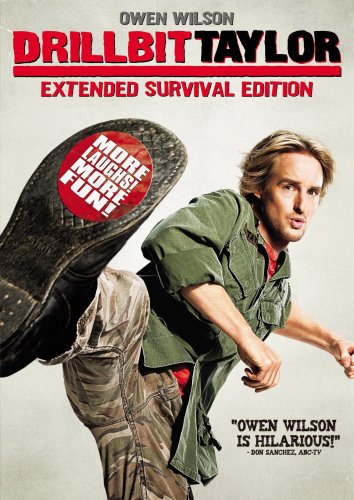
I don’t know what it is about Owen Wilson, but whatever film he’s in he seems to be playing himself. The soft-spoken, rather glib personality has taken him places over the years, but you have to ask yourself if he’s ever going to actually take any risks. Drillbit Taylor is no more a stretch for the actor than any of these other roles. What that means for us, the viewers, is that we’re sure to get a solid and quite believable performance. We know that we’ll end up warming to Wilson’s character in spite of the various flaws we are apt to discover along the way. If Wilson does anything well, it’s redemption. You get the impression that a lot of Wilson’s lines are his own. Whether this is simply a case of a writer having great feel for his star or Wilson changing things up is anyone’s guess, but I’d put my money down on the latter.


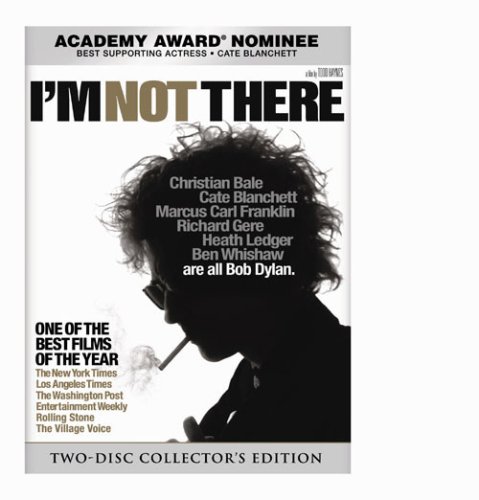
Todd Haynes continues to dazzle and amaze with his body of work. In Velvet Goldmine, he told the story of a fictitious glam-rock band in David Bowie/Ziggy Stardust style. Far From Heaven found him taking the Douglas Sirk films of the ‘50s into a nontraditional turn. In his follow-up film I’m Not There, his first directorial effect in five years, Haynes examines the persona and essence of Bob Dylan without actually really using the name or the words together at all in the film in a film released in 2007, where features like No Country For Old Men and There Will Be Blood earned a slew of awards, I’m Not There was an understated gem, and yet summing it up is a little difficult.

First off, while I’m Not There is a film inspired by the life of Bob Dylan, semantically it’s not a biopic. It examines the more notable images created by Dylan; one of the adolescent who portrayed himself to be the poor white kid who liked the work of Woody Guthrie and who, ironically enough, is named Woody (Marcus Carl Franklin, Be Kind Rewind). Arthur Rimbaud (Ben Whishaw, Layer Cake) is the mid-‘60s Dylan and de facto narrator whose words appear to be lifted from magazine articles of the era; Jack Rollins (Christian Bale, Batman Begins) is the folk hero and later born-again Christian-era Dylan; ironically Rollins is played by Robbie Clark (Heath Ledger, Brokeback Mountain), who watches his marriage deteriorate while he deals with the period of fame he has wrought; and Cate Blanchett (Elizabeth) plays the electric Dylan, touring in England, addicted to pills and alienating his acoustic fans. In his later years, Billy the Kid (Richard Gere, Pretty Woman) plays Dylan as the aging anonymous hero in the west, which in a way Dylan seems to want to do in reality. While none of these interpretations can be claimed to be accurate, they are, as Haynes says, fleeting glimpses of the image that Dylan created for himself. Using surrealistic and style choices influenced by Fellini and Goddard, Haynes helps make the worlds of Dylan all the more emotionally affecting.

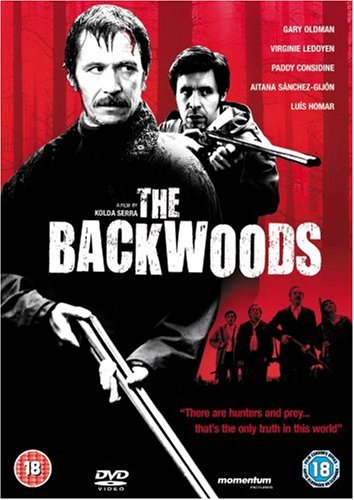
Call it Deliverance meets Texas Chain Saw Massacre by way of Straw Dogs. Really that’s the best way I can describe this incredibly derivative film starring Gary Oldman. It’s Summer in 1978 and two couples are making their way to an isolated vacation house in the woods. The house is the ancestral home for Paul. The four are traveling from England to Spain where Paul impresses the locals with his ability to speak Spanish. More importantly it’s his ability to understand the language as they were insulting the group intending for them to be oblivious to the slights. The location is quite off the beaten trail and the four must abandon one of their cars and pool in Paul’s Land Rover to reach the house. The men are looking forward to doing some hunting and maybe getting away from the women. You get the sense early that each of the couples is experiencing some tension in their relationships. On their first day hunting the guys stumble upon what appears to be an abandoned house. Inside they find a young girl chained to the floor. Fancying themselves as a pair of knights in shining armor they “rescue” the girl and bring her back to their house. From there the trouble starts. The girl has deformed hands, a prosthetic effect and is simply laughable on every level. The locals consider such things in typical superstitious terms and want the girl returned. What we get for the rest of the film is a lot of running from men in shotguns and an almost senseless attempted rape on one of the woman by a local.


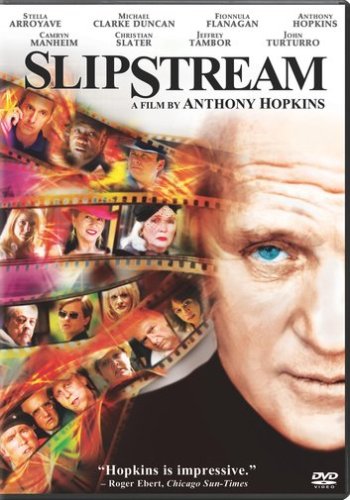
Hannibal Lechter is running the show, and even if it is his alter-ego Sir Anthony Hopkins who�s at the wheel of this ride, it could just as easily have been Hannibal the Cannibal pulling the strings. Hopkins is a literal one man show. He wrote, directed, composed the score, and starred in this abysmally horrible film. I wouldn�t be surprised if he pitched in on a couple of coats of paint here and there as well. One man ego driven artistic films are often messy, but Slipstream goes far beyond messy. It�s an impossible film to watch. By the time it was over my head hurt so bad I thought I�d just been beaten over the skull with a two by four for the entire hour and a half. Some will call it art and praise it, either because of the respect Hopkins carries, or because they�re simply too afraid to admit they hated it. If you say you loved this film, you�re lying. The entire running time is nothing but a merciless assault of disconnected images, erratic cuts (as many as dozens in a minute), endless chatter, and an overindulgence of cinematic style over substance. The film makes David Lynch look tame by comparison.

�