




“One … two … Freddy’s coming for you, three … four … better lock the door, five … six … grab your crucifix …”
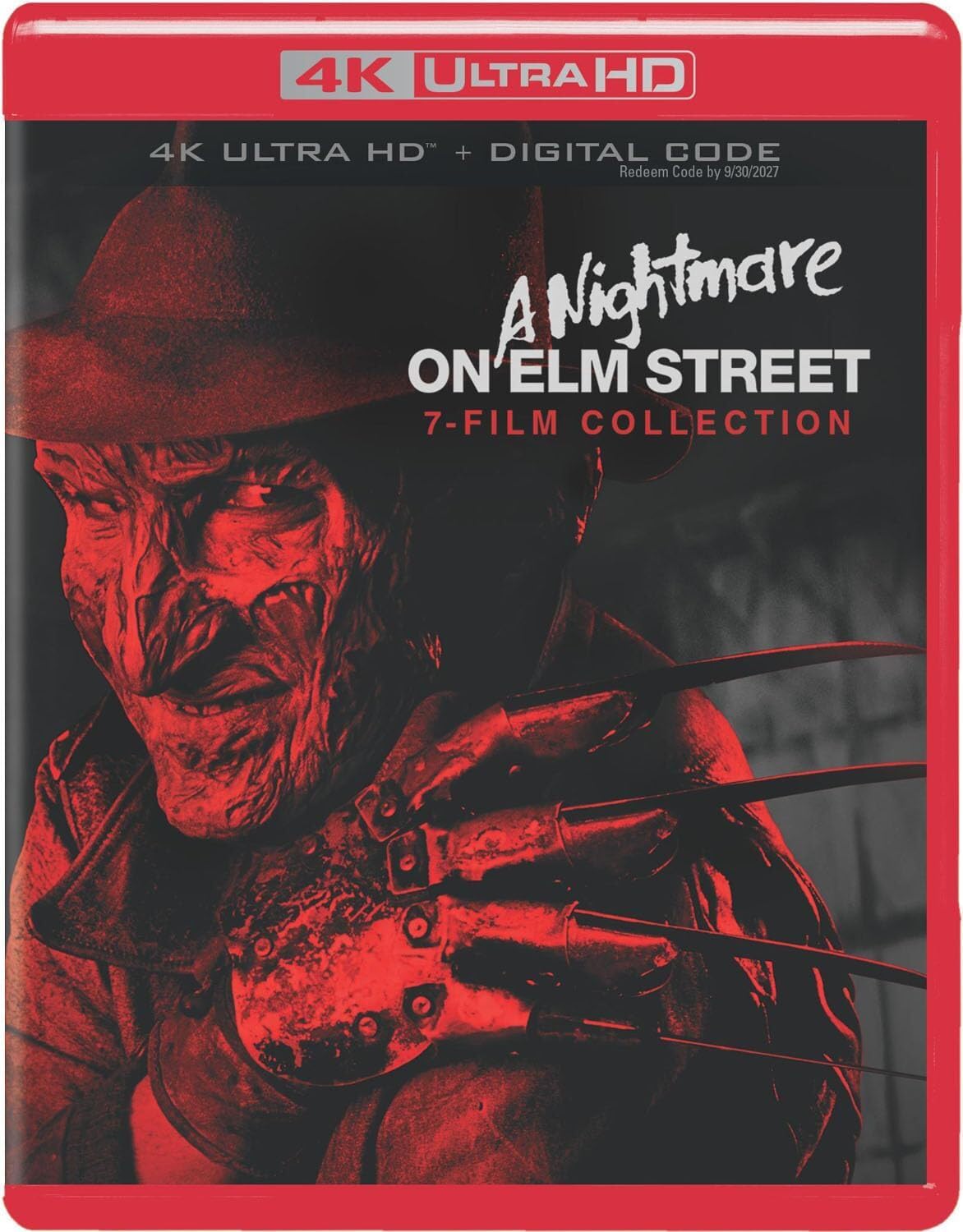
Freddy might have been born in the mind of Wes Craven, but he grew and developed in the knife-wielding hands of Robert Englund. Granted, not all of these films are equal in quality, but the first was everything you could ask for in a horror/slasher film of the era. Freddy himself is by far the most colorful and animated of the slashers. His burned face, fedora, striped sweater, and knife-blade glove were all integral parts of the wise-cracking maniac. Now Warner Brothers has released the original seven films on UHD Blu-ray in Ultra High Definition. It’s a dream come true … well … at least a nightmare come true.
A Nightmare On Elm Street (1984)
You know the story already, so I’ll stick the main idea. Freddy was a child molester and killer before the parents of Elm Street decided to burn him to the ground in a boiler room. Good home-style justice goes wrong when Freddy reappears in the nightmares of the children of Elm Street. He has become a demon of sleep, where he is able to manipulate the world into the most terrifying images possible for his victims trapped by their own slumber.
What was just as iconic as Freddy himself were the fabulous dreamscapes that were his domain. Unlike the other slashers of the time, Freddy didn’t operate in some dark place out in the real world. No lake campgrounds or quiet any town streets here. Freddy created a domain of pure evil and hell inside the dreams of his victims. Here there were no rules of physics. Reality was whatever the dark corners of the human mind could conjure. It was a land of endless possibilities, and Freddy was king. He could manipulate these dream wonderlands to his own brutal purposes. Some of the most memorable scenes in the franchise can be found in the sleep world of Freddy’s intended victims. Who can forget the stretching arms in the alley with those knives sparking against a metal wall? An incredibly vivid and bizarre look is what this dreamland brought to the movie and its sequels. This film doesn’t have the hell playland kind of sets that later films would employ, but Freddy’s boiler room has a fanciful, yet stark reality that creates superb atmosphere. It’s a very sweet treat indeed to be able to finally see those images in high definition. I’d love to see the entire series get the 4K treatment sooner rather than later.
There should be some talk about the cast of A Nightmare On Elm Street. Of course, it all begins with Freddy himself and the incredible Robert Englund. More than any actor of this genre, Englund created a real character that relied more on who was playing him than any of the others. In fact, various actors ended up playing the likes of Jason and Michael Myers during even the original runs. But Englund gave life to Freddy and continued with the character through all of the sequels. It makes me just a bit nervous to think about the current remake and having someone else, for the very first time, fill that fedora and sweater. John Saxon delivers as the police lieutenant whose own culpability in Freddy’s demise makes his daughter one of the killer’s intended targets. He carries just the right amount of determination tinged with that nuanced look of guilt and regret to make us understand the situation with that much more clarity. Heather Langenkamp is an unusual and effective choice as the primary representative of the victims. She’s not the typical great-body-survivor chick. She’s far more everyday girl than you ever see in these things. She manages to make it that much more real for us. Finally, you just can’t talk about the cast without a mention of one of the kids that is here purely to get knocked off. This would be the very first movie for future superstar Johnny Depp. Yes, that really is a teenage Depp getting swallowed by his bed. He would later make a cameo on the sixth film as a guy on the television. I think you can say that Depp has come a long way.
Ain’t nothing like the real thing, baby. It was such a treat to have the original in 4K. I was never happy with the remake, and as good of an actor as Jackie Earle Haley really is, he’s just no match for Robert Englund. Of course, Englund is much to old to ever do it again, but I think I’d take an old Englund over any young whippersnapper the studios might be tempted to pull out. Jason and Michael are well hidden and rather stoically violent. Freddy has a strong personality that can’t be recreated. It’s why this film alone from all of the slasher franchises just hasn’t been remade after the first and only attempt. “It is now twelve midnight, and this is station KRGR leaving the air.”
A Nightmare On Elm Street 2: Freddy’s Revenge (1985)
“We have special work to do, you and I. You got the body. I got the brains.”
Robert Shaye, the leader of New Line Cinema, was about to make the biggest mistake of his career. When it was decided to do another film, he decided Robert Englund wasn’t worth the money he was asking and thought any stunt performer could play Freddy. So he turned Englund down, and the movie started filming without Englund or creator/director Wes Craven. It took only two weeks for the mistake to be so obvious that the stunt performer was fired and Englund brought back for everything he wanted. You can still see that performance during the locker room scene where the coach gets it. It’s still the first guy, and they didn’t go back and refilm it. Still, Shaye’s mistake about not trying harder to get Craven turned this into one of the two worse films of the franchise. It did well because we just couldn’t get enough of Freddy, but it was pretty much a disaster.
The story found Freddy looking for revenge for his treatment in the first film. With the help of Jesse Walsh (Patton), Freddy leaves the dreamworld and creates a kind of spiritual takeover of Jesse. It leads up to a pool party scene where Freddy crashes and goes stomping around killing and creating general mayhem. Jake Sholder, who also did the 1995 remake of The Omen, and writer David Chaskin completely threw away any of the rule book that Wes Craven had set up. The film meanders and becomes the senseless gore-fest that so many of the classic films have had to live with. This is more of a possession film than Nightmare On Elm Street piece. It’s forgettable. Or maybe the problem is we can’t forget. “Everybody has bad dreams.”
A Nightmare On Elm Street 3: The Dream Warriors (1987)
“Freddy’s Home”
Indeed he is. That’s because Robert Shaye paid for his previous mistakes and brought back Wes Craven, who brought the old band back together again. Wes did not return to direct because he had another commitment, but he did supply the story that would be the huge win for the franchise. He brought back Nancy, played by Heather Langenkamp, and John Saxon as her father.
Nancy’s experience turned her to study dreams and get a degree. She is now joining a facility that houses troubled teens, and there are a growing number of them who are killing themselves, at least that’s what most people think. She convinces the staff therapist, Neil (Wasson) that she has an understanding of why these kids are afraid to sleep. She believes them and their stories about Freddy. She should know … right? The cast is also made up of a stronger collection of characters than you usually see in these environments.
Patricia Arquette gets her first feature film role as Kristen Parker. She has an amazing ability to bring others into her dreams. Nancy sees this as a chance to recruit a willing army to take the battle directly to Freddy in his dream realm. In this world the teens have superpowers that reflect their personalities. Kincaid (Sagoes) is a bit of a wise guy, and he has super strength in the dreams. Joey (Eastman) is a mute, but he can talk in the dream realm. Taryn (Rubin) is a wicked-hot weapons expert with an attitude, and Will (Heiden) takes on the magical powers of a wizard master that he takes from his role as a dungeonmaster in the group’s games. While she didn’t live long enough to join the warriors, Jennifer (Sudrow) gets one of Freddy’s best lines in the series. She wants to be a television star, and when she falls asleep in the television room, she dreams of Dick Cavett interviewing Zsa Zsa Gabor when he turns into Freddy. The television sprouts arms, and as Jennifer’s head is smashed into the television, he gives the adlibbed line: “Welcome to prime time, Bitch.”
This is a very important film for the franchise. We get a deeper story about how Freddy was born here, and it propels the next two films of the series. We learn his mother was a nun who was accidentally locked in a room with 100 criminally insane maniacs who all rape her. So Freddy is the child of a 100 maniacs, and that explains things. Craven once again steps in and sets the franchise on a quality path.
The film also sees an early role for Laurence Fishburne, who plays an orderly. Priscilla Pointer would become the oldest living member of the franchise until she finally passed away at 100 years of age. She plays the head of the facility and a bit of a foil for Nancy and the team, because she doesn’t believe any of this stuff. But we do, don’t we? It’s all because Wes Craven set the ship right once again. “You won’t make any progress until you recognize your dreams for what they are.”
A Nightmare On Elm Street 4: The Dream Master (1988)
“You shouldn’t have buried me, because I’m not dead.”
It looked like Freddy was finally dead and gone after the third film. Craven gave us a mythology and a way of killing him by putting his remains in consecrated ground. That might have been it until a dog, conveniently named Jason, pees some fire on his grave. Now Freddy’s awake, and he’s not happy. The film fell to Renny Harlin, who wasn’t very well known in that time. He simply pestered Robert Shaye until he gave in. Harlin was living out of his van at the time. Harlin would go on to make some huge movies, and he had made a couple before. But after his dabble in the Freddyverse, he never looked back. The same was true for New Line Cinema. While Freddy had twice saved them from going under, this time the money made put the studio on the map. They want from tens of employees to hundreds and became a studio big enough to take on the Lord Of The Rings films with Peter Jackson. Fans of that franchise owe it all to Freddy. Imagine that.
His first order of business is to take care of the surviving Dream Warriors. The cast return just to get killed off. The notable exception was Patricia Arquette, who did not return as Kristen. Tuesday Knight takes on the role and also provides the film’s soundtrack with some songs. She doesn’t remain long. As she is being killed, she reaches out to Alice, played by Lisa Wilcox, and gives Alice her powers. Of course, Alice has no idea what just happened, and the Looking Glass metaphor is played out for all it’s worth. She discovers her powers only after she has been unwittingly feeding Freddy with her friends by using the power.
Harlin really became the first director in the series to follow his story immediately after the film before it. So Wes Craven might be gone again, but those threads he put down are still playing out, and this is a surprisingly strong entry for a fourth part of a film franchise. “This isn’t a normal nightmare.”
A Nightmare On Elm Street : Dream Child (1989)
“Faster than a bastard maniac! More powerful than a loco-madman! It’s … Super Freddy!”
Alice and Lisa Wilcox return to the franchise. This time Lisa is with child. Because an unborn child sleeps like all of the time, Freddy is almost always on. While he appears to leave the dream realm, he doesn’t really, as we learn about the child. Now Freddy is using the child not only to reach the kids he wants to kill, but he hopes to be reborn in the child’s body so that he can return to the awake world.
This film does give us some Freddy mythology moments. We see acted out the rape of Amanda Kruger (Boepple). Amanda is also kind of haunting Alice. This time her remains must be found in order to put a stop to Freddy’s plan. This film contains some of the best animation stuff including some stop-motion and hand-drawn animation. It shows off the biggest budget to this point, and this is where New Line Cinema’s own growth is reflected in the franchise. They put some real money behind Freddy this time, and it shows on the screen. Stephen Hopkins takes the director’s chair this time. He was coming from a career directing music videos, and this film is often called the Freddy MTV film. “Just another trip down memory lane with my friend with the funny hand.”
Freddy’s Dead: The Final Nightmare (1991)
“No screamin’ while the bus is in motion.”
What really killed Freddy was another really bad film. This one was rushed out because they had just seen more money in the last film than any Nightmare before it. I think by the time this film came out, it really was intended to finish the franchise, at least for a good long while. Even Robert Shaye was aware they were doing them just to do them and actually apologized to the fans for letting the greed get the better of the studio and the franchise.
The film takes us back to an institutional setting where kids who are getting in trouble with the law are starting to fear their dreams. Meanwhile a John Doe (Greenblatt) is the last of the Elm Street children. He tries to escape, and Freddy kind of lets him go so he can fetch new children to taunt and haunt. He ends up at this juvie facility where “Doc” studies ancient dream legends and knows of entities like Freddy. He’s played by future Homicide: Life On The Streets captain Yaphet Kotto. He’s pretty much underused here as several of the students break out on an adventure that takes them to Freddy’s house while John Doe is with facility sympathetic girl Maggie, played by Lisa Zane. Freddy does his thing, and characters here are just fodder for Freddy. The film employed a 3-D Freddy demise, and you can access that version with a single pair of cardboard glasses in the release.
It was directed by Rachel Talalay, who had acted as producer on the franchise for years and was starting to work with John Waters .This would not be a proud moment in her career, and it pretty much looked like the franchise had finally run out of steam. But do you want more? “Of course you do.”
Wes Craven’s New Nightmare (1994)
“Just when you thought it was safe to get back to bed.”
New Nightmare is hands-down the best of the sequels to the franchise. As the name suggests, Wes Craven is back, and he breaks the mold. The film would be clever for its time. Today the idea has been done to death with the Scream franchise, and this is where Wes Craven first flirted with the ideas that would make that series of films so popular.
The idea is so simple it’s diabolical. Wes Craven is writing a new film for the Nightmare On Elm Street franchise. Meanwhile Heather Langenkamp is having nightmares, very much like her character Nancy has had in the films. It turns out Freddy is real, and he scares Robert Englund so much he splits dodge to parts unknown. Heather is trying to protect her son Dylan from the wrath of Freddy.
In the film the actors get to play themselves, and it’s quite a refreshing film. It runs longer than any other entry at nearly two hours. Wes Craven brings us full circle, and you can relive it all here in UHD. Ten years. Seven films. “What a rush.”
I know that fans of the franchise have bought these movies in so many formats already. It was released at the forefront of the home video market, a business New Line was pioneering at the time. That means you could easily have this movie on VHS, Laserdisc, several DVD’s, Blu-ray, and now in 4K. I won’t argue that each new release was necessarily a huge enough upgrade to warrant the extra dip into your wallet. But this might well be the definitive release. It’s very hard for me to imagine it ever looking or sounding better. Of course, Freddy was always about the imagination. So, who knows? I’d take the chance and spring for this one anyway. It’s the stuff dreams, or at least nightmares, are made of.
Video
A Nightmare On Elm Street returns to its original aspect ratio of 1.85:1, and all of the others are in their original aspect ratios. Let’s talk about the first film, and much of it will apply across the board. The previous Blu-ray release gave us a matted 1.78:1 aspect ratio. I’m happy this release takes us back to the intent Wes Craven had when he shot the dang thing. The ultra-high-definition 2160p image is arrived at by an HEVC codec with an average bitrate of 65 mbps. The ultra high definition gets most of its bump from textures in the details. This is a very textured world, and the UHD release is far more accurate in those fine details. This is one hell of an exotic world at times, pun intended. I’ve watched this film several times, including more than once during its theatrical run. I’ve never before had quite this kind of look at the incredible set design and special f/x on this film. Then there’s the wonderful burned face of Freddy himself. You won’t have had a better look at the details of the scarred countenance than you had by watching the high-definition Blu-ray release. The HDR gives a bump to it all. One of the most obvious color and detail points is the color of Nancy’s eyes. I never before realized how blue they were. Rather sweet detail. Freddy’s iconic sweater has far more texture detail. Black levels might not be exceptional, but they work when they need to work. Certainly, the film’s age and limitations are just as easy to see here. But somehow it all worked together to create some fine atmosphere here. This was a visual presentation worthy of a classic horror film. Remember this was shot on film, and that means it’s native 4K. I’m happy to report that the grain was not washed completely away with DNR. There is some evidence of its use, but the organic nature of the film elements remain.
Audio
The Dolby Atmos audio presentation defaults to 7.1. Anything more would ruin the atmosphere of the original film. It would be a mistake to try and expand the audio field. The dialog and the wonderful Henry Mancini score come through just fine. There’s no distortion, and a clean audio presentation is all I’m looking for here.
Special Features
No Blu-ray copies of any of the films here. Most of the extras are ported over from the Blu-ray with extras made around 2010. On the final disc there are two 8-minute brand new interview clips with Robert Englund and two of the earlier sequels.
Final Thoughts:
Here’s the thing: either you love Freddy or you hate him. Entering Freddy’s world is like one giant haunted house at your local amusement park. There’s enough going on that you can usually see new things on repeated viewings. Maybe what makes this series more effective than some of the others is the material itself. We can all try to avoid the creepy places and people in life, but we’re all prisoners of our dreams. It’s the one place where we are a captive audience. Invite Freddy, and you never know what’s going to happen. “Nine … ten … never sleep again.”
