“Well, gentlemen, in my opinion, if we send him back to Pendleton or we send him up to Disturbed, it’s just one more way of passing on our problem to somebody else. You know, we don’t like to do that. So I’d like to keep him on the ward. I think we can help him.”
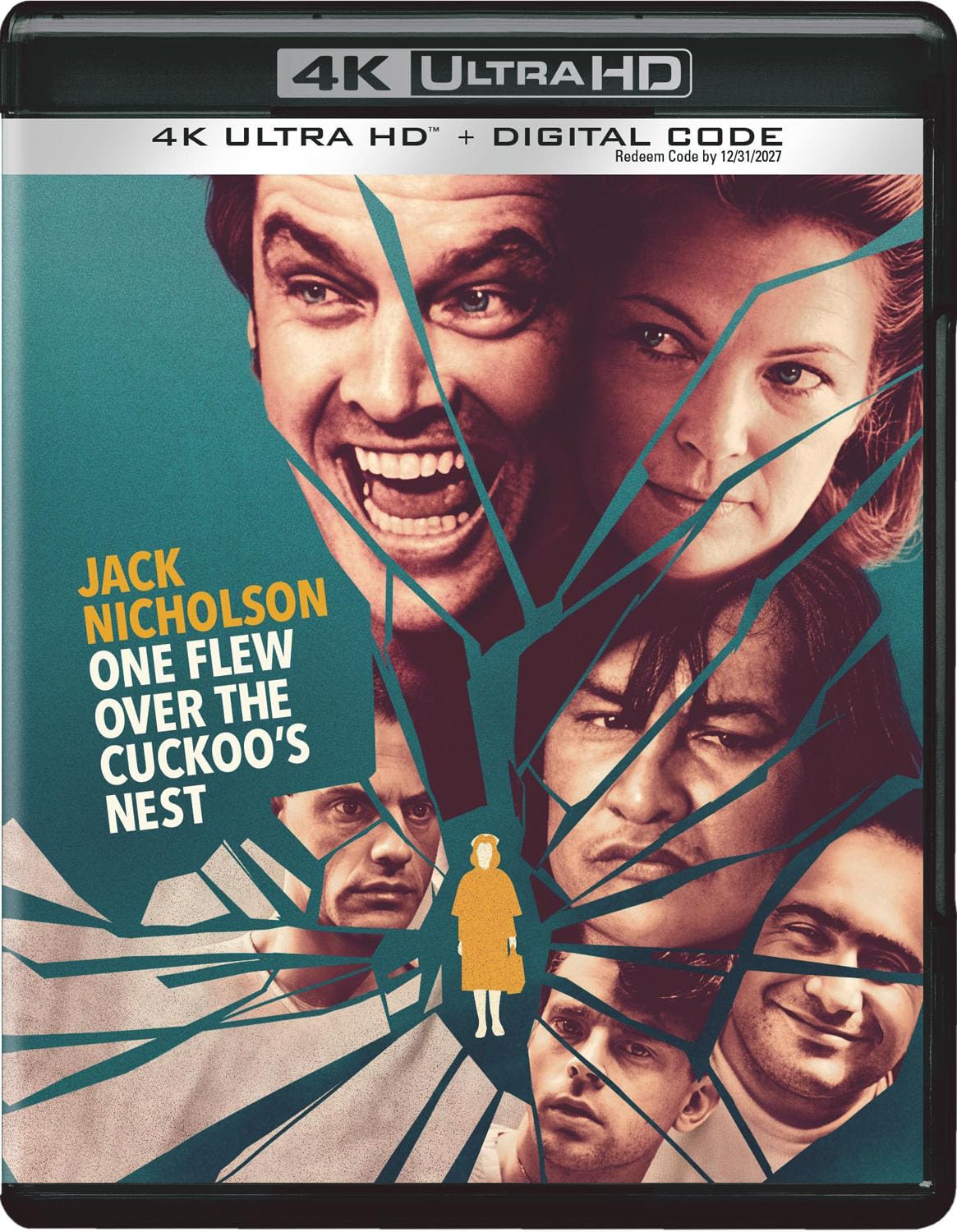
One Flew Over The Cuckoo’s Nest was the first movie I ever saw on HBO. These were the very early days of the cable network. It was before the dawn of any real home video. It was at my Aunt Shirley’s house that several members of the extended family gathered in dining room chairs around a 19-inch television to watch a movie uncut and without commercial interruption for the first time in our lives. A lot has changed since that 1970’s afternoon at my aunt’s house. Today we have hundreds of such choices on our television dials. I’ve seen a huge wave of home video technologies since that day that have included CED video discs, VHS/Beta, laserdisc, DVD, high-definition Blu-ray and now on UHD Blu-ray in glorious 4K The entire game has changed since that gathering 50 years ago. One thing has not changed a bit. One Flew Over The Cuckoo’s Nest was a dynamic and compelling film that day. It remains so today.
R.P. McMurphy (Nicholson) is a repeat criminal who has caused more than his share of trouble in the system. He is sent to the Oregon State Hospital to have his sanity evaluated. There the head psychiatrist Dr. Spivey (Brooks) doesn’t really think he’s crazy. But McMurphy is held over for observation. He’s placed inside a general population ward where he comes into contact with the resident “crazies” of the hospital. He takes a particular liking to Billy (Dourif) who is a sexually repressed teenager who stutters and lacks any kind of self-confidence. In a big way, he is the opposite of McMurphy himself, who is quite the extrovert and borders on manic most of the time. There is an Indian man who is about as big as a mountain who the staff and inmates simply call Chief (Sampson). At first Chief is the subject of mockery from McMurphy, but the allegedly deaf and dumb Indian soon earns McMurphy’s respect, something we quickly understand is a rarity for McMurphy. Other patients include the childish Cheswick (Lassick), the shy and naive Martini (DeVito), the borderline psychotic Taber (Lloyd), and Harding (Redfield) who was pretty much the crew’s unofficial leader before McMurphy came along. In charge of the ward is the indominable Nurse Ratched (Fletcher). A battle of wills soon develops between McMurphy and the cold nurse. What McMurphy doesn’t know is that she has the power to keep him even after his original jail sentence has expired.
One Flew Over The Cuckoo’s Nest has about as storied a history as any film made in the last 50 years. The book was written in 1961 by Ken Kesey. It was immediately controversial. It didn’t help that the author himself was a self-admitted drug addict who was high while he wrote a good deal of the book. But that didn’t mean that the story wasn’t a powerful one. It shone a light on the mental-care industry from a man who had worked in the field himself. One of the early admirers of the book was Kirk Douglas, who got a copy of the manuscript while it was still in galleys. He quickly obtained the rights and turned it into a Broadway play where he played the part of McMurphy. The play only lasted three weeks but had stirred up quite a buzz. That was fine with Douglas, because he had always intended it to be a film anyway. Unfortunately, he couldn’t find financial backing, and there wasn’t a studio out there willing to touch the property. After 10 years of trying, he gave up on the whole idea.
Enter his son Michael, who was just starting his own acting career on television with the popular Streets Of San Francisco. Michael was also very intrigued with the story and asked his father to let him have a crack at getting the thing made. He decided to go with private financing and partnered with Saul Zaentz to produce the picture. They hired Kesey to write a screen adaptation of the book. But Kesey was still very much in his drug days and created a film that showed the Chief having weird hallucinations throughout the film. I guess we all know which character the author identified most with. The author had a rather messy split with the producers, who went in a more conventional direction.
Once there was a script, the film had to be cast. Both Gene Hackman and Marlon Brando turned down the part of McMurphy. It was then that the producers and director Milos Forman came up with the idea that they wanted a known name, but maybe not so much of a big star. That was much of the concern of studios and investors when Kirk wanted to do the lead role. At the time Jack Nicholson had established himself as a solid actor and was just ready to break out into another level of stardom. One Flew Over The Cuckoo’s Nest would become that break-out role for the eccentric actor. Danny DeVito came about his supporting role because he had been a long-time friend of Michael Douglas. The two are still the best of buddies today. The final piece of the cast puzzle was The Chief. Apparently large Indians are not so easy to come by. Will Sampson was a criminal who had just gotten out of jail for “borrowing” a horse that didn’t belong to him when he was discovered by a car salesman hired by Douglas to locate a large Indian.
Still, it’s Nicholson’s incredible performance here that makes the cast what it is. Many have admitted that it was easy to just react to Nicolson’s antics and methods as their characters would to McMurphy. It took the actor out of his laid-back reputation and made him one of the most animated actors of our time. You wouldn’t be quite so surprised at his turn as The Joker after watching him play McMurphy. He doesn’t get near enough credit, because he makes it look so easy and natural. One falls into the trap that he isn’t acting, the performance is so seamless.
Finally, the movie was ready to shoot. The location would be that last hard-fought piece to fall into place. Douglas had always intended that the film be made at the real Oregon State Hospital, but ran into considerable opposition. There was fear, not entirely unfounded, that the movie might make the institution look bad. Fortunately, the supervising doctor, Dr. Dean Brooks, would fight to have the film made there with some conditions that included the hiring of many of the inmates as extras and technical craftsmen on the film. Dr. Brooks himself would snag the role of Dr. Spivey in the film. His staff would also act as the other doctors on the film. So the cast and crew practically lived in a wing of the hospital. The dressing rooms were actual cells, and many of the cast members would sleep there rather than go home for the short respites between shoots. Nicholson became the manic leader of the actors and was found to be as vocal and protective of them as McMurphy was. Even Louise Fletcher was kept at an arm’s length from the boys to maintain that detached coldness in front of the cameras. Dr. Brooks also ended up bringing the cast and crew some tragic news. Acting as the film’s medical doctor he diagnosed actor William Redfield with leukemia. The production stalled a bit as Michael Douglas and his team had to decide if they should recast the part and reshoot the actor’s scenes as Harding the inmate with wife issues or hope that Redfield could finish the work. He was given 18 months to live by Brooks and he was so good in the part, as was everyone here that they stuck with him and he survived to see the film released. He died almost 18 months to the day of his diagnosis. If he had not been diagnosed at that time it’s likely he would not have had even that much time.
The movie is loaded with symbolism that survives the many drafts and incarnations from the original book. McMurphy was always intended to be a Christ figure. He comes to the ward to bring a kind of salvation to the patients and ends up dying for his trouble. He had the same anti-establishment credentials. Nicholson was made aware of the symbolism and attempted to bring it to life. It’s odd, but in my many conversations about the film, that analogy escapes most viewers. You should watch the movie with an eye to all of the symbolism. It’s loaded.
The film did begin a debate in the mental health industry that brought about many reforms and rights to patients that did not exist in most states before the film was made. It’s almost dated today because of how much the field and the hospitals have changed in the 50 years since the movie was released.
Many of the supporting cast went on to pretty healthy careers. This was Brad Dourif’s first film, which would lead to his wonderful Chucky portrayals and voice work. He had a wonderful turn in The Lord Of The Rings. Christopher Lloyd and Danny DeVito would go on to star in Taxi together where they shared wonderful chemistry. Both have since had very illustrious careers. Lloyd, of course, peaked as Doc Brown in the Back To The Future Films. Scatman Crothers has a small but entertaining part in the film as well.
Video
One Flew Over The Cuckoo’s Nest is presented in an aspect ratio of 1.85:1. The ultra-high-definition 2160p image is arrived at by an HEVC codec with an average bitrate of 65-70 mbps. The ultra high definition gets most of its bump from textures in the details. This is a very textured world, and the UHD release is far more accurate in those fine details. Of course, it was shot on 35mm and is thus a native 4K presentation. The film has an opening tag that informs us that this 2025 restoration was made from the original 35mm negative. You really would not expect to see a huge spike in the image presentation but as I’ve already hinted at the textures are wonderful from the patient clothing to the authentic environments. There are a ton of close-ups and they provide a wonderful look into the nuances of these amazing performances. The natural grain retains the organic look of the film which is so important here. There is some grain removal but I feel there was enough remaining to be faithful to the original film’s intended look and feel. Colors have that 70’s film stock look and it’s faithfully reproduced here. Often there ends up being color correction along with grain removal that often appeals to a younger crowd but not to those that studied film. It looks very much like I remember it did at the movies 50 years ago.
Audio
The DTS-HD Master Audio 5.1 track does a fair job here but there are issues. Of course in 1975 there was no surround sound I feel there are separation issues that aren’t obvious but do impact the sound placement a bit. There’s not anything aggressive here and the audio presentation was also restored but from an earlier surround mix. You might enjoy the stereo track just as well. The characters, as part of their roles often mumble and so you can’t catch everything. They still haven’t manage to overcome the harshness of the ward music coming from the record player as well as “announcements. No question it’s intended to be harsh and that’s part of the authenticity but once they decided to go with surround I think those elements were no longer a good idea. I would have either stuck with the 2.0 Mono or cleaned up those issues if a surround mix was going to be repeated. It’s a judgement call here but I would have gone one way or another.
Special Features
There is only the single UHD disc here. There are a couple of short segments from a virtual gathering of Michael Douglas, Danny DeVito, Christopher Lloyd and Brad Dourif. They share a lot of memories and there’s a lot of laughter and sincere fondness for the experience and the movie all of these years later. I’m happy these new pieces were added.
We also get the feature length Completely Cuckoo ported from the earlier Blu-ray. I would have left it off and taken advantage of the extra bandwidth for the film presentation. It’s a nice piece but I bet you already own it. The original collection of Deleted Scenes are also ported over.
Final Thoughts:
It’s about time that One Flew Over The Cuckoo’s Nest received the kind of clean-up that this release demonstrates. It deserves the attention and careful restoration it finally got. I didn’t find the Blu-ray “restoration” was quite so genuine so Warner Brothers is now giving you a definitive copy of the film just in time to celebrate 50 years. “No man alive could resist that.”