




“Two little mice fell in a bucket of cream. The first mouse quickly gave up and drowned. The second mouse wouldn’t quit. He struggled so hard that eventually he churned that cream into butter and crawled out. Gentlemen, as of this moment, I am that second mouse.”
Frank, Jr. is that second mouse … and then some. Before his 19th birthday, Frank Abagnale Jr. posed as a pilot, doctor, lawyer, and secret service agent in an uncanny crime spree that saw him forging millions of dollars worth of fraudulent checks. This film chronicles the fantastic yet true adventure with large doses of fun injected into the two-and-a-half-hour-long chase.”
Abagnale committed these crimes in a time that was far more trusting than it is now. (In fact, Abagnale would go on to use his skills to boost the security of the currency and checks he took advantage of before.) Whenever Abagnale’s crimes are described, his statistics are read like highlights from a sports star rather than someone malevolent. We do not see any actual victims. Even his nemesis, Agent Carl Hanratty (portrayed by Tom Hanks) eventually gains a lifelong friendship after multiple years of pursuing (and frequently being humiliated by) Abagnale.
Indeed, there is a very interesting dynamic between Abagnale and Hanratty. As much as this film is about a wild chase, it is about a broken home and Abagnale’s search for a fatherly connection. After running away from home, Abagnale constantly attempts to impress his father, Frank Sr. (a wonderful performance by Christopher Walken), but fails to reunite his family the way he wishes to. Every Christmas Abagnale calls Hanratty, and only then displays his weakness and sorrow. Abagnale is surrounded by women, wealth, and partiers, but his only true connection is to an FBI agent who is seeking to place him behind bars. In fact, it is on Christmas, and only after seeing his mother for the first time since he ran away from home, that he finally surrenders to Hanratty.
Outside of the film, we learn the deeper significance of Abagnale’s broken home motivating his actions. Though it kind of darkens repeat viewings of the film to learn this, it is interesting to know that the real-life Abagnale never did get to see his father again after he ran away. Director Steven Spielberg and screenwriter Jeff Nathanson included the fictionalized meetings between Abagnale and his father in order to firmly establish this relationship (or simply the desire for this type of relationship) as a major motivator for Abagnale. This is the only major element in the film that is purely fiction, and this knowledge can help the audience sympathize with Abagnale, because it enforces that idea that he was not motivated by money, but was simply running away from the home life he held so dear which was broken forever.
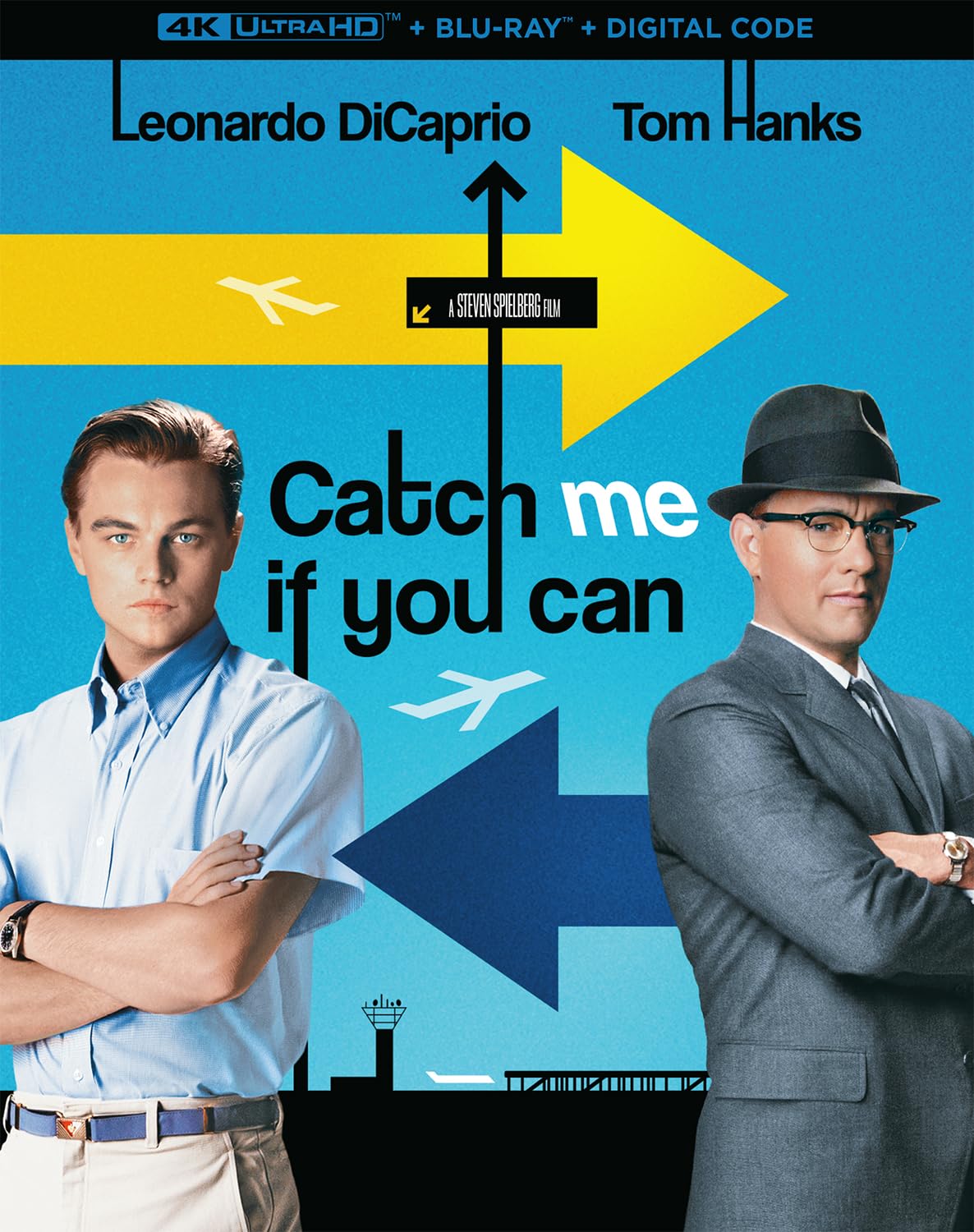
Leonardo DiCaprio takes full advantage of his boyish looks while demonstrating fine acting skills in portraying Abagnale as someone who thrives on roguish charm coupled with a youthful enthusiasm that disarms the audience into sympathizing with a master criminal. This performance is juxtaposed nicely against the stuffy but intensely motivated Hanratty that Tom Hanks offers us. Both actors are able to convey just how obsessed they are with each other (as indirectly as it may be at times, since Abagnale’s obsession with finding fatherly approval is displaced and sometimes set to Hanratty, the only authority figure he bothers to communicate with). Hanratty’s obsession is frequently noted by his attempts to solve the mystery of how Abagnale managed to pass the bar exam and become a lawyer (and the truth is the most entertaining fact the film has to offer).
John Williams’ score is another highlight of this film. Williams takes a step away from his well-known orchestrated scores to create something much jazzier that invokes the work of Henry Mancini, sans Mancini’s level of memorable hooks. Spielberg already did an admirable job recreating the visuals of the 1960s, Williams helps bring us even closer to that time with his delightful musical contributions.
Video
Catch Me If You Can is presented in its original aspect ratio of 1.85:1. The ultra-high-definition 2160p image is arrived at by an HEVC codec with an average bitrate of 65-70 mbps. The ultra high definition gets most of its bump from textures in the details. This film hasn’t really popped in previous editions, and while this is certainly the best to date, it still isn’t quite as good as I hoped/expected. The print isn’t the cleanest, and that surprises me. That means there wasn’t any restoration effort made here. It still looks good, and the Dolby Vision/HDR help make the desaturated period colors a bit more constant. As a period piece, it absolutely captures the necessary atmosphere appearing as 1960’s film stock might have presented the film. But there are better details here, and nowhere is that more obvious than when Frank is studying and honing his craft on checks and documents. That’s the lift here, and since it’s a crucial point of the film, it’s worth the upgrade. Black levels are average and fortunately not often called upon to do the heavy lifting.
Audio
The DTS Master Audio 5.1 track is also a bit of a letdown. An Atmos upgrade would have been nice, but that’s really not a huge liability, because the film is so dialog-heavy, and that comes through fine. Some surrounds kick in, particularly during his airplane escape, but there’s not much needed here. The underrated John Williams score is a bit jazzy and would have benefited from better subs and a brighter audio presentation.
Special Features
The extras are 2-disc DVD and Blu-ray editions released some years back. Among the bonus features there are a few redundancies, but still plenty of interesting points, mostly when involving the real Frank Abagnale Jr.
Behind the Camera: Running over 17 minutes, this is a decently thorough look at the different stages of creation of this film. Mostly we hear how everyone involved was enthralled with this story from the get-go.
CAST Me If You can: The Casting of the Film: The main cast get their own profiles.
–Leonardo DiCaprio: It is interesting to learn here that Leo was the one who started with the film and helped bring it to Spielberg’s attention. If anyone can be credited with instigating its creation, it is Leo.
-Tom Hanks: Spielberg and various actors praise Hanks for his ability to take what seemed on the page to be a supporting role and make it a lead.
-Christopher Walken and Nathalie Baye: Just as he does in the film, Walken steals the spotlight in this mini-feature. His performance in the lunch scene alone is spectacular to behold, especially from behind the scenes.
-Martin Sheen and Amy Adams: Sheen comments on how he can check Spielberg off his list of big-3 directors he wished to work with (Coppola, Malick, and Spielberg). Meanwhile Amy Adams gets profiled as one of the only cast member in these profiles who actually auditioned for her role.
-Jennifer Garner: It may have only been a cameo appearance, but hers was the scene that Leo demanded be returned to the film after it was removed from the shooting script.
Scoring Catch Me If You Can: Williams explains his jazz inspirations for this unique score.
Frank Abagnale: Between Reality and Fiction: Another series of mini-features under one big banner.
–Meet: This enforces the view of Abagnale as a “misguided” anti-hero by retelling his stories in a light, forgiving tone. We also get to see Abagnale on the film set as he continues to demonstrate the extreme confidence and natural charm that got him into this amazing story to begin with.
-Pilot: The real Abagnale regales us with the identical story that is within the film.
-Doctor: It’s amazing to hear how this occurred that allowed this to happen. It was pure luck and moxy.
-Lawyer: Just like his adventure becoming a doctor, a ton of lucky happenstance helped make this happen. There was just the right amount of leniency in Louisiana (especially since you do not need an actual law degree there) that helped Abagnale get in.
–Teacher: In the film, this is only referenced slightly in one scene, but the real Abagnale tells how he pretended to be a teacher simply by staying one chapter ahead of the class.
-Getting Caught: Before he got caught, Abagnale had warrants for his arrest in 26 different countries. The film shows how he was caught in France and spent some time in one of their prisons, but it does not include the fact that he was transferred to Sweden before finally spending time in an American jail. He also expands on his contributions to anti-fraud measures added to checks and various forms of modern currency based on his work with the FBI.
The FBI Perspective: A technical advisor who used to work for the FBI gives tips to the cast and crew. Beyond seeing that for a few seconds, his dry interview doesn’t offer anything entertaining or enlightening.
In Closing: This is basically just everyone from all the previous special features offering their final thoughts.
Photo Galleries: Three different sets that profile the actors, behind-the-scenes, and a costume gallery which has some interesting sketches by the costume designer.
Final Thoughts:
The film stands up almost 25 years later and is one of two Paramount Blu-ray film releases of Spielberg films from 2002. While you’re not going to use this one to show off your system, it’s a nice upgrade in areas, and I think worth the pop for the extra few bucks. Paramount is counting on it.
Parts of this review were written by Gino Sassani
