

“Tell me, O Muse, of that ingenious hero who travelled far and wide after he did sack the famous town of Troy. Many cities did he visit, and many were the nations with whose manners and customs he was acquainted. Moreover he suffered much by sea while trying to save his own life and bring his men safely to their homes; but do what he might he could not save his men, for they perished through their own sheer folly in eating the cattle of the Sun-god Hyperion; so the god prevented them from ever reaching home. Tell me, too, about all of these things, oh daughter of Zeus, from whatsoever source you may know them.” – Homer c750 B.C.
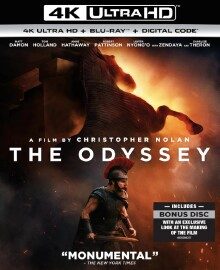
Christopher Nolan has a tell, and he exposes it almost every time he makes a film. He’s not a one-source kind of a guy, and he’s not above creating composite characters or adding a flourish here and there in order to tell a good story. Like Homer before him, he knows how to tell a good story, and while the film is called The Odyssey, it borrows rather heavily from other ancient sources, most notably Virgil’s Aeneid. I’m actually quite on board with the approach, because that’s what Homer beseeches us at the very beginning of his epic poem, The Odyssey. Nolan becomes himself the bard, the teacher … the storyteller. I’m not on board with everything he’s done here, and the problem is this is too ambitious of a story to tell in 10 hours, let alone three. But the telling of this classic tale could not have been made by anyone quite like Christopher Nolan. His choice to shoot on actual 70mm film ensures a film that is organic. It lives and breathes, just as the old Greek stories still live and breathe in any of us who have read the original work. So allow me to tell you the story … about the telling of the story. There’s only one way to see this at home in your own theatre. That is on UHD Blu-ray in 4K, and that’s what you’re getting from the Universal release of The Odyssey.
Nolan does not tell the story in the same mostly linear fashion in which Homer told it. He used the various epic moments and atmosphere to try to spin an even wider tale, and in this I think we find what flaw there is to find. There have been controversial moments over casting and the like, but all of that is just noise. These performers all tell their stories, and with Nolan’s guidance, they each tell them well. I have no issue with the casting. I do take some issue with how briefly episodic many of these moments have been presented.
Again, this is not an easy story to tell in a three-hour film, so I’m not finding fault as much as questioning some of the decisions. The story take place after Troy has been sacked and the war won. If you want to get into all that happened in the war, that’s actually a different story. Homer’s first “chapter”, if you will, is The Iliad. It’s also told from several other sources. Briefly, Paris of Troy kidnapped Helen, the Queen of Sparta. He took her back to Troy, while King Agamenon pulled together a vast Greek navy to give chase. Hence the well-known line that Helen was the face that launched a thousand ships. But the Trojan walls were not so easy to penetrate, and the Greeks stayed for nearly a decade hoping to lure their enemy out of the protected city. There were skirmishes, and here you’ll find the stories of Hector and Achilles. Strangely, you will not find reference to the mythic horse. Those references do happen in The Odyssey, but quite fleetingly. The fuller story of that infamous horse is mostly taken from Virgil’s Aeneid. As our story here begins, the Greeks have now set off for their homes. For Odysseus, played by Matt Damon, it was prophesied to him that he would take a long way back home, nearly a decade, making his absence 20 long years. During that time he is presumed dead, and in Ithaca his wife Penelope, played by Ann Hathaway, is being pressured to choose from the number of rich and important suitors who have gathered at her home, eating and consuming the resources of their estate. His son Telemachus, played by Tom Holland, is forced to watch the estate that he hopes to inherit if indeed his father is dead disappear. They plot against him to try to remove his own claim to the estate, and more importantly the long-empty throne of Ithaca.
On the sea Odysseus and his men fall into all manner of traps and dangers. They find themselves cornered in the home of a Cyclops, who is also a shepherd. They eat the forbidden cattle of Hyperion even though warned not to. Each time Odysseus attempts to guide them from trouble, but trouble was meant to be. The magical Circe, played by Samantha Morton, turns them into pigs, and the lovely but isolated and lonely Calypso addicts him to the lotus flower and keeps him for herself for nearly eight years, finally relenting and guiding him home. It sounds rather ridiculous to describe these epic events with so little description, and sadly Nolan is forced to do the same thing. In the epic poem there are tons of details Nolan simply could not include, but the failure to do so makes these encounters less than they should have been. He has no time to tell the entire story, and there are huge chunks he must abandon completely, leaving the uneducated viewer to feel they’ve been short-shrifted with each adventure. I think Nolan did the best he could do, and my argument isn’t what he should have kept, but rather can you honestly tell this story in this format? The answer just might be that you really can’t.
There are entire stops that are skipped, and there are important subplots that involve the giving and the taking of gifts according to Zeus’s law that are only alluded to once when he asks his son if he had such gifts. But these gifts were essential to a story where there was just no time to include them.
Nolan gives us a huge canvas, and he captures the epic and atmospheric quite well. Someone asked how can you deliver claustrophobia in the Cyclops cave on such a wide pallette? Nolan delivered. Can’t exactly tell you how, but he delivered something that captivates you and never gives you a chance to feel those three hours going by. So when I make the criticism I’m making, it’s not to call out Nolan. This is a masterpiece film as much as it ever could be. But it’s incomplete. Maybe putting this in more than one film like the Lord Of The Rings and Dune films had done might have been the better choice. But how long can you tie up such an important cast?
My real complaint comes at the end of the film. Odysseus has a huge pang of regret about the trick he used to win the war. Homer makes no regrets in his own telling, and neither does Virgil. It’s the requisite antiwar message delivered by a career warrior. There’s also a story that involves Pattinson’s character, who buys a young boy off to take his place in the war. It also adds to Odysseus’s pangs of guilt because he was forced to give the boy a duty almost certain to result in his death. These are the pangs of command, and Homer avoids them, for the most part. I was happy to see the ending remained much as it should have been. Odysseus, disguised by Athena as an old man, performs a feat only Odysseus could have accomplished. I am disappointed that his relationship with Athena, played by Zendaya, was so short. In the actual story she appears often and helps him. She also pleads his case with the other gods and begs for mercy for him. All of that is missing, and while a good casting choice, she’s more implied in the story than actually present.
I had one really bad complaint when I saw the trailer for the first time months ago. Nolan had made the sirens bird-women, not mermaids, and I’m happy to say I must not have been the only negative voice here. We never see them at all. We hear them, of course, and we get a misty view of manatees, who are named from the siren in their Latin name. Thank you for sparing me those birds. The funny thing is I tried to find the original trailer that showed these bird-sirens, but it was gone. He not only cut them from the film, but Universal must have withdrawn the trailer that contained that close image.
Video
The Odyssey is a bit of a situation. Nolan uses multiple aspect ratios in the theatrical release in IMAX. It looked perfectly natural but for the UHD release the entire film is re-matted in 1.78:1. The ultra-high-definition image is brought to you with an average 70-75 mbps bit rate. I think it was a fair choice, and I didn’t feel like part of this world was cut off to me, and I don’t think you will, either. It’s shot on FILM, and 65/70mm film, to boot. That’s a natural 8K resolution, so there’s no upconverting here. It looks fantastic from start to finish. The Dolby Vision allows for wonderful contrast, which truly provides nice shadow definition in places like a dark, storm-swept ocean. Colors are vibrant where they should be. Sunsets are the best example of the array of color reproduction going on here. This is a showoff piece, to be sure. The textures are also quite nice, particularly the costumes. Close-ups reveal wonderful facial details, and the attention to detail in Nolan’s production design shines through in every frame.
Audio
There is no Dolby Atmos here, and that surprises me. If ever a release cries out for Atmos, it’s this one. There is so much going on around you that it cries out for more. I will have to say that once again Nolan fixed a frequent sound issue he has with his film. He’s a great filmmaker, but he struggles with dialog cutting through all of the score and sounds. That’s fixed here, and I could follow the dialog much better here than I could at the screening I attended months ago. The score is still rousing and hits all of the emotional beats but no longer gets in the way. Whoever does the sound for Nolan disc releases needs to join the filming squad next time. The subs are almost always present, but the film has some rather wonderful quiet moments. The audio isn’t quite the showoff piece I hoped for, but it’s still pretty sweet.
Special Features
There are three discs included in the release. You get the film on two standalone discs. A UHD and Blu-ray version. There is another Blu-ray disc with the bonus features. They’ve all been shoved into one feature that runs 90 minutes and has 12 sections with a handy play-all option. The feature covers every aspect of the film’s creation, and it’s led with much more intimate cast and crew interviews than I usually find. It’s a conversation, having less of that promotional feel and more a feeling of being given a guided personal tour of the making of the film.
Final Thoughts:
Look, I could write all day about the film and I’ll never be able to describe this journey to you. This is one you should ignore anything I have to say and experience it. It will be an experience you will remember for a long time. Read the books. I took it upon myself to prepare by re-reading both Homer books during the last holiday season. I’m glad I did, because I was able to fill in those blanks I keep talking about. The Iliad and The Odyssey are two of the oldest stories in recorded history. They aren’t quite the oldest, but they are the oldest of this epic style to survive the days of the ancients. If this film pushes you to read them, then that’s the greatest thing a movie like this can do. And beware those non-bird sirens, because, “These are the mighty singers, whose voice will make a man forget all else. And, at last, will steal his life away.”