Posted in: Brain Blasters by David Annandale on February 13th, 2009
A few days ago (and with my advancing age and failing memory, I cannot now recall precisely where), I read a commentator who essentially bemoaned the fact that every single piece of celluloid dreck ever to hit the grindhouse, drive-in, or VHS remainder bin is now being repackaged as a “Cult Classic” on DVD. There is something to this criticism, but I would argue that, in the final analysis, this is no bad thing.
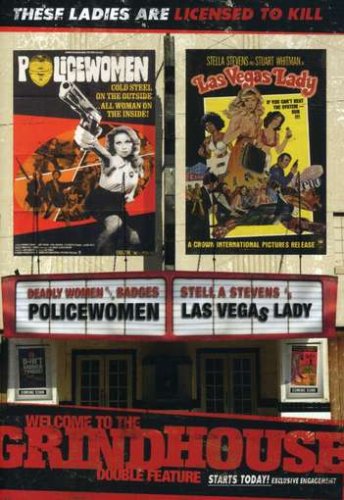
First, though, let me acknowledge the validity of the point. There is no doubt that many of the films being released with this description are certainly no classics, and just as certainly not the subject of the adoration of any cult worthy of the name. For instance, one of the Welcome to the Grindhouse double-bills is a combo of Policewomen and Las Vegas Lady. Now, maybe, maybe there is someone (or more than one someone) out there who was pining for these titles, someone for whom these were formative viewing experiences (or, which might be a teensy, eensy, weensy bit more likely, whose posters were formative viewing experiences). Maybe. But not likely. Honesty forces me to admit that I haven’t viewed the disc yet, so take my comments with a suitable amount of salt, but by all accounts, the films don’t even rank as decent sleaze, but are rather mere filler.
Posted in: Disc Reviews by David Annandale on February 11th, 2009
Welcome to 1972, when the sexual revolution is simultaneously in full swing, yet also showing signs of exhaustion (all that swinging can wear a body down, don’t you know). Barbi (Anna Biller) is a model housewife who is awakening to the feeling that there is a world outside her four walls. When she and her husband have a falling out, she hooks up with her more extroverted neighbour Sheila (Bridget Brno), who is also in the midst of a marriage crisis, and the two of them seek new love by taking work at an escort agency. What follows is a picaresque series of encounters, with nary a sexploitation angle ignored.
This film is a textbook definition of “labour of love.” Anna Biller no only stars, she directed, scripted, co-produced, edited, and took care of production and costume design. The latter took ages, since she wanted the costumes to match the decor, but the result was worth it – no small part of the film’s humour comes from its rigorous fidelity to the worst of seventies’ sense of aesthetics. Biller has recreated the classic sexploitation film down to the smallest detail. There are just enough winks to the audience to acknowledge the passage of time (and there is one address to the camera, describing the era as a fleeting utopia for the male of the species, that is as incisive as it is hilarious). The performances perfectly nail their models, capturing stilted, unnatural expressions and their forced enthusiasm. But no matter how much fun is poked at those bygone films, Viva also radiates an enormous love for them. As funny as the movie is, though, at 120 minutes, it is simply too long, and the pace is too measured. Lost of fun, all the same.
Posted in: Brain Blasters by David Annandale on February 7th, 2009
This past weekend, the Goya Awards were handed out. These are Spain’s equivalent to the Oscars. And during those awards, there was a moment that, for followers of mainstream film, must surely portend the End of Days, but which for fans of psychotronic or paracinema is tantamount to the Raputre itself: the lifetime achievement award was presented to Jess Franco.
Check out the YouTube video. There are no subtitles, but a longer version of the clip montage is available as “The Life and Times of Jess Franco,” and it has (somewhat dodgy) subs. Some of the highlights of the Goya footage are as follows. As the montage rolls, the audience is being told:
Posted in: Disc Reviews by David Annandale on February 4th, 2009
Hedda and Neal (Lydia Lunch and Don Bajema) are a couple whose relationship needs work. They have retreated to an old plantation house for precisely that reason, but then Hedda invites over her former lover, Jackson (Henry Rollins). The inevitable triangle that occurs is intercut with flashes of other events from the house’s past.
The fact that the film is barely more than half-an-hour long will be perceived as either a blessing or a curse, depending on the viewer. While this is not as abrasive as Lunch’s collaborations with Richard Kern (Fingered), it will be a hard sell for many viewers due to technical aspects alone (see below). Lunch cuts loose as a femme fatale, but her revealing outfits and pale-face-and-crimson-lips makeup remain resolutely New York Underground, looking rather silly in the rural setting. Some evocative shots, then, and some amusing bits of dollar-store surrealism (check out the bunnies in the kitchen), but also rather more pedestrian than it thinks it is.
Posted in: Disc Reviews by David Annandale on February 3rd, 2009
Director Rene Daalder is best known in cult film circles as the man who gave us Massacre at Central High. But now Cult Epics has released a pair of his films (this and Here Is Always Somewhere Else) that seem more in keeping with his real interests. A long and twisting road led to this effort, starting with an abortive collaboration with Russ Meyer and the Sex Pistols, which brought Daalder into the world of punk rock. In that field he met Tomata Du Plenty, vocalist for The Screamers. After funding for their proposed collaboration Mensch collapsed and Du Plenty’s HIV-positive status became apparent, they put together the present film out of a mixture of footage from the abandoned project, plus new elements. The striking result is Du Plenty as the last survivor of nuclear holocaust, holed up in his bunker, declaming/singing poetic rants about the history of the United States, all the while surrounded by a phantasmagoria of bizarre sights. Whether the result is compelling or pretentious (or both) will depend on one’s sympathies with respect to the art scene from which it emerges, but that it is a work that rigorously works out its conceptual and artistic premises all the way to the end cannot be denied.

Audio
Posted in: Disc Reviews by David Annandale on February 3rd, 2009
This is another of Cult Epics’ entries in their new Rene Daalder Collection. His most recent film, it’s a documentary about conceptual artist Bas Jan Ader. The brief body of work he left behind is best known for using gravity as a medium (so, for instance, he did a number of filmed pieces of himself or objects falling). He was lost at sea in1975 while attempting to cross the Atlantic in a minuscule boat as part of a piece to called “In Search of the Miraculous.” Daalder’s 68-minute film retraces Ader’s life, but does so in part through the filter of Daalder’s own parallel experiences as an expatriate Dutch artist. The film is very interesting, though I would have like a bit more analysis of Ader’s work, in order to have a better understanding of exactly what it was doing, and Daalder’s speculations about what Ader’s final thoughts might have been are a little too definitive. Still, a strong documentary.
Audio
Posted in: Disc Reviews by David Annandale on January 31st, 2009
If ever there was a release whose title told you everything you need to know, this is it. Yup, the second part of season 5. There you go. Which is in no way a condemnation. Well over four hours of prime silliness is reason enough to pick this up. Unless, of course, you have picked up any of the other recent SpongeBob releases, in which case the curse of double-dipping will likely befall you. Many of these episodes have already been released on the shorter compilation discs. If you held off until now, though, this is a wonderful fix for nautical nonsense junkies.
Audio
Posted in: Brain Blasters by David Annandale on January 30th, 2009
Not one to let being late to the party get in the way of verbiage, allow me now to add my voice to the chorus of praise for Tomas Alfredson’s Let the Right One In. Though it has, in some quarters, been referred to as the anti-Twilight, but such a designation does no justice at all to a film as complex, witty, moving and gloriously horrific as this one.
Scripted by John Ajvide Lindqvist (based on his novel of the same name), and set in a dreary 70s Sweden that would have Ingmar Bergman nodding in appreciative recognition, this is the tale of Oskar (Kåre Hedebrant), a shy, sensitive 12-year-old. His divorced parents have little time for him, but Conny (Patrik Rydmark), the school bully, has plenty. Life is thus pretty miserable, and Oskar spends many an evening hanging around the sad-looking playground of the apartment complex where he lives. One night, he meets Eli (Lina Leandersson), who appears to be a young girl his age, even though she feels no need to wear winter clothing. Eli is, in fact, a vampire, and is accompanied by Håkan (Per Ragnar), her aging Renfield figure, who is having increasing trouble harvesting blood for her. His attempts are both horrific in their detail, and hilarious as they start to go wrong. At any rate, the two outsiders soon bond, and Oskar begins to blossom and find inner strength, even as he penetrates deeper into Eli’s dark world.
Posted in: Disc Reviews by David Annandale on January 27th, 2009
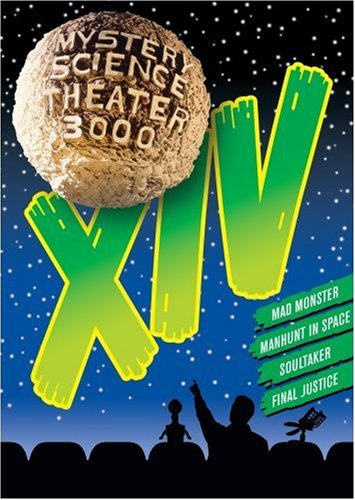
Here we go with four more cruel experiments inflicted on Joel, Mike, Tom Servo and Crow T. Robot on the Satellite of Love. The Mad Monster is a 1942 proverty row epic with George Zucco as a mad scientist giving future Frankenstein Monster Glenn Strange transfusions of wolf blood, with predictable results. Manhunt in Space is a Rocky Jones, Space Ranger adventure – multiple TV episodes pasted together into one dreadful piece of SF idiocy. Soultaker has the unfortunate Joe Estevez, under the orders from Angel of Death Robert Z’Dar, tracking down four teens who are supposed to have died in a car crash. Finally, Final Justice sees Joe Don Baker as a Texas Ranger confronting the mob in Malta. But of course.
Naturally, the real interest of these releases is not in the films themselves (which are, with the partial, nostalgic exception of The Mad Monster, utterly unwatchable), but in what Joel or Mike (depending on the episode) and the ‘bots do with the films. Two hits here, and two misses. The comments aimed at The Mad Monster and Final Justice are disappointingly unimaginative. The failure of the latter is a special sore point, since MST3K’s previous shot at Joe Don Baker, Mitchell, is one of the series’ masterpieces. This time around, the boys don’t have much to say other than to comment on the man’s eating and digestive habits. On the other hand, inspiration was at hand for both Soultaker and for a good chunk of Manhunt in Space (i.e. the first half, and with the accompanying episode of General Hospital).
Posted in: Disc Reviews by David Annandale on January 27th, 2009
So there's this group of flight attendants, and we follow their swinging adventures and affairs on and off planes. One, for instance, hopes to be an actress, and hooks up with an advertising executive. And if you care what the plot of “the first 3D sex film” is, you need your head examined. Much of the what goes on is mind-numbingly banal (SEE Wine being poured SEE Drinks being mixed HEAR Dull conversations ), though the acid trip that leads one woman to make out with a lamp in the form of a greco-roman head is something you don't see every day.
The film is an object lesson on how far mere novelty can take a film – it was a huge success at the time, and 3D was, in 1969, a rarity again after its initial craze in the 50s. So there are numerous shots of legs and pool cues (and feet) jabbing at the camera, enough, presumably, to have kept audiences entertained while everything else remained mundane beyond words. Or, so the situation is for most of the running time. But the last act takes a sudden turn into the starkly dramatic, and becomes very dark indeed. It is also rather more imaginatively shot than most of the rest of the film. The ending is a vicious sucker punch that must be seen to be believed, and suggests that the filmmakers were storing all of their creative juices for the cruel finale. In fact, as the accompanying featurettes reveal, the dramatic plot was added to the film after the rest of it was completed, and indeed, after it had already been released in some markets. In the final analysis, this is a vital piece of low culture.