Foreign

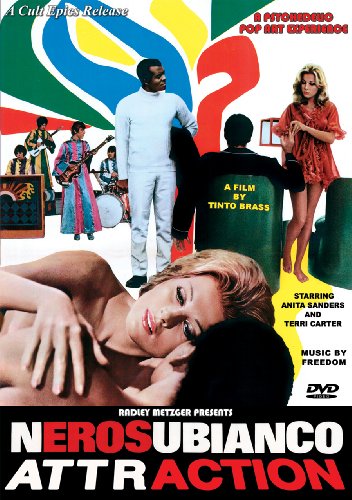
Only the most foolhardy of mortals would attempt a plot summary of this film, and I'm not quite that crazy. This is Tinto Brass's 1969 effort, coming between 1967's Deadly Sweet and 1970's The Howl. The former is a mad, pop-culture collage of noir elements, while the latter is a hallucinatory picaresque. This one is the most plot-free of the the lot. The original title is Nerosubianco, an untranslatable pun that combines “black on white” with the word “eros” (Attraction – note the word contains “action” – is an honorable attempt, and better than the theatrical title of “The Artful Penetration of Barbara,” which is what appears on the screen here, with the new name showing up as a subtitle), and that's about as much as can be summarized: this is an interracial romance. Beyond that, we have an exercise in pure formalism, an eye-popping collection of images and incidents as abstract as they are psychedelic.

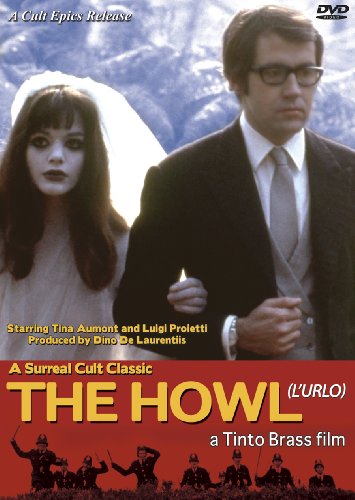
Cult Epics continues its love affair with director Tinto Brass, and here once again delves into one of his early works. For my money, for all that his later erotica is handsomely shot and produced, what I'm seeing of his 1960s output (so far Deadly Sweet and this) is far more interesting. If 1967's Deadly Sweet was demented, it at least followed a semi-recognizable mystery plot. The Howl (1969), on the other hand, defies description. It is basically a surreal picaresque, as a young woman (Tina Aumont) flees her wedding with a stranger (Luigi Proietti) who gives her a come-hither look. Already, this sounds far more sensible than the film really is. The couple race from one lunatic encounter to the next: a resort hotel apparently designed by Sade; a naked, cannibalistic philosopher and his family, and on we go.

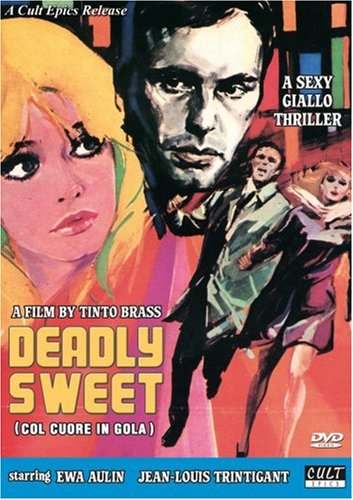
Jean-Louis Trintignant (here dubbed into Italian) is a hard-boiled actor (!). Arriving at a night club to meet the proprietor, he instead finds the man dead, and the luscious Ewa Aulin standing over the corpse, protesting her innocence. Trintingnant believes her, and decides to help her out. The quest for the truth leads them though a series of encounters with various aspects of London nightlife and lowlife, 1967 vintage.

This early Tinto Brass effort is nominally a thriller, though, as he himself points out on the commentary track, the film is only vaguely interested in its thriller aspects. The big influence here is Antonioni's Blow Up, which is name-checked a couple of times. Deadly Sweet has the same kind of meandering plot and love of lingering over various examples of Swinging London counterculture. The other guiding muse is comic book artist Guido Crepax, and Brass mimics comic panels with multiple split screens, shifts between colour and black-and-white, and the like. It is an open question whether all of these games work at a cinematic level, but they are certainly visually interesting. The films is, like so many of its contemporaries, self-indulgent, but in a rather endearing way. For my money, it's a more engaging viewing experience than many of the erotica exercises from the director's mature period.

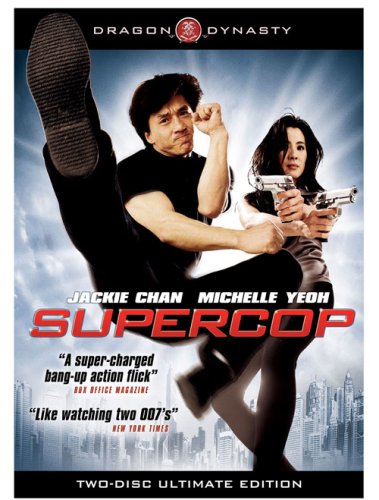
Supercop is really just the American title for the third entry in Jackie Chan’s very popular Police Story series in Hong Kong. For the first time in the franchise, Chan decided to go with an outside director, and he made a wise choice with newcomer Stanley Tong. Tong might have been a green director, but he had a natural feel for the abilities and strengths of his mega-star. The two would go on to collaborate on several more films after this rather remarkable first time pairing. It didn’t hurt that Tong not only had Jackie Chan to draw upon for the film, but he also had Chan’s Hong Kong film female equivalent with the talented Michelle Yeoh. Both stars are accomplished martial artists and perform nearly all of their stunts without the use of doubles. Tong’s task here was to allow his stars to “do their thing”, yet bring something new and fresh to the formula of Police Story, and to a certain degree all of the Jackie Chan films. He succeeded on all accounts, and Supercop is easily the best of the Chan Police Story films. The two would also team up for one of Chan’s most popular films, Rumble In The Bronx. While I’ve not seen anywhere near all of Chan’s Hong Kong outings, this is high and away the best that I’ve seen from that market.

Jackie Chan once again stars as police inspector Chan. When he overhears his superiors talking about a dangerous mission in need of a “supercop”, Chan volunteers for the task. Of course, he has to convince his girl that the month long job is going to be easy and safe, all the while giving her his life insurance policy and bank book records. Chan’s job is to pretend to break the infamous Panther (Wah) out of State custody and infiltrate the organization. He is briefed and trained by INTERPOL Inspector Jessica Yang (Yeoh). Once he’s ready the breakout commences, but the military guarding the prisoner aren’t in on the gag. After dodging bullets and missiles, Chan gets Panther safely away. Now the gang wants to meet with their contact in a local town that just so happens to be Chan’s cover story hometown. This is where his family is supposed to be. The only trouble is that Chan’s never been there before. INTERPOL sets up a fake group of family and friends, and it’s amusing to watch Chan try and fake his way about knowing these people when he’s not even sure who they are each even playing. Chan has a particular problem when he’s introduced to his “sister” played by Yang. The two follow the gang through various government operations to recapture him. Finally they’re in it for the meet and payoff, but Chan’s cover gets blown by a chance meeting with his girl, May (Cheung). Now it’s as much a matter of survival as of bringing down the bad guys.

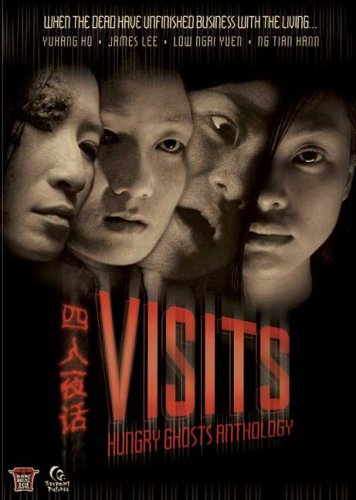
Visits – “an anthology of bone-chilling horror”? Well, it has its moments, I will say that. The most effective scenes are the ones that don’t call attention to the scare elements. Scenes that involve one or two little things out of the ordinary that don’t smack you in the face, but actually force a double-take in considering what it was you just saw – that’s when this quartet of horror tales is at its peak. Too many hack horror movies nowadays come pre-packaged for disaster, placing all their little synthetic jumps in the same places they’ve always put them, signifying to the audience, “It’s okay to be scared now.” What happened to films like Bob Clark’s original Black Christmas, where the director lays it all out and lets the audience use its brain to decide what is (and isn’t) scary?

I blame Carpenter’s Halloween, with its simple, creepy musical score, and its stunning musical “stabs.” Grant it, Halloween did this effectively. But that’s because Carpenter knew what the hell he was doing. Unfortunately, the imitators that came after did not.

Every now and then, the good folks at Upcoming Discs think it’s time I receive a little culture in my dreary, work-a-day life. There was the time they thought I could use some sensitivity training, so I ended up with Old Yeller, a film I had avoided for years because of the painful memories of Tommy Kirk gunning down his beloved pet. Sure wasn’t easy. (Bastards.)

I also admit that until I was assigned Gallipoli, most of my understanding of Australian culture had been siphoned from the first two Crocodile Dundee films. Luckily, that one turned out better for me. And then, of course, there was the time they tried to turn me gay by showing the dreamy-eyed Harry Hamlin, in his younger days, playing the wedge between a married woman and her homosexual husband – (hello, Liza Minelli) – in the forgotten Making Love.

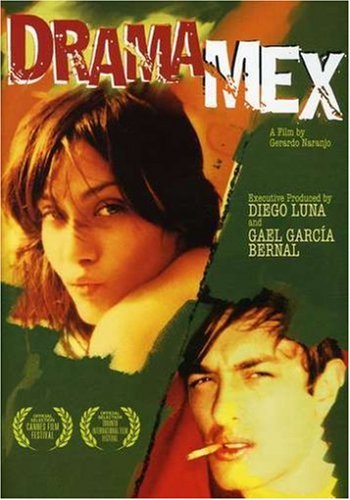
Very much in the tradition of such other overheated Mexican emotional dramas as Amores Perros and Y Tu Mamá También, Drama/Mex gives us two intertwining plot strands, each dealing with relationships as tormented as they are sexual. In one, upper-class Fernanda’s bad boy ex-lover Chino resurfaces, takes her violently, but she doesn’t exactly hate it, and this has, as one might imagine, some awkward consequences for her relationship with current boyfriend Gonzalo. Meanwhile, a middle-aged man, guilt-ridden over what he has done to his daughter (take a guess), is contemplating suicide when he runs into a precocious teenage hustler. In other words, basically enough material to give Sarah Palin a fatal coronary.


Audio

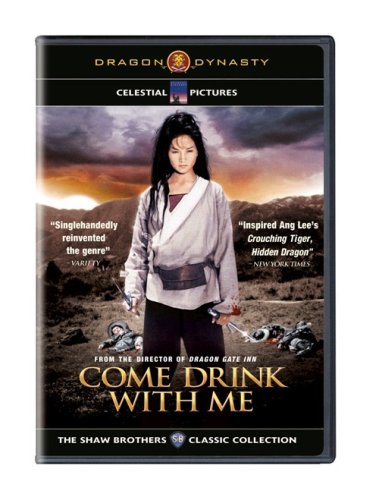
There's much ado on the case's copy that this was a major inspiration for Crouching Tiger, Hidden Dragon, and the similarities are hard to miss. Like Ang Lee's film, this 1966 effort is a lush period piece with gorgeous, rich colours and elaborate wire work. And, as in the later film, the central character is a female warrior, in this case an officer of the law sent to rescue a kidnapped victim from a clan of ruthless (but not always terribly bright) bandits. There’s a male aid here, too, in the form of an apparent drunken bum who is, of course, in reality a martial arts master.

There is a lot of pleasure to be had here, and the film has considerable charm, though some viewers might be put off by the sometimes jarring juxtaposition of silly, knockabout comedy and harsh violence. Modern viewers might also be a bit disappointed in the fight scenes, which don’t have the grace of the later movie, and they can also be very brief. Nonetheless, a good time at the flicks.

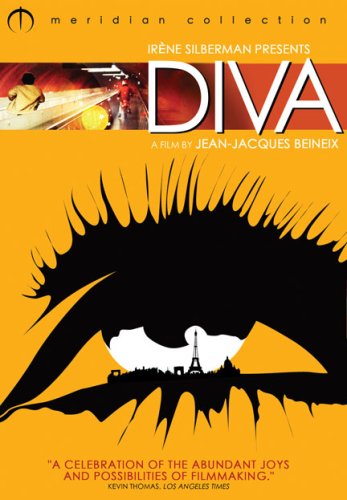
I don’t remember that much about Diva growing up; it was a film that I heard about as a kid, and a lot of people liked it, but that was the first time I can honestly say I was exposed to the arthouse film, and that it was something that I wanted to find out more about. Through the years, I’ve seen many a foreign or independent film, however the one that started all of it off for me I hadn’t seen, until now.

Diva was adapted from the Daniel Odier novel by Jean-Jacques Beineix, who previously directed a documentary version of The Diving Bell and the Butterfly long before Julian Schnabel put together a dramatic version of Jean-Dominique Bauby’s life. The story of Diva is a little complicated, but I’ll give it a go; a young messenger attends the concert of an opera singer, and creates a recording of the performance, which is a rarity for the singer, who normally frowns on recording her work. A line is said in the film along the lines of “art shapes itself around business, when business should actually shape itself around art.” A woman is murdered and drops a separate recording that is criminally linked to the police, and the tape winds up with the messenger. When the messenger, named Jules, is spotted recording the singer’s concert, they threaten him and demand to obtain the tape, so that it can be sold to the highest bidder. Unbeknownst to Jules, the participants of the other tape include a crooked police chief, who wants to try and get the other tape by any means necessary.

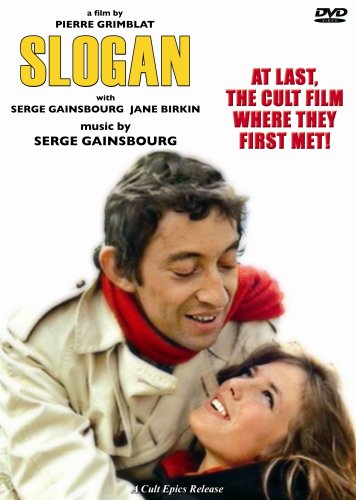
Serge Gainsbourg and Jane Birkin were the “it” couple in France during the late 60s and early 70s. This is the film that brought them together, their To Have and Have Not, if you will. Musician Gainsbourg (who, for the uninitiated, had a singing style that was a cross between Leonard Cohen and Tom Waits) plays a married director of successful TV commercials. He begins an affair with an 18-year-old (Birkin). Their relationship hits most of the predictable moments of such movie romances from that period.

And it is almost completely uninteresting. There is zero chemistry between the leads, but neither has much by way of screen presence to start with. Gainsbourg is startlingly ugly, and Birkin is strikingly beautiful, but that's hardly enough to keep us watching. Neither character is remotely likeable, and the self-referential moments in the film were smug clichés already in 1969. The film holds some interest as a pop culture trivia answer, but for anyone unfamiliar with Gainsbourg and Birkin, it's an intolerable bore.