Posted in: Disc Reviews by Archive Authors on June 25th, 2006
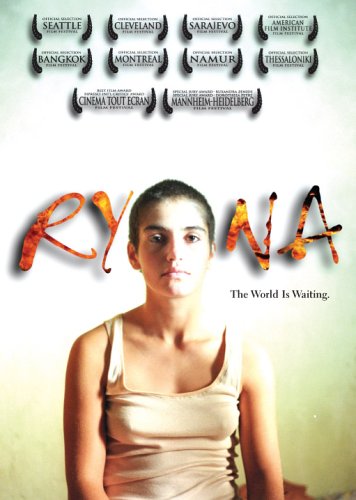
I watched Ryna while my wife watched Shopgirl on the TV. And aside from watching Ryna because I thought it was going to be a film about a DVD reviewer whose name is misspelled, there were a lot more differences between the two films. As far as I could tell, Shopirl appeared to be about a girl with Down�s Syndrome who falls in love with her Dad but reconsiders at the end (whoops, my wife tells me that I�ve got it wrong), Ryna is about a girl who tries to rise above being repressed because of her gender.
Ryna is the title character of a 16 year old girl (played by Doroteea Petre) who lives with her parents in a small Romanian town. Her father Biri (Valentin Popescu) has raised her as a boy with short hair, because he's disappointed that his only child was not born a male. Together they run an auto repair service that does price gouge foreign travelers from time to time. When a French anthropologist comes into town, he tells her about the world outside of her small town, and she wants to break out and enjoy life, despite her father's wishes.
Posted in: Disc Reviews by Archive Authors on May 28th, 2006
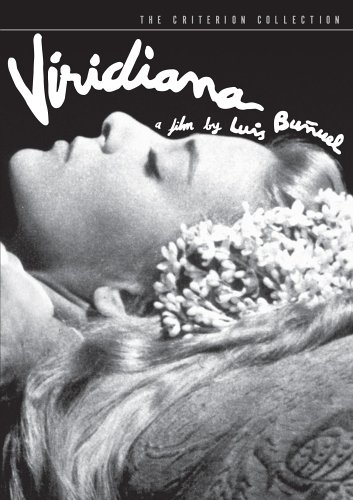
As is the case with many of Criterion's releases, Viridiana is a film that was quite controversial upon its original release, and to some extent, still is today. The film's namesake is a young woman who is just a week away from taking part in the investiture ceremony, her convent receives a letter from her Uncle, who sends his regrets that he will be unable to attend the event. The convent's Mother Superior sends Viridiana to see this Uncle, and that's where the trouble begins.
The Uncle is a single ol... man who lives in self-imposed isolation, save for a servant and the servants daughter. Once Viridiana arrives at his estate, she discovers that the Uncle has some plans for her that will certainly not agree with her faith. While most films see this as enough of a plot to complete a film, this setup is just the tip of the iceberg here.
Posted in: Disc Reviews by Archive Authors on April 22nd, 2006
Synopsis
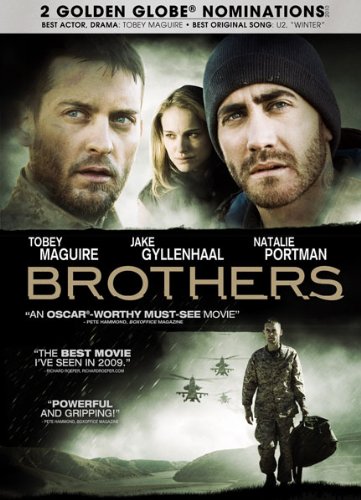
After hearing a lot of good things about a sleepy film from Denmark called Brothers, I was curious to see what all the fuss was about. After all, we are talking about a country that has produced a visionary director in Lars von Trier (Breaking the Waves), but whose films have been a little bit on the polarizing side.
Posted in: Disc Reviews by Archive Authors on April 13th, 2006
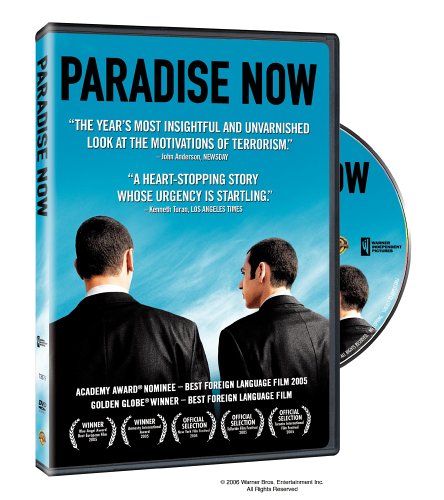
The Academy Awards are starting to build a case against their own validity. In 2005, they nominated a simply amazing film called Downfall in the Best Foreign Film category, but eventually gave the award to The Sea Inside. While Sea is a fine film, it was clear that the Academy got nervous about the ramifications of giving an award to a film about the last days of Adolph Hitler, and took the easy way out.
In 2006, they again got nervous and avoided ultimate controversy by giving their Best...Picture Oscar to the safe vote of Crash, thus avoiding the controversial choice of Brokeback Mountain. Likewise, Paradise Now was also the victim of the weak knees of the Academy. The Foreign Language Oscar in 2006 eventually went to a South African film called Tsotsi, instead of the proper (and controversial) choice of Paradise Now.
Posted in: Disc Reviews by Gino Sassani on April 5th, 2006
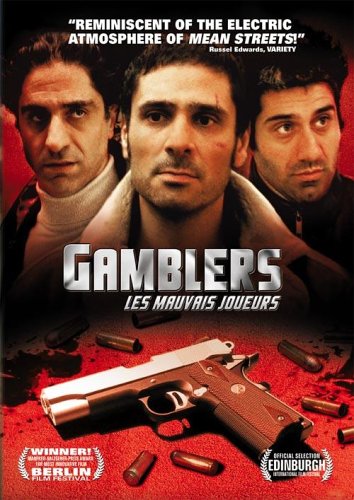
Let me admit straight away, I generally do not watch very many foreign films with subtitles. If a film is not dubbed in English, I generally pass. It’s not for a lack of tolerance. When I watch a film, I immerse myself into what I’m seeing. Films are total escapist fun. I experience a film more than view it. Having to read the dialogue denies me the ability to experience rather than watch the film. I also find that while I am busy reading subs I will tend to miss some of the film’s subtleties, which are quite important to me. In Gamblers, there is the added liability of dual languages. There is a prominent Asian element to this film. It took me too long to realize that more than one language was being spoken and that some of the characters could not understand others. The subs are presented with no distinction as to who is speaking or what language they are speaking. OK. End of disclosure.
As far as I could make out, Gamblers involves a territorial street gang that is somewhere between the mob and the IRA. In typical “Bloods” vs. “Crips” style, there is a reasonable amount of mayhem between two of these street gangs. Unfortunately we are never brought into the workings of either gang, and the violence appears simply as a result of one Asian boy’s love for an Asian girl. To add to the silliness of the whole premise, the violence results simply because Juen is bothering the girl while she is supposed to be working. A series of inexplicable romantic relationships is never fleshed out enough for us to care. Unless something serious was lost in translation, the dialogue is very simple tripe. An entire romantic conversation seems to be about nothing but another man’s penis. Fortunately much of the music is in English.
Posted in: Disc Reviews by Archive Authors on March 31st, 2006
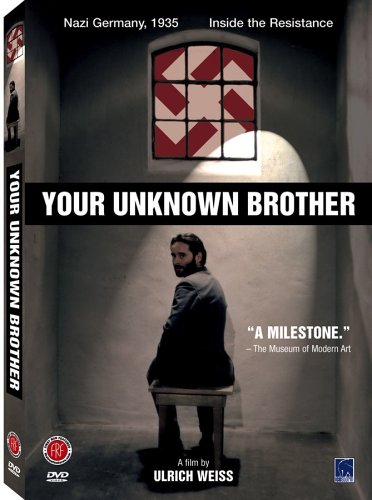
Arnold Clasen reenters society after time away in a Nazi prison camp, and returns to Hamburg and a life of quiet solitary resistance, in the 1981 war-time drama Your Unknown Brother. Clasen immediately reconnects with his old love Renate, and embarks on a turbulent, dangerous friendship with resistance leader Walter, a man of ulterior motives, who is also in bed with the Nazi regime. Clasen starts to suspect Walter when many of his old comrades are seized by authorities. It seems everyone in the resistance, wh... comes into contact with Walter soon become property of the State, yet he remains suspiciously unscathed.
The film deals with themes of stark isolation and hopelessness, as well as an individual’s efforts in facing widespread fascism. It’s always at the top of its craft, but the action lacks that extra something to make it all seem interesting. On paper, the film will have foreign drama buffs salivating, but in execution, it fails to make its premise as intriguing as it sounds. With that said, I am hard-pressed to find any fault in the performances, and Director Ulrich Weiss really does know how to use camera, lighting, and sound effects, to his advantage. It just seems like the intangibles are missing – those unexplainable qualities, which pack all the emotional power, and allow a movie to transcend the average film within its genre.
Posted in: Disc Reviews by Archive Authors on March 17th, 2006
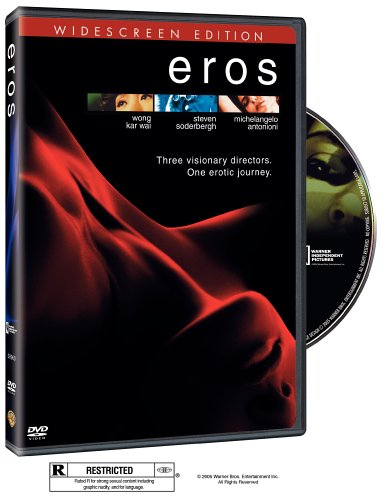
Anthology films are a good training ground for young filmmakers to flex their muscles and really get creative. However, with Eros, the three filmmakers have already been around the block a time or two, and on the surface, that could be considered a good thing. But when you consider what Michaelangelo Antonioni, Steven Soderbergh, and Kar-Wai Wong, are already capable of, these shorts seem a bit of a letdown. The best segment is Soderbergh’s “Equilibrium,” with its symbolic stylistic effects and wry sense of hu...or. It was the only one of these vignettes, which seemed neither cliché (“The Hand” – Kar-Wai) nor pointless (“The Dangerous Thread of Things” – Antonioni). In “Equilibrium,” Robert Downey Jr. plays a man caught up in an ambiguous dream world, who explains his situation to an eccentric psychiatrist (Alan Arkin). Arkin’s psychiatrist is a capable man, but he often uses his patients’ discussion time to do other less constructive things (i.e. stare out the window with binoculars, fly paper airplanes to the street below, etc.). The whole time, he is equally capable of dispensing advice and helping his patients get to the root of their issues. There are three color schemes in this segment (black-and-white; all blue, natural), all of which add artistic flare by making each portion a genre in and of itself. And in the blue portion (Downey’s recurring dream), the camera bobs slowly from side to side, giving an off-equilibrium effect, which is contrasted in the other two portions.
In “The Hand,” Kar-Wai proves himself a quality director, while the story of fading love and devotion rekindled for one final farewell lacks the intrigue of similar – and better executed – works. However, the performances by the two lead stars are solid. Unfortunately, even that perk is missing from the uninspired Antonioni contribution. “The Dangerous Thread of Things,” meanders about with all the importance of a porno (but without the excessive sex and nudity those, who might find such fare entertaining, are interested in seeing). It’s not a flattering introduction to the works of the great Italian director. As for storytelling, I’m not sure he even attempted to dabble in it here. Stick with Blow-Up, if you want a primer on Antonioni.
Posted in: Disc Reviews by Archive Authors on January 30th, 2006
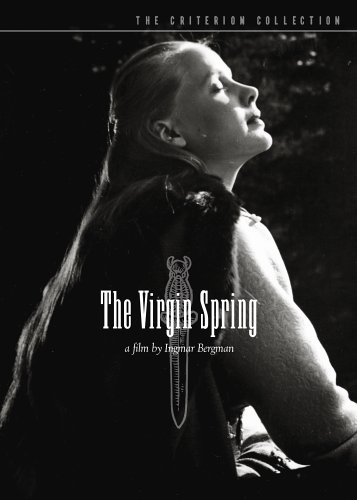
Honestly, I wasn't expecting too much from The Virgin Spring. I know that it's Bergman, but it's based on an ancient Swedish medieval ballad. If your source material is hundreds of years old and only two pages long, surely there can't be much to see from the film, can there?
I could not have been more wrong. Though this may be just under an hour-and-a-half in length, the film is filled with subtext, imagery and several powerful messages. Spring tells the story of a fair maiden who is brutally ...aped and murdered on her way to church, and her father's revenge on those responsible. Bergman has managed to make his morality tale into a complex commentary on both human nature and the nature of Christian faith. By setting his story in the period in Swedish history between paganism and Christianity, he is able to masterfully illustrate the struggle of both the first Christians and Christians today between denying basic impulses and focusing on the will of God.
Posted in: Disc Reviews by Archive Authors on January 7th, 2006
The Bad Sleep Well reminded me a lot of The Godfather. Both films begin with a large wedding, where the story behind the wedding is more fascinating than the event itself. Both films are also about corruption, what it means to be loyal, and what happens if you do favors for the wrong people. The Bad Sleep Well is particularly meaningful to our modern society, as instead of the subject of the film being gangsters, the focus is on the new heavies on the block... corrupt corporate heads. In the wake of the scandals at Tyco, Worldcom, Enron and others, this 1963 film carries new weight for American audiences.
Kurosowa was famous for his samurai films, and this modern film still carries some of those same themes. The Lords have moved from the countryside to the boardroom, but the pressure to perform and protect the organization at all costs remains. Those warriors in the support roles are compelled to defend the actions of the corporation even with their own lives, if it comes to that. This film is part film noir, part corporate drama, and yes, part samurai film.
Posted in: Disc Reviews by Archive Authors on December 18th, 2005
Synopsis
Thankfully, as part of Criterion’s desire to be completists of the Akira Kurosawa collection, they have finally decided to release Ran on DVD. For the sake of time, I’ll include my thoughts of the film based on my review of the Kurosawa boxed set, which included a previous version of Ran: