The Reel World

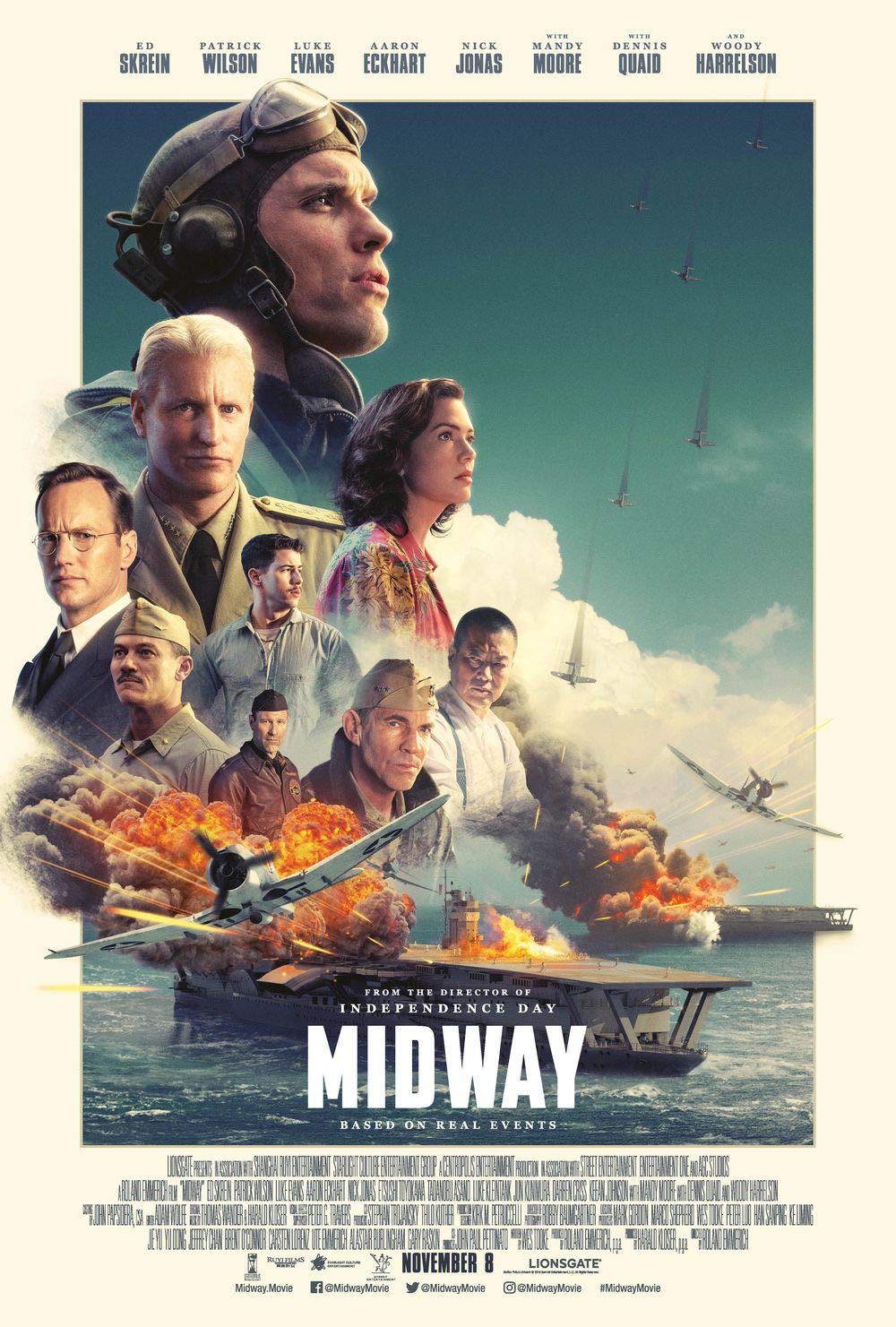
Director Roland Emmerich is no stranger to big-screen battles. The difference is that up until this year those battles have been against aliens, huge climactic changes, or giant lizards named Godzilla. There's no question that he understands how to shoot epic confrontation. The question I had going in to Midway was, can he deliver a battle that wasn't fiction? After nearly tow and a half hours, the answer came back somewhat mixed. This isn't the first time that the Battle of Midway has been brought to the big screen. In the 1970's Charlton Heston gave us a film that was more renowned for the trendy Sensurround gimmick than it was for the drama that unfolded on the screen. Sensurround was a fancy name for huge subs that would shake the theater, and if you were lucky enough to be seeing the film at a theater with enough money to go all the way, you might have found yourself in a seat that was wired to shake, rattle, and roll. Today the chains call that Dolby. This Midway didn't lend itself to some William Castle hustle. It's all up on the screen. The film bears no relation to that earlier effort except for the legendary battle in the Pacific that turned the tide of the Pacific theater of World War II toward the Allies. The film actually shares more in common with the classic Tora Tora Tora in that we spend a good deal of screen time with the Japanese players in the battle. Not at all like the earlier gimmick film, this movie is intended to place you squarely in the middle of the action. If that's what you came to see, you are certainly in for an immersive experience only without the hot-wired seat.

Taking a lot of liberties while giving a cinematic interpretation of a time in his life, Pedro Almodovar’s movie Pain & Glory is as expressive as Roma. His directing and screenwriting is by far some of the best I’ve seen by the famous director, and yes, there’s a spark of surprise in this one, as in every one of his films. Taking extra liberties, he even shocks his audience at one point. That said, if you are a fan of Almodovar’s films, then you will not want to miss the amazing performances that bring the man’s film to the big screen. The story follows Salvador Mallo (Antonio Banderas), a screenwriter and director who has had huge success with his film Sabor. He has not written another for some time, yet he’s still known by many for his work. Now living in semi-seclusion, we find him working on a new project while visiting the past in his mind. In flashback, we see his life at an early age (Asier Flores) and his inquisitiveness that led him to become a great director. His darker side includes taking a turn with drugs and a gay lover from the past.

By John Delia, Jr.

During the 1950’s, being a private investigator wasn’t always a safe and sure way to make a living. But it was a popular way to make some cash for returning soldiers or ex-police officers. During these times things were beginning to modernize, and the world was becoming more dependent on advancement in the skyline. With these changes, corruption and deceit became more evident, and private investigators became more popular. When Frank Minna’s (Bruce Willis) agency gets a chance to make some real money, things begin to get ugly fast. In his crew there is Lionel Essrog (Edward Norton), an orphan with Tourette's syndrome that Frank took under his wing when Lionel was 13; they have been friends ever since. Then there is Tony Vermonte (Bobby Cannavale), Gilbert Coney (Ethan Suplee), and Danny Fantl (Dallas Roberts). Frank has known these guys for many years and trusts them with helping to investigate the cases for his company.

"There's just more to it than picking the right color. It's the texture, the weight of the material. One wrong choice, it can destroy the look of the entire room."

Film rights can be a tricky and complicated issue. Sometimes these rights aren't quite clear and lead to popular titles never making it to the home video market, or at least suffering long delays as in the 1960's Batman television series situation. Often rights are held for certain periods of time and end up moving from holder to holder. That's been the case with the Terminator franchise. The result has been some sequels that pulled in different directions and failed to provide a nice linear history from film to film. Now those rights have reverted back to a favorable situation for the likes of James Cameron. The result is an attempt to get back to the original course of the first two films. Terminator: Dark Fate picks up from T2 and ignores any of the other films made since then. It's very much like the path taken by the new trilogy of Halloween films we got a taste of last year. There isn't any denying the fact that T2 was the best this franchise has had to offer. Something was always just a little bit off with the rest of the films. There's a texture to all of this that James Cameron has a unique eye for. And while he didn't direct this film, he created the story and produced the film. Like the new Halloween direction, this is also intended to be the first film in a new trilogy. The Terminator franchise appears to be back, and on track to please the legions of fans from the old to the new.

When it comes to Rob Zombie, his films are a bit hit-or-miss. Halloween and The Devils Rejects are his biggest commercial successes, but when he delivers films like Halloween 2, fans tend to be unforgiving.  Now we have 3 From Hell, the final chapter in his Firefly family saga that began way back with House of 1000 Corpses and followed up by The Devils Rejects.  While many fans have been excited about this third film, I’ve been on the fence wondering if this is really something I want to see.  The Devils Rejects is a dark and mean little film that delivers one of the most satisfying endings for a horror film. It’s so good I have my doubts that it could ever be topped.  But in Hollywood, if there is potential to make more money off a “franchise”, then there is going to be a sequel whether you want it or not.  It’s been 16 years since the franchise began. How does he wrap it up?  Well, buckle up, it’s a bit of a bumpy ride; that’s for sure.

We take it for granted. Every day our lives depend on the flow of electricity to our homes, workplaces, entertainment venues, and hospitals. Living in Florida where you might brush the occasional hurricane, it's the thing I dread the most when a storm approaches. I don't worry so much about damage to my home as I do the inevitable five days without power. No AC. No television. No refrigeration for the food. We are so dependent that it's hard for me to comprehend that I grew up knowing people in my own family who lived before there was any electricity service at all. In another 70 years people will be saying the same thing about the internet. We all know Al Gore invented the internet. But who got us connected with this whole electric power grid? Like most things in a capitalistic society, there was fierce competition. Companies fought for the ability to bring electricity to your home. City by city, the contest endured until eventually the entire country could bask in the glaring glow of the world's first light bulbs. The Current War: The Director's Cut takes us inside that struggle to win that race. It's a compelling story, and even if it doesn't all ring quite true, it's an entertaining journey to the moment in time when everything changed.

When it comes to writer/director Robert Eggers, despite only directing The Witch, he’s currently one of the most divisive directors working today. Personally I loved The Witch and feel it’s one of the best horror films in the past decade, while others openly loathe the film and consider it a snooze-fest. Eggers has a style that really isn’t for everyone, but for those who are fans (myself included), he’s a breath of fresh air to the horror genre, though his style is very much a throwback to the times before computer graphics and his films rely heavily on atmosphere, where his stories take time to develop as he wants us to be like a fly on the wall as we watch his characters fall apart.  The Lighthouse is very much a claustrophobic character piece that will once again divide audiences, but one thing I believe we can all agree on: the performances of Willem Dafoe and Robert Pattinson are phenomenal and deserve all the recognition that will be coming their way.

Here comes the second addition to this sequel weekend, as well as another welcome addition to the 31 Nights of Terror. Welcome back, ladies and gentlemen, to Zombieland, and it’s like we never left. True, ten years have passed since we last saw Tallahassee, Columbus, Wichita, and Little Rock, and I was beginning to believe that the likelihood of a sequel was low given the rising profiles of each of the actors involved, but I can happily say that it is here, and it was worth the wait. When last we saw this makeshift family, they were leaving Pacific Playland amusement park after annihilating a zombie horde; romance was brewing between Columbus and Wichita, and Tallahassee finally got their hands on his beloved Twinkie. Had this been the last time we saw the group, I would have been content, but the unwritten law of Hollywood is to never let go of a profitable franchise. Now, this unwritten law can be both good and bad, as it could result in a film that is on par or better than its predecessor, or the result could be a product of the law of diminishing returns. Lucky for us, Zombieland: Double Tap is the former instead of the latter.

Well, well ... it would appear that this weekend is the weekend of sequels with two movies worthy of 31 Nights of Terror. First is the return of Angelina Jolie as Maleficent. When we last saw the Mistress of Evil (which also happens to be the title for the sequel) she was more of a hero rather than villain. However, the sequel sees her return to her previous status as the feared fairy that ruled the Moors. How quickly people forget her contributions. Though not traditionally scary, the film features plenty of magic and carnage courtesy of Jolie. Additionally, the film features the return of Elle Fanning, Sam Riley, and Harris Dickson as Aurora, Diaval, and Prince Philip. With the addition of Chiwetel Ejofor and Ed Skrein, as well as Michelle Pfeiffer as Queen Ingrith, Philip’s mother, who gives Maleficent a run for her money for the title of Mistress of Evil.

It may be similar to other sci-fi films of its kind, but Gemini Man tips the scale with action and storyline.  The CGI is incredible, and the re-aging of Will Smith amazing in this assassin vs. clone movie that will knock your socks off. Oh, and the answer is yes, Will Smith plays both parts with seamless detail. A crack shot and assassin for a US government special ops, Henry Brogan (Will Smith) has set himself up on a hill readying himself to kill someone in a fast moving train.  As the train passes by he makes the kill shot, but it almost puts a bullet in a child nearby.  Deciding to retire, he tells his boss that it’s time because there’s a good chance he’ll botch the next job.