Posted in: Brain Blasters by David Annandale on January 27th, 2009
So we’ve had plenty of horror remakes, and we’ll continue to have plenty more. Most, as we know, are at best middling, at worst utter desecrations of the originals. We have had some cases where a remake might actually make sense, cases where the first film could certainly do with some improvement. Amityville Horror, I’m looking at you. And yet somehow, that remake managed to be worse. The job is made easier for the upcoming Friday the 13th retread, since the original, despite its iconic status, is nothing more than hackwork, and I say that with love. But the current offering, and today’s topic, is the 3D return to My Bloody Valentine.
Now, I have a great deal of fondness for the original, not all of which is Canadian pride in a homegrown product. There’s a nice, gritty atmosphere and setting, the killer is well designed, and the murders (truncated though they originally were -- all hail the restored release!) are inventive. But let’s not kid ourselves, either. This ain’t Bergman. This is no holy text.
Posted in: Brain Blasters by David Annandale on January 17th, 2009
Pupi Avati’s The House with Laughing Windows (1976) isn’t the most high-profile Italian horror film, and only landed a legit North American release with Image's 2002 DVD release. But it has been a succès d’estime for quite some time, particularly in its homeland, and it is well worth tracking down. Viewers looking for something fast-paced, or a Lucio Fulci-style gorefest will be disappointed, but those willing to work with it will find a deeply atmospheric, disturbing and intelligent contemporary gothic with elements of the giallo.
Stefano (Lino Capolicchio) is an art restorer who arrives in an out-of-the-way village to rescue a damaged church fresco depicting the martyrdom of St. Sebastian. He is initially very impressed by the artist’s ability to capture pain, but the more he uncovers of the painting, and the more works by the deceased artist he sees, the more disturbed he is by the man’s obsessive depictions of cruelty and death. When a friend of his, who claims something terrible is happening in the village, is killed, Stefano is drawn further and further into a deadly mystery, at whose centre lies the impulse behind these gruesome images.
Posted in: Disc Reviews by David Annandale on January 13th, 2009
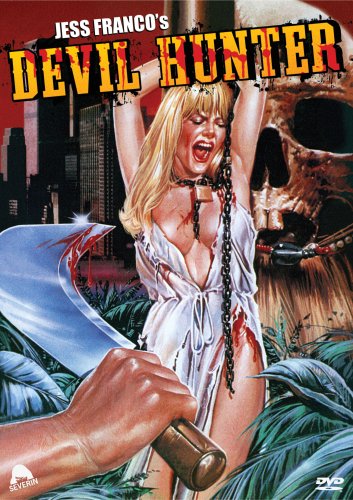
A disfigured young man with an unhealthy interest in his sister attacks and kills a woman. Five years later, he is released (by psychiatrist Jess Franco) into his sister’s care, who is helping organize a language school on property owned by her disagreeable, but very rich, aunt. In short order, the female students at the school (and there are ONLY female students, for reasons not explained) start being killed off. But no one other than heroine Olivia Pascal actually believes that anything is going on.
This was Jess Franco’s contribution to the slasher craze, though it demonstrates just how much that subgenre owes to the giallo by incorporating many of the elements of the latter (whodunit, unseen killer instead of hulking masked figure, etc). The production values are perhaps a bit higher than usual for Franco, and the gore effects are, all proportions maintained, quite good (and certainly very gruesome). But it’s obvious that this is work for hire, as the work lacks many of the more endearing eccentricities and personal obsessions that mark the films he’s more interested in. There is also some unnecessary animal cruelty involving the decapitation of a snake. The sharp-eyed will catch Lina Romay in the credits (as assistant director, under her real name of Rosa Amiral).
Posted in: Disc Reviews by David Annandale on January 12th, 2009
The giallo was never a genre that specialized in tight, coherent, logical storylines. But even by the bizarre standards of the form, In the Folds of the Flesh takes some kinda cake. Trying to summarize its plot is next to impossible, as the first two thirds of the plot are incomprehensible, and are cleared up only in the final third, which feels more like a play than a film, and where the revelations and twists pile up to such a degree that they don't induce whiplash – they torque your head clean off. So, for what it's worth, we have a castle (whose interiors look distinctly un-castle-like) where, thirteen years ago, a man was decapitated. His body was disposed of by the woman living there, and she and two children, now grown and thoroughly insane, dispose of anyone else foolish enough to come prying into their lives.

This is certainly no lost masterpiece. Its story is clumsily told, and would be offensive if it weren't so ridiculous. The murders vary from the delightfully cheesy (the decapitations) to the utterly WTF (death by cuckoo clock?? ). But the demented nature of the exercise makes it compelling in the nature of a train wreck (and speaking of trains, what's with the constant shots of one?). Lovers of the deranged will find much to feast upon here.
Posted in: Disc Reviews by David Annandale on January 11th, 2009
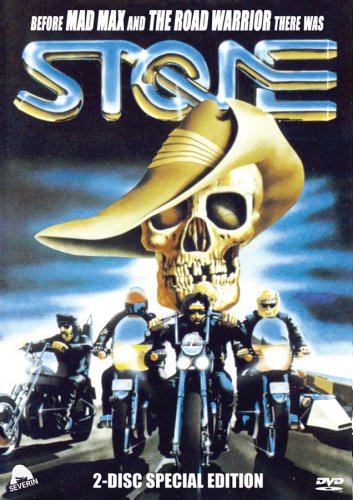
After having been present at a political assassination, the Grave Diggers biker gang starts being killed off one by one. Undercover cop Stone joins the gang (by basically saying, “Hi, I’m a cop. Can I hang out with you guys?”) in an effort to solve the murders. Plenty of shenanigans, riding around, and utterances of the word “man” ensue.
This 1974 Australian effort gets off to a bang of a start with the assassination, a scene that is largely witnessed through the eyes of a heavily stoned biker. The murders that follow are also nicely staged. But then we start getting many, many scenes of riding around and rather aimless hanging about. The eponymous hero doesn’t show up until a quarter of the way through the film, at which point he is able to find out, though his own experiences and the interviews he conducts, what a great bunch the bikers are. So there’s a fair bit of meandering about. But the action scenes are well done, and as a cultural artifact, the film is really quite fascinating.
Posted in: Brain Blasters by David Annandale on January 10th, 2009
I have, for work-related reasons, been watching quite a number of European horror films in close succession, mostly from the 1960s and 1970s. Yesterday, in the middle of this, I was moved to reflect on what seems to be a fairly significant difference between the British and Continental films. I won't go so far as to claim that what I'm going to describe is universal, but it is prevalent enough to be, at the very, very least, a marked trend. And it is this: that the Continental variant has a distinctly sleazier feel than do its cousins.
Now, sleaze is an extremely subjective term. How, precisely, does one define it? This is not the place to attempt to answer such a weighty question, but I do feel I should remind my patient reader that, in these quarters, the term is frequently not pejorative, but often a mark of the highest praise. Furthermore, as I said above, this isn't a universal law. England's Pete Walker has pumped out a body of work that is emphatically sleazy, as is evident from the titles alone: House of Whipcord, Die Screaming Marianne , The Flesh and Blood Show, and so on. But his films, memorably described by Kim Newman as “defiantly grotty,” stand out as such because they are, relatively speaking, the exception that proves the rule. Hammer is, of course, the paradigm for British horror, and as prurient as some of its later offerings would become (Vampire Lovers, Lust for a Vampire, To the Devil a Daughter), there was always an aura of polished respectability about the films. Whereas on the Continent, the films were notably far more sexualized, to the point, at times, of completely erasing the line between porn and horror. Thus, people like Jean Rollin and Jess Franco would move back and forth between making outright hardcore and more traditional genre fare.
Posted in: Disc Reviews by David Annandale on January 9th, 2009
A group of low-life gangsters kidnap a starlet (Ursula Fellner) and hightail it off to a jungle island, where they subject their victim to endless indignities while waiting for the ransom money to arrive. Al Cliver is dispatched to rescue her, but his helicopter arrival draws the attention of a group of hostile natives and, more to the point, a red-eyed, cannibal zombie-god who holds them in a grip of fear.
It was 1980, and so the short-lived cannibal subgenre was in its heyday, so naturally Jess Franco was faced with directing his own contribution. Of course, he did so in his own peculiarly idiosyncratic way. Released the year prior to Severin's other recent cannibal release, Cannibal Terror, it shares that film's conceit of gangsters running afoul of dangerous locals. Also common to both films is some unintentional hilarity (“primitive” tribesmen sporting wedding rings and running shoes, a park bench visible in the background of the jungle around minute 93, or the hero climbing a “vertical” cliff face on his knees, thanks to the wonders of a tilted camera). The usual racism associated with the cannibal movie is somewhat problematized (deliberately or not) by the odd and obvious multiracial composition of the tribe. Where Franco's film steals the march on its poorer successor is a greater sense of expansiveness, even on what couldn't have been much greater means (we even get a helicopter crash), and a more lush, somewhat more convincing jungle (even though we are still pretty clearly in Spain). As well, Franco keeps the pace up with a wealth of incident, not to mention that strange mixture of elements (crime, action film, cannibal film, supernatural terror, even a little bit of King Kong). And the scenes of cannibalism, while far more simplistically mounted than in the likes of Cannibal Holocaust (an extreme close-up of a mouth showing meat and dribbling blood) are nonetheless suitably disgusting. The only shot of innards being yanked out is so brief, it feels like the contemptuous dismissal that it is. All in all, a sleazily entertaining mish-mash that could only have been made by one man, bless his twisted little heart.
Posted in: Disc Reviews by David Annandale on January 9th, 2009
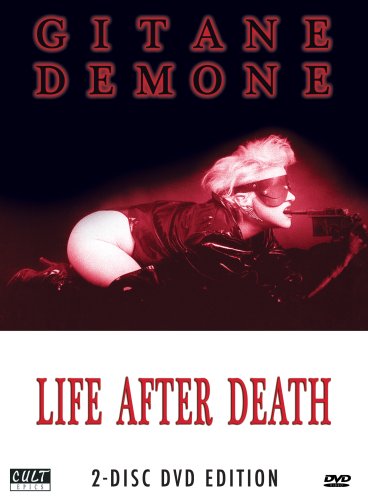
Gitane Demone was one of the lead singers for seminal deathrock band Christian Death before going solo in 1989. This 2-DVD set is a record of her various solo efforts, tracking various incarnations, most notoriously (and most prominently featured in the release's packaging) being the fetish performances for the likes of the DeMask club and Skin Two magazine. Present here is a mix of television interviews, one video, and a raft of live footage.
Given the necessarily raw, semi-underground nature of the material (more one the picture and sound quality below), this is not really a release for the previously unconverted. The fuzzy picture and muzzy sound is not likely to draw in viewers who don't already have an investment in the subject. That said, the interviews are interesting, with Demone, in most articulate fashion, clearly situating herself within various scenes and phases of her life, and explaining how all this has affected her art. As for those who are fans, this is a very valuable record of a decade of performances.
Posted in: Brain Blasters by David Annandale on January 5th, 2009
Some movies have “cult” written all over them. But that can actually be counterproductive. If the psychotronic audience sense the film is trying too hard to be a cult epic, then it risks rejection. In this context, I’m not quite sure what to think of Minoru Kawasaki’s The World Sinks Except Japan (2006).
Kawasaki is a filmmaker who is idiosyncratic, to put it mildly. His work is gradually becoming available to North American audiences, with such titles as The Calamari Wrestler and Executive Koala leading the pack (and those titles are not metaphors – they literally describe the main characters). I confess to being very curious to see what he does with his recent revival of Guilala (in The Monster X Strikes Back: Attack the G8 Summit) – surely the giant monster that the fewest people have been clamoring to see again. The World Sinks Except Japan is another film whose title precisely describes the central concept. When everywhere else drops beneath the waves, Japan is flooded with refugees from the rest of the world. Result: Americans reduced to service sector jobs, Chinese and Korean leaders suddenly becoming lapdogs to the Japanese Prime Minister, caricatures of Arnold Schwarzenegger and Bruce Willis play-act action scenes for chump change, and so on.
Posted in: Brain Blasters by David Annandale on December 26th, 2008
First, let me wish my fellow site scribes and whoever might be reading this the best of the season. Now I should turn to the painful task of following up my speculative piece a couple of weeks ago about what might go wrong with the remake of The Day the Earth Stood Still, a blockbuster whose success is so anemic that, a few years from now, it will certainly have lapsed into sufficient obscurity that whatever profile it might still have will be the result of masochists voluntarily subjecting themselves to its inanities. It will, in other words, have become a cult film, but of the sort where the cult’s loyalty is the loyalty of absolute contempt.
My concern leading up to seeing the film was that the need to provide big-bang FX would overwhelm the story itself. In this, I was both right and wrong. Yes, the grand spectacle is saved up for the end of the film, but as spectacles go, it isn’t all that impressive. And there is enough flash during the rest of the film to keep those jonesing for eye candy satiated. Keanu Reeves, meanwhile, acquits himself honorably as Klaatu, quite convincingly coming across as an alien in a human body. Where the film fails, and fails in jaw-dropping manner, is at the level of the script.