Posts by David Annandale

Elizabeth Bathory (or, more properly, Erzsébet Báthory) is one of those historical figures just made for horror film. A Hungarian aristocrat, she, if the stories are to be believed, had some 650 young women killed, and would, it has been said, roar from her seat as she watched the torture. And did I mention she believed bathing in blood would keep her eternally young? Eventually, the authorities had at her, and though she was not executed, all the windows and doors of her castle were bricked up, imprisoning her in da...kness until the end of her life. I say, “if the stories are to be believed,” because there are, as one would imagine with this notorious a figure, many disputes (check out the Wikipedia entry and you’ll see what I mean). It has also been argued that she, and not Vlad Tepes, is the real inspiration for Stoker’s Dracula.

At any rate, this kind of tale is too gruesomely juicy to ignore, combining as it does slaughter and sex on an almost apocalyptic scale, and the fact that a woman is the perpetrator is, for good or ill, an added inducement to certain filmmakers and audiences. Bathory sprang to mind because there have been a couple of recent releases that use this figure, and so herewith, a very rough survey of a few of the Bathory films out there.

Recently, Anchor Bay released, at long last, Cemetery Man< to DVD. In so doing, they made available one of the last gasps (for now) of truly first-rate Italian horror, and it might be worth while to spend a few minutes considering the director, Michele Soavi, a man who has been nowhere near as prolific a filmmaker as might be devoutly wished.

In my piece on Joe D’Amato a few weeks ago, I mentioned that the best film he was involved with was Soavi’s debut, StageFright (1987). One of the fascina...ing aspects of this effort is that, while Soavi had been assistant director on films either directed by Dario Argento (Tenebre, Phenomena) or produced by him (Demons< .I>), Argento had no role to play in the making of StageFright. His influence, however, looms large. We can be thankful that it was his aesthetic sense that was a model for Soavi, and not D’Amato’s. In event, this film did wonders with its basic slasher set-up, and its killer’s mask (a gigantic owl’s head) is one that is not soon forgotten by any viewer. Micro-budgeted but a feast for the eyes, StageFright promised much for the future of its director. It remains, as well, his most purely terrifying film.

With The Curse of Frankenstein in 1957, Peter Cushing and Christopher Lee became the new kings of British horror, and their frequent co-starring roles made them a tandem the likes of which the industry hadn’t seen since the heyday of the Karloff-Lugosi double-threats of the late-30's. Their films for Hammer and Amicus have long been fan faves, but the film I’m going to sing the praises of here doesn’t have quite the same profile as the likes of Horror of Dracula. Most horror fans of a certain vintage no...doubt have a soft spot for it, but for the few out there who haven’t had the pleasure yet, allow me to direct your attention to Eugenio Martín’s Horror Express (1972).

At the turn of the 20th Century, anthropologist Lee finds, in the mountains of China, what for all the world looks like a dark-haired abominable snowman frozen in ice. He loads his jealously guarded prize onto the Trans-Siberian Express, much to the curiosity of rival scientist Cushing. It turns out the creature isn’t dead, and it also turns out it can pick locks and has other useful skills, as it absorbs the knowledge of whoever meets its eyes. Unfortunately for those individuals, their brains are boiled away. The apeman is inhabited by an alien life force, which soon transfers itself first to one human being, then another.

Remaking cult movies is a risky proposition. By their nature, they are going to have a rabidly loyal fan base, and therefore the people most likely to be interested in the remake are also the people most likely to be hostile towards it. This is the lesson being learned the hard way by Neil LaBute. His remake of 1973's The Wicker Man is in the theatres now. He faced a barrage of criticism from the fans even before he’d finished his work. He’s unlikely to hear anything different now. Both films tell a similar st...ry of a police officer arriving in a remote island community to look for a missing girl, only to find that everyone is in on some kind of conspiracy. But the storytelling is where LaBute falls down.

Remakes can certainly be worthwhile, especially if they take the original premise in a new direction. Thus, the new versions of The Thing and The Fly became classics in their own right. LaBute, unfortunately, has simultaneously been too faithful to his source, and betrayed it. How he has done so is by misunderstanding what made the original work so well, and then, having destroyed its soul, kept a lot of the original dialogue. This is called being true to the letter, and not the spirit.

Back in the sixties, Gamera was Godzilla’s poor, trailer-trash cousin. This flying, fire-breathing turtle (but of course!) gallumphed his way through a series of films. The first, under its North American release title Gammera the Invincible (the one time there was a double “m” in the name), is a pretty decent monster flick for that period, with some fine destruction, and introduces Gamera’s fondness for children (so though he trashes cities, he can’t be all bad). US-shot scenes were added to the original, and...the producers seem to have gone out of their way to find a Japanese actor whose mispronunciation of English was as stereotypical as possible (as his every “l” becomes an “r,” imagine how he utters the line, “Our fuel supplies are dangerously low”). The subsequent films degenerated almost immediately into full-on juvenilia. Most of these films are available in one form or another (none fabulous) from various budget labels. Check the bins at Wal-Mart.

Flash-forward to 1995. After a long hiatus, the turtle came back in Gamera: Guardian of the Universe. And everything changed. Where before the Gamera pics were hard-pressed to live up to even the weakest of the Godzilla movies, now the situation was reversed. Director Shusuke Kaneko here began a trilogy that set a new high watermark for giant monster movies. Gamera is now the creation of a lost civilization, and his mission is to defend the Earth against whatever might threaten it. In this case, the threat is the flying monster Gyaos, though it could almost as easily have been humanity. There are scenes of stunning pictorial beauty, and the monster battles are as thrilling as the child in you remembers the fights being in the older Godzilla flicks. One scene in particular (involving a failed missile attack on Gyaos) was stolen holus bolus by Dean Devlin and Roland Emmerich for their misbegotten Godzilla (1998), but rendered nonsensical.

Cult Epics' series takes a step back in time with this release. The last one took us to the 1950s, and now we go considerably further back. Where to go next I'm not sure, but anyway, this is an interesting collection of antique porn. That this is a French import is obvious not only from the fact that all the films hail from there, but also from the fact that the jacket copy has been rather clumsily translated into English. But never mind. The films, while hardly masterpieces, are fascinating little curios, and it says something that pieces such as "Le Verrou" actually expected their target audience to know who Fragonard was (the starting point of the short is a recreation of the painting of the same name). Also intriguing is an pornographic cartoon from twenties - now that-s something you don't see every day.Audio

As opposed to the running-projector-noise that accompanied the previous release, there is a music score for each film. The sound is mono and quite rough, but to be frank, given what's on display here, stunning surround sound would seem weirdly out of place. At any rate, the job is done quite adequately. "Le Verrou" has a new score (complete with come crackles and pops).

You’re a fan of Eurohorror, especially the Italian variety. You’ve seen everything you can find from the masters: Mario Bava, Dario Argento, Riccardo Freda, Michele Soavi. You’ve exhausted the catalogue of less reliable but nonetheless important figures such as Lucio Fulci. You plunge deeper, sleazier, in the company of cannibal-meisters Ruggero Deodato and Umberto Lenzi. Ere long, you’re scraping the bottom of the barrel, tracking down the incompetent, boring, but at least gory work of the likes of Bruno Mattei ( and Night of the Zombies). And still you’re looking for more.

Might as well accept it. Sooner or later, the path will lead to Aristide Massaccesi, better known as Joe D’Amato. This is a man who considered himself a cinematographer first and foremost, and a director second, as a means to pay the bills between more artistically rewarding DP gigs. It’s just as well he didn’t look on his directorial efforts as high art. Consider the titles: Emanuelle and the Last Cannibals (AKA Trap Them and Kill Them), Porno Holocaust, Erotic Nights of the Living Dead. You get the idea. D’Amato’s propensity to mix sex and horror in his sleaze might one in mind of Spanish director Jess Franco, previously discussed in this space. D’Amato’s visual work tends to be less sloppy than Franco’s, and is noticeably less reliant on the zoom lens. But with Franco, one always feels that one is watching the work of a man caught in a genuine obsession. D’Amato, on the other hand, doesn’t really seem to care.

The work of H.P. Lovecraft has had a rather uneasy relationship with film adaptations. The attraction of his fiction for filmmakers is understandable: this is classic horror, and the cosmic evil on display can potentially lead to huge payoffs. Yet his prose style is very difficult, and most of the attempts at adaptation have been, at best, flawed. Stuart Gordon is the director who most consistently returns to his work, but he doesn’t really have the right touch. Re-Animator is a hell of a lot of fun, and it he...ps that the stories it is based on are Lovecraft being deliberately silly, but there is nothing very Lovecraftian about the result. The closest Gordon has come to getting it right is Dagon (which is actually his long-awaited adaptation of “The Shadow Over Innsmouth”).

Most of the other Lovecraft adaptations out on DVD aren’t really worth the effort to track down. There are a few that are rewarding. I’ll mention three. Two are mainstream releases. One will take a bit more effort (but not much) to obtain, and is more than worth it.

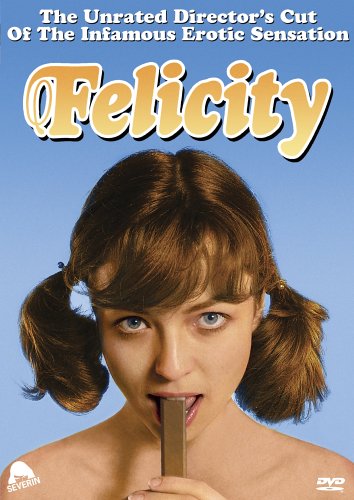
Felicity (Glory Annen) is reaching sexual maturity, but the outlets for her desires at her convent school are limited and not entirely satisfying. She leaves the school for the big bad world, and winds up travelling to Hong Kong where she has one adventure after another.If the concept of an Asian-set sexual coming-of-age sounds familiar, it should, and the movie is honest enough to wear its influences on its sleeve (Felicity is seen reading Emmanuelle and The Story of O). It is what it is. It may not be exactly an unearthed classic, but it is a solidly crafted bit of erotica, very much of its period (1979), and rather interesting precisely for that reason.

Audio

Without question, the most celebrated bad director is Ed Wood. He is the portal through which so many people discover the joys of the terrible film. He stands out from so many contenders because his films are not ordinarily bad. They are deeply felt, deeply earnest. He meant what he was saying, whatever that was. And his style, particularly his screenwriting style, is unmistakeable. Insanely purple, banal, and incomprehensible, it cannot be mistaken for anyone else’s work. It is as individual as the writing of the Co...n Brothers, but for all the wrong reasons.

But Wood is far from being the only deity in the badfilm pantheon. There are other directors who vie for his throne. And it is one of those I’m here to tell you about today: Doris Wishman.