Genre

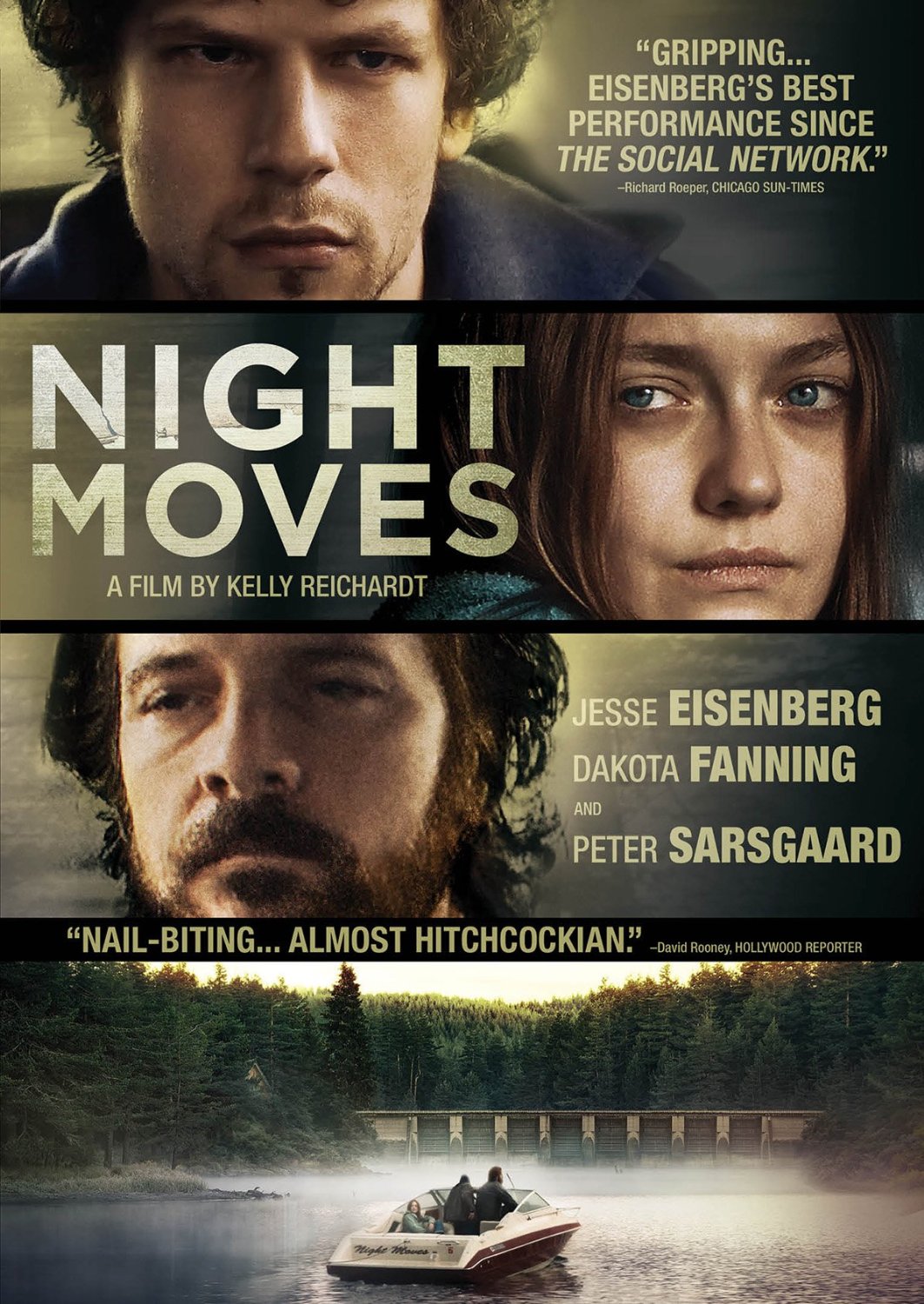
There are movies that can be described as slow burns, and then there's Night Moves. Director Kelly Reichardt frames much of her 112-minute thriller in a way that invites you to pay an inordinate amount of attention to the lush greenery, winding trails, and tranquil water the film's three protagonists go to dangerous lengths to preserve. The extended, quiet sequences and exceedingly simple plot also encourage viewers to fill in spaces in the story that seem to have been intentionally left blank. This deliberate approach will undoubtedly infuriate and bore some people, but I personally found it absorbing enough to recommend as an unconventionally tense drama.

Night Moves is about three environmentalists who plot to blow up a hydroelectric dam. (See? I told you the plot was exceedingly simple.) Given that the movie's synopsis can be neatly wrapped up in a single sentence, the real pleasures in Night Moves are derived from trying to figure out precisely how they're going to pull it off and how the characters relate to one another.

The list of bad videogame movie adaptations is as ridiculously long as the titular weapon in this animated offering. In fact, the film that has best captured the spirit of gaming wasn't even based on an actual videogame. The bottom line is it's hard to translate the highly-interactive thrills of videogames into a satisfying, relatively passive moviegoing experience. So maybe the answer lies in targeting inherently cinematic games like Heavenly Sword.

Prophecies speak of a savior, a deity born of man whose fate is to wield the Heavenly Sword.”

Right now in the martial arts world I don’t believe there is a bigger star than Donnie Yen.  From his work in Iron Monkey to his modern classic Ip Man, Yen shows he is nearly an unstoppable force in the martial arts world, and when his name is involved with a project, you should be ready for a spectacle.  His fight choreography is stunning to say the least, and despite the genre of film, he’s able to keep his fight scenes grounded in reality.  Now teamed with director Daniel Lee who brought us Black Mask, 14 Blades is on first glance the kind of movie martial arts fans should get excited about.

I’m not too sure about the historical accuracy of this film, but during the Ming Dynasty the Emperor created his own special security team by finding orphaned kids and training them to be his personal guards.  These special guards were called Jinyiwei; basically think about the President’s Secret Service agents, only extremely skilled in martial arts.  The one who would oversee the Jinyiwei would be the most skilled of the group and called Qinglong.  What made this Qinglong even more threatening is this special box he would carry with him, and inside are an array of bladed instruments, the 14 blades.

“It’s kind of a corny, romantic comedy-type story.”

Even those of us who actually enjoy a good romantic comedy have rolled our eyes or groaned about some overused cliche in the genre. Well David Wain and Michael Showalter — who last teamed up to satirize summer camp movies in 2001's Wet Hot American Summer — have gathered many of their famous, funny friends to make They Came Together, an alternately hilarious and uneven spoof that lovingly skewers rom-com tropes.

"My siblings and I are the first vampires in all of history. The Original Family. Three centuries ago, we helped build a town called New Orleans. Now a plot by witches has lured me back, hoping that I will defeat a tyrant, a vampire I created. My brother hopes I will find redemption through the power of family, a miracle child, part werewolf, part vampire, a hybrid. My sister is doubtful; she thinks I am beyond redemption. Despite my brother's best efforts, I have a plan of my own. I will take back my home and reclaim what was mine. I will be king."

If you're a fan of The Vampire Diaries, you need no introduction to Klaus Mikaelson and his family of original vampires. They were cursed by a powerful witch, their mother, to live forever as vampires. Klaus was her bastard son and also a werewolf. His cruelty and brutality are a millennium-long Grand Guignol of the most graphic kind. Can you build a spinoff show around a creature who has pretty much been the vicious villain of the mother show? That was my biggest question going in. The answer was a very resounding yes.

The backwoods flesh-eating disease film Cabin Fever was writer/ director Eli Roth’s first dip into horror and helped establish Roth as one of the “it” guys of the industry despite having a limited film catalog.  The film’s cringe-worthy deaths, not to mention the memorable bathtub sequence, made the film an overnight sensation, and when talk of a potential sequel came out, I was more than a little excited.  Picking up the reins for Roth would be another young rising star of the horror genre, Ti West.  The film made a valiant attempt at capitalizing on the fame of the original, but it just never made the connection with audiences.  Now we have the third entry in the Cabin Fever saga, Cabin Fever: Patient Zero.  This time the film trades in its familiar backwoods local on a tropical paradise in the Caribbean.

When you see the title Patient Zero, you go into this with the hopes that this would be the film to have the big reveal as to how the virus managed to make its way to a lake in the middle of the woods in the outskirts of a small mountain town.  Or you would be like me and have your fingers crossed for more fun from the party guy himself, Deputy Winston.  Unfortunately, we get no familiar faces, but instead two separate storylines that we know inevitably will cross over.

Oregon may have been the 33rd state to join our union — and Portland may be its most populous city — but Portlandia is a (beet-eating, Bigot Parade-hosting, 3D printer-buying) state of mind. And four seasons into lovingly mocking upper middle class indulgence along with the denizens of the Pacific Northwest, the show — created by stars Fred Armisen, Carrie Brownstein and director Jonathan Krisel — continues to feel more like a fully-realized destination than ever.

Armisen actually picked up a Best Supporting Actor Emmy nomination for his work this season. It was great for the show because it marked Portlandia's first nod in a major category, but it was also strange to see him slotted into the "Supporting" race given that he and Brownstein appear in almost every scene of every episode. Armisen keeps on finding genuine shades of weirdness in every character he plays, but I continue to be impressed by Brownstein's work as a comedic actress. (The former Sleater-Kinney singer/guitarist isn't an actress by trade.) Her subtler goofiness is a great match for — and no less funny than — what Armisen does.

The first thing you should know about The Walking Dead is that it's unlike any television series you have ever seen before. The images here are intense, and the crew has been given a blank check to create this vision without the burden of censors looking over their shoulders. There are plenty of blood-and-gore effects that rival any of the Hollywood zombie films you've seen in the last few years. The makeup effects are handled by the very capable hands of KNB and supervised personally by Greg Nicotero (the N from KNB). KNB isn't treating this like a television production, and while I personally get tired of the cliché about making a movie each week, this one lives up to the hype. They aren't doing anything different here than they would do for a big-budget film. The zombies look incredible, and the effects are completely first-rate.

If you need to know more before considering the fourth season, you need to go back to the beginning. It will be well worth the time and money to do so. You can check out our reviews of the previous seasons by banging it here: Walking Dead Reviews. These will quickly get you hungry for the first three seasons and get you caught up with the rest of us and into the breach with Season 4.

“You were always such a clever troublemaker.”

When Audrey Parker (Emily Rose) entered the barn in the conclusion of season 3 of Haven, all “the Troubles” were supposed to come to an end for the small seaside town of Haven, Maine.  Sure everything seemed to go as planned, that is until Duke (Eric Balfour) took the plunge into the barn before it disappeared, leaving Sheriff Nathan Wuornos (Lucas Bryant) behind.  As cliffhangers go, this ranked right up there with the season 1 finale when we discovered that there were two Audrey Parkers.  I loved season 3 of Haven; the pursuit of the “Bolt Gun Killer” as well as the show’s exploration into Audrey Parker’s past was excellent storytelling that continues to remind me of the David Lynch classic series Twin Peaks.

Considering the state the world is in, I’m a little surprised there isn’t more talk about a possible World War 3 scenario being played out.  This isn’t something I want, but watching the news, it is certainly something that resonates in the back of my mind and gives a moment of reflection.  Aftermath is the film that preys upon that fear of what a possible World War 3 could be. The results are far from promising, and it succeeds in telling the inevitable fate of the world, despite how bleak the outcome may be.

The film opens with Hunter (C.J. Thomason) hiking in the wastelands of Texas.  Along the highway he comes across a mother and her son; together they witness what appears to be the beginning of a nuclear war.  Hunter is quick to react, using his medical training to do what he can for the young boy who looked directly into the impact light and has now gone blind.  The three set off together to find food and shelter, knowing they do not have long before the radiation spreads and begins to have its effects.